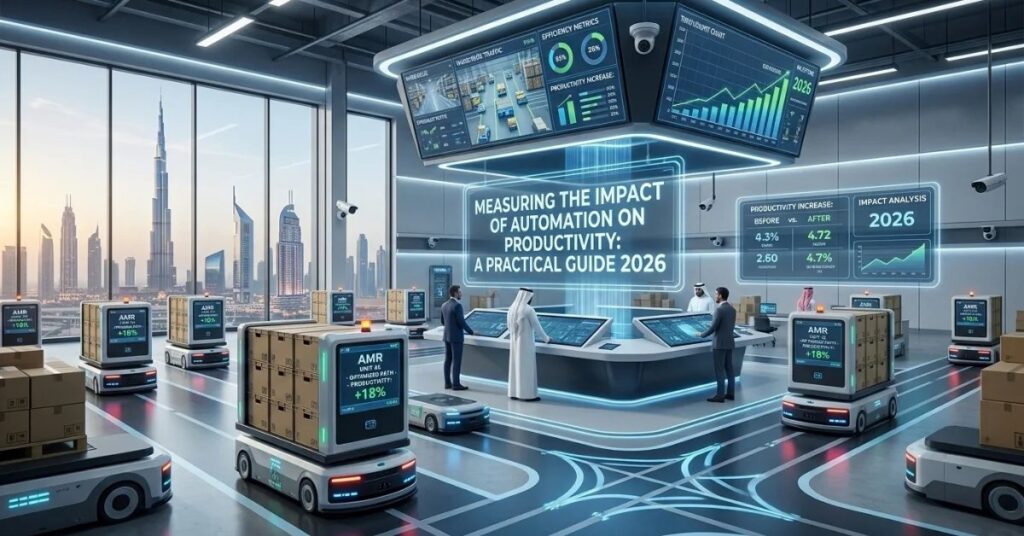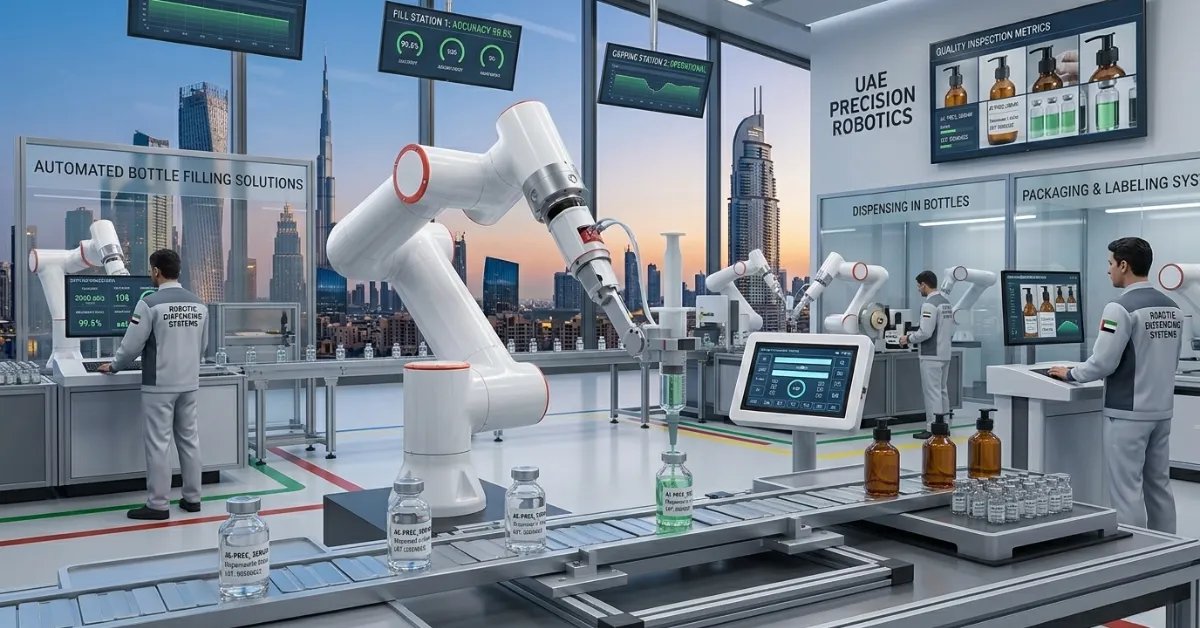
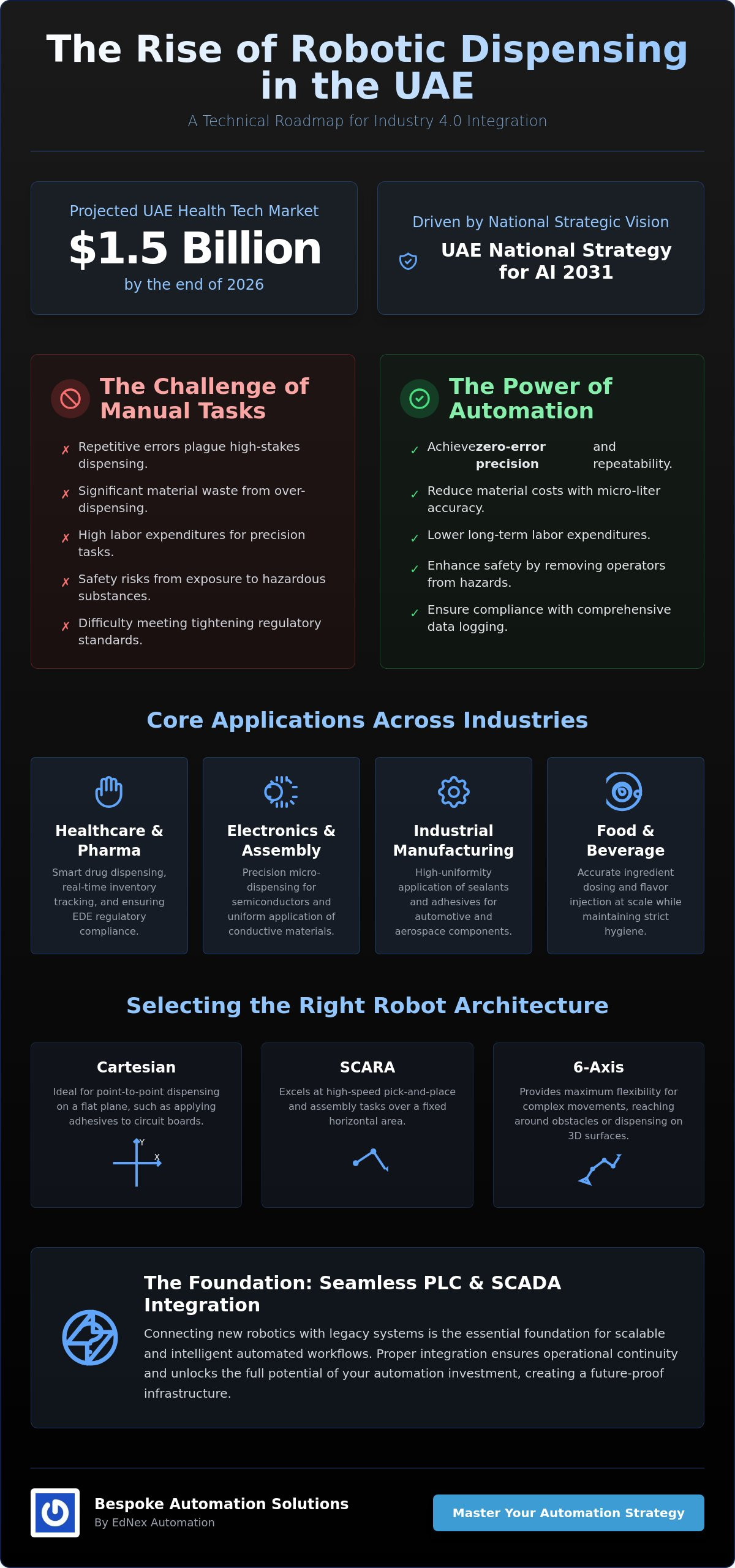
Will your facility be part of the projected 1.5 billion dollar UAE health tech market by the end of 2026, or is it still anchored by the hidden costs of manual precision tasks? Achieving zero-error accuracy is no longer an aspirational goal but a regulatory necessity as the Emirates Drug Establishment tightens oversight on pharmaceutical and industrial workflows. Implementing advanced robotic dispensing systems UAE allows organizations to eliminate the repetitive errors that plague high-stakes dispensing while simultaneously reducing labor expenditures.
You understand that the challenge isn’t just acquiring hardware; it’s the complex task of integrating new robotics with legacy PLC systems without disrupting operational continuity. This guide provides a technical roadmap to mastering these integrations, ensuring your infrastructure meets the latest UAE Industry 4.0 standards. We’ll explore the transition to multi-distributor models and the specific SCADA network configurations that secure your position as a leader in the region’s industrial transformation.
Key Takeaways
- Understand how the UAE National Strategy for Artificial Intelligence 2031 provides the regulatory framework for modernizing your facility’s dispensing infrastructure.
- Discover how advanced robotic dispensing systems UAE achieve zero-error precision in pharmaceutical and electronics manufacturing to mitigate the risks of manual handling.
- Learn why the seamless integration of PLC and SCADA networks is the essential foundation for scalable and intelligent automated workflows.
- Evaluate the technical advantages of Cartesian, SCARA, and 6-Axis architectures to select the most efficient system for your specific cycle-time requirements.
- Gain insights into conducting comprehensive feasibility studies that ensure your automation investment delivers sustainable operational improvements and high-level ROI.
The Evolution of Robotic Dispensing Systems in the UAE
Defining robotic dispensing systems UAE as autonomous or semi-autonomous units for the high-precision distribution of materials, these technologies represent a fundamental shift in the nation’s industrial framework. These systems manage the delivery of liquids, solids, and specialized chemicals with a level of repeatability that manual processes simply cannot replicate. Positioning the UAE as a global leader in technological adoption, the UAE National Strategy for Artificial Intelligence 2031 provides the necessary roadmap for integrating these intelligent systems across pharmaceutical, electronics, and manufacturing sectors. This strategic alignment ensures that the transition from error-prone manual workflows to high-speed automated accuracy isn’t just a trend, but a core pillar of the nation’s economic diversification.
The year 2026 marks a definitive tipping point for regional automation. With the recent establishment of the Emirates Drug Establishment (EDE) and new mandates for supply chain resilience, organizations are facing increased pressure to modernize their infrastructure. Transitioning to automated solutions allows businesses to stay ahead of these regulatory shifts while meeting the rising demand for rapid, error-free delivery. The adoption of automated dispensing in healthcare has already demonstrated how technology can safeguard patient outcomes by eliminating the risks associated with human fatigue in high-volume environments.
Precision as a Competitive Advantage
Reducing material waste is a critical objective for manufacturers handling high-value chemicals or sensitive pharmaceutical ingredients. Utilizing advanced robotic architectures, facilities can achieve micro-liter accuracy that significantly lowers the cost of production and mitigates the financial impact of over-dispensing. Beyond financial metrics, these systems enhance operational safety by removing human operators from hazardous environments where exposure to toxic or volatile substances is a constant risk. Precision dispensing acts as a primary catalyst for achieving the UAE’s zero-waste initiatives by ensuring that every milligram of material is utilized with maximum efficiency.
Meeting Regulatory and Quality Standards
Adhering to international ISO standards and local health authority requirements is essential for maintaining long-term business viability in the Emirates. Modern robotic dispensing systems UAE incorporate sophisticated data logging and traceability features that provide a comprehensive audit trail for every cycle performed. This level of transparency is vital for meeting the stringent quality control standards required in the 2026 regulatory landscape. By implementing compliant technology architectures, organizations don’t just solve today’s precision challenges; they build a foundation for future-proof operations that can scale alongside evolving global and regional mandates.
Core Applications: From Healthcare to Industrial Manufacturing
Healthcare and Pharmaceutical Excellence
Hospitals and retail pharmacies across the Emirates are deploying smart drug self-dispensing systems to manage complex medication regimens with zero error. By integrating these units with hospital management software, facilities achieve real-time inventory tracking and automated replenishment triggers. This digital synchronization significantly reduces patient wait times through rapid robotic retrieval, allowing medical staff to focus on clinical care rather than manual logistics. Implementing these systems ensures compliance with the latest EDE regulations while safeguarding the supply chain against the risks of manual handling errors, ensuring that the right dose reaches the right patient every time.
Beyond automated delivery, the quality of patient care is further enhanced by specialized expertise. For those requiring detailed health assessments, C Beauty UAE provides professional skin care and scalp consultations, ensuring that the precision of technology is matched by personalized professional guidance.
Advanced Manufacturing and Assembly
In the high-tech hardware sector, managing micro-dispensing for semiconductor production requires a level of stability that only automated systems can provide. Utilizing collaborative robots UAE allows manufacturers to deploy flexible dispensing tasks that adapt to varying production lines without extensive retooling. The intersection of these systems with autonomous mobile robots facilitates mobile station replenishment, creating a truly fluid assembly environment. Achieving this level of coordination requires a robust technical foundation where PLC and robot motion control are perfectly aligned to manage dispensing cycle times and material flow. For organizations seeking to modernize their production floors, exploring bespoke automation architectures is the first step toward achieving global Industry 4.0 benchmarks. This integrated approach ensures that whether you’re dispensing solder paste or protective coatings, the output remains consistent, reliable, and optimized for high-volume throughput.
The Control Layer: PLC and SCADA Integration for Dispensing
Standalone robotic hardware often reaches a performance ceiling without a sophisticated control layer to guide its operations. Within the high-stakes industrial environments of the Emirates, a robot operating in isolation lacks the facility-wide visibility required to maintain peak efficiency. Programmable Logic Controllers (PLCs) serve as the central nervous system for robotic dispensing systems UAE, managing precise cycle times and ensuring that material delivery is perfectly synchronized with assembly line speeds. By establishing this robust industrial control framework, organizations can transition from simple automation to a fully integrated, intelligent ecosystem that prioritizes data integrity and cybersecurity across the entire network.
Supervisory Control and Data Acquisition (SCADA) systems provide the necessary oversight to monitor dispensing accuracy and fluid levels in real time. This centralized visibility is critical for preventing dry-run errors or material overflows that lead to costly downtime. As facilities move toward the benchmarks of Industry 4.0, the ability to protect the control network from external threats becomes as vital as the precision of the dispensing nozzle itself. Implementing encrypted communication protocols within the PLC architecture ensures that proprietary dispensing formulas and operational data remain secure against unauthorized access.
Seamless System Architecture
Linking dispensing hardware to PLC and SCADA integration services ensures that individual units function as part of a unified, intelligent ecosystem. Utilizing real-time feedback loops, the system can automatically adjust dispensing volumes based on sensor data, compensating for changes in fluid viscosity or ambient temperature. This dynamic adjustment capability significantly reduces waste and ensures product consistency. Furthermore, the control layer generates predictive maintenance alerts by analyzing motor torque and valve performance, allowing technical teams to address potential failures before they disrupt the production schedule.
Data-Driven Operational Insights
Capturing granular dispensing data is essential for meeting the stringent quality control audits required by UAE regulatory bodies in 2026. Centralized dashboards allow managers to visualize throughput and efficiency metrics, identifying bottlenecks that were previously invisible in manual or standalone setups. By analyzing historical data, organizations can utilize AI-driven adjustments to optimize material usage and refine dispensing paths for complex geometries. This analytical approach transforms raw operational data into a strategic asset, ensuring that every milligram of material dispensed contributes to the organization’s long-term business viability and competitive standing.
Strategic Implementation: Maximizing Accuracy and ROI
Leading with a comprehensive feasibility study ensures that the selected robotic dispensing systems UAE align perfectly with the specific rheology of the materials being handled. Conducting rigorous material compatibility tests prevents the common pitfalls of nozzle clogging or fluid degradation during high-speed operations. This technical assessment phase allows organizations to determine if a Cartesian system is sufficient for linear, high-load tasks or if the complex geometries of their components necessitate the multi-directional flexibility of 6-axis or SCARA architectures. Selecting the right robotic architecture is a critical decision that directly influences cycle times and the long-term scalability of the production line.
Calculating the Total Cost of Ownership requires a sophisticated view that extends far beyond the initial hardware acquisition. Forward-thinking enterprises must account for long-term software licensing, preventive maintenance schedules, and the essential upskilling of the workforce. Training your internal teams to manage these automated environments ensures that the shift to Industry 4.0 standards is a collaborative evolution rather than a disruptive event. Providing your staff with the technical expertise to supervise automated dispensing environments transforms them from manual operators into high-level systems managers, securing the intellectual capital necessary for future growth.
Phased Deployment Strategies
Starting with pilot programs allows facilities to validate precision and repeatability in a controlled environment before committing to facility-wide changes. Scaling automation from single stations to fully integrated production lines ensures that each stage of the transition is optimized for maximum throughput and seamless PLC synchronization. Adopting a phased deployment strategy mitigates operational risk by allowing for real-time adjustments and performance benchmarking within UAE facilities.
Calculating Tangible ROI
Measuring labor cost reduction provides an initial metric, but a true ROI framework must also factor in significant material savings and the drastic reduction in rework and defect rates. In high-precision assembly, even a fractional decrease in error rates can lead to substantial financial gains over high-volume production cycles. Utilizing digital twin modeling in the design phase allows for the simulation of dispensing cycles, identifying potential bottlenecks before a single piece of hardware is installed. This predictive approach ensures that every investment in automation is backed by data-driven certainty. For organizations ready to define their technical roadmap and secure a competitive edge, engaging with bespoke automation consultants is the most efficient path toward achieving sustainable industrial transformation.
Bespoke Automation Solutions by EdNex Automation
Positioning itself at the vanguard of the region’s digital shift, EdNex Automation acts as a visionary partner for organizations navigating the complexities of high-tech industrial transformation. We provide the intellectual and technical framework necessary to transition from legacy operations to modernized, autonomous environments. Implementing bespoke robotic dispensing systems UAE requires more than just high-end hardware; it demands a comprehensive, start-to-finish approach that begins with expert consultation and concludes with full-scale PLC and SCADA integration. By leveraging a sophisticated portfolio of collaborative robots and autonomous mobile robots, we deliver flexible, mobile dispensing solutions that adapt to the fluid requirements of modern production floors.
Supporting the UAE’s ambitious economic vision, EdNex bridges the gap between global technological breakthroughs and localized industrial needs. Our team provides the regional expertise required to ensure that every automation project aligns with the National Strategy for Artificial Intelligence 2031. We don’t merely supply equipment; we act as systematic organizers who bring order, safety, and efficiency to complex environments through controlled and deliberate innovation. This commitment to excellence ensures that your facility remains competitive in an increasingly automated global marketplace, backed by a partner with a proven track record of industrial success.
Integrated Robotics Ecosystems
Creating a seamless flow of materials requires the synchronization of multiple automated layers. Combining high-precision dispensing robots with automated storage and retrieval systems allows facilities to establish end-to-end logistics chains where material handling and distribution are fully autonomous. In the healthcare sector, deploying humanoid robots for sale UAE provides a sophisticated solution for front-end medical dispensing and customer interaction, enhancing the patient experience through high-tech engagement. These integrated ecosystems are designed for 24/7 operational reliability, supported by a dedicated network that prioritizes uptime and system integrity.
Future-Proofing Your Facility
Evolving beyond simple automation, modern facilities must embrace intelligent, self-optimizing systems that utilize real-time data to refine their own performance. EdNex Automation provides the intellectual framework to help your organization outpace the competition by adopting technologies that grow alongside your business. We ensure that your infrastructure isn’t just a current acquisition but a necessary evolution for long-term viability. When you’re ready to redefine your operational standards, Contact EdNex Automation to modernize your facility’s dispensing precision and secure your place at the cutting edge of UAE Industry 4.0.
Leading the Future of Industrial Precision
The transition toward high-speed, zero-error production isn’t just a technical upgrade; it’s a strategic necessity for any organization operating within the Emirates’ competitive industrial landscape. Mastering the complexities of robotic dispensing systems UAE requires a deep understanding of the control layer, where robust PLC and SCADA architectures ensure every cycle meets the highest quality standards. By aligning your facility with Industry 4.0 benchmarks, you’re not only mitigating the risks of manual errors but also securing the long-term business viability mandated by the National Strategy for Artificial Intelligence 2031.
Our commitment to localized technical expertise and global partnerships provides the intellectual framework necessary for successful implementation. EdNex Automation offers Industry 4.0 certified integration and comprehensive national support for complex robotic deployments. It’s time to evolve your operations with a partner who understands the gravity of large-scale industrial transformation. Scale your precision with EdNex Automation solutions and lead the next era of regional innovation.
Frequently Asked Questions
What are the primary benefits of robotic dispensing systems for UAE pharmacies?
Robotic dispensing systems UAE provide zero-error medication management and rapid retrieval, significantly improving patient safety in high-volume clinical environments. These systems align with the Dubai Health Authority’s smart pharmacy projects by streamlining inventory tracking and ensuring full compliance with the latest Emirates Drug Establishment mandates. Implementing these autonomous units allows medical staff to focus on clinical care rather than manual logistics, optimizing the overall healthcare delivery model.
Can industrial dispensing robots handle high-viscosity materials like sealants?
Industrial dispensing robots are specifically engineered to manage high-viscosity materials such as thick sealants and adhesives used in automotive or aerospace assembly. Utilizing advanced pressure-fed systems and specialized valves, these robots ensure high-uniformity application without compromising cycle times or material integrity. This level of precision is essential for maintaining structural standards in complex manufacturing environments where manual application often leads to costly overages or inconsistent bonding.
How do I integrate a robotic dispensing system with my existing SCADA network?
Integration is achieved through the PLC control layer using standardized communication protocols that bridge the dispensing hardware with your centralized SCADA network. This architecture allows for facility-wide monitoring of fluid levels and dispensing accuracy via real-time dashboards. Establishing this secure link enables the capture of granular operational data, facilitating predictive maintenance alerts and ensuring that your infrastructure meets the benchmarks of a modern Industry 4.0 ecosystem.
What is the expected ROI for a robotic dispensing system in a manufacturing plant?
Calculating the return on investment involves measuring labor cost reduction against increased throughput and significant material savings achieved through micro-liter accuracy. Facilities typically experience a drastic reduction in rework and defect rates, which provides substantial financial gains over high-volume production cycles. While initial implementation costs are a factor, the long-term business viability is secured through optimized material usage and the elimination of human error in high-precision assembly tasks.
Are there specific UAE regulations for automated pharmaceutical dispensing?
The primary legislation governing these systems is Federal Decree-Law No. 38 of 2024, which transitioned regulatory control to the Emirates Drug Establishment (EDE) as of January 2, 2025. This law mandates strict adherence to quality standards and comprehensive traceability for all medical products. Additionally, Federal Law No. (2) of 2019 requires that all health data generated by these systems be stored locally and maintained for a minimum of 25 years.
How does temperature control factor into automated fluid dispensing?
Temperature control is a critical factor for maintaining fluid viscosity and ensuring consistent flow rates during the dispensing cycle. Automated systems often utilize integrated thermal sensors and specialized heating or cooling jackets to stabilize the dispensing path. This precision prevents material degradation and ensures that the volume dispensed remains constant, even when ambient environmental conditions in the facility fluctuate, protecting the integrity of sensitive chemical components.
What maintenance is required for high-precision robotic dispensing units?
Routine maintenance involves the regular calibration of high-precision sensors and the thorough cleaning of dispensing valves to prevent material buildup or clogging. Predictive maintenance alerts generated by the PLC layer are essential for identifying motor torque fluctuations or valve wear before they result in operational downtime. Scheduled technical inspections ensure that the robotic dispensing systems UAE continue to operate within their specified tolerance levels, maintaining long-term reliability.
Can robotic dispensing systems be used for micro-electronics assembly?
Robotic dispensing systems are ideal for micro-electronics assembly, providing the stability and micro-liter accuracy required for semiconductor and high-tech hardware production. These units manage the precise application of solder paste and protective coatings on densely packed circuit boards where manual handling is impossible. Utilizing collaborative robots in these environments allows for flexible deployment and the seamless integration of dispensing tasks into intricate, high-speed assembly lines.