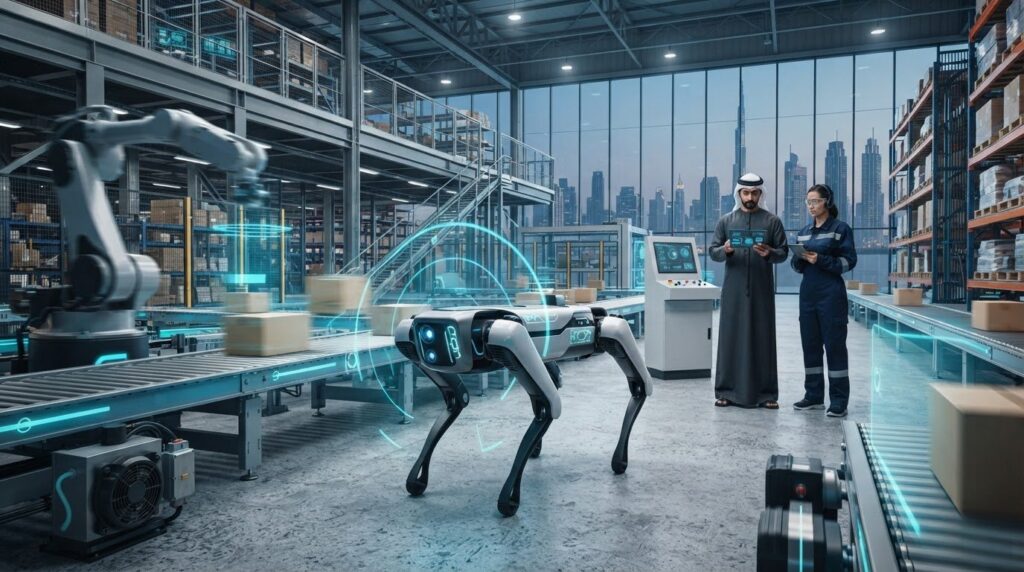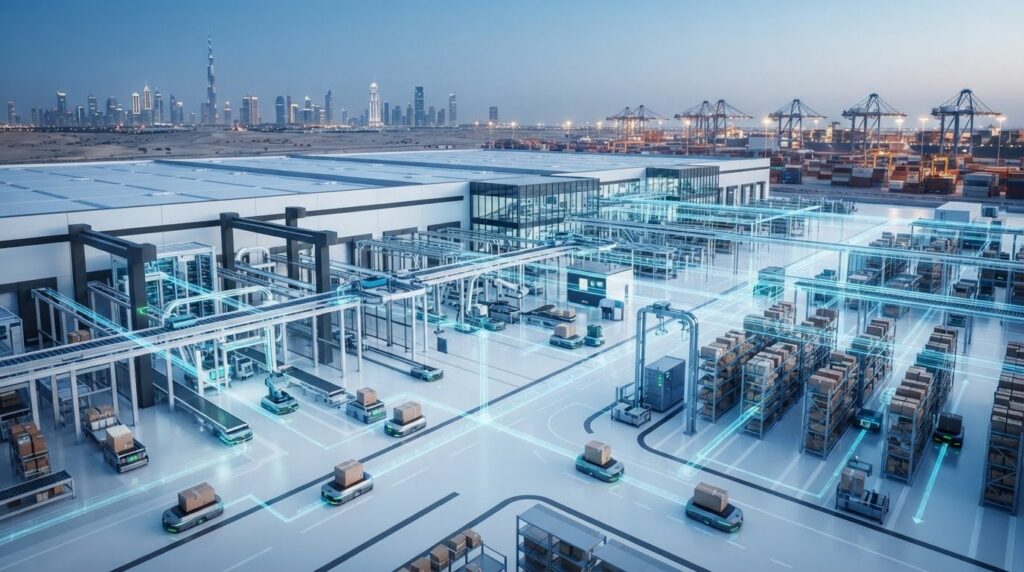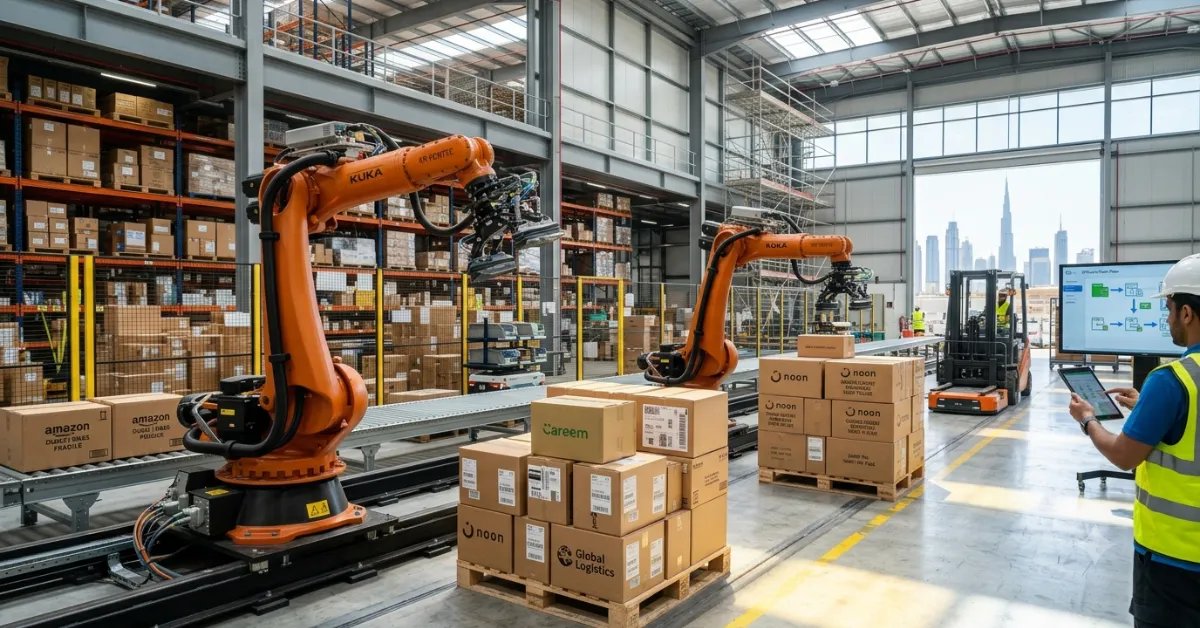
With the global robotics market estimated at $88.27 billion in 2026, the transition toward fully autonomous operations has evolved from a visionary concept into a non-negotiable mandate for industrial survival. You’ve likely recognized that rising operational costs and acute warehouse space constraints are directly hindering your ability to scale effectively. Achieving true modernization requires a sophisticated approach to improving supply chain efficiency with robotics, ensuring that every hardware deployment serves a broader strategic objective rather than acting as an isolated tool.
We understand the technical friction involved when synchronizing advanced robotic hardware with existing software stacks. This article provides a comprehensive framework for integrating Automated Storage and Retrieval Systems (ASRS) and Autonomous Mobile Robots (AMRs) into a cohesive industrial ecosystem. By aligning PLC and SCADA integration with modern robotic capabilities, national industrial leaders can secure increased throughput and build a future-proofed infrastructure designed to thrive. We’ll explore how these high-tech systems transform traditional bottlenecks into measurable competitive advantages through deliberate, intelligence-driven automation.
Key Takeaways
- Identify the critical roles of AMRs and ASRS in optimizing facility space and accelerating material handling throughput for 2026 industrial standards.
- Learn a comprehensive framework for improving supply chain efficiency with robotics by addressing manual bottlenecks through automated precision and scalability.
- Recognize why PLC and SCADA integration forms the essential architectural foundation required for reliable, real-time multi-robot orchestration.
- Develop a strategic roadmap that prioritizes high-impact automation targets to ensure a seamless transition from manual labor to autonomous operations.
- Future-proof your industrial infrastructure by exploring the strategic deployment of humanoid robots and collaborative systems within your logistics ecosystem.
The Imperative for Improving Supply Chain Efficiency with Robotics in 2026
Industrial efficiency in 2026 is a dynamic measure of predictive responsiveness rather than a simple metric of units per hour. Organizations that rely on manual labor face inherent limitations in speed and precision that cannot be overcome through traditional management alone. Improving supply chain efficiency with robotics has become the definitive strategy for leaders seeking to eliminate these bottlenecks while ensuring their infrastructure remains scalable during periods of extreme market volatility. Manual logistics systems struggle with the high-velocity requirements of modern commerce; they lack the sub-millimeter precision and 24/7 reliability demanded by global distribution networks. Adopting advanced robotic systems is no longer an optional upgrade for the ambitious. It’s a foundational requirement for national competitiveness and long-term business viability.
From Manual to Autonomous: The 2026 Landscape
The transition from isolated automated tasks to end-to-end autonomy represents the full maturation of Industry 4.0. Modern facilities utilize Logistics automation to connect every node of the supply chain, ensuring that data-driven decision-making informs physical execution in real time. This shift allows for a level of operational transparency that was previously impossible, positioning the supply chain as a source of strategic intelligence rather than just a cost center. National expectations have shifted. Customers and partners now demand the precision that only autonomous systems can provide. By integrating these technologies, industrial leaders transform their warehouses from static storage spaces into intelligent, self-optimizing ecosystems that respond instantly to shifting demand patterns.
The Economic Rationale for Robotic Investment
Shifting ROI models in 2026 reflect a broader understanding of robotics as a strategic capital asset. While initial investments are significant, these systems provide a critical hedge against labor market volatility and rising operational costs. Unlike static machinery, modern robotics appreciate in value through continuous software updates and AI refinements, offering a flexible platform that evolves alongside your business. This economic stability ensures that industrial leaders can maintain high throughput and accuracy regardless of external economic pressures. Investing in robotics today secures a scalable future. It allows businesses to mitigate risks associated with human error and fatigue, ultimately driving a more predictable and profitable bottom line through the sustained process of improving supply chain efficiency with robotics.
Core Technologies: AMRs, ASRS, and Collaborative Systems
The physical architecture of a modern distribution center relies on three technological pillars that redefine operational capacity. These systems don’t just move items; they represent a fundamental shift in how we approach improving supply chain efficiency with robotics. By deploying Autonomous Mobile Robots (AMRs) alongside sophisticated storage systems, national industrial leaders achieve a level of operational fluidness that manual processes cannot replicate. This synergy allows for the rapid transformation of warehouse bottlenecks into streamlined throughput channels.
Autonomous Mobile Robots: Navigating Complexity
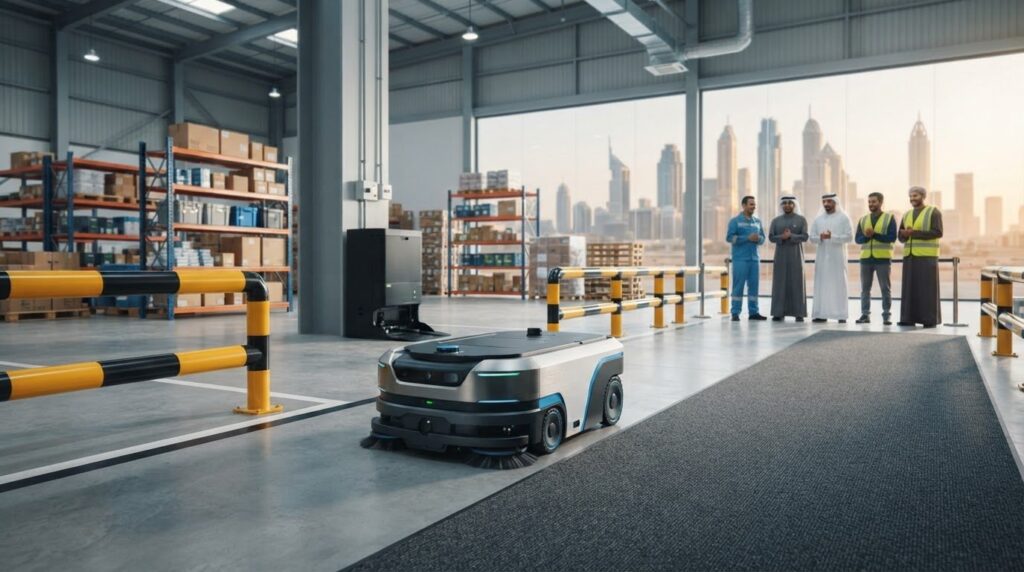
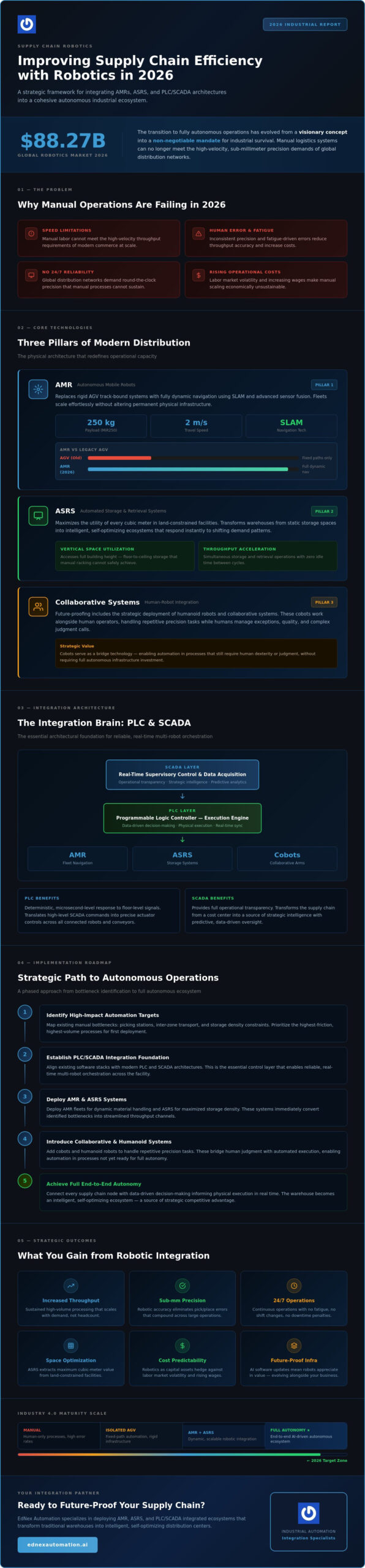
Transitioning from legacy Automated Guided Vehicles (AGVs) to modern autonomous mobile robots marks the end of rigid, track-bound automation. Unlike AGVs, which require magnetic tape or fixed paths, 2026 AMRs utilize Simultaneous Localization and Mapping (SLAM) and advanced sensor fusion to navigate dynamic environments. Industrial-grade models, such as the MiR250 with its 250 kg payload capacity and 2 m/s travel speed, demonstrate the robust performance now available for heavy material handling. These fleets scale effortlessly, allowing facilities to increase unit movement without altering permanent physical infrastructure or stopping production. This flexibility is essential for maintaining a competitive edge in volatile markets where demand can shift overnight.
ASRS: Maximising Vertical and Horizontal Throughput
Maximizing the utility of every cubic meter is critical for industrial growth in land-constrained regions. Utilizing automated storage and retrieval systems allows organizations to condense their storage footprint by up to 85% compared to traditional racking. You can choose between mini-load systems for high-density small parts storage or shuttle-based architectures for rapid pallet retrieval. These systems link directly to warehouse management software, ensuring real-time inventory accuracy and eliminating the time-consuming “search and find” delays inherent in manual picking. This precision is a cornerstone of improving supply chain efficiency with robotics, as it ensures the right SKU is always ready for the next stage of the fulfillment process.
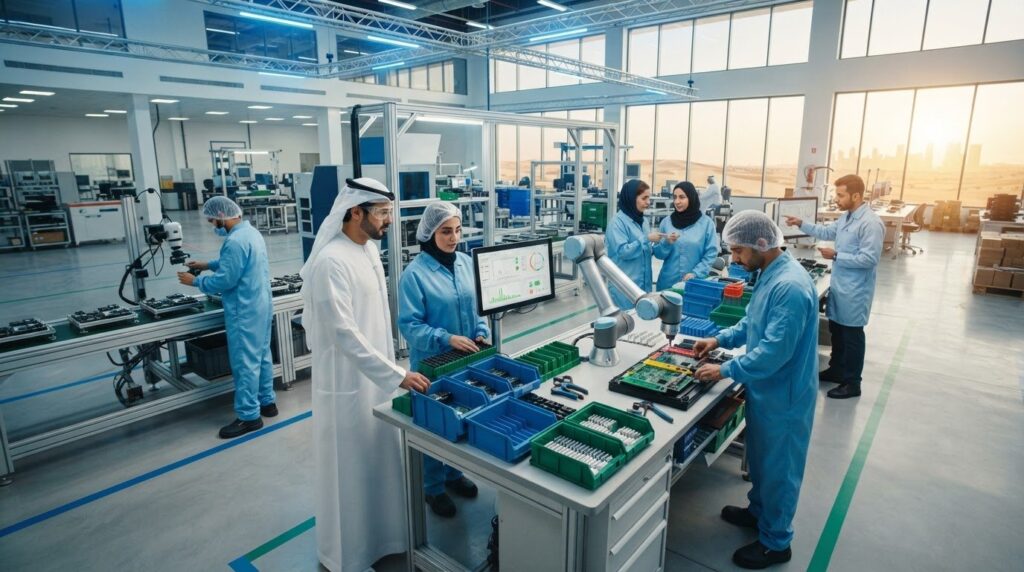
Collaborative Robots (Cobots) have revolutionized the packing and sorting stages by working safely alongside human teams. They handle repetitive, ergonomically taxing tasks with a level of consistency that manual labor cannot sustain. Looking ahead, humanoid robots are beginning to enter the logistics space to manage complex, unstructured environments. These units provide the dexterity needed for intricate sorting and the mobility to navigate aisles designed for people. If you’re ready to modernize your floor-level logistics, exploring our range of autonomous mobile robots is the first step toward total facility autonomy.
The Integration Brain: PLC and SCADA Architectures
Deploying advanced hardware is only the first step in a broader digital transformation. True progress in improving supply chain efficiency with robotics requires a robust control architecture to act as the operation’s central nervous system. Utilizing PLC and SCADA integration services provides the intellectual framework necessary to synchronize disparate robotic units into a singular, high-performance ecosystem. Without this foundational layer, AMRs and ASRS operate as isolated islands of automation rather than a unified force. This integration ensures that every mechanical movement is backed by real-time data and strategic logic.
SCADA: Visualising the Autonomous Supply Chain
Maintaining high-level visibility is critical for national enterprise operations managing complex, multi-site logistics. SCADA systems aggregate real-time data from every sensor and robotic unit, providing visualizations that allow operators to identify and prevent systemic bottlenecks before they impact throughput. Integrating predictive maintenance alerts within the SCADA interface ensures that potential hardware failures are addressed during scheduled downtime, preserving the long-term business viability of the facility. This remote monitoring capability allows for centralized control over geographically dispersed facilities, ensuring consistency across the entire industrial network. It’s about moving from reactive troubleshooting to proactive orchestration; to support this digital backbone on a global scale, many organizations explore data center Miami for the enterprise-grade colocation and carrier-neutral connectivity required for such operations.
PLC Integration: Ensuring Hardware Synchronisation
Programmable Logic Controllers (PLCs) handle the granular, millisecond-accurate execution required for seamless hardware hand-offs. Managing the transition between high-speed conveyors and robotic picking arms requires custom PLC logic tailored to bespoke industrial workflows. These controllers also enforce the rigorous safety protocols mandated by 2026 standards, ensuring safe human-robot co-existence in collaborative warehouse environments. By implementing sophisticated safety interlocking, PLCs protect both high-value assets and the workforce while maintaining peak operational speed. This level of control is what allows complex machinery to operate with the fluidness of a single, well-oiled machine.
Standardizing communication through unified data protocols like OPC UA and MQTT is essential for achieving true interoperability in 2026. These protocols allow robotic APIs to communicate effortlessly with legacy industrial equipment, bridging the gap between old and new infrastructure. This connectivity ensures that every piece of hardware contributes to a data-rich environment where improving supply chain efficiency with robotics is driven by empirical evidence rather than guesswork. Through this integrated approach, industrial leaders move beyond simple equipment acquisition to achieve total system intelligence, creating a future-proofed foundation for further innovation.
Strategic Roadmap: Implementing Supply Chain Robotics
Transitioning from theoretical control architectures to physical deployment requires a systematic, high-tech roadmap. Improving supply chain efficiency with robotics is not a singular event but a phased evolution that begins with identifying high-impact automation targets within your existing facility. This strategic approach ensures that every robotic unit, from floor-level AMRs to complex ASRS, contributes directly to measurable throughput goals. By following a structured implementation framework, industrial leaders can minimize operational disruption while securing a definitive competitive advantage.
Phase 1: The Operational Audit and Feasibility Study
Conducting a rigorous operational audit is the essential first step in any automation project. You must define clear metrics for success, such as cycle time reduction, error rate mitigation, and the total cost per pick. Assessing the readiness of your existing industrial control infrastructure determines whether your current systems can support the data loads required for 2026-level autonomy. This phase also involves determining the optimal mix of collaborative robots and high-speed autonomous units to balance human safety with maximum output. Identifying these variables early prevents costly misalignments during the hardware acquisition stage.
Phase 2: Integration and Commissioning
Selecting a partner with deep national integration expertise is critical for managing the technical challenges of modern deployment. Whether you’re aiming for a fully autonomous “dark warehouse” or a hybrid environment where humans and machines work in proximity, the integration phase must be precise. Utilizing digital twins allows for high-fidelity pre-implementation simulation, enabling you to test robotic workflows in a virtual environment before a single unit is placed on the floor. This risk-mitigation strategy ensures that hardware hand-offs and path-planning algorithms are optimized for your specific facility constraints.
Following successful simulation, the pilot phase involves testing robotic units in controlled environments to validate performance against your initial audit metrics. Full-scale integration then follows, accompanied by comprehensive workforce training to ensure your team can manage and maintain the new autonomous ecosystem. Post-deployment optimization relies on SCADA feedback loops to continuously refine workflows based on real-world performance data. This iterative process ensures that your investment continues to deliver value, consistently improving supply chain efficiency with robotics as your facility adapts to new demands. If you’re ready to begin your transformation, consult with our automation specialists to design your bespoke implementation strategy.
Future-Proofing with EdNex Automation: Your Integration Partner
Leading the charge in national industrial transformation, EdNex Automation provides the intellectual and mechanical framework necessary for improving supply chain efficiency with robotics. As a visionary partner, we bridge the gap between global technological breakthroughs and the specific requirements of regional industries. Our approach ensures that your organization doesn’t just acquire equipment but undergoes a comprehensive evolution into a high-performance, autonomous enterprise. By delivering start-to-finish technical integration, we secure your long-term business viability in an increasingly automated global market. We act as a systematic organizer, bringing order, safety, and efficiency to complex industrial environments through controlled and deliberate innovation.
Bespoke Solutions for National Industrial Sectors
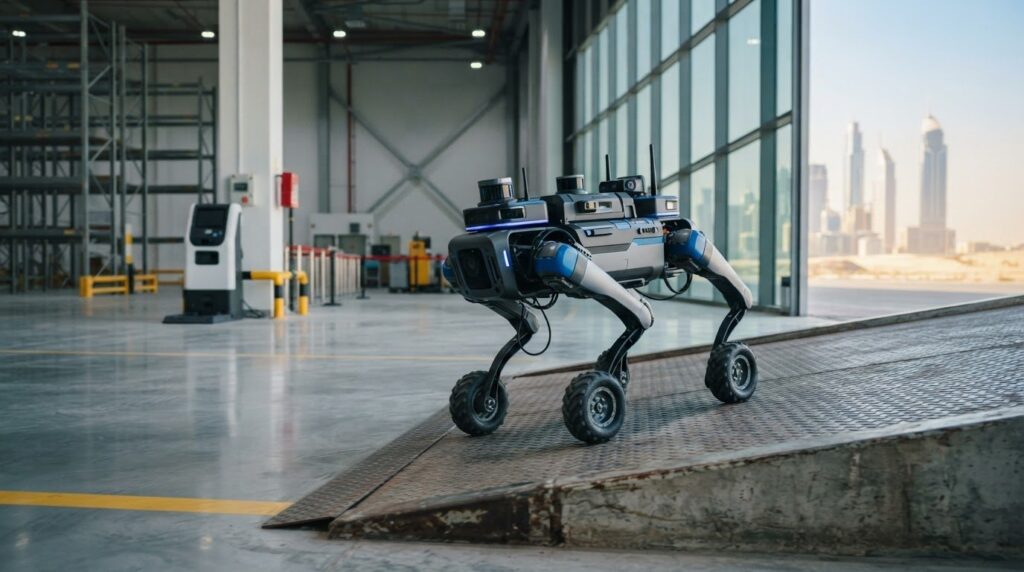
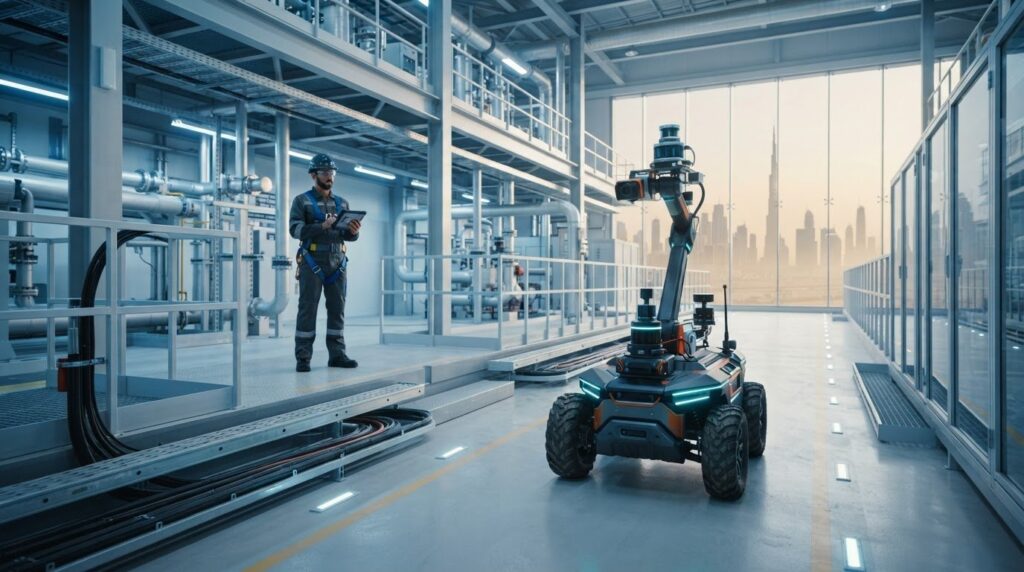
Customizing automation to fit unique operational contexts is a hallmark of our service. We offer a sophisticated range of humanoid robots for sale alongside specialized units for inspection, surveillance, and internal delivery. These systems aren’t isolated tools; they’re integrated components of a larger strategic roadmap designed to solve complex industrial challenges. Our inspection and surveillance robots provide continuous, high-precision monitoring of critical infrastructure, while our delivery robots optimize the flow of goods across expansive facilities. We invite industrial leaders to consult on a tailored automation roadmap that aligns these advanced capabilities with their specific throughput and security objectives. This bespoke integration ensures that every robotic deployment contributes directly to improving supply chain efficiency with robotics across your entire network.
The EdNex Advantage: Certified Technical Excellence
Ensuring the reliability and safety of every deployment, EdNex Automation prioritizes high-level PLC, SCADA, and ASRS integration as the foundation of our robotic solutions. We understand that the strength of an autonomous system lies in its control architecture, and our certified technical excellence guarantees a seamless synchronisation between hardware and software. This methodical approach minimizes risk and maximizes the return on your technological investment. By partnering with a regional expert who possesses deep knowledge of global standards, you gain access to a professional consultant capable of bringing order and efficiency to the most demanding environments. We provide the intellectual framework required to transform your facility into a future-proofed industrial leader. Modernize your operations today by integrating the next generation of industrial intelligence into your supply chain.
Securing Industrial Dominance through Autonomous Integration
Achieving long-term business viability in 2026 requires moving beyond isolated machinery toward a unified, intelligent ecosystem. By aligning advanced hardware like AMRs and ASRS with robust PLC and SCADA architectures, organizations transform logistical bottlenecks into streamlined competitive advantages. This systematic approach to improving supply chain efficiency with robotics ensures your facility remains resilient against labor volatility and space constraints. Modernization isn’t just about speed; it’s about building a predictive infrastructure that scales with global demand, and you can check out NB eCommerce & Design to ensure your online storefront matches this level of operational excellence.
Partnering with a regional leader who understands the gravity of large-scale transformation is essential for success. Founded in 2018 as a specialized division of the EdNex group, we’ve established ourselves as expert integrators of PLC, SCADA, and ASRS systems. We provide the intellectual framework and the high-tech tools, including humanoid and collaborative units, required for total facility modernization. Partner with EdNex Automation to revolutionise your industrial supply chain and lead the next era of industrial excellence. Your journey toward a fully autonomous future begins today.
Frequently Asked Questions
How does robotics specifically improve supply chain efficiency?
Robotics accelerates throughput by automating repetitive tasks and eliminating human error in picking and sorting stages. By improving supply chain efficiency with robotics, industrial leaders achieve a level of precision and speed that manual labor cannot match. These systems provide real-time data visibility, allowing for predictive workflow adjustments that prevent systemic bottlenecks. This transformation ensures that the supply chain functions as a responsive, self-optimizing ecosystem rather than a series of disconnected manual nodes.
What is the difference between AMRs and traditional AGVs in 2026?
The primary difference lies in navigation autonomy and operational flexibility. Traditional Automated Guided Vehicles (AGVs) rely on fixed infrastructure like magnetic tape or wires, whereas 2026 Autonomous Mobile Robots (AMRs) utilize SLAM and sensor fusion to navigate dynamic environments. This allows AMRs to recalculate paths in real time to avoid obstacles, making them far more scalable for facilities with changing layouts. AMRs don’t require costly floor modifications, ensuring a faster deployment and higher adaptability.
Can robotic systems be integrated with my existing PLC and SCADA setup?
Yes, modern robotic systems are designed for seamless integration with legacy industrial control architectures. Utilizing unified data protocols such as OPC UA and MQTT, robotic APIs can communicate directly with your existing PLC and SCADA setup. This connectivity ensures that your new autonomous units function as part of a cohesive brain, allowing for centralized monitoring and synchronized hardware hand-offs. Expert integration services bridge the gap between old and new infrastructure to maintain total facility control.
What is the expected ROI for implementing an ASRS in a national warehouse?
ROI for Automated Storage and Retrieval Systems (ASRS) is typically realized through significant reductions in physical footprint and increased inventory accuracy. By condensing storage by up to 85%, facilities can delay or eliminate the need for expensive warehouse expansions. Additionally, the elimination of manual searching and retrieval errors drives higher throughput, which directly impacts the bottom line. While initial capital expenditure is high, the long-term viability of the operation is secured through stabilized operational costs and 24/7 reliability.
Are collaborative robots (cobots) safe to use alongside human workers?
Collaborative robots are engineered specifically for safe human-robot interaction in shared workspaces. They utilize advanced force-limiting sensors and vision systems to detect human presence and respond instantly by slowing or stopping their movement. These units comply with the latest safety standards, such as ISO 10218-2:2025, which incorporates collaborative safety requirements. By taking over ergonomically taxing tasks, cobots improve workplace safety while allowing human workers to focus on higher-level decision-making and quality control.
How do humanoid robots fit into the 2026 supply chain landscape?
Humanoid robots are emerging as the primary solution for navigating unstructured environments designed for human workers. Their bipedal mobility and advanced dexterity allow them to handle intricate sorting and material movement in aisles that are too narrow or complex for traditional AMRs. In the 2026 landscape, they serve as a flexible bridge between manual tasks and full automation. These units provide the versatility needed to manage diverse SKUs and dynamic workflows without requiring extensive facility redesigns.
What maintenance is required for industrial cleaning and delivery robots?
Maintenance for these autonomous units focuses on predictive sensor calibration and routine software optimization. Unlike traditional machinery that requires reactive repairs, modern cleaning and delivery robots utilize SCADA feedback loops to alert operators of potential issues before they cause downtime. Regular checks of LiDAR sensors, battery health, and wheel alignment ensure peak performance. Software updates are equally critical, as they often include refinements to navigation algorithms and AI-driven efficiency improvements that keep the hardware modern.
How do EdNex Automation support the implementation process?
EdNex Automation provides a comprehensive, start-to-finish framework for industrial modernization. We act as a visionary technical partner, offering everything from the initial operational audit and digital twin simulation to the final commissioning of PLC, SCADA, and ASRS systems. Our team provides the intellectual framework necessary for improving supply chain efficiency with robotics, ensuring that every deployment is tailored to your specific regional needs. We also provide workforce training and long-term technical support to guarantee the viability of your autonomous ecosystem.