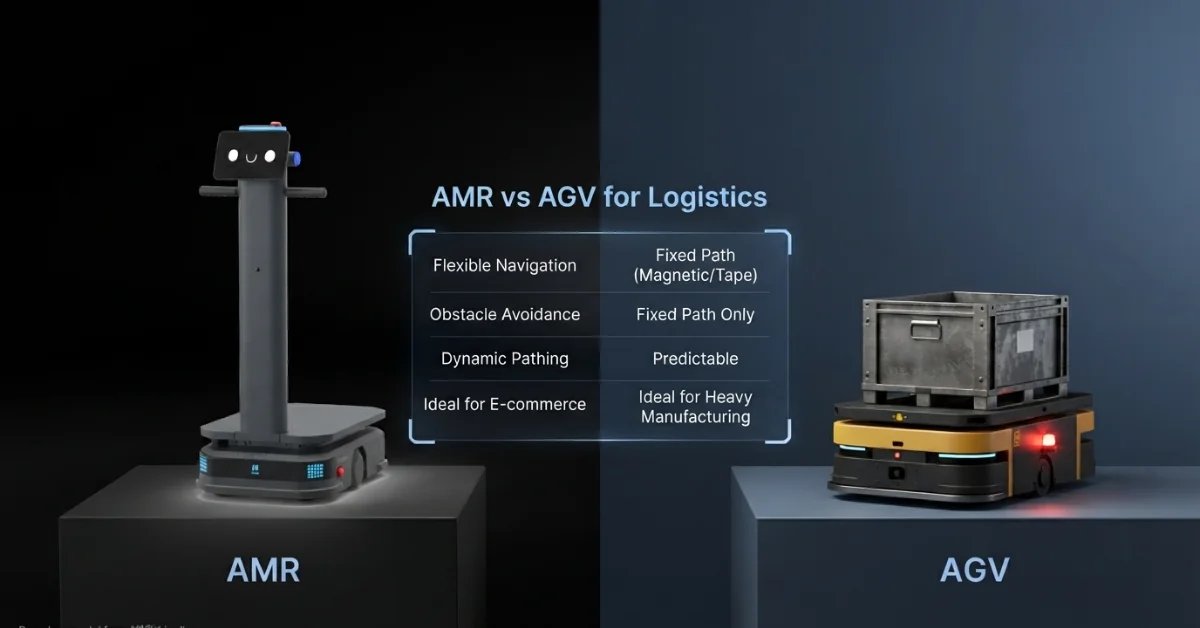
The most advanced robotic platform isn’t necessarily the optimal choice for every industrial facility. When evaluating AMR vs AGV for logistics, many decision-makers mistakenly prioritize raw autonomy over environmental suitability, leading to integration friction and deferred ROI. You’re likely grappling with escalating labor costs and the persistent threat of operational bottlenecks, yet the fear of investing in a solution that becomes obsolete within a few years remains a significant barrier to entry.
This guide provides the technical framework necessary to master the operational differences between these systems, ensuring your automation CAPEX delivers long-term viability. By analyzing the AMR vs AGV for logistics paradigm through a 2026 lens, we’ll explore how modern mobile robots interface with PLC and SCADA systems to create a unified fleet. You’ll gain a clear understanding of the AMR vs AGV for logistics trade-offs regarding payload stability and navigational flexibility, empowering you to select a solution that aligns perfectly with your facility’s specific industrial dynamics.
Key Takeaways
- Distinguish between the fixed-path reliability of AGVs and the dynamic, SLAM-based intelligence of AMRs to optimize your facility’s specific workflow demands.
- Evaluate the strategic ROI of AMR vs AGV for logistics by matching robotic autonomy levels to your environmental predictability and payload requirements.
- Understand the critical role of PLC and SCADA integration in creating a unified fleet management system that eliminates operational silos and maximizes throughput.
- Identify essential safety standards and obstacle avoidance logics, such as “Stop-and-Wait” versus “Reroute-and-Continue,” that protect your human workforce in complex environments.
- Access a framework for selecting a technical partner capable of delivering bespoke, end-to-end automation solutions tailored to the UAE’s industrial landscape.
The Fundamental Shift: Defining AGVs and AMRs in Modern Logistics
Industry 4.0 has redefined material handling expectations, moving industrial facilities from rigid automation toward decentralized, intelligent networks. By 2026, the global market for mobile robotics is projected to hit $13.2 billion according to Food Logistics, signaling a massive shift in how global supply chains operate. At the heart of this transformation lies a critical technical decision involving AMR vs AGV for logistics. Understanding the fundamental shift between these two systems is essential for any facility manager looking to secure long-term ROI on automation CAPEX. While both technologies aim to reduce labor costs and eliminate bottlenecks, they achieve these goals through vastly different technical architectures.
The Mechanics of Automated Guided Vehicles (AGVs)
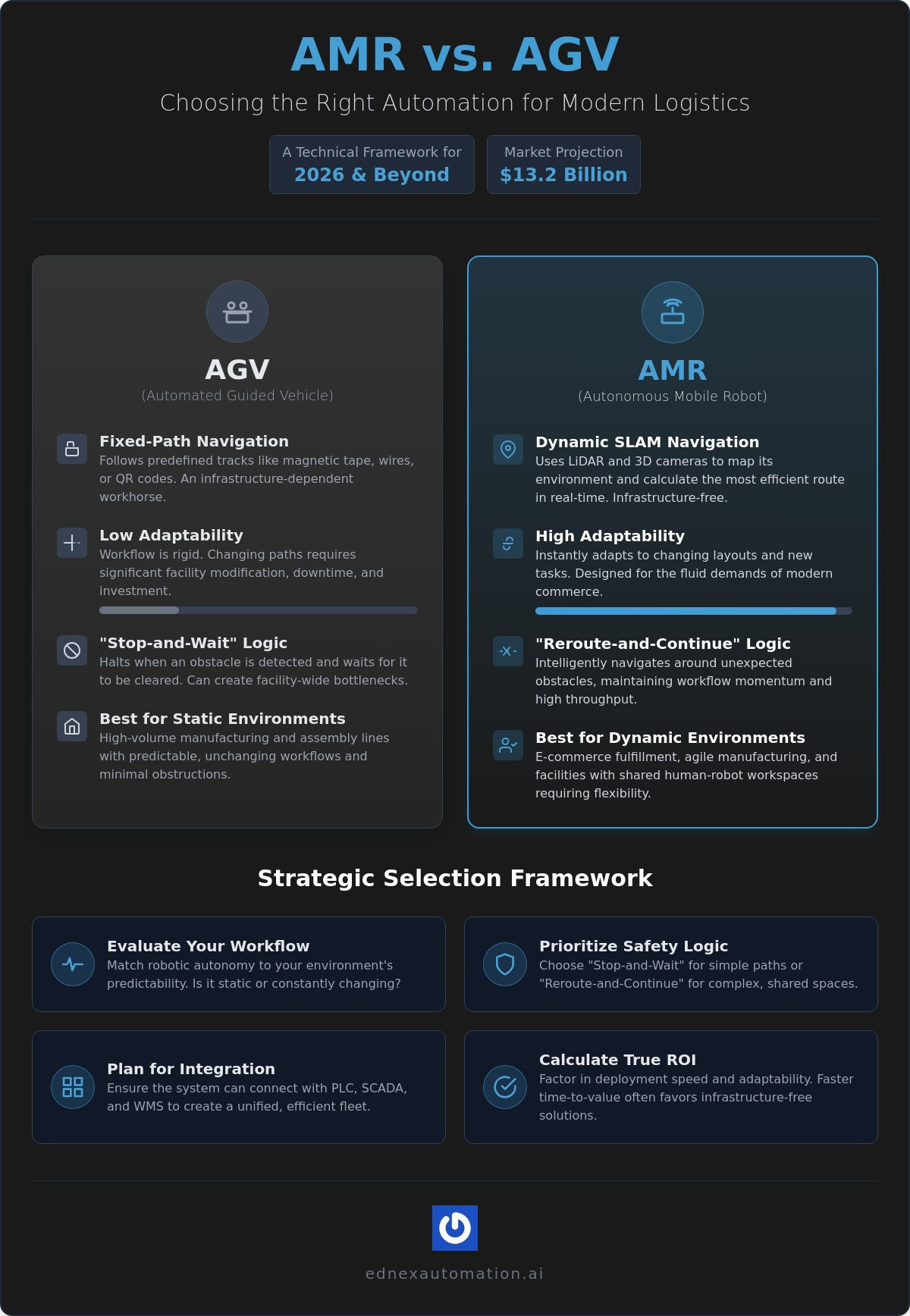
AGVs function as the reliable workhorses of fixed-path logistics. They operate by following predefined tracks, which are typically installed as magnetic tape, embedded wires, or specialized QR code grids on the facility floor. This infrastructure-dependent model provides exceptional predictability and consistent throughput, making it ideal for high-volume manufacturing environments where the workflow remains static. An Automated Guided Vehicle (AGV) is essentially a driverless train that stays on its tracks. However, this reliability comes with a specific cost structure. Implementing an AGV system requires significant facility preparation, which can increase initial CAPEX and create operational downtime during the installation phase. If your facility layout is permanent, the AGV’s rigid logic offers a stable, high-performance solution.
The Intelligence of Autonomous Mobile Robots (AMRs)
AMRs represent the intelligent evolution of industrial mobility, stripping away the need for physical tracks or wires. These units utilize sophisticated on-board intelligence and 2026-era sensor suites to interpret their surroundings in real-time. By using dynamic path planning, an AMR can navigate from point A to point B without a predefined track, instantly calculating the most efficient route based on its digital map. This infrastructure-free navigation allows for rapid deployment, often resulting in a faster time-to-value compared to traditional systems. When evaluating AMR vs AGV for logistics, the primary advantage of the AMR is its ability to adapt to changing warehouse layouts without requiring additional floor modifications. It’s a solution designed for the fluid, high-speed demands of modern e-commerce and agile manufacturing where flexibility is the ultimate currency.
Evaluating Operational Intelligence: Navigation, Obstacle Avoidance, and Safety
Harnessing the power of sensor fusion, 2026-era robots achieve total spatial awareness through the simultaneous processing of LiDAR, 3D time-of-flight cameras, and ultrasonic arrays. This high-level intelligence distinguishes modern platforms, allowing them to function not merely as transport tools but as proactive participants in a facility’s workflow—a level of precision also found in the advanced mobility equipment offered by Etech Motion. When analyzing the AMR vs AGV for logistics debate, the primary differentiator is how each system manages unexpected interruptions. While traditional AGVs are governed by a rigid “Stop-and-Wait” protocol, AMRs leverage “Reroute-and-Continue” logic to maintain momentum. This distinction is critical for high-throughput environments where a single blocked aisle could otherwise cascade into a facility-wide bottleneck.
Navigation Technology: Fixed vs. Dynamic
SLAM navigation is a method for robots to map unknown environments while tracking their own location. Utilizing this capability, AMRs bypass the technical limitations of track-bound AGVs, which often struggle in agile environments where floor space is shared with manual forklifts and personnel. By 2026, SLAM algorithms have reached a level of maturity where precision and repeatability are no longer exclusive to fixed-path systems. Modern autonomous mobile robots now achieve docking accuracy within millimeters, rivaling the stability of AGVs while offering the flexibility of a human operator. This evolution is a primary driver behind the positive economic impact of robotics and autonomous systems seen across global industrial sectors.
Safety Protocols in Collaborative Environments
Implementing safety standards like ISO 3691-4:2023 ensures that autonomous systems can operate safely alongside human workers in the UAE industrial sector. Moving beyond simple emergency stops, modern robots use AI to predict human movement, slowing down or adjusting their trajectory before a potential collision occurs. This shift from passive to active safety fosters a true collaborative environment where robots and humans share the floor without physical barriers. To explore how these safety-first systems can be tailored to your specific facility, consider reviewing the bespoke robotic solutions available for regional integration. By prioritizing intelligence and safety, organizations don’t just automate; they build resilient, future-proof operations that thrive in complex logistics landscapes.
The Integration Layer: Connecting Mobile Robots with PLC, SCADA, and ASRS
Eliminating data silos remains the primary challenge for facilities transitioning to Industry 4.0. While the hardware selection in the AMR vs AGV for logistics debate is critical, the true value of automation is realized only when these mobile units communicate seamlessly with your broader industrial control environment. By establishing a robust integration layer, organizations transform standalone robots into a synchronized fleet that responds in real-time to production demands. This connectivity ensures that every movement is optimized for maximum throughput rather than operating in isolation. Fleet management systems act as the orchestrator, coordinating multiple units to prevent congestion and ensure that the highest priority tasks are handled first, regardless of the robot’s specific navigation type.
PLC and SCADA: The Brain of the Automated Facility
Utilizing PLC and SCADA integration services allows your facility’s brain to trigger robotic missions based on specific production line signals. When a sensor on a conveyor detects a completed pallet, the PLC communicates this state to the robot controller, which then dispatches the nearest available unit. SCADA systems provide the necessary visualization, allowing operators to monitor the entire mobile fleet alongside fixed machinery from a single, high-tech interface. This unified control significantly reduces downtime through centralized diagnostics, ensuring that technical issues are identified and resolved before they impact the global supply chain. By integrating these systems, you create a transparent operational environment where data flows freely between the shop floor and the management level.
Synergy with Automated Storage and Retrieval Systems (ASRS)
Achieving peak efficiency requires a strategic synergy with automated storage and retrieval systems. In this sophisticated architecture, the ASRS acts as the heart of the logistics center, while AMRs serve as the arteries that transport goods to their final destination. Solving the “last meter” hand-off problem involves precise technical coordination, where mobile robots align with ASRS output stations to receive loads without human intervention. As highlighted by the Material Handling Institute (MHI), these integrated workflows are essential for modern high-density warehouses that require rapid order fulfillment. By leveraging mobile robot telemetry, facilities create a continuous data loop that informs real-time optimization. This allows for a more responsive operation where the fleet can adapt to sudden shifts in inventory levels or order priority, grounding high-tech aspirations in practical, results-oriented execution.
Strategic Selection Framework: Matching Technology to Warehouse Dynamics
Establishing a strategic selection framework requires a deep dive into the specific dynamics of your facility. Choosing between AMR vs AGV for logistics depends largely on environmental predictability and the necessity for long-term scalability. While entry-level AGVs might offer a lower unit cost, high initial deployment costs act as a barrier for 52% of users according to Market Growth Reports. Decisions must account for the total cost of ownership (TCO), balancing the physical infrastructure upkeep of AGVs against the software-centric maintenance of AMRs. By aligning robotic autonomy with the specific predictability of your warehouse floor, you ensure that your CAPEX investment yields maximum operational efficiency.
Evaluating payload requirements is equally critical when defining your automation roadmap. AGV platforms traditionally excel in heavy-duty applications, such as moving automotive chassis or massive paper rolls, where extreme stability and fixed paths are non-negotiable. In contrast, AMRs offer superior flexibility for light to medium payloads in decentralized environments. Scalability also differs significantly between the two. Adding a new unit to an AMR fleet in 2026 is often a matter of software synchronization, whereas expanding an AGV system may require additional floor modifications and facility downtime.
When to Choose an AGV
Selecting an AGV is the optimal path for facilities characterized by high-volume, repetitive movements where layout changes aren’t expected. These systems provide unmatched reliability in manufacturing plants with dedicated production lines that remain static for years. If your operations involve heavy-duty payloads requiring extreme stability, the rigid guidance of an AGV ensures consistent throughput. Organizations already planning major floor renovations can often integrate AGV infrastructure cost-effectively during the construction phase, securing a stable foundation for long-term material handling.
When to Choose an AMR
Deploying autonomous mobile robots is the strategic choice for dynamic environments with high human traffic and frequently changing pallet positions. These robots solve critical labor shortages by taking over low-value transport tasks without requiring expensive facility prep. Multi-site operations benefit from the AMR’s ease of redeployment, as units can be moved between warehouses and remapped in hours. If your facility demands an agile response to seasonal peaks or shifting inventory profiles, the AMR’s decentralized intelligence provides the necessary operational resilience.
Ready to determine which technology fits your specific operational profile? Request a comprehensive facility assessment to secure a bespoke automation strategy tailored to your regional industrial needs.
Bespoke Automation: Implementing Scalable Robotic Solutions with EdNex
Positioning your facility for the 2030 industrial landscape requires more than just an equipment acquisition; it demands a technical partner capable of bridging global technological breakthroughs with regional industrial needs. When evaluating AMR vs AGV for logistics, the difference between a successful deployment and a costly operational silo lies in the quality of the integration layer. EdNex Automation operates as a visionary systems integrator, providing the intellectual framework necessary to transform fragmented machinery into a cohesive, intelligent ecosystem. By focusing on the gravity of large-scale industrial transformation, we ensure that every robotic unit serves a specific, data-driven purpose within your facility.
Successful mobile robot deployment is rarely about the robot itself. It’s about the underlying software architecture and the ability of that hardware to interface with existing industrial control systems. For specialized applications like waste management, Eco Software Solutions provides the innovative software architecture required to optimize complex recycling and material handling workflows. As a specialized division of the EdNex group focused on Industry 4.0, we provide the technical expertise required to navigate these complexities. We don’t just supply hardware; we act as high-level consultants who understand that risk mitigation and operational improvement are the primary drivers of your automation CAPEX. This results-oriented approach ensures that your facility doesn’t just adopt new tech but masters it for long-term business viability.
The EdNex Integration Process
Our end-to-end approach begins with a rigorous operational audit and technology selection phase, where we determine whether your facility layout favors the fixed-path reliability of an AGV or the dynamic intelligence of an AMR. Following this, our engineering team initiates custom control system design and SCADA mapping, ensuring that your new mobile assets communicate perfectly with existing infrastructure. Finally, we manage national deployment and provide local technical support across the UAE, guaranteeing that your Industry 4.0 transition is supported by on-the-ground expertise and methodical execution.
Comprehensive Robotics Portfolio
Beyond material handling, our expertise extends to a diverse range of automated systems designed to solve complex industrial challenges. We integrate collaborative robots UAE for precision assembly tasks, alongside specialized units for inspection, surveillance, and industrial cleaning. EdNex ensures seamless communication between mobile fleets and ASRS infrastructure by architecting custom middleware that synchronizes storage retrieval with robotic transport missions. This comprehensive portfolio allows us to deliver bespoke solutions that enhance safety and efficiency across every sector of the regional economy. Future-proofing your facility is a deliberate act of controlled innovation, and selecting a partner with national coverage is the first step toward securing your competitive edge in the AMR vs AGV for logistics landscape.
Orchestrating the Next Era of Industrial Mobility
Navigating the complexities of industrial transformation requires a precise alignment between technological capability and facility requirements. Choosing the right path in the AMR vs AGV for logistics debate ensures your organization avoids the pitfalls of obsolete infrastructure or incompatible silos. By prioritizing seamless PLC and SCADA integration, you establish a unified control layer that maximizes throughput and provides the transparency needed for real-time optimization. Success in 2026 isn’t defined by the acquisition of the newest hardware, but by the strategic orchestration of these systems into a cohesive, intelligent network.
As a specialized division of the EdNex group, we leverage our status as an official integrator for leading global robotics brands to deliver bespoke, end-to-end solutions. Our comprehensive expertise in hardware supply and technical integration provides the intellectual framework necessary for sustainable Industry 4.0 success. We invite you to consult with our automation experts to design your robotic logistics strategy and secure your competitive advantage in the UAE’s evolving industrial landscape. Embracing this level of controlled innovation will empower your facility to thrive in an increasingly autonomous future.
Frequently Asked Questions
What is the primary difference between an AMR and an AGV for logistics?
The primary distinction lies in navigation intelligence. AGVs are restricted to predefined paths like magnetic tape or wires, whereas AMRs utilize SLAM technology to navigate dynamically around obstacles. This makes the choice of AMR vs AGV for logistics a matter of environmental predictability. While AGVs provide extreme consistency on fixed routes, AMRs offer the agility needed for decentralized, high-traffic operations.
Which is more expensive to install: AGV or AMR?
AGVs typically require higher initial installation costs due to the physical infrastructure needed for guidance. Modifying warehouse floors for magnetic tape or wires represents a significant CAPEX commitment. AMRs have a higher per-unit cost but require minimal infrastructure, often resulting in a lower total cost of ownership in facilities that undergo frequent layout changes.
Can AMRs and AGVs operate in the same facility together?
Coexistence is entirely possible through advanced fleet management and interoperability standards like VDA 5050. Utilizing a centralized control layer allows a facility to deploy AGVs for heavy-duty, repetitive line-side delivery while using AMRs for flexible order picking. This hybrid approach optimizes throughput by matching the specific robotic capability to the task’s predictability.
How long does it take to deploy an autonomous mobile robot fleet?
AMR deployment is significantly faster, often taking only weeks to map and integrate into a live environment. AGV installations typically span several months because they involve physical floor modifications and the commissioning of guide paths. The speed of deployment for AMRs provides a faster time-to-value for organizations facing immediate labor shortages or seasonal surges.
Are AMRs safe to use around human workers in a busy warehouse?
Modern AMRs are engineered for safe human-robot collaboration, adhering to international standards like ISO 3691-4:2023. They employ sensor fusion, combining LiDAR and 3D cameras to detect and predict human movement. This active safety logic allows them to operate in busy warehouses without the need for physical safety cages or restricted zones.
Do I need to change my warehouse floor to use an AGV?
AGV implementation almost always necessitates floor modifications to install guidance indicators. Whether you’re using magnetic tape, embedded wires, or QR code grids, these systems rely on external infrastructure to maintain their path. If your facility isn’t prepared for these permanent changes, an infrastructure-free AMR solution might be the more viable alternative.
How do mobile robots integrate with my existing WMS or ERP system?
Integration is achieved through a sophisticated middleware layer that connects the robots to your WMS or ERP via PLC and SCADA systems. This architecture allows the warehouse management system to trigger robotic missions based on real-time inventory data. Successful AMR vs AGV for logistics deployments rely on this seamless data flow to eliminate operational silos.
What is the typical ROI period for a mobile robot investment in 2026?
While ROI periods vary based on operational scale, most industrial facilities see a return on investment within 12 to 24 months. This timeline is driven by significant reductions in labor costs and a reported productivity increase of over 27% in many logistics settings. Long-term viability is further secured through reduced error rates and improved facility safety.