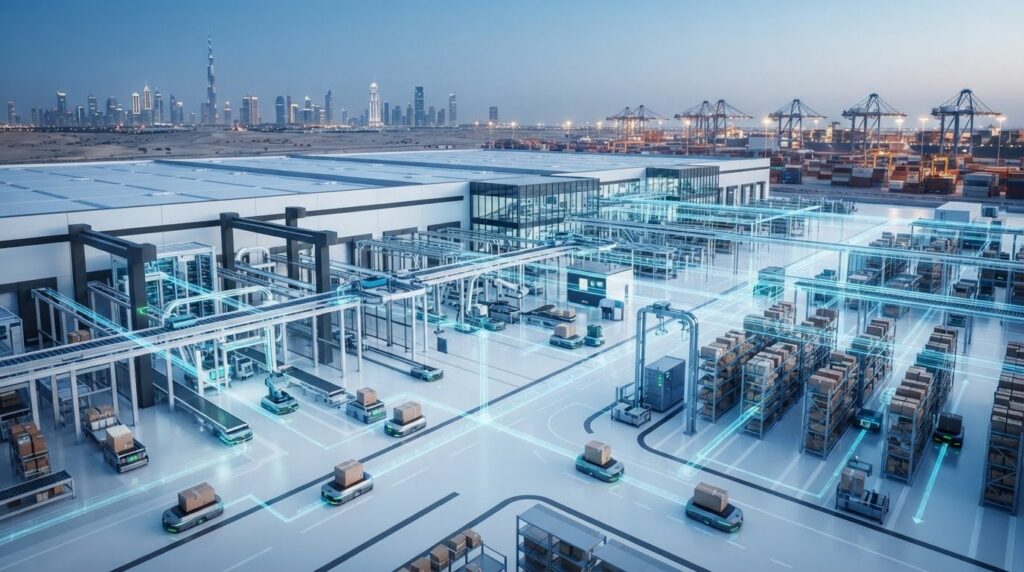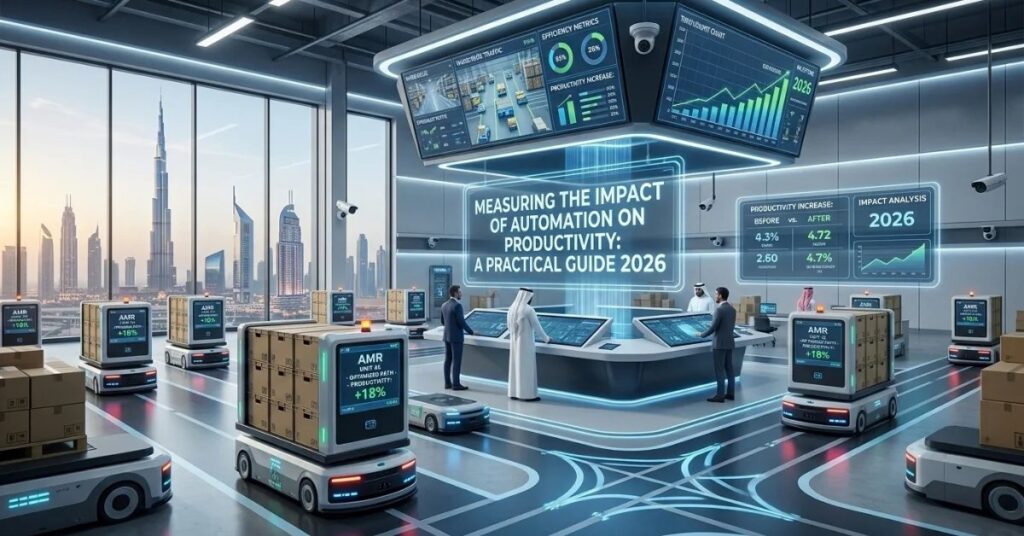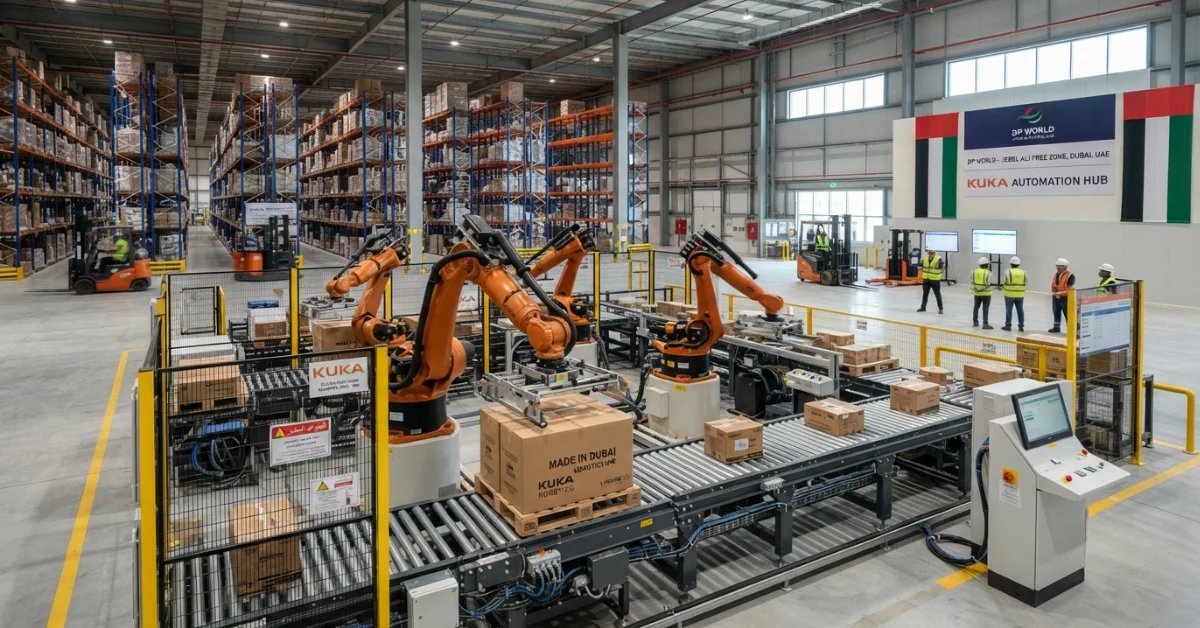
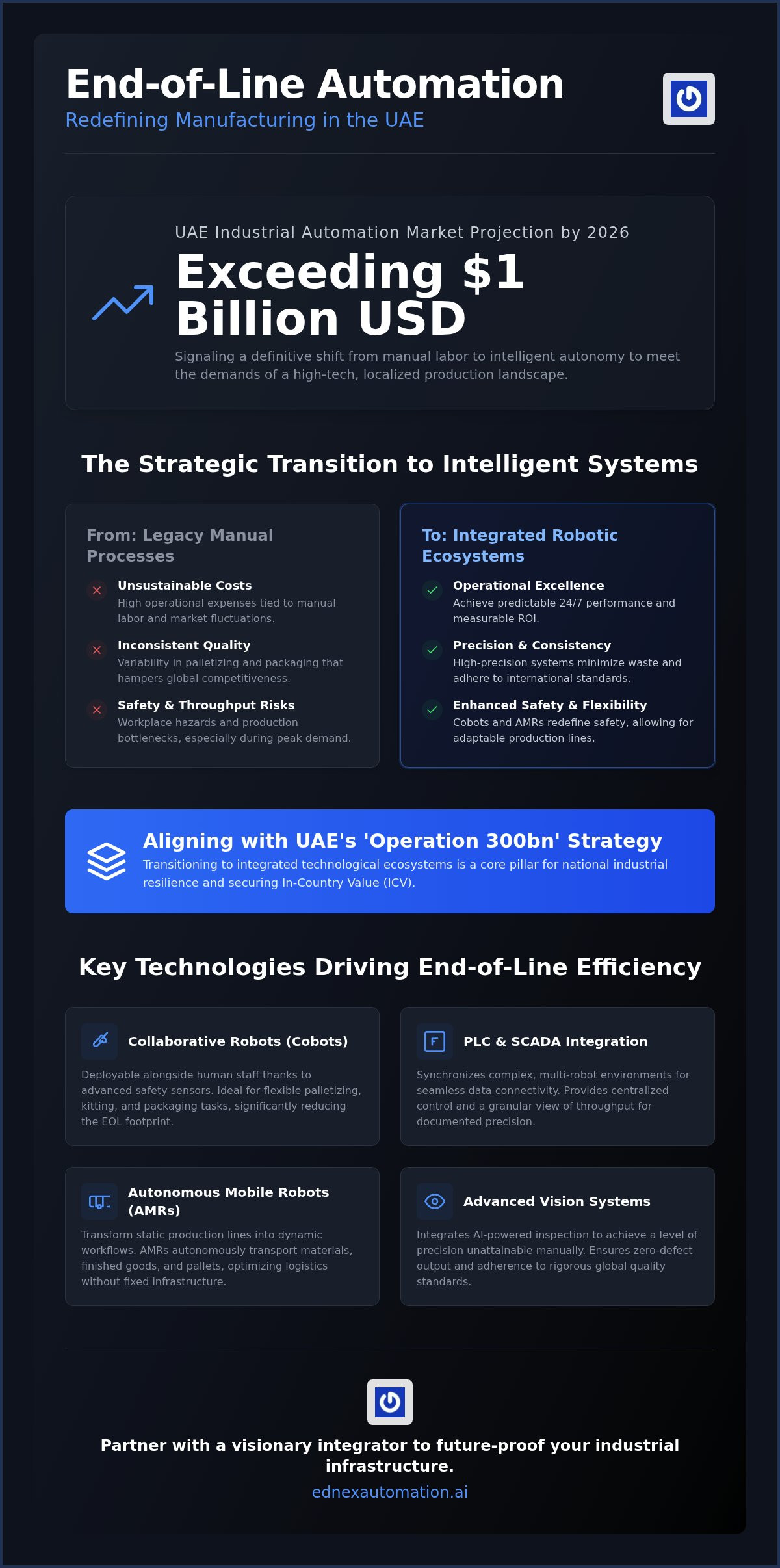
By 2026, the UAE industrial control and factory automation market is projected to surge toward a valuation exceeding USD 1 billion, signaling a definitive shift from manual labor to intelligent autonomy. Relying on legacy manual packaging processes often leads to unsustainable operational costs and inconsistent palletizing quality that hampers global competitiveness. Integrating sophisticated end-of-line automation UAE solutions allows manufacturers to mitigate these risks while aligning with the mandatory In-Country Value (ICV) program requirements that now prioritize localized, high-tech production.
You’re likely seeking a method to stabilize throughput during peak demand cycles without compromising workplace safety or regulatory compliance. This strategic guide demonstrates how intelligent end-of-line automation is redefining manufacturing efficiency and safety across the UAE industrial landscape. We’ll preview the transition from fixed mechanical hardware to flexible robotic ecosystems, providing a roadmap for future-proofing your production lines through advanced cobot deployment and seamless PLC and SCADA integration. By examining the latest technological benchmarks, you’ll discover how to transform once-static packaging zones into autonomous hubs of measurable productivity.
Key Takeaways
- Align your manufacturing facility with the UAE’s ‘Operation 300bn’ strategy by transitioning from manual packaging to integrated technological ecosystems.
- Leverage high-tier collaborative robots and autonomous mobile robots to redefine end-of-line automation UAE standards for safety and flexibility.
- Achieve measurable operational excellence by calculating Total Cost of Ownership and minimizing product waste through high-precision robotic systems.
- Synchronize complex production lines through sophisticated PLC and SCADA integration, ensuring seamless data connectivity and centralized control across multi-robot environments.
- Partner with a visionary integrator like EdNex Automation to secure bespoke, start-to-finish solutions that future-proof your industrial infrastructure for 2026 and beyond.
The Evolution of End-of-Line Automation in the UAE Industrial Sector
Aligning with the Ministry of Industry and Advanced Technology’s ‘Operation 300bn’ mandate, end-of-line automation UAE is no longer a peripheral upgrade; it’s a core strategic pillar for national industrial resilience. Transitioning from manual labor to autonomous precision allows manufacturers to meet the stringent requirements of the 2026 industrial landscape. Providing a foundational perspective on industrial progress, The Evolution of End-of-Line Automation mirrors the broader global shift toward cyber-physical systems where hardware and software converge. By establishing the Dh1 billion national industrial resilience fund in April 2026, the UAE government has effectively signaled that high-tech integration is the primary vehicle for achieving a competitive, localized manufacturing base.
Positioning the UAE as a global hub for smart logistics requires a departure from isolated mechanical units. Modern facilities are now adopting integrated technological ecosystems that unify palletizing, wrapping, and labeling into a single, data-driven workflow. This shift ensures that every product leaving the facility adheres to international quality standards, a necessity for businesses looking to capitalize on the expanded In-Country Value (ICV) program. Leveraging these advanced systems transforms the final stage of production from a bottleneck into a high-speed gateway for global export.
From Packaging Machines to Intelligent Systems
The transition toward intelligent systems is defined by the replacement of static machinery with interconnected smart lines. In 2026, real-time data informs every aspect of end-of-line automation UAE, allowing for dynamic adjustments based on upstream production speeds. This connectivity ensures that automated consistency remains high, even during rapid product changeovers. By utilizing PLC and SCADA frameworks, manufacturers gain a granular view of their throughput, enabling them to meet global export standards with documented precision. These systems don’t just move boxes; they provide the intellectual framework necessary for predictive maintenance and zero-defect output.
Addressing the UAE’s Unique Manufacturing Challenges
Operating within the Middle East presents specific environmental and economic hurdles that demand robust industrial solutions. High-tier robotics are engineered to maintain peak performance in high-temperature environments that often degrade standard hardware; for specialized pneumatic components that withstand these conditions, you can visit Abbey Extrusions to explore their selection of durable tubing. Implementing these autonomous systems solves labor market fluctuations by providing predictable, 24/7 performance without the risks associated with manual handling in extreme conditions. Furthermore, intelligent end-of-line configurations allow for enhanced facility throughput without requiring a physical expansion of the warehouse footprint. This optimization is critical for urban industrial zones in Dubai and Abu Dhabi where space remains a premium commodity.
Key Technologies Driving End-of-Line Efficiency in 2026
While legacy systems once relied on rigid, fenced-off machinery, the modern approach to end-of-line automation UAE utilizes adaptive technologies that prioritize safety and spatial efficiency. These intelligent systems represent a shift from purely mechanical hardware to autonomous ecosystems capable of real-time decision-making. By integrating advanced robotics with vision-based inspection, manufacturers can now achieve a level of precision that was previously unattainable through manual processes or static conveyors. This technological shift is essential for facilities aiming to scale production while maintaining the rigorous quality standards required for global export markets.
The Rise of Cobots in Palletizing and Kitting
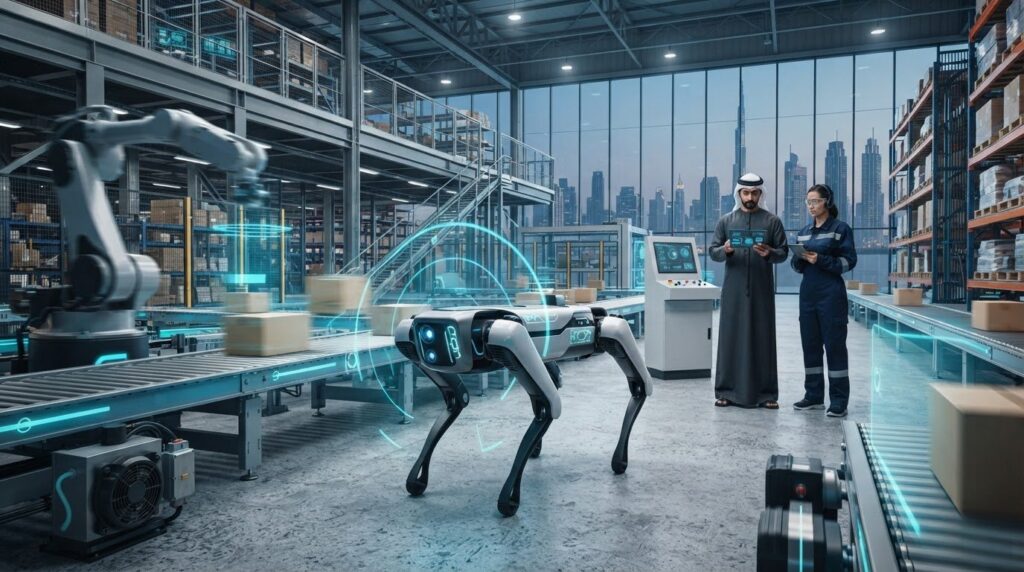
Deploying collaborative robots UAE has become the standard for palletizing and kitting tasks that require both speed and flexibility. Unlike traditional industrial arms that necessitate heavy safety gating and large exclusion zones, cobots feature sophisticated force-limiting sensors and human-robot proximity protocols. This allows them to operate safely alongside human staff, significantly reducing the physical footprint of the EOL zone. Their rapid redeployment capabilities make them particularly effective for high-mix, low-volume production environments where packaging requirements change frequently. This versatility ensures that the production line remains agile, allowing for seamless transitions between different product SKUs without lengthy downtime.
Mobile Autonomy: AMRs in the EOL Workflow
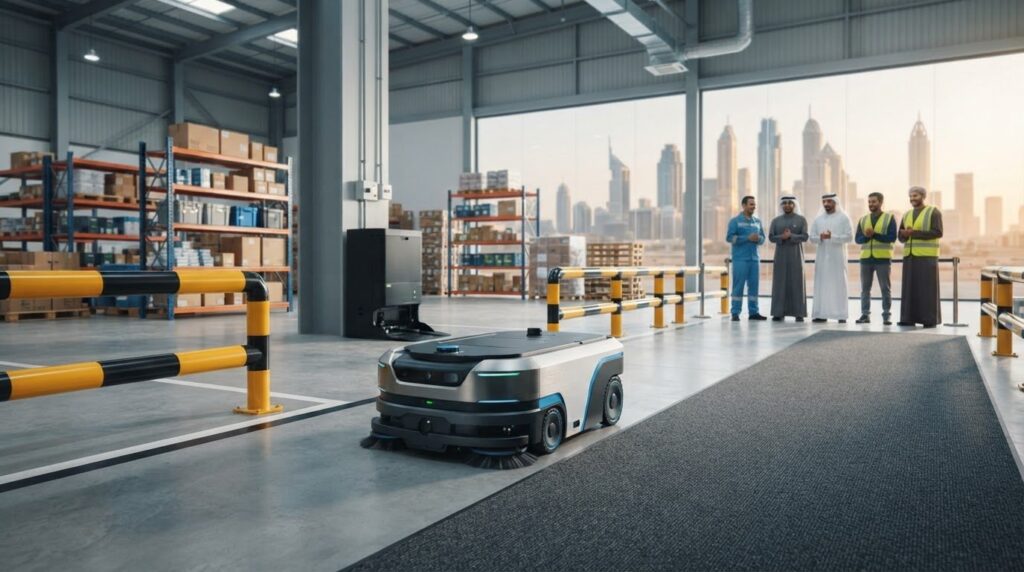
Transitioning from fixed conveyor paths to autonomous mobile robots offers a level of operational flexibility that traditional infrastructure simply cannot match. AMRs navigate complex warehouse floors using dynamic obstacle avoidance, ensuring that internal transport and buffering remain fluid even in high-traffic zones. By integrating these robots with palletizing stations, manufacturers create a touchless workflow that connects the end of the production line directly to the dispatch dock. This eliminates the bottlenecks often associated with manual forklift operations and fixed-path systems, providing a scalable solution for internal logistics. Consulting with an expert integrator like EdNex Automation ensures these disparate mobile units are unified into a cohesive, high-performance system.
Vertical Optimization and Vision Systems
Maximizing vertical space is a critical requirement for UAE facilities operating in high-value industrial zones where ground area is limited. Automated Storage and Retrieval Systems (ASRS) allow for the dense, high-speed storage of finished goods, effectively turning vertical height into a strategic asset. Complementing this storage efficiency, high-speed labeling and vision-based quality inspection systems verify the integrity of every outbound pallet. These systems use advanced imaging to detect packaging defects or labeling errors in real-time, ensuring that only perfect goods reach the customer. This combination of vertical density and automated quality control creates a robust end-of-line automation UAE framework that supports long-term business viability.
The Strategic Business Case: ROI and Operational Excellence
Evaluating the economic viability of end-of-line automation UAE requires a shift from viewing procurement as a capital expense to recognizing it as a strategic investment in operational excellence. Calculating the Total Cost of Ownership (TCO) involves more than the initial equipment acquisition; it encompasses long-term energy efficiency, reduced maintenance intervals, and the elimination of labor-intensive bottlenecks. By achieving 24/7 operational capability, facilities can meet aggressive export deadlines without the overhead of shift-based overtime or the inconsistency of manual handling. This predictable performance provides the intellectual framework necessary for long-term financial forecasting, ensuring that production output remains decoupled from labor market volatility.
Reducing product damage and waste through robotic precision directly impacts the bottom line by preserving the integrity of finished goods throughout the supply chain. Manual palletizing often results in uneven load distribution or mishandling, which leads to costly returns and brand degradation. Implementing automated systems mitigates these risks by ensuring every unit is placed with mathematical accuracy, which optimizes load stability for international transit. This precision also minimizes the use of consumables like stretch wrap and adhesive, resulting in measurable cost savings that accumulate over high-volume production runs.
Quality Assurance and Brand Consistency
Eliminating human error in labeling and secondary packaging is essential for maintaining the reputation of UAE-made products in international markets. Vision systems integrated into the EOL workflow provide 100% inspection of every finished pallet, detecting even minute discrepancies in barcode placement or wrap tension. This level of automated scrutiny ensures that every outbound shipment meets rigorous global standards, reinforcing the status of the UAE as a premium manufacturing origin. By providing documented proof of quality, manufacturers can secure higher-tier contracts and reduce the risk of non-compliance penalties in foreign jurisdictions.
Workplace Safety and Ergonomics
Prioritizing worker welfare involves removing personnel from high-risk, repetitive tasks that involve heavy lifting and awkward postures. Compliance with UAE health and safety regulations, such as the safety requirements mandated in Cabinet Resolution No. (15) of 2026, becomes significantly more manageable when dangerous manual processes are replaced by controlled robotic units. Transitioning to automated systems doesn’t just reduce insurance premiums; it allows for upskilling the workforce to manage and maintain advanced robotic units. This evolution shifts the focus of the human element from physical labor to technical oversight, creating a safer and more resilient industrial environment.
Integrating EOL Systems: PLC, SCADA, and Data Connectivity
Achieving a seamless transition to a fully autonomous facility requires more than just high-tier robotics. The true intelligence of end-of-line automation UAE lies within the control layer that orchestrates every movement across the production floor. Utilizing sophisticated PLC and SCADA integration services allows for precise line synchronization, ensuring that palletizing, wrapping, and labeling units operate as a unified organism. Facilitating this level of connectivity bridges the gap between raw shop-floor data and high-level ERP systems, providing a single source of truth for production metrics. This digital transparency is essential for UAE manufacturers looking to optimize their supply chains and demonstrate the efficiency required for federal government contracts under the mandatory ICV program.
Developing a centralized control architecture for multi-robot environments ensures that disparate systems communicate without latency. When cobots, AMRs, and ASRS units are linked through a unified framework, the entire EOL workflow becomes self-optimizing. This integration allows for real-time monitoring and predictive maintenance, which are the hallmarks of a zero-downtime EOL strategy. By identifying wear patterns in mechanical components before they lead to failure, plant managers can schedule interventions during planned pauses, effectively eliminating the risk of catastrophic production halts during peak demand periods.
The Role of Industrial Control Systems
Bespoke PLC programming acts as the nervous system for complex packaging logic, enabling the system to handle diverse product dimensions without manual intervention. SCADA visualization goes a step further by providing plant managers with a digital twin of the EOL environment, allowing them to simulate operational scenarios and identify potential failures before they occur. As these systems become increasingly interconnected, ensuring cybersecurity within the industrial network remains a top priority to safeguard sensitive operational data. It’s no longer enough to have a fast line; that line must be secure, intelligent, and capable of autonomous adjustment.
Steps to a Successful Integration
- Step 1: Conduct a comprehensive line audit and throughput analysis to establish a technical baseline and identify existing bottlenecks.
- Step 2: Design a scalable control architecture using PLC/SCADA frameworks that support multi-robot synchronization and future facility expansions.
- Step 3: Execute phased deployment strategies to minimize production interruptions, ensuring the facility maintains output while upgrades are implemented.
Navigating these technical complexities requires the expertise of a high-level consultant rather than a simple equipment vendor. Engaging with EdNex Automation for comprehensive PLC and SCADA integration provides the intellectual framework necessary for a successful industrial transformation.
EdNex Automation: Pioneering Intelligent EOL Solutions across the UAE
EdNex Automation serves as a pivotal architect for Industry 4.0 transformation, providing the intellectual framework necessary for large-scale industrial evolution. By positioning itself as a high-level consultant rather than a simple equipment vendor, the brand ensures that end-of-line automation UAE implementations are both technically robust and strategically aligned with national economic goals. Leveraging its proven track record in national industrial infrastructure projects, EdNex connects global technological breakthroughs with the specific requirements of the regional market. This approach guarantees that every system represents a controlled and deliberate innovation designed to bring order and efficiency to complex manufacturing environments.
Delivering a comprehensive suite of solutions involves the bespoke integration of high-tier robotics. Integrating Cobots for safe human collaboration and AMRs for fluid internal logistics allows for a touchless workflow that maximizes throughput. When these systems are combined with advanced ASRS systems, manufacturers can optimize vertical space while maintaining high-speed retrieval capabilities. EdNex maintains strategic alliances with global robotics leaders, ensuring that UAE-based facilities have access to the same cutting-edge technology driving the world’s most advanced industrial sectors. This nationwide technical support and engineering expertise provide the reliability required for continuous, high-volume production.
A Full-Service Automation Approach
Providing start-to-finish expertise, EdNex guides organizations through every phase of the automation journey, from initial feasibility studies and bespoke design to final installation and staff training. This commitment to long-term business viability ensures that current acquisitions are built on scalable architectures capable of evolving with future demand. Adhering to official certifications and global industry standards, the brand provides the legitimacy required for high-stakes industrial transformation. This methodical approach reassures partners of a reliable and consistent delivery model that prioritizes operational continuity and system longevity.
Empowering UAE Manufacturers for the Future
Securing Your Industrial Future in the UAE
Transitioning toward a fully autonomous industrial model is a necessary evolution for manufacturers aiming to remain competitive within the region’s rapidly expanding economic landscape. Adopting advanced end-of-line automation UAE solutions ensures that production facilities don’t just survive but thrive by achieving total inspection accuracy and seamless palletizing through collaborative robotics. These technologies, when unified by a robust control architecture, provide the measurable increase in throughput and safety compliance required for the 2026 market. Integrating these systems allows for a strategic decoupling of output from labor market volatility, securing long-term business viability.
As an Authorized Integrator for Global Robotics Brands, EdNex Automation provides the comprehensive nationwide support and specialized PLC & SCADA engineering expertise needed to execute complex transformations. We provide the intellectual framework to bridge the gap between your current shop floor and a future-proofed production line. Partner with EdNex Automation to revolutionize your production line and lead the charge in the UAE’s industrial digital transformation. Your journey toward industrial excellence starts with a controlled, visionary approach to automation.
Frequently Asked Questions
What is included in a typical end-of-line automation system?
A comprehensive end-of-line ecosystem typically integrates high-precision palletizing units, such as collaborative robots, with autonomous mobile robots (AMRs) for fluid internal transport. These physical components are unified by sophisticated PLC and SCADA frameworks that manage vision-based quality inspection and automated storage and retrieval systems (ASRS). By orchestrating these technologies into a single workflow, manufacturers achieve a touchless transition from the production floor to the dispatch dock, ensuring total consistency and documented quality for every outbound pallet.
How long does it take to see a return on investment (ROI) for EOL automation in the UAE?
While specific recovery periods depend on production volume and facility scale, many regional manufacturers report a definitive return on investment within 18 to 36 months of deployment. This timeline is accelerated by the significant reduction in product waste, lower workplace insurance premiums, and the ability to maintain 24/7 operational capability without shift-based overhead. Utilizing federal financing incentives under the “Operation 300bn” strategy further enhances the strategic business case for end-of-line automation UAE, making high-tech adoption a financially viable necessity for modern industry.
Can collaborative robots work alongside my existing manual workforce safely?
Collaborative robots, or cobots, are specifically engineered with advanced force-limiting sensors and proximity protocols that allow them to operate safely without traditional safety cages. These units immediately decelerate or halt upon detecting human presence, fulfilling the rigorous safety requirements mandated in the UAE’s 2026 industrial regulations. Integrating cobots into your workflow allows your human staff to shift from repetitive, high-risk physical labor to higher-value technical oversight roles, creating a safer and more ergonomically sound environment.
Is end-of-line automation suitable for small-to-medium enterprises (SMEs) in the UAE?
Scalable robotic solutions make automation highly accessible for SMEs looking to optimize specific production bottlenecks without a total facility overhaul. The introduction of the Dh1,000 instant industrial license in Sharjah and expanded federal resilience funds provide the economic framework for smaller enterprises to adopt advanced technologies. Starting with a single palletizing cell or a small fleet of AMRs allows for incremental modernization, providing a clear path toward full-scale industrial transformation as the business expands.
What kind of maintenance is required for robotic palletizing and AMR systems?
Modern robotic systems prioritize predictive maintenance over reactive repairs, utilizing real-time data from SCADA systems to identify potential wear before it leads to failure. Maintenance typically involves regular software optimization, sensor calibration, and routine mechanical checks that are scheduled during planned production pauses. This proactive approach effectively eliminates the risk of catastrophic downtime, ensuring that your automated lines remain operational during critical peak demand cycles or tight export deadlines.
How do I integrate new EOL automation with my current legacy PLC systems?
Integrating modern robotics with legacy infrastructure involves developing bespoke communication gateways that bridge older protocols with modern industrial IoT frameworks. Our engineering team specializes in creating custom PLC and SCADA interfaces that allow new autonomous units to synchronize perfectly with existing upstream machinery. This phased integration ensures a seamless data flow across the entire production line, allowing you to modernize your facility without the need for a complete and costly replacement of current hardware.
What are the first steps to starting an EOL automation project with EdNex?
The journey toward industrial excellence begins with a comprehensive facility audit and throughput analysis conducted by our senior technical consultants. This initial phase identifies your specific operational bottlenecks and establishes the technical requirements for a bespoke automation roadmap. Following this assessment, we design a scalable control architecture that aligns with your sector’s unique needs, ensuring a controlled and deliberate transition to an autonomous, high-performance manufacturing environment.