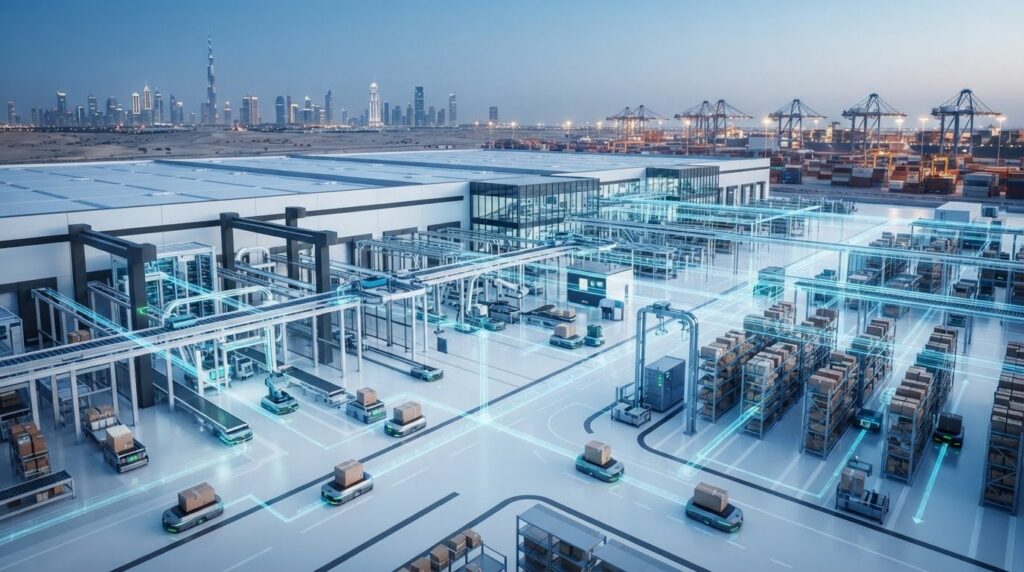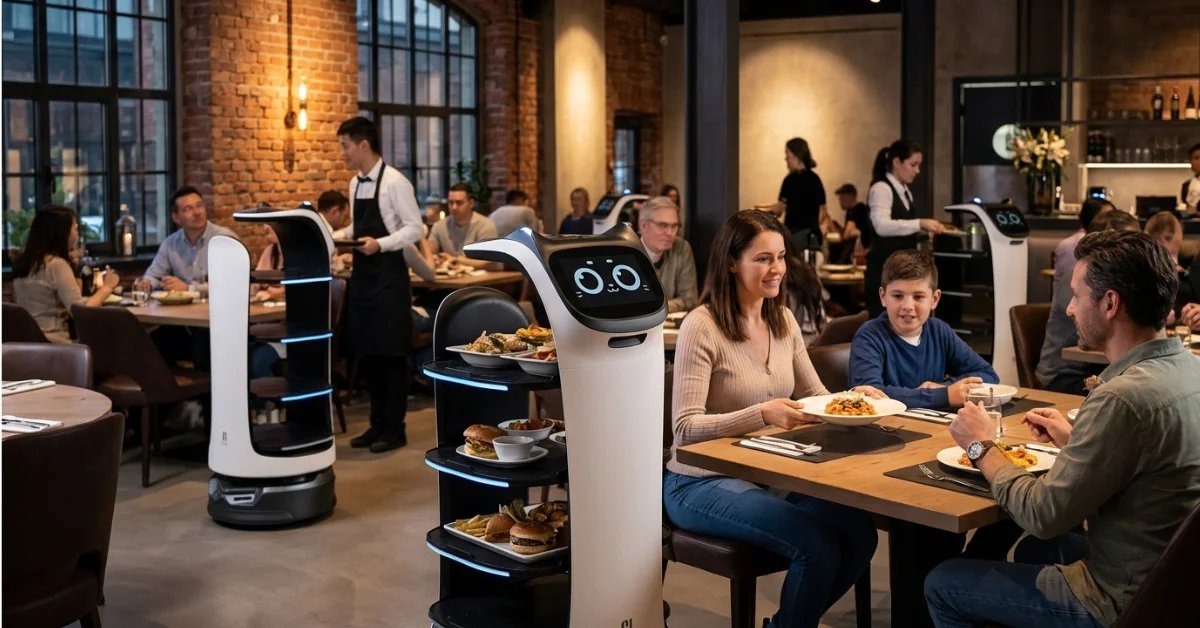
The UAE’s food and beverage sector is no longer competing on cost alone; it’s competing on sovereignty. As national food security targets tighten and production demands accelerate, manufacturers who rely on legacy processes are discovering that operational vulnerability isn’t a future risk — it’s a present reality. Food and beverage automation in the UAE has crossed a critical threshold: it’s now a strategic instrument of industrial policy, not simply an efficiency upgrade.
If you’re a production director or operations leader in this sector, you already feel the pressure. Labor turnover disrupts line continuity. Halal compliance and traceability requirements demand zero-error precision. Gulf temperatures test the limits of cold chain integrity every single day. And with high-speed packaging lines running at capacity, the margin for human error is shrinking to nothing.
This guide addresses the question at the center of every serious F&B operation in the region right now: how do you implement advanced automation to meet UAE food security standards while simultaneously driving down operational costs? In the sections ahead, you’ll find a structured breakdown of the robotics technologies, PLC and SCADA integration strategies, and Automated Storage and Retrieval Systems transforming UAE production facilities from the warehouse floor to the final packaging stage.
Key Takeaways
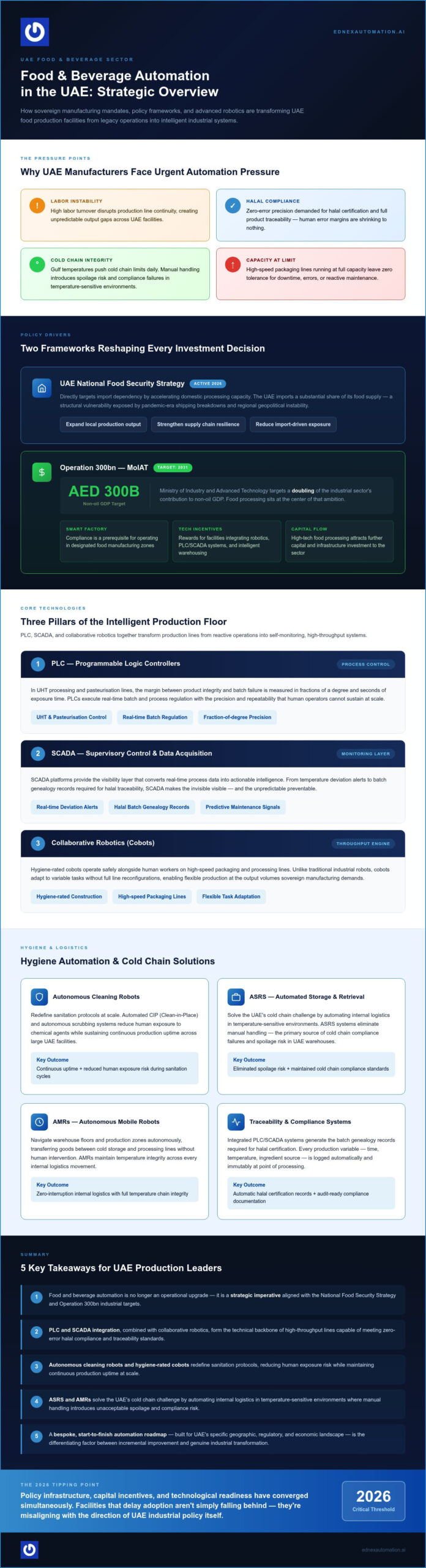
- Food and beverage automation UAE is no longer an operational upgrade — it is a strategic imperative directly aligned with the National Food Security Strategy and Operation 300bn industrial targets.
- PLC and SCADA integration, combined with collaborative robotics, form the technical backbone of high-throughput production lines capable of meeting zero-error halal compliance and traceability standards.
- Autonomous cleaning robots and hygiene-rated cobots are redefining sanitation protocols at scale, reducing human exposure risk while maintaining continuous production uptime across large UAE facilities.
- ASRS and AMRs are solving the UAE’s cold chain challenge by automating internal logistics in temperature-sensitive environments where manual handling introduces unacceptable spoilage and compliance risk.
- A bespoke, start-to-finish automation roadmap — one that accounts for the UAE’s specific geographic, regulatory, and economic landscape — is the differentiating factor between incremental improvement and genuine industrial transformation.
The Strategic Landscape of Food and Beverage Automation in the UAE (2026)
The UAE’s industrial trajectory has shifted decisively. What began as a broad ambition to diversify beyond hydrocarbons has crystallized into a precise, policy-driven mandate: build sovereign manufacturing capacity, and build it now. For the food and beverage sector, this means automation is no longer a competitive differentiator — it’s the baseline expectation of any facility operating at the level the nation requires.
Understanding where that pressure originates requires looking at the two policy frameworks shaping every investment decision in UAE manufacturing today.
National Food Security and Sovereign Manufacturing
The UAE imports a substantial share of its food supply, a structural vulnerability that global disruptions — from pandemic-era shipping breakdowns to regional geopolitical instability — have repeatedly exposed. The UAE National Food Security Strategy directly targets this dependency by accelerating domestic processing capacity, with 2026 objectives centered on expanding local production output, strengthening supply chain resilience, and reducing the country’s exposure to import-driven shortfalls.
Automation is the mechanism that makes sovereign food processing viable at scale. Consistent, high-throughput production lines don’t rely on seasonal labor availability or fluctuating workforce conditions. They maintain output integrity regardless of external disruption. For UAE manufacturers, deploying advanced food and beverage automation isn’t simply an operational choice — it’s the infrastructure through which national food security targets become achievable.
Operation 300bn: A Catalyst for Industrial Digital Transformation
The Ministry of Industry and Advanced Technology’s Operation 300bn program targets a doubling of the industrial sector’s contribution to the UAE’s non-oil GDP, reaching AED 300 billion by 2031. Food processing sits at the center of that ambition. Facilities that align with MoIAT’s smart manufacturing standards gain access to a framework of incentives designed specifically to accelerate digital transformation across UAE industrial clusters.
The practical implications for production leaders are direct:
- Smart factory compliance is increasingly a prerequisite for operating within designated food manufacturing zones, not an optional upgrade.
- Technology adoption incentives tied to Operation 300bn reward facilities that integrate advanced robotics, PLC and SCADA systems, and intelligent warehousing solutions.
- Non-oil GDP contribution from high-tech food processing strengthens the sector’s political and economic standing, attracting further capital and infrastructure investment.
2026 represents a tipping point precisely because the policy infrastructure, the capital incentives, and the technological readiness have converged simultaneously. Facilities that delay adoption aren’t simply falling behind competitors; they’re misaligning with the direction of UAE industrial policy itself. For operations leaders evaluating food and beverage automation UAE-wide, that misalignment carries consequences that extend well beyond the production floor.
Core Technologies Driving Industrial Efficiency: PLC, SCADA, and Robotics
Policy ambition requires a technical foundation capable of delivering on it. For UAE food and beverage manufacturers, that foundation rests on three interconnected pillars: programmable logic controllers, SCADA platforms, and collaborative robotics. Together, these technologies transform production lines from reactive operations into intelligent, self-monitoring systems capable of sustaining the output volumes and compliance standards that sovereign manufacturing demands.
Advanced Control Systems for Batch and Process Regulation
In UHT processing and pasteurisation lines, the margin between product integrity and batch failure is measured in fractions of a degree. PLC and SCADA integration services address this precision requirement directly, enabling real-time regulation of temperature, pressure, and flow parameters across the entire processing sequence. Where legacy control systems logged data after the fact, modern SCADA architectures deliver plant-wide visibility as conditions change, allowing operators to identify deviations before they escalate into compliance failures or product losses.
The operational advantage extends beyond process control. Predictive maintenance diagnostics embedded within SCADA platforms flag equipment anomalies based on performance trend data, reducing unplanned downtime without requiring manual inspection cycles. For high-throughput facilities running continuous shifts, that capability translates directly into protected output capacity.
Standardisation is the other critical dimension here. Implementing ISA-88 batch control standards within PLC architecture ensures that recipe management is consistent, auditable, and transferable across production lines. For halal-certified facilities managing multiple product categories, ISA-88 compliance eliminates the recipe inconsistencies that manual processes introduce and provides the documentation trail that regulatory audits require.
Collaborative Robotics in the Packaging Hall
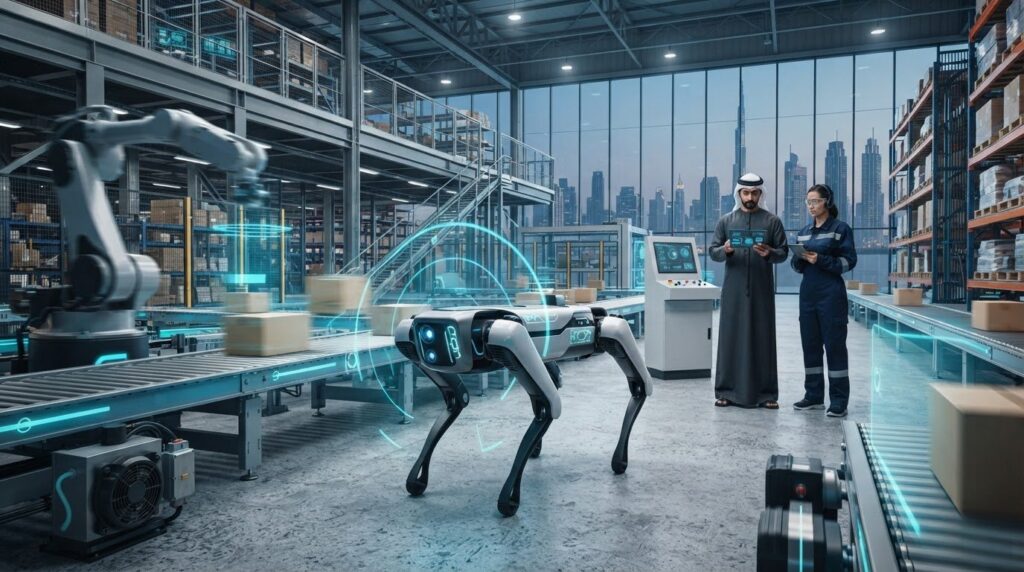
End-of-line packaging has historically been one of the most labour-intensive and error-prone stages of food and beverage production. Collaborative robots in the UAE are redefining that reality. Unlike traditional 6-axis industrial robots, which require physical guarding and fixed operational zones, cobots are engineered to work alongside human operators in shared spaces, responding to proximity in real time without stopping the line.
The practical implications for food and beverage automation UAE-wide are significant:
- Palletising operations benefit from cobots that handle repetitive high-cycle stacking tasks with consistent force and placement accuracy, reducing musculoskeletal injury risk for workers while maintaining throughput.
- Delicate product handling in bakery, fresh fruit, and confectionery applications is addressed through bespoke gripper integration, where soft-touch end-effectors are configured to match the specific fragility and geometry of each product category.
- Rapid changeover between SKUs is achievable through cobot programming interfaces that allow line supervisors to reconfigure pick-and-place parameters without specialist robotics engineers on-site.
The transition from rigid industrial automation to flexible cobot deployment also reduces the capital barrier for mid-sized UAE manufacturers who cannot justify the floor space or safety infrastructure that traditional robotic cells demand. It’s a practical shift, not just a technological one.
For operations leaders evaluating where to begin this transition, working with an integration partner who understands both the technical architecture and the regulatory environment specific to UAE food production is the difference between a controlled rollout and a costly reconfiguration. Explore EdNex Automation’s cobot and PLC integration capabilities to understand what a bespoke deployment looks like for your facility.
Ensuring Hygiene Standards through Autonomous Cleaning and Cobots
Production throughput means nothing if a contamination event shuts down your facility for 72 hours. In UAE food and beverage manufacturing, hygiene isn’t a background function — it’s a compliance-critical operation that runs parallel to every production shift, every day. The question facing operations leaders isn’t whether to automate sanitation; it’s how quickly they can transition from manual cleaning protocols that introduce variability to automated systems that eliminate it.
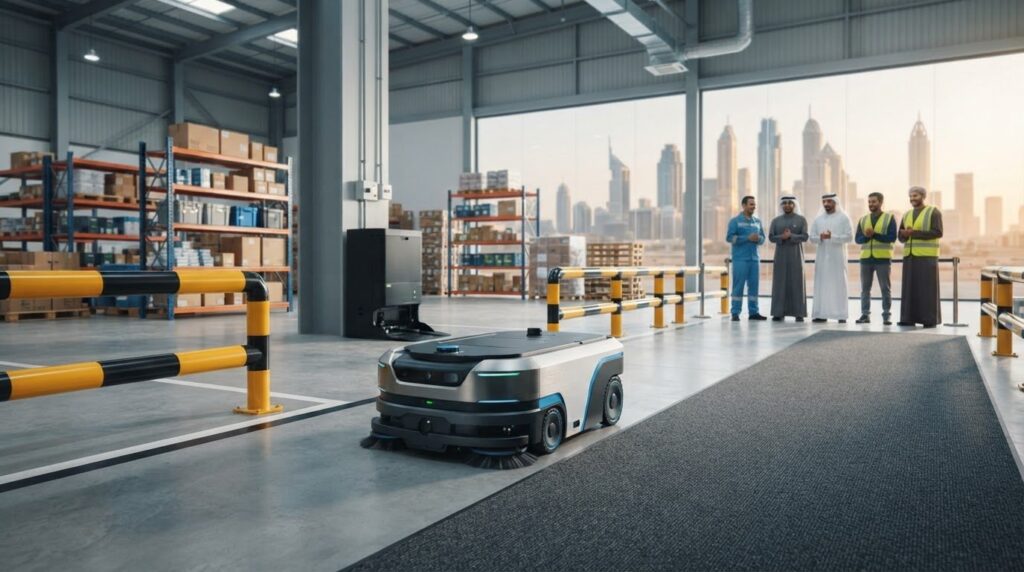
Autonomous cleaning robots represent a structural shift in how large-scale food facilities approach sanitation. Unlike scheduled manual cleaning crews, autonomous systems operate continuously, navigating processing halls, cold storage corridors, and packaging zones without interrupting production flow. They apply precisely calibrated volumes of cleaning agents to designated surface areas, removing the over-application and missed-zone inconsistencies that characterise human-led cleaning operations at scale.
Industrial Hygiene and Regulatory Compliance
Regulatory audits in UAE food manufacturing are increasingly documentation-intensive. Inspectors don’t simply observe conditions; they examine cleaning logs, cycle timestamps, and chemical concentration records. Automated sanitation systems generate this audit trail automatically, timestamping every cleaning cycle and logging parameters against pre-set compliance thresholds. That documentation layer removes the administrative burden from supervisors while producing a verifiable record that manual logbooks cannot match for accuracy or completeness.
Halal integrity introduces an additional compliance dimension that manual processes handle poorly. Where multiple product categories share production infrastructure, the risk of cross-contamination between halal and non-halal lines is a genuine regulatory exposure. Automated production line segregation, controlled through plant-wide PLC architectures, enforces physical and procedural separation without relying on operator vigilance at every changeover. In dairy and juice processing, where Grade A hygiene classifications are a baseline operating requirement, this level of automated control is the only reliable mechanism for sustaining certification across continuous multi-shift production.
Robotic Floor Scrubbers and Facility Maintenance
High-output processing plants face a specific operational tension: hygiene standards demand frequent, thorough cleaning, but stopping production lines to accommodate cleaning crews destroys throughput efficiency. Robotic floor scrubbers resolve this tension directly. Deploying autonomous units during active production shifts, these systems maintain continuous hygiene across facility floors without requiring production pauses, line shutdowns, or additional labour allocation.
Precision matters beyond compliance. Autonomous cleaning systems apply water and chemical agents according to surface-specific protocols, reducing consumption compared to manual methods where over-application is common. For food and beverage automation UAE operations pursuing ESG commitments, that reduction in water and chemical waste translates directly into measurable sustainability metrics that align with the UAE’s broader environmental targets for industrial facilities.
Integrating Clean-in-Place systems with plant-wide SCADA architectures extends this precision into processing equipment itself. CIP cycles triggered and monitored through centralised control platforms ensure that tanks, pipelines, and heat exchangers are cleaned to validated standards without manual intervention, closing the hygiene loop across both the facility environment and the processing infrastructure it contains.
Optimising Logistics: ASRS and AMRs in the Food Supply Chain
Production efficiency on the line means very little if the internal logistics surrounding it are fractured. Ingredients arriving late to processing stations, pallets queued in ambient corridors instead of temperature-controlled zones, warehouse staff navigating congested aisles during peak shifts — these aren’t minor inefficiencies. They’re structural vulnerabilities that compound across every production cycle. For food and beverage automation UAE operations targeting sovereign-grade output volumes, the warehouse floor and cold storage corridors demand the same level of intelligent automation as the processing line itself.
AMRs vs. Manual Material Handling
Autonomous mobile robots address the material handling problem at its root. Where forklifts require dedicated operators, fixed traffic lanes, and significant floor clearance, AMRs navigate dynamically, recalculating routes in real time as factory floor conditions change across multi-shift operations. They transport ingredients from goods-in to processing stations, move finished goods to staging areas, and integrate directly with Warehouse Management Systems to ensure that every movement is logged, sequenced, and aligned with production schedules.
The safety dividend is equally significant. Forklift incidents in high-density food manufacturing environments carry serious operational and regulatory consequences. AMRs eliminate that exposure by removing human-operated heavy vehicles from shared pedestrian zones entirely. In facilities running continuous shifts, that risk reduction isn’t theoretical — it’s a measurable improvement in both workforce safety and operational continuity.
ASRS for Cold Storage and Distribution
The UAE’s climate makes cold chain integrity a non-negotiable operational requirement. Manual pallet handling in chilled and frozen storage environments introduces two compounding problems: human exposure risk in extreme cold, and the repeated door-open cycles that degrade temperature consistency across the storage zone. Automated storage and retrieval systems resolve both simultaneously.
ASRS maximise vertical storage density, extracting significantly more usable capacity from the same footprint — a critical advantage in UAE industrial clusters where land costs are substantial. Automated cranes and shuttle systems retrieve specific pallets on demand without requiring human entry into the cold zone, maintaining thermal stability and reducing the energy load required to sustain target temperatures. The result is a storage environment that’s faster, safer, and materially more energy-efficient than manual alternatives.
| Operational Factor | Manual Pallet Handling | ASRS-Driven Logistics |
|---|---|---|
| Storage density | Limited by aisle clearance requirements | Maximised through full vertical utilisation |
| Temperature integrity | Compromised by frequent human entry | Maintained through minimal zone penetration |
| Retrieval accuracy | Subject to human error and mislocation | System-directed with WMS-verified precision |
| Traceability | Manual logging, prone to gaps | Automated serialisation from intake to dispatch |
| Labour dependency | High; shift-dependent throughput | Low; continuous operation without staffing constraints |
| Worker safety risk | Elevated in extreme cold environments | Eliminated through full automation of cold zones |
Traceability runs through every layer of this infrastructure. ASRS platforms log ingredient batch data from intake, tracking serialised units through storage, picking, and outbound dispatch. That end-to-end visibility satisfies the documentation requirements of halal certification audits and food safety inspections without generating additional administrative overhead. It’s the kind of integrated traceability that manual processes structurally cannot replicate at scale.
If your facility is evaluating how ASRS and AMR deployment maps to your specific cold storage configuration and production volumes, speak with EdNex Automation’s logistics integration specialists to develop a structured deployment roadmap.
Partnering for Progress: EdNex’s Comprehensive Automation Solutions
Selecting the right technology is only half the challenge. Deploying it correctly, within the specific regulatory, geographic, and operational context of UAE food and beverage manufacturing, is where most automation initiatives either succeed or stall. EdNex Automation’s role isn’t simply to supply robotics hardware; it’s to serve as the technical architect of your facility’s transformation, from the initial feasibility assessment through to live production deployment and ongoing operational support.
That distinction matters. A project photo on a competitor’s website tells you nothing about how a system was engineered, what integration challenges were resolved, or whether the solution was genuinely calibrated to the client’s production environment. EdNex operates as a strategic consultant first, building automation roadmaps that account for the UAE’s industrial cluster geography, MoIAT compliance requirements, and the specific throughput demands of food and beverage automation UAE operations targeting sovereign-grade output.
Start-to-Finish Technical Expertise
EdNex’s engagement model is structured around the full project lifecycle, not individual technology sales. The process begins with engineering-led feasibility studies that map existing production workflows against target performance outcomes, identifying where cobot deployment, PLC and SCADA integration, ASRS configuration, or AMR routing will generate the highest operational return. From there, EdNex’s technical team handles PLC programming, robotic cell design, and system commissioning as an integrated sequence rather than a series of disconnected vendor handoffs.
Post-deployment, local support infrastructure ensures that critical production systems aren’t dependent on international response timelines. For food and beverage facilities running continuous multi-shift operations, that regional maintenance capability is the difference between a minor adjustment and an extended unplanned shutdown. Long-term ROI is protected through systematic performance monitoring and iterative optimisation, not left to chance after installation day.
EdNex’s confirmed capabilities span the full technology stack relevant to UAE food manufacturing:
- Collaborative robots and industrial cobots for packaging, palletising, and delicate product handling
- PLC and SCADA integration for process control, batch management, and predictive maintenance
- ASRS and AMR deployment for cold chain logistics and internal material flow
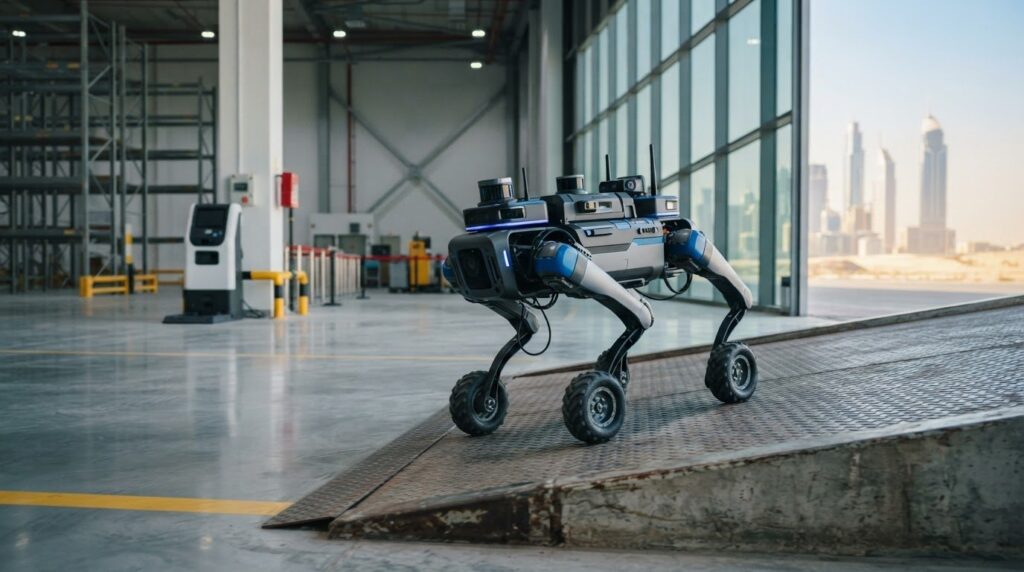
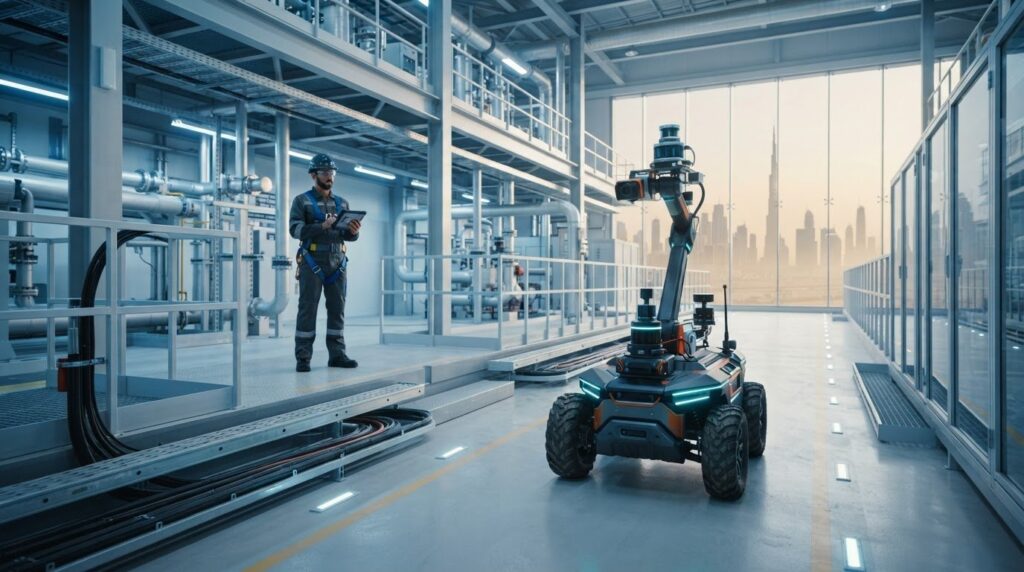
- Autonomous cleaning, inspection, and surveillance robots for hygiene compliance and facility security
The Vision for 2026 and Beyond
The next phase of food and beverage automation UAE-wide will be defined by AI-driven predictive analytics embedded directly into production control platforms, enabling facilities to anticipate equipment failures, demand fluctuations, and supply chain disruptions before they affect output. Humanoid robots, currently transitioning from controlled pilots to broader industrial deployment, will extend automation into unstructured environments where fixed robotic cells can’t reach. Advanced surveillance robots will further enhance facility safety, providing real-time monitoring across large processing and warehousing footprints without expanding headcount.
Beyond the production line, integrating comprehensive business automation through providers like Rocatech ensures that the entire facility—from the administrative offices to the secure entry points—operates with the same level of smart efficiency as the factory floor.
Facilities that build scalable, modular automation infrastructure now will absorb these advances without wholesale system replacement. Those that don’t will face compounding retrofit costs as the technology gap widens.
Contact EdNex Automation for a bespoke consultation on your F&B facility’s modernisation and establish the engineering foundation your operation needs for the decade ahead.
The Window for Strategic Advantage Is Open — Act on It
Food and beverage automation UAE-wide has reached an inflection point where delay carries a measurable cost. Facilities that align their production infrastructure with the UAE’s sovereign manufacturing agenda now will operate from a position of structural strength as policy requirements tighten and competitive pressure intensifies through 2026 and beyond.
Three realities define where this sector is heading. First, compliance demands across halal certification, cold chain integrity, and traceability will only grow more rigorous. Second, the facilities closing the gap between legacy operations and Industry 4.0 standards are doing so through integrated deployment, not piecemeal technology purchases. Third, the right integration partner determines whether that transition delivers its projected returns or stalls at the commissioning stage.
As a specialized Industry 4.0 division of the EdNex group, EdNex Automation brings comprehensive PLC and SCADA integration expertise alongside nationwide UAE support for advanced robotics and ASRS, covering the full technical stack your facility needs to compete at the level this market demands.
Future-proof your production with EdNex Automation’s bespoke Industry 4.0 solutions and build the operational foundation your facility needs for the decade ahead.
Frequently Asked Questions
What are the primary benefits of food and beverage automation in the UAE?
Food and beverage automation UAE-wide delivers four core operational advantages: consistent production throughput regardless of workforce availability, zero-error precision in compliance-critical processes like halal certification and traceability, reduced spoilage through automated cold chain management, and lower long-term labour dependency across high-cycle repetitive tasks. These aren’t incremental gains; they’re structural improvements that directly address the vulnerabilities built into manual production models.
Beyond the production floor, automation aligns facilities with MoIAT’s smart manufacturing standards under Operation 300bn, positioning manufacturers to access technology adoption incentives and operate within designated food manufacturing zones where smart factory compliance is increasingly a prerequisite rather than an option.
How does PLC and SCADA integration improve food safety?
PLC and SCADA integration improves food safety by replacing after-the-fact data logging with real-time process monitoring, enabling operators to catch temperature, pressure, or flow deviations before they compromise a batch. In UHT and pasteurisation lines specifically, that live visibility is the difference between a corrected process parameter and a full batch rejection.
The compliance dimension is equally important. SCADA platforms generate automated audit trails that log every process variable against validated thresholds, producing documentation that regulatory inspections require without creating additional administrative work for supervisors. ISA-88 batch control standards implemented within PLC architecture further ensure that recipes are consistent, auditable, and protected from the inconsistencies that manual processes introduce.
What is the role of collaborative robots (cobots) in food packaging?
Cobots handle the repetitive, physically demanding packaging tasks that drive high injury rates and labour turnover in conventional production environments, including palletising, pick-and-place operations, and delicate product handling in bakery or fresh produce lines. Unlike traditional industrial robots, they operate alongside human workers in shared spaces without requiring fixed guarding or dedicated safety zones, which makes deployment practical for mid-sized facilities with space constraints.
Their programming flexibility is particularly valuable for UAE manufacturers managing multiple SKUs. Line supervisors can reconfigure pick-and-place parameters between product changeovers without specialist engineers on-site, reducing downtime between production runs and protecting throughput across varied product categories.
How can ASRS systems help manage cold storage costs in the UAE?
ASRS systems reduce cold storage operating costs primarily through two mechanisms: maximising vertical storage density to extract more usable capacity from the same footprint, and minimising the door-open cycles that degrade temperature consistency and increase energy consumption. Automated cranes and shuttle systems retrieve pallets on demand without requiring human entry into the cold zone, sustaining thermal stability more reliably than manual handling allows.
In a market where industrial land costs are substantial and energy expenditure in refrigerated environments is significant, those efficiency gains translate into measurable cost reduction per pallet stored. The additional benefit is worker safety; removing personnel from extreme cold environments eliminates a category of operational risk that manual cold storage handling routinely creates.
Are autonomous cleaning robots compliant with UAE industrial hygiene standards?
Autonomous cleaning robots are designed to support compliance with industrial hygiene standards by applying precisely calibrated volumes of cleaning agents to designated surface areas and generating timestamped cycle logs that document every cleaning event against pre-set compliance thresholds. That automated audit trail addresses the documentation requirements that UAE food manufacturing inspections increasingly demand, replacing manual logbooks that are inherently prone to gaps and inconsistencies.
Facilities considering deployment should confirm that specific robot models and cleaning protocols are validated against their applicable certifications, whether Grade A dairy classifications, halal compliance requirements, or sector-specific hygiene codes. EdNex Automation’s integration approach accounts for these regulatory parameters during the system design phase rather than treating them as a post-deployment consideration.
What is the typical ROI for implementing AMRs in a food processing plant?
ROI timelines for AMR deployments vary based on facility scale, shift patterns, and the volume of material movements being automated, so it’s not accurate to quote a universal figure without a site-specific assessment. The measurable return drivers are consistent across deployments: reduced labour costs in material handling roles, elimination of forklift-related incident costs, improved production line continuity through reliable ingredient delivery sequencing, and WMS integration that removes the administrative overhead of manual inventory tracking.
Facilities running continuous multi-shift operations typically see faster payback periods because AMRs generate return across every operational hour rather than a single shift. An engineering-led feasibility study, structured around your specific production volumes and floor configuration, is the most reliable way to project realistic ROI before committing capital.
How does automation support the UAE National Food Security Strategy?
The UAE National Food Security Strategy targets reduced import dependency by expanding domestic processing capacity, and automation is the mechanism that makes high-throughput sovereign production viable at scale. Automated production lines maintain consistent output regardless of seasonal labour availability or external supply chain disruptions, directly addressing the structural vulnerabilities that have historically limited domestic food processing capacity.
Food and beverage automation UAE-wide also strengthens the traceability and quality control infrastructure that sovereign manufacturing requires. Facilities capable of demonstrating verifiable, documented compliance with halal standards, cold chain protocols, and batch integrity requirements are better positioned to supply national food security stockpiles and distribution networks where those standards are non-negotiable.
Can EdNex Automation integrate new robots with my existing legacy systems?
EdNex Automation’s engagement model is built around the reality that most UAE food and beverage facilities aren’t starting from a blank slate; they have existing PLC architectures, production control systems, and warehouse infrastructure that new automation must work within rather than replace wholesale. The integration process begins with an engineering-led assessment that maps current system capabilities against target performance outcomes, identifying where new robotics, SCADA enhancements, or AMR routing can be layered onto existing infrastructure without requiring full system replacement.
As a specialised Industry 4.0 division of the EdNex group, the technical team handles PLC programming, robotic cell design, and system commissioning as a coordinated sequence, with nationwide UAE support infrastructure ensuring that live production systems aren’t dependent on international response timelines once deployed. Contact EdNex Automation to discuss the specific legacy integration requirements of your facility.