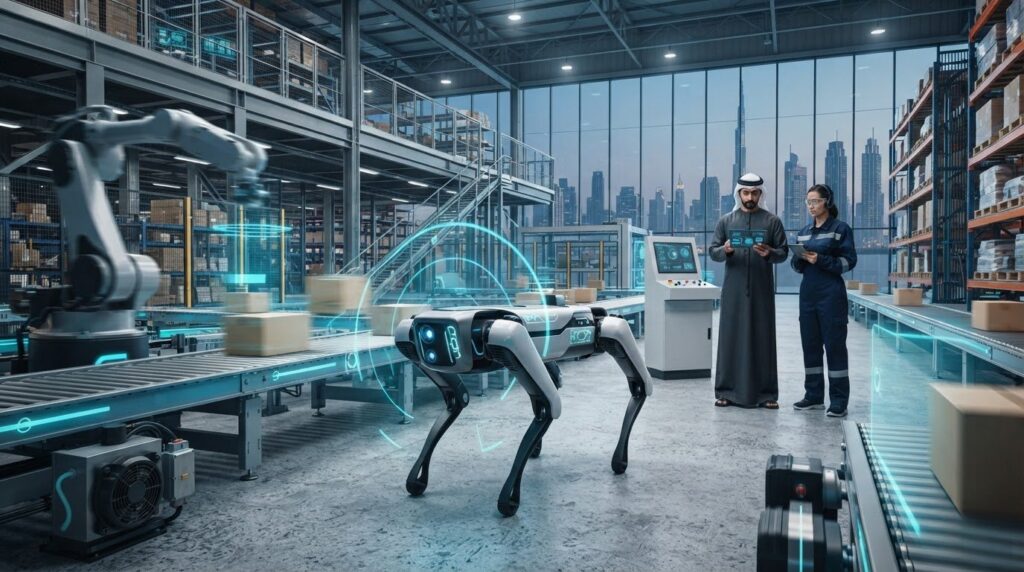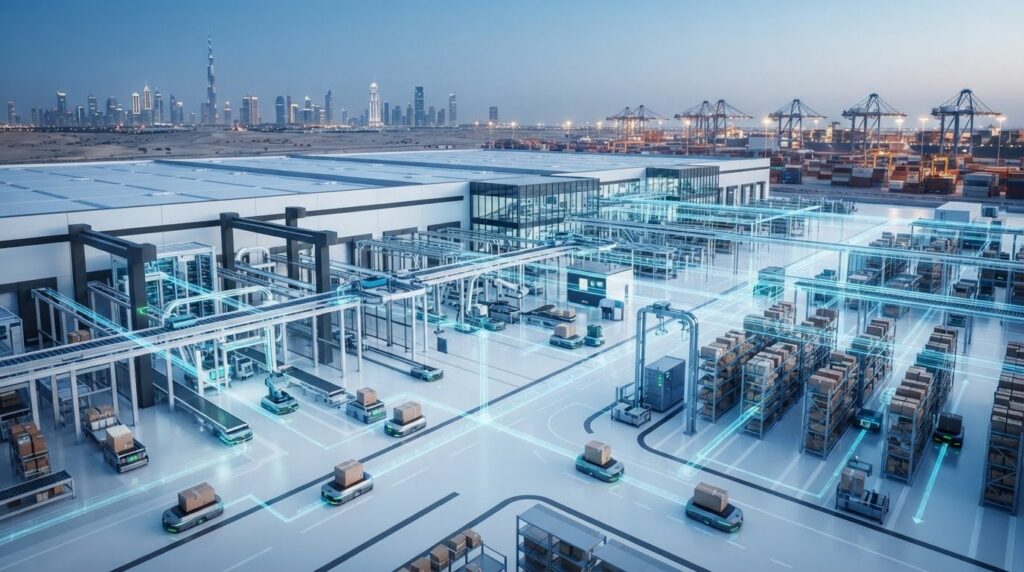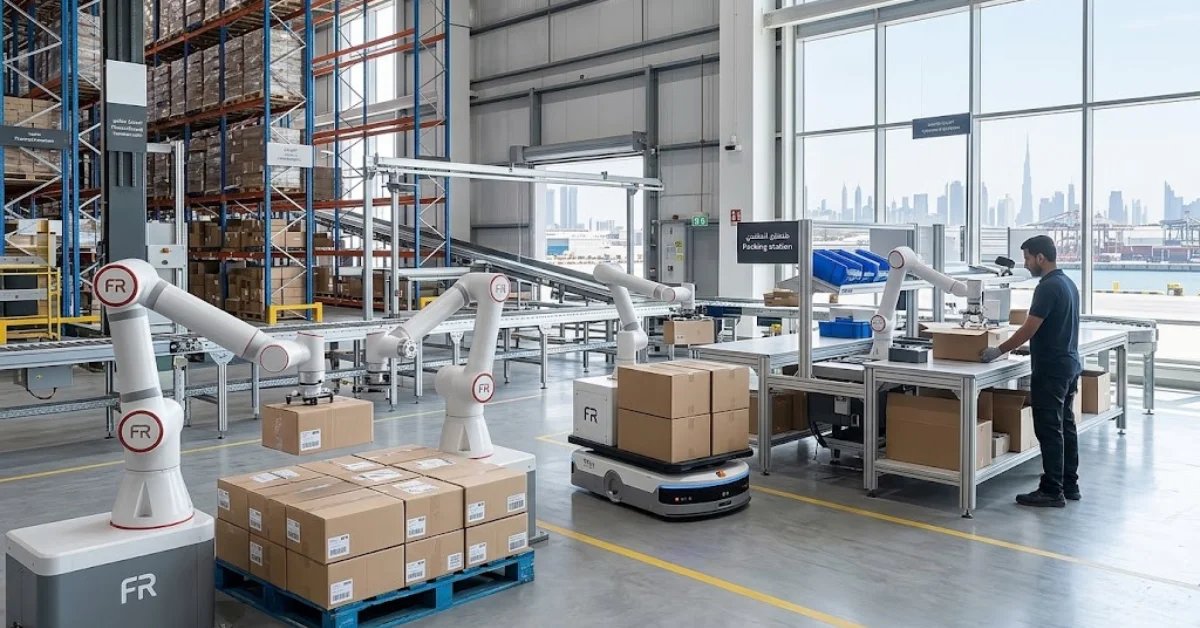
The era of manual-heavy logistics across the Emirates has reached its conclusion, replaced by a mandate for total technological integration. Adopting sophisticated cobot applications in UAE logistics is now the primary strategy for enterprises seeking to mitigate the risks of high labor turnover in high-heat environments and inconsistent throughput during peak seasons. You likely recognize that maintaining a competitive edge requires more than just incremental changes; it demands a fundamental restructuring of how human intelligence and robotic precision coexist on the warehouse floor.
Positioning your organization at the forefront of this transformation, this strategic roadmap reveals how collaborative robots deliver higher palletizing speeds and reduced workplace injuries through intelligent, high-precision kitting. It’s our goal to provide the intellectual framework necessary to achieve seamless integration with existing WMS and PLC systems, ensuring your infrastructure remains agile despite significant space constraints. This article explores the specific technological applications and bespoke integration strategies that define the next era of regional industrial excellence as we approach the 2026 automation milestones.
Key Takeaways
- Evaluating the transition to Industry 4.0, this roadmap outlines how national productivity mandates are accelerating the adoption of collaborative systems in regional supply chains.
- Identifying high-value cobot applications in UAE logistics provides the technical foundation for automating end-of-line palletizing and precision e-commerce kitting.
- Synchronizing robotic arms with AMRs and ASRS creates a dynamic, mobile infrastructure that optimizes existing warehouse footprints through high-level autonomy.
- Navigating technical implementation requires a structured approach to end-of-arm tooling design and strict adherence to ISO 10218 and ISO/TS 15066 safety standards.
- Leveraging bespoke engineering and PLC/SCADA integration facilitates a unified industrial architecture that ensures long-term scalability and operational reliability.
The Strategic Shift: Collaborative Robotics in the UAE Logistics Landscape
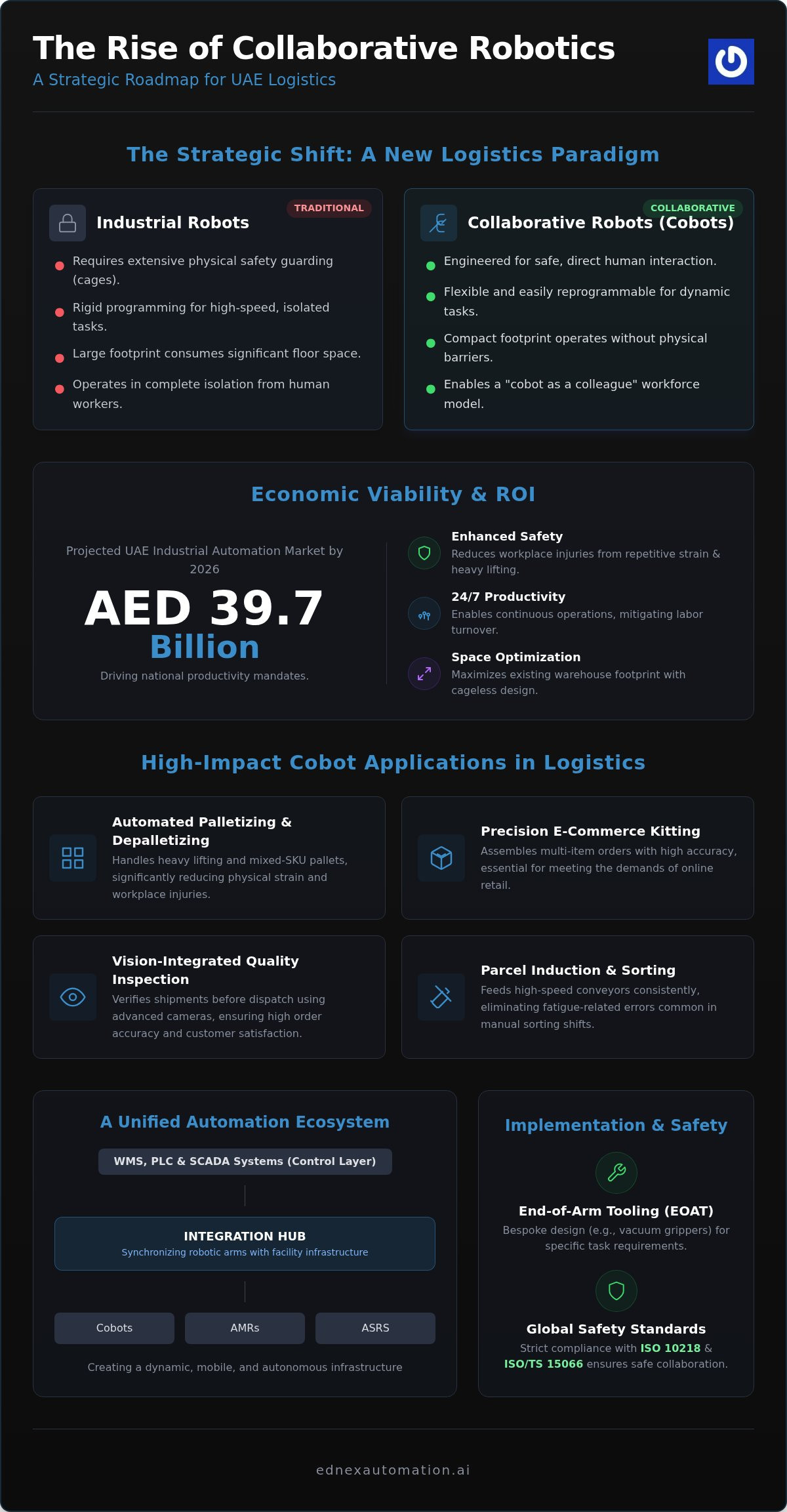
Representing a distinct evolution in industrial automation, collaborative robots function as power- and force-limited systems engineered for safe, direct interaction with human operators. Unlike traditional industrial robots that require extensive guarding, collaborative robotics utilize advanced sensors and software to detect human proximity, allowing for a shared workspace without physical barriers. This shift is critical as we approach the 2026 industrial milestones, where national productivity goals in the UAE necessitate a departure from manual-heavy operations toward tech-driven efficiency.
High-throughput e-commerce and 3PL demands across the country have created a bottleneck that traditional automation cannot solve due to space constraints and rigid programming. Integrating cobot applications in UAE logistics allows facilities to maintain a compact footprint while gaining the flexibility needed for dynamic warehouse environments. While conventional robots excel in high-speed, isolated tasks, cobots offer the agility to pivot between kitting, sorting, and palletizing as daily requirements shift.
Human-Robot Collaboration: A New Logistics Paradigm
Human-Robot Collaboration: A New Logistics Paradigm
Reducing operational expenditure (OPEX) by enabling 24/7 logistics cycles, cobots eliminate the overhead associated with manual shifts in high-heat environments. Collaborative ROI is the strategic intersection of safety, speed, and floor-space optimization. Providing a scalable entry point for small-to-medium enterprises (SMEs) across the UAE, these systems offer a lower total cost of ownership compared to fixed robotic cells. Optimizing cobot applications in UAE logistics ensures that even smaller players remain competitive within an industrial automation market projected to exceed AED 39.7 billion by the end of 2026.
High-Impact Applications: Where Cobots Drive Efficiency in UAE Warehouses
Identifying specific high-impact cobot applications in UAE logistics is essential for facilities transitioning from manual sorting to autonomous throughput. While the strategic shift toward automation is well underway, the actual deployment focuses on high-precision tasks that were previously labor-intensive. End-of-line palletizing represents one of the most significant opportunities for ROI, as it automates the heavy lifting required for national distribution networks. By utilizing vision-integrated cobots for quality inspection, logistics providers can verify shipments before dispatch, ensuring that order accuracy remains high even during peak e-commerce seasons.
Parcel induction and sorting tasks now benefit from robotic precision, feeding high-speed conveyors without the fatigue-related errors common in manual shifts. These systems address the technical, safety, and human factors involved in modern warehouse design. It’s not just about speed; it’s about creating a consistent, error-free flow of goods that can scale with demand.
Automated Palletizing and Depalletizing
Modern retail logistics demand the ability to handle mixed-SKU pallets where payload variations are the norm. Cobots equipped with sophisticated vacuum grippers and specialized end-effectors manage varied packaging types, from corrugated boxes to shrink-wrapped bundles, with ease. This automation directly correlates with a reduction in workplace injuries, particularly those associated with heavy lifting and repetitive motion. By removing human operators from these physically demanding roles, companies can reallocate their workforce to more strategic supervisory positions.
Precision Kitting and Order Consolidation
High-density fulfillment centers utilize cobots for promotional kitting and order consolidation to meet rapid delivery windows. Deploying these specific cobot applications in UAE logistics allows robotic arms to interact with automated storage and retrieval systems, mirroring results seen by industry leaders who have achieved up to a 30% reduction in order processing time through robotic picking. This integration significantly reduces ‘dead-time’ in the order cycle, allowing for continuous operation that isn’t tethered to human shift changes. If you’re looking to optimize your facility’s throughput, exploring tailored robotics solutions can provide the necessary technical edge.
The Automation Ecosystem: Synchronizing Cobots with AMR and ASRS Infrastructure
Achieving true industrial autonomy requires more than isolated robotic cells; it demands a synchronized ecosystem where disparate technologies communicate in real-time. Central to this evolution is the ‘Mobile Cobot’ concept, which involves mounting high-precision robotic arms on autonomous mobile robots to facilitate dynamic warehouse navigation. This hybrid configuration allows the system to move fluidly between workstations, effectively extending the reach of traditional cobot applications in UAE logistics beyond the limitations of fixed pedestals.
Utilizing AMRs to transport goods directly to cobot-led palletizing zones, facilities eliminate the manual transit times that frequently stall production. This synergy ensures that the robotic arm is consistently fed with materials, maintaining a steady throughput that’s independent of human intervention. Implementing a unified control layer through PLC and SCADA integration is vital here, as it prevents bottlenecks by orchestrating the movement of AMRs and the task-execution of cobots within a single, cohesive industrial framework.
Cobots and AMRs: The Mobile Manipulation Advantage
Eliminating the need for rigid, fixed conveyors, mobile cobots provide a level of flexibility that’s essential for modern, modular warehouse layouts. Advanced navigation technology enables these units to position themselves with millimeter precision at various induction points, allowing for rapid reconfiguration during seasonal logistics peaks. This ‘on-demand’ automation model ensures that capital equipment isn’t sitting idle but is instead deployed where the immediate workload is highest, maximizing the utility of every robotic asset in the fleet.
ASRS Integration for High-Density Fulfillment
Maximizing vertical space is a priority for regional facilities facing land constraints, making the hand-off between high-speed ASRS retrievers and collaborative picking arms a critical operational link. As the ASRS brings bins to the pick-face, the cobot utilizes vision-integrated sensors to identify and pick specific items for order consolidation. This process supports the national push for ‘Smart Warehousing’ by creating a closed-loop system where data synchronization between the ASRS controller and the cobot’s vision system ensures total order accuracy. It’s this level of technical cohesion that transforms a standard facility into a future-proofed logistics hub capable of handling the most complex cobot applications in UAE logistics.
Navigating the Integration: Safety Standards and Technical Implementation
Successful deployment of cobot applications in UAE logistics requires a methodical engineering approach that prioritizes both mechanical precision and human safety. Transitioning from a theoretical design to a live warehouse environment demands a structured five-step implementation framework. This process begins with a comprehensive risk assessment based on ISO 10218 and ISO/TS 15066 standards, ensuring every human-robot interaction point is quantified and mitigated. Following this, engineers must design the mechanical interface and end-of-arm tooling (EOAT) specifically tailored for the facility’s unique logistics tasks, such as vacuum gripping for porous surfaces or mechanical clamping for heavy-duty kitting.
Integrating the cobot controller with existing PLC and SCADA integration services ensures the new unit operates in harmony with the broader facility. Once the digital handshake is established, the implementation of safety sensors and area scanners allows for dynamic human-robot proximity management, where the robot automatically adjusts its speed based on operator distance. The final phase involves rigorous pilot testing and workforce training to ensure that operational handovers are seamless and that supervisors can manage the systems with total confidence.
Data Connectivity: PLC and SCADA Integration
Real-time data visualization through SCADA is essential for monitoring cobot performance and identifying throughput bottlenecks before they impact the supply chain. PLC programming ensures synchronized motion between cobots and peripheral conveyors, preventing the mechanical collisions that lead to costly downtime. Utilizing edge computing reduces latency for vision-guided cobot tasks, allowing the robotic arm to process visual data and make picking decisions in milliseconds. This technical cohesion is what separates a basic robotic arm from a truly intelligent, integrated logistics asset.
Adhering to National Safety Protocols
Meeting the critical safety requirements for collaborative workspaces in the UAE industrial sector involves a deep understanding of specific operational modes. Engineers must distinguish between ‘safety-rated monitored stop’ modes, where the robot halts completely during human entry, and ‘power and force limiting’ modes, where the robot continues to work at a safe, reduced speed. Safety-First Automation is the non-negotiable foundation of modern logistics. Adhering to these national protocols ensures long-term business viability and protects the organization’s most valuable asset: its people. To achieve this level of technical excellence, enterprises should partner with a certified automation consultant who can manage the entire integration lifecycle.
Future-Proofing UAE Supply Chains with EdNex Automation
Acting as the primary architect for industrial modernization, EdNex Automation serves as the strategic integrator for collaborative robots in the UAE. We provide more than hardware; we deliver the intellectual framework required to align robotic deployment with specific logistics KPIs, such as cycle time reduction and floor-space utilization. Implementing modular cobot applications in UAE logistics ensures that your automation journey isn’t a static purchase but an evolving asset that scales alongside your business growth. These systems are designed for portability and rapid redeployment, allowing your facility to adapt to shifting market demands without requiring a total infrastructure overhaul.
Providing national coverage with enterprise-grade reliability, our specialized division offers the local technical support and certified expertise necessary to maintain 24/7 operational continuity. This regional presence is vital for minimizing downtime and ensuring that complex cobot applications in UAE logistics remain optimized for the unique environmental and economic demands of the territory. By acting as a grounded technical partner, we bridge the gap between global technological breakthroughs and regional industrial needs through controlled and deliberate innovation.
Bespoke Integration and Technical Consulting
Transitioning from manual sorting to cobot-assisted logistics requires a partner who understands the nuances of both hardware and control software. Our methodology focuses on a comprehensive ‘start-to-finish’ approach, managing everything from initial mechanical design to the final SCADA integration. This high-level oversight eliminates the integration gaps that often plague multi-vendor projects and ensures a unified industrial architecture. Stakeholders are invited to explore the ROI potential of customized robotic workcells designed to solve specific throughput challenges. By analyzing your current workflows through the lens of Industry 4.0, we can identify exactly where robotic precision will yield the highest impact for your 3PL or e-commerce operations.
Preparing for the Next Wave: AI and Humanoid Synergy
Anticipating the rapid convergence of physical robotics and advanced intelligence, AI-enhanced cobots are set to handle increasingly complex logistics tasks involving non-uniform items and unpredictable sorting environments. This evolution will eventually see humanoid robots assisting cobot-led fulfillment lines, providing a level of dexterity and mobility previously reserved for human operators. We remain committed to maintaining the UAE’s position as a global logistics leader through continuous innovation and the early adoption of these transformative technologies. Ensuring your facility is ready for this humanoid synergy is the final step in a truly future-proofed automation strategy, positioning your brand at the absolute cutting edge of the global supply chain.
Mastering the Next Frontier of Industrial Autonomy
Embracing the shift toward a fully integrated supply chain requires moving beyond isolated hardware toward a unified, intelligent ecosystem. Implementing sophisticated cobot applications in UAE logistics provides the technical agility necessary to overcome labor inconsistencies and space constraints while maintaining a compact operational footprint. By synchronizing robotic precision with AMRs and high-density ASRS infrastructure, enterprises secure a competitive advantage that scales alongside national economic growth.
As an Authorized Gold Partner of leading global robotics brands, EdNex Automation provides the intellectual framework and technical expertise required for this large-scale transformation. Our specialized Industry 4.0 division focuses on delivering expert PLC and SCADA integration, ensuring that every robotic deployment contributes to a seamless industrial control layer. We don’t just provide tools; we act as a grounded partner in your journey toward total operational modernization and long-term business viability. The path to a more efficient, safer, and highly autonomous warehouse begins with a commitment to deliberate and systematic innovation.
Optimize your logistics workflow with EdNex Automation’s cobot solutions and lead the transition to a future-proofed industrial landscape today.
Frequently Asked Questions
What are the primary benefits of using cobots in UAE logistics?
The primary benefits include stabilized throughput during peak e-commerce seasons and the elimination of labor turnover risks in high-heat warehouse environments. By deploying cobot applications in UAE logistics, facilities achieve higher palletizing speeds while reducing workplace injuries associated with repetitive heavy lifting. These systems also offer a compact footprint compared to traditional robotic cells, allowing for increased storage density without requiring facility expansion or structural modifications.
Is a cobot safe enough to work alongside my warehouse staff without fencing?
Collaborative robots are specifically engineered with power and force-limiting technology that allows for safe human proximity without physical safety cages. Adherence to ISO 10218 and ISO/TS 15066 standards ensures that these systems detect contact and stop immediately to prevent injury. However, a comprehensive risk assessment of the entire workcell, including the end-effector and the objects being handled, is mandatory to certify the workspace as safe for fence-free operation.
Can cobots be integrated with my existing Warehouse Management System (WMS)?
Seamless integration with existing Warehouse Management Systems is achieved through a unified industrial control layer utilizing PLC and SCADA protocols. This connectivity allows the cobot to receive real-time picking orders and update inventory levels instantly upon task completion. By establishing a digital handshake between the robotics controller and the WMS, enterprises eliminate data silos and ensure that every automated movement is synchronized with broader supply chain requirements.
What payload capacities are typically available for logistics cobots?
Logistics-focused collaborative robots typically offer payload capacities ranging from 3kg for high-speed kitting to 30kg for heavy-duty end-of-line palletizing. While earlier models were limited to lighter tasks, 2026-era engineering has expanded these capabilities to handle bulkier goods without sacrificing safety or precision. Selecting the correct payload capacity depends on the specific weight of the SKUs and the mechanical requirements of the specialized end-of-arm tooling used in the application.
How do cobots handle different types of packaging, such as shrink-wrapped trays or fragile boxes?
Handling diverse packaging types requires the integration of specialized end-of-arm tooling, such as soft-touch vacuum grippers or adaptive mechanical fingers. These components allow cobot applications in UAE logistics to transition seamlessly between fragile electronics and shrink-wrapped beverage trays. Advanced vision systems further enhance this capability by identifying the orientation and material type of each parcel, adjusting the robot’s grip force in real-time to prevent product damage during the palletizing process.
What is the expected ROI period for a cobot installation in a UAE logistics facility?
While individual results vary based on shift volume, most logistics facilities in the region report an expected ROI period of 12 to 24 months. This calculation accounts for reduced operational expenditure, minimized downtime, and the elimination of recruitment costs for high-turnover manual roles. Because these systems are modular and easily redeployed, the long-term value increases as the hardware is adapted to new tasks, ensuring business viability across multiple growth cycles.
Do I need specialized robotic engineers to operate cobots daily?
Daily operation does not require a resident team of robotic engineers thanks to intuitive, no-code programming interfaces and hand-guiding features. Existing warehouse staff can be trained to supervise these systems and perform basic task reconfigurations in just a few days. While the initial setup and SCADA integration require certified technical expertise, the goal of modern collaborative robotics is to empower the current workforce to manage sophisticated automation with minimal technical friction.
How does the UAE’s climate affect the operation of collaborative robots in warehouses?
Modern collaborative robots are designed with high-grade industrial components that maintain peak performance in the elevated temperatures common in regional facilities. Unlike human labor, these systems operate consistently in high-heat environments without requiring frequent breaks or air-conditioned zones. However, maintaining proper ventilation around the control cabinets and adhering to scheduled maintenance cycles ensures that sensitive electronics remain protected from dust and thermal stress, guaranteeing enterprise-grade reliability throughout the year.