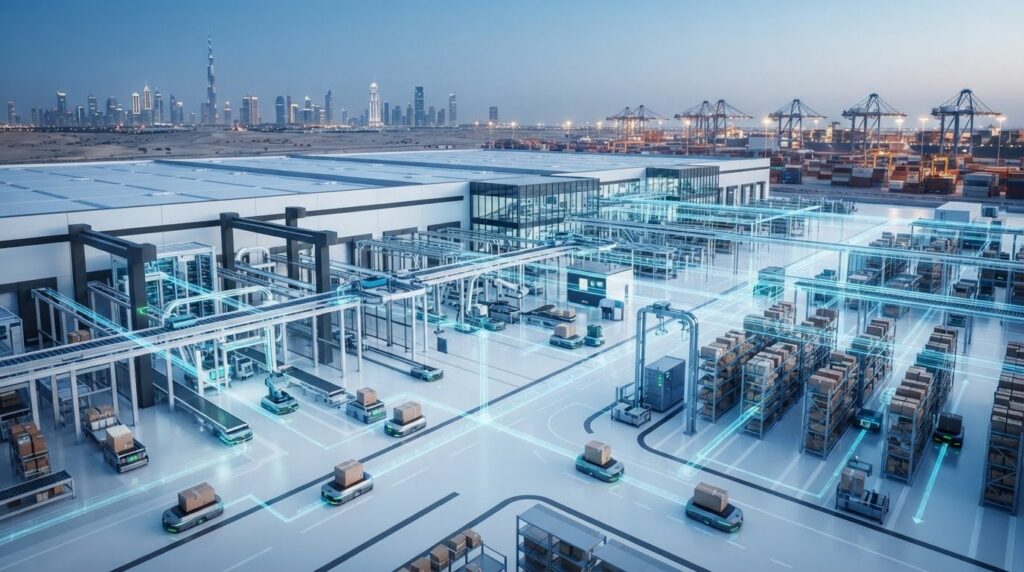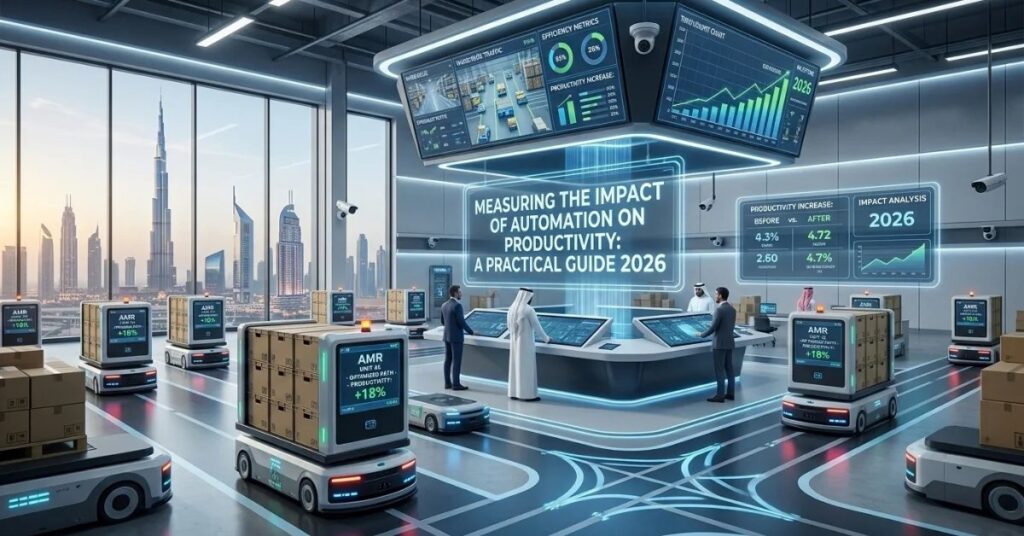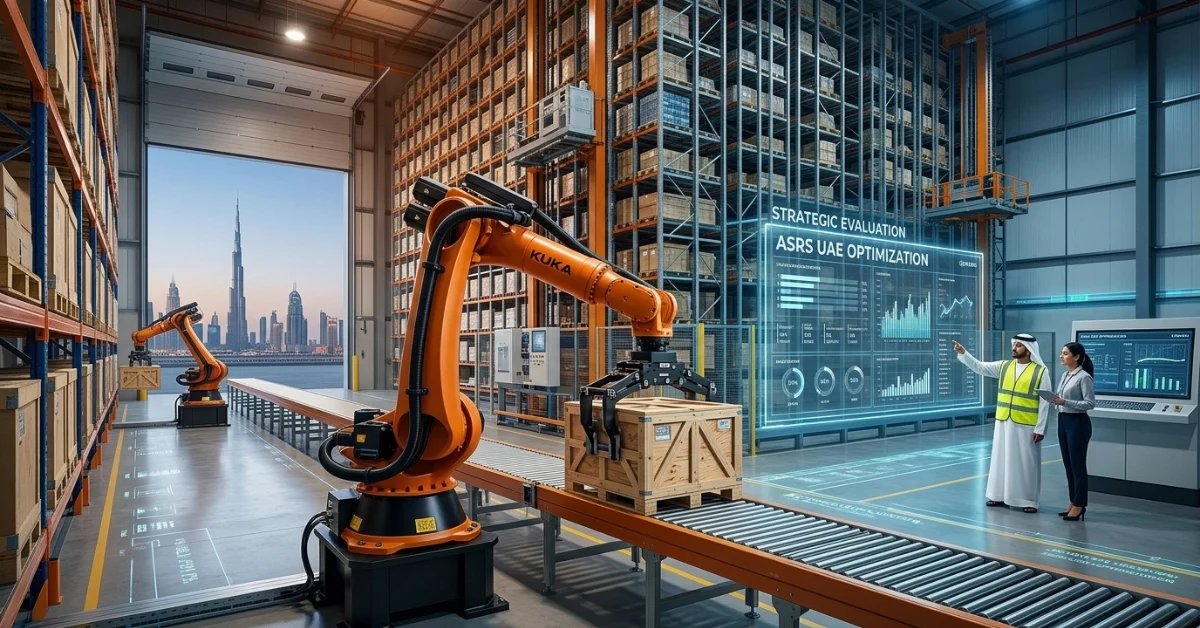
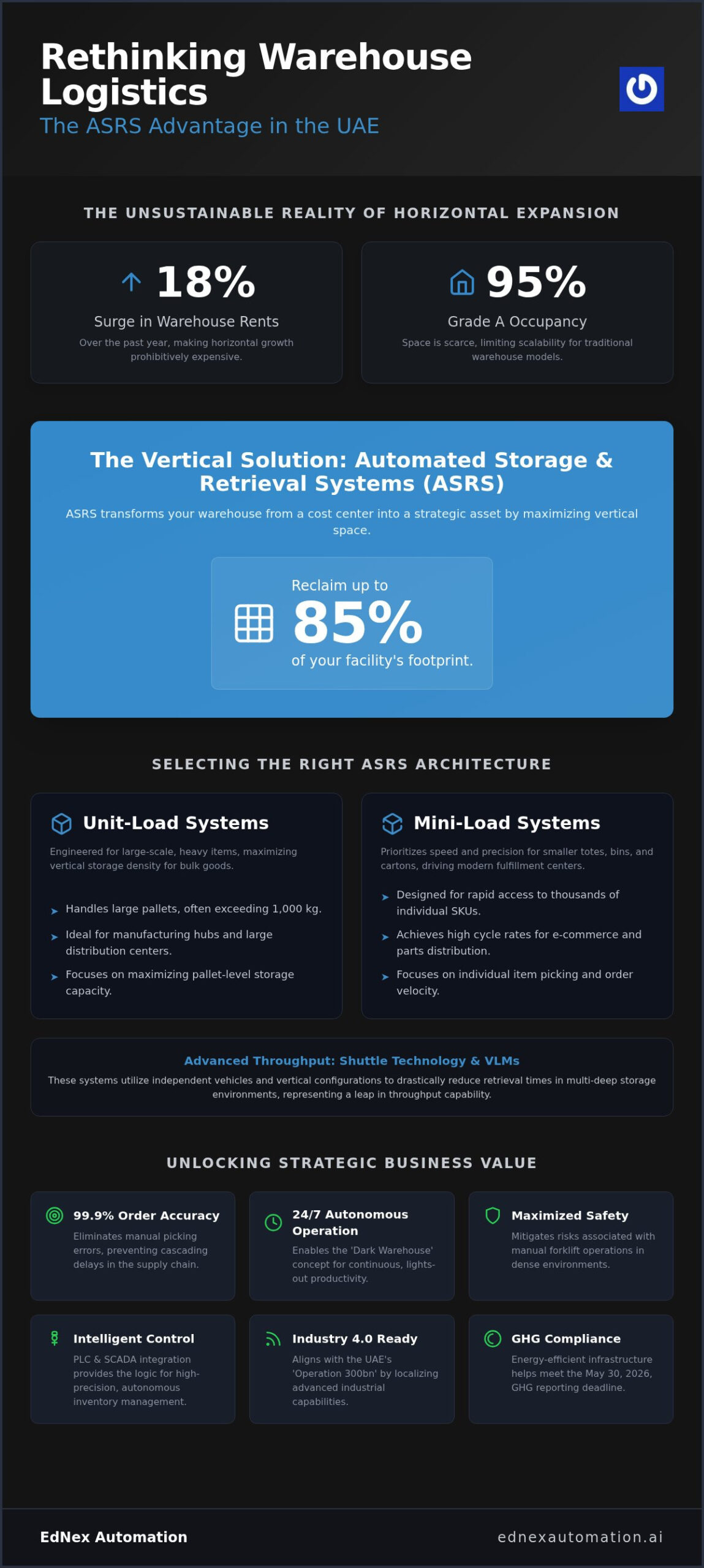
Facing warehouse rents that have surged by 18% over the past year and Grade A occupancy levels reaching 95%, industrial leaders now recognize that horizontal expansion is no longer a sustainable strategy for growth. You’ve likely encountered the operational friction caused by manual picking errors and the increasing difficulty of retaining skilled warehouse personnel in a tightening market. Integrating a sophisticated automated storage and retrieval system UAE provides the technical framework necessary to reclaim vertical space, effectively mitigating the risks associated with skyrocketing real estate costs and labor scarcity.
Achieving long term business viability in this climate demands a transition toward energy-efficient, autonomous infrastructure that prioritizes precision and speed. This guide details how ASRS technology optimizes operational throughput while ensuring compliance with the May 30, 2026, GHG reporting deadline for Scope 1 and Scope 2 emissions. By examining the synergy between high-density storage, AI-driven inventory management, and intelligent control systems, we provide the roadmap for building a resilient, Industry 4.0-ready logistics ecosystem that thrives under the UAE’s unique economic pressures.
Key Takeaways
- Leverage vertical density to combat rising real estate costs, reclaiming up to 85% of your facility’s footprint through high-density storage solutions.
- Identify the ideal automated storage and retrieval system UAE configuration by matching specific hardware architectures to your unique load profiles and throughput requirements.
- Recognize the critical role of PLC and SCADA integration in providing the intelligent control logic required for autonomous, high-precision operations.
- Enhance long-term business viability by transitioning from manual picking to a systematic, digital framework that eliminates inventory errors and maximizes safety.
- Understand the strategic advantage of a consultancy-led implementation that bridges the gap between global technological breakthroughs and regional industrial needs.
The Evolution of Automated Storage and Retrieval Systems in the UAE
Positioned at the vanguard of global logistics, the United Arab Emirates is undergoing a structural transition toward total industrial autonomy. Integrating Automated Storage and Retrieval Systems (ASRS) into the industrial core allows for the precise handling, storage, and retrieval of materials through a synchronized combination of robotic equipment and control logic. It’s no longer sufficient to view storage as a static function; it must be an active, intelligent component of the supply chain. An automated storage and retrieval system UAE represents the intersection of high-density hardware and intelligent software orchestration.
In the 2026 economic climate, where warehouse rents have surged by 18% and occupancy for Grade A facilities has reached 95%, vertical density has shifted from a luxury to a non-negotiable operational requirement. Aligning with the national ‘Operation 300bn’ strategy, these systems foster technological self-reliance by localizing advanced industrial capabilities within the region. By transitioning to these automated frameworks, businesses don’t just save space; they establish the intellectual infrastructure necessary for long-term scalability.
Why Manual Warehousing is No Longer Sustainable
Traditional racking configurations impose a hard ceiling on operational throughput because they rely on the physical speed and consistency of human operators. Navigating dense aisles with manual forklifts introduces significant safety risks, particularly when attempting to maintain high-speed cycles in facilities operating near capacity. Human error remains a primary driver of supply chain friction. In 2026, even minor picking inaccuracies lead to cascading delays across the region’s interconnected trade networks, making manual systems a liability for high-growth organizations.
ASRS as the Pillar of UAE Industry 4.0
Adopting automation is a calculated elevation of industrial capability that aligns with the UAE’s vision for a high-tech, knowledge-based economy. These systems provide the structural foundation for the ‘Dark Warehouse’ concept, where fully autonomous facilities operate 24/7 without the need for lighting or climate control in storage zones. By centralizing inventory control within a digital framework, companies can achieve the 99.9% order accuracy required to remain competitive. This evolution transforms the warehouse from a static cost center into a dynamic asset that drives operational excellence through controlled innovation.
Core Technologies: Selecting the Right ASRS Architecture
Selecting the optimal automated storage and retrieval system UAE begins with a precise evaluation of the facility’s load profile. Whether managing heavy industrial components or high-velocity e-commerce inventory, the hardware architecture must match the physical characteristics of the stored goods. Environmental factors play a decisive role in the region. High humidity and ambient heat require systems with robust thermal management and specialized lubrication to prevent mechanical degradation. Integrating Autonomous Mobile Robots (AMRs) into this framework creates a flexible, hybrid environment where fixed storage density meets mobile agility, allowing for a more responsive supply chain.
Unit-Load vs. Mini-Load Systems
Unit-load systems are engineered for large-scale pallet storage, often supporting weights exceeding 1,000 kilograms. These configurations utilize heavy-duty cranes to maximize vertical space in manufacturing hubs and large distribution centers. Mini-load systems prioritize speed and precision for smaller totes or bins. They are the engine of modern fulfillment centers, delivering rapid access to thousands of SKUs. While unit-load systems focus on bulk density, mini-load architectures achieve the high cycle rates necessary for the UAE’s expanding digital economy. The choice depends entirely on whether your operation prioritizes pallet-level storage or individual item picking.
Shuttle Technology and Vertical Lift Modules (VLMs)
Shuttle-based technology represents a leap in throughput capability for multi-deep storage environments. These systems utilize independent vehicles to move goods across multiple levels simultaneously, significantly reducing retrieval times compared to traditional crane-based models. As noted in this review of ASRS and shuttle-based systems, the modular nature of shuttles allows operators to scale performance by adding more vehicles as demand grows. This flexibility is essential for businesses facing seasonal fluctuations in volume.
Vertical Lift Modules (VLMs) provide a different advantage by utilizing an internal elevator to deliver trays of small parts directly to an ergonomic workstation. This architecture is particularly effective for high-density storage of specialized components where floor space is at a premium. An automated storage and retrieval system UAE utilizing VLM technology can reduce the required storage footprint by up to 85% while improving worker safety. Choosing the correct configuration is a strategic decision that impacts long-term operational costs. To ensure your facility utilizes the most efficient technology, you can consult with our technical integration team for a customized site assessment.
The Brains of the Operation: PLC and SCADA Integration
While the physical racks and cranes of an automated storage and retrieval system UAE define its storage capacity, the control logic dictates its ultimate efficiency. Hardware components represent approximately 50% of the functional solution; the remainder is governed by high-level orchestration. Programmable Logic Controllers (PLCs) function as the primary execution engine, translating digital commands into precise mechanical movements with sub-millimeter accuracy. Executing complex retrieval sequences, these controllers eliminate the variability inherent in human operation. Complementing this, SCADA systems provide a comprehensive visual and diagnostic overlay, allowing for real-time monitoring of every component within the facility. Utilizing expert PLC and SCADA integration services ensures zero-latency communication between the warehouse floor and the management office, effectively bridging the gap between physical operations and corporate strategy.
Synchronizing ASRS with Warehouse Management Systems (WMS)
Establishing a seamless data bridge between physical retrieval hardware and digital inventory records is essential for modern supply chain integrity. When an automated storage and retrieval system UAE is fully synchronized with a WMS, inventory updates occur instantaneously upon every movement. This real-time visibility prevents stockouts and overstocking in high-volume UAE distribution hubs, ensuring that capital isn’t tied up in stagnant goods. Intelligent software orchestration also facilitates rigorous ‘First-In, First-Out’ (FIFO) automation. By automatically selecting items based on expiration dates or production batches, the system eliminates the waste associated with expired or obsolete inventory, protecting the long-term viability of the business.
Predictive Maintenance and System Longevity
Leveraging SCADA diagnostics allows industrial operators to transition from reactive repairs to a proactive maintenance model. By monitoring torque levels, temperature fluctuations, and cycle times, the system identifies mechanical wear before a critical failure occurs. This continuous oversight significantly reduces operational downtime, which is a vital metric in the current high-pressure logistics environment. Proactive technical diagnostics ensure that every equipment cycle is optimized for longevity, preventing the unnecessary stress on components that typically results from manual override or poorly tuned logic. Ultimately, this software-driven approach translates into substantial long-term cost savings by extending the lifecycle of the entire ASRS infrastructure.
Strategic Benefits: Efficiency, Accuracy, and Safety
Transitioning to an automated storage and retrieval system UAE yields measurable improvements in facility geometry and inventory integrity. By utilizing the full vertical height of a warehouse, ASRS can reduce a facility’s physical footprint by up to 85%, effectively neutralizing the impact of rising real estate costs. Beyond space optimization, these systems eliminate the “lost inventory” phenomenon by maintaining a perfect digital-to-physical match through every cycle. Order accuracy reaches 99.9%, a critical threshold for high-volume trade hubs. Removing human personnel from high-traffic racking zones significantly reduces workplace incidents, creating a safer environment while enabling 24/7 operations without the exponential increase in labor costs associated with manual night shifts.
Maximizing Throughput in High-Volume Environments
Automated architectures redefine the limits of operational speed. While manual forklift picking is constrained by human fatigue and travel time, shuttle-based systems can achieve pick rates of up to 700 lines per hour. This capability allows UAE enterprises to manage peak seasonal surges without the friction of temporary hiring or complex onboarding processes. In the cold storage and pharmaceutical sectors, where thermal management is critical, ASRS maintains environmental integrity by minimizing door openings and human presence within the storage cube. This precision ensures compliance with ISO 22000 and HACCP standards while maximizing throughput in temperature-controlled zones.
The ROI of Automation: Beyond the Price Tag
Investing in an automated storage and retrieval system UAE serves as a strategic hedge against the 18% increase in warehouse rents observed leading into August 2026. The financial rationale extends beyond immediate savings; it addresses the “Cost of Inaction.” Businesses that remain reliant on manual processes face a widening competitive gap as automated peers lower their cost-per-pick and improve service levels. Modernizing a facility also enhances its long-term asset value, transforming it from a simple shell into a high-tech industrial hub. To evaluate the specific impact on your facility, request an ROI analysis from our automation consultants to quantify your potential savings and operational gains.
Implementing ASRS with EdNex Automation
Realizing the full potential of an automated storage and retrieval system UAE requires a transition that extends beyond simple equipment installation. EdNex Automation operates as a visionary integrator, employing a systematic, consultancy-led approach to ensure Industry 4.0 readiness. By delivering end-to-end industrial digital transformation, we manage the entire lifecycle of the project, from initial feasibility studies to the final SCADA integration. This comprehensive methodology ensures that the storage architecture is not an isolated tool but the foundation of a broader autonomous mobile robots ecosystem. Integrating these technologies creates a seamless flow of goods, where high-density storage and robotic agility operate in total synchronization.
Bespoke System Design and Simulation
Precision in execution begins with advanced digital twin technology. Utilizing sophisticated simulation software, we model every retrieval cycle and movement within the facility before a single component is installed. This predictive approach allows for the optimization of racking configurations and retrieval logic, particularly when handling non-standard loads or specialized industrial components. The design process is inherently collaborative. By working closely with operational stakeholders, we ensure that the bespoke system architecture reflects the specific throughput requirements and physical constraints of the facility, mitigating implementation risks and ensuring a high-performance outcome from day one.
National Expertise and Technical Support
Navigating the UAE’s evolving regulatory landscape, including the May 30, 2026, GHG reporting deadline, requires a partner with deep regional expertise. EdNex Automation provides the intellectual framework necessary to align high-tech aspirations with national industrial goals like ‘Operation 300bn’. Our commitment to long-term business viability includes providing ongoing technical support and comprehensive training for local teams. This ensures that the workforce is equipped to manage and optimize the automated systems effectively. By acting as the bridge between global technological breakthroughs and regional needs, we empower UAE enterprises to achieve controlled, deliberate innovation that drives sustainable growth. We provide the tools and the expertise to transform complex environments into models of efficiency and safety.
Securing UAE Industrial Viability Through Advanced Automation
Adopting an automated storage and retrieval system UAE represents a definitive move toward industrial maturity. By reclaiming up to 85% of your facility’s footprint and achieving 99.9% order accuracy, you effectively neutralize the pressures of rising real estate costs and labor scarcity. This transition isn’t just about hardware; it’s about establishing a resilient, software-driven framework that integrates PLC and SCADA logic into a unified, high-performance ecosystem. As the UAE continues its trajectory toward becoming a global logistics hub, the ability to operate with zero-latency precision becomes the primary differentiator between market leaders and those constrained by traditional limitations.
Our Specialized Industry 4.0 Division provides the intellectual and technical framework necessary for this evolution. Through expert PLC/SCADA integration and comprehensive UAE national support, we bridge the gap between global technological breakthroughs and your specific operational goals. Partner with EdNex Automation for your ASRS digital transformation to ensure your organization remains competitive in an increasingly autonomous future. The path to operational excellence is clear, and the tools for your success are ready for implementation today.
Frequently Asked Questions
What is an automated storage and retrieval system (ASRS) and how does it work?
An automated storage and retrieval system (ASRS) is a high-tech combination of computer-controlled equipment and software designed to handle, store, and retrieve materials with total precision. It functions by integrating a Warehouse Management System (WMS) with robotic hardware, such as cranes or shuttles, to automate inventory movements. By executing these tasks autonomously, the system eliminates human error while maximizing storage density and operational speed across the facility’s vertical space.
How much does an ASRS system cost to implement in the UAE?
Implementation costs for an automated storage and retrieval system UAE vary significantly based on the project’s scale, technological complexity, and storage volume. While enterprise-grade software platforms for regulatory compliance represent a substantial initial investment, the total expenditure includes hardware, control logic, and site-specific integration. Organizations should focus on the long-term ROI, as these systems mitigate rising industrial rents and labor inflation, eventually lowering the overall cost-per-pick in high-density environments.
Can ASRS be integrated into an existing warehouse or does it require a new build?
ASRS technology is highly adaptable and can be integrated into both existing brownfield sites and new greenfield developments. Retrofitting existing warehouses often involves deploying modular solutions like Vertical Lift Modules (VLMs) or shuttle systems that work within current ceiling heights. While new builds allow for maximum vertical expansion and optimized floor loads, a systematic consultancy-led approach ensures that automation can be successfully deployed in older facilities to reclaim underutilized space.
What are the primary maintenance requirements for an automated warehouse system?
Primary maintenance protocols focus on the synergy between mechanical integrity and software precision. Regular requirements include sensor calibration, lubrication of moving parts, and periodic inspections of electrical components. Utilizing SCADA systems allows for predictive maintenance, where real-time data identifies potential wear before a failure occurs. This proactive strategy ensures system longevity and minimizes operational downtime, protecting the substantial capital investment made in the facility’s autonomous infrastructure.
How long does the typical ASRS implementation process take from design to launch?
The implementation timeline typically spans several months, depending on the complexity of the bespoke design and the scale of the integration. A systematic process begins with a comprehensive feasibility study and digital twin simulation, followed by hardware procurement and physical installation. The final phase involves rigorous testing of the PLC and SCADA logic to ensure zero-latency communication. Working with a regional partner helps streamline this process by navigating local regulatory requirements effectively.
Is ASRS suitable for cold storage facilities in the UAE?
ASRS is exceptionally suited for cold storage environments where maintaining thermal integrity is a critical operational challenge. By automating retrieval processes, these systems minimize the need for human presence in temperature-controlled zones, reducing heat gain from open doors and personnel movement. This high-density approach ensures strict compliance with food safety standards like ISO 22000 and HACCP while optimizing energy consumption in the UAE’s demanding climatic conditions.
What is the difference between a shuttle ASRS and a crane-based system?
Shuttle-based systems utilize independent robotic vehicles to move goods across multiple levels simultaneously, providing higher throughput and scalability for high-velocity operations. In contrast, crane-based systems typically utilize a single mast to service an entire aisle, making them ideal for traditional high-bay pallet storage. While cranes offer excellent vertical reach for heavy loads, shuttle technology provides the rapid cycle rates necessary for modern e-commerce and pharmaceutical fulfillment centers.
How does ASRS improve workplace safety in industrial settings?
Automation significantly enhances workplace safety by removing human workers from high-traffic, high-racking areas where the risk of accidents is highest. Eliminating manual forklift operations in narrow aisles reduces the potential for collisions and falling goods. By centralizing picking at ergonomic workstations, the system also reduces the physical strain on personnel. This transition creates a controlled, predictable environment where safety is managed through intelligent software logic rather than human vigilance.