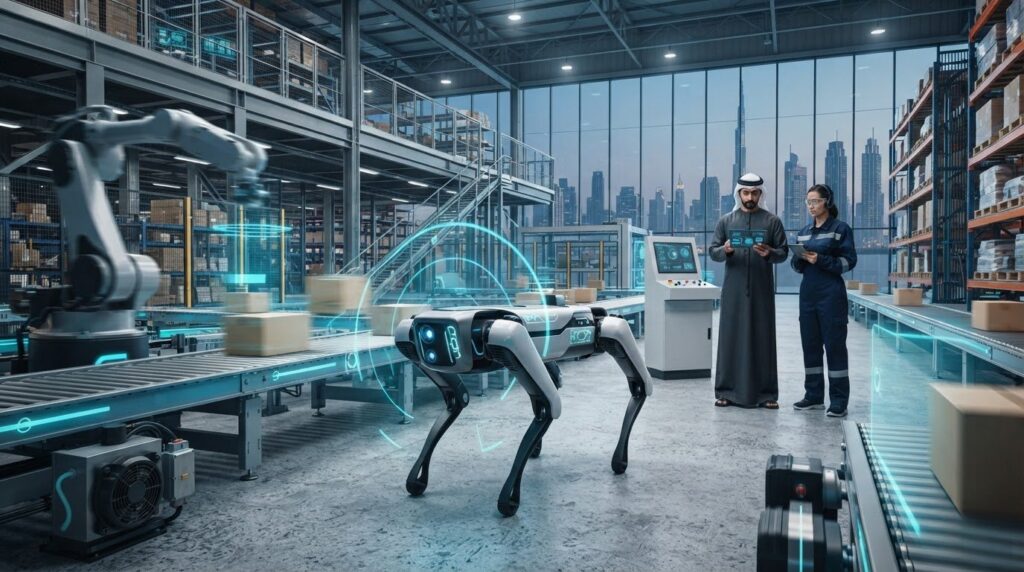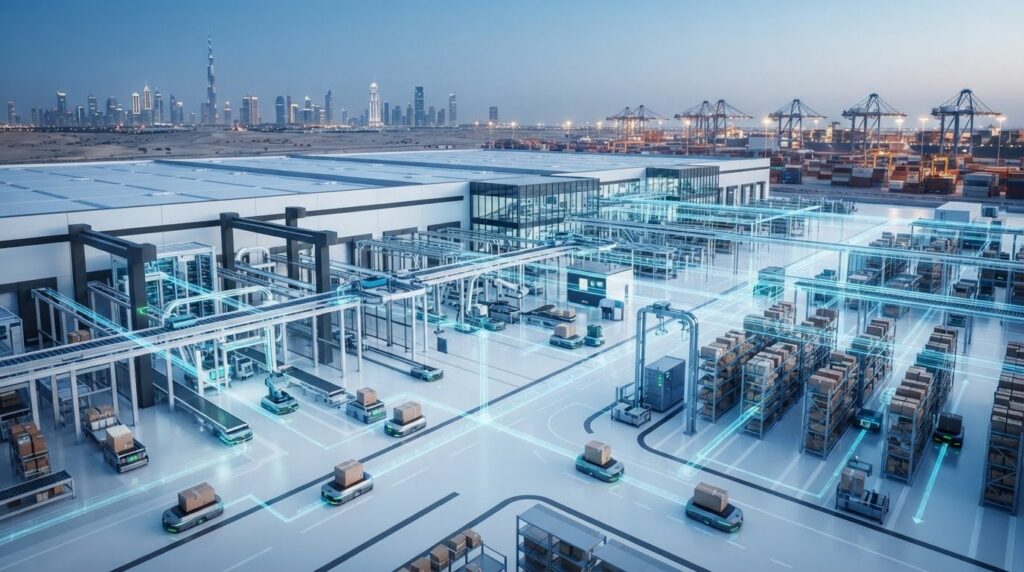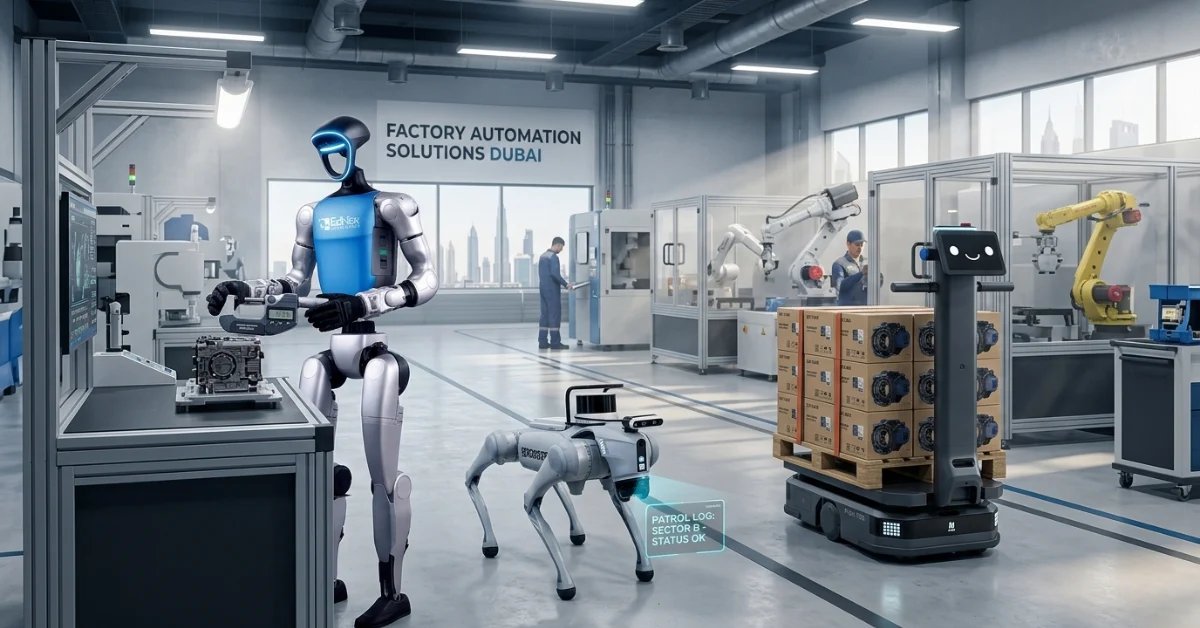
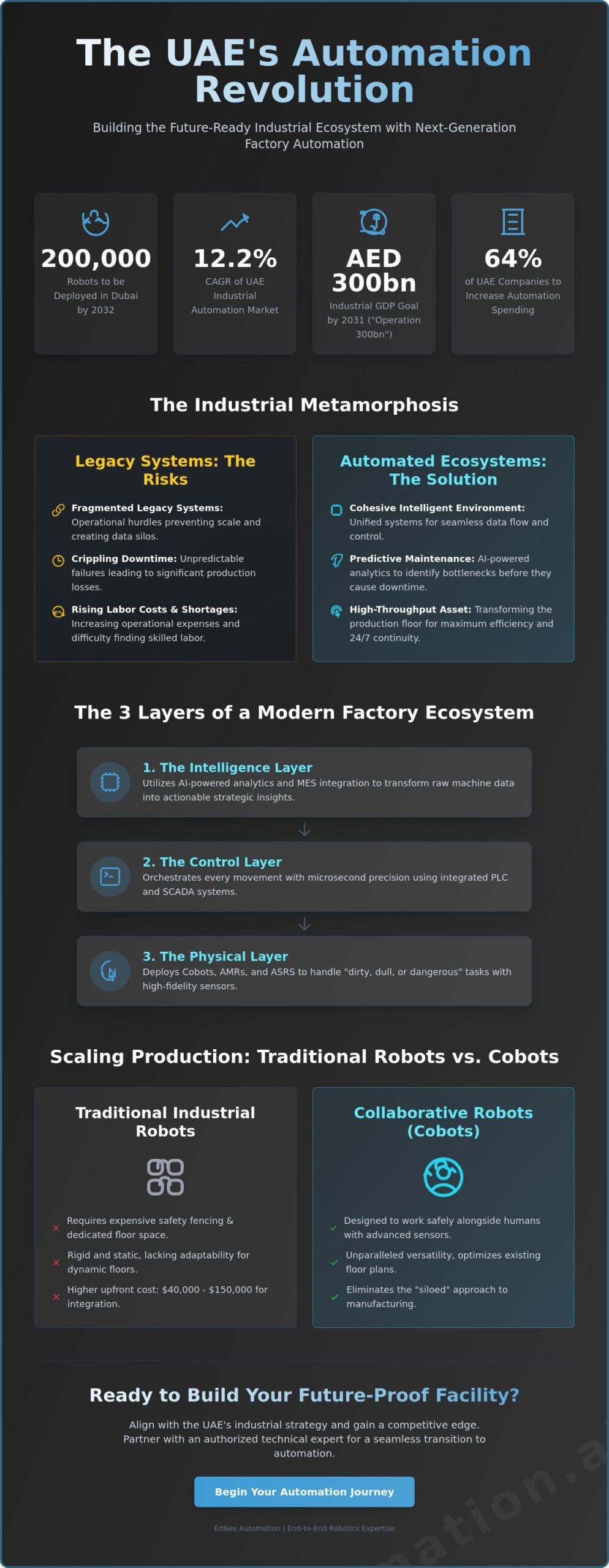
By 2032, the Dubai Robotics and Automation Program will have deployed 200,000 robots across the emirate, signaling a radical shift in how we define industrial excellence. You likely recognize that fragmented legacy systems and rising labor costs are no longer just operational hurdles. They’re systemic risks that prevent you from scaling without crippling downtime. To remain competitive in a market projected to grow at a CAGR of 12.2% through 2033, your facility must evolve into a cohesive, intelligent environment.
This guide demonstrates how to leverage next-gen factory automation solutions Dubai to move beyond manual material handling and build a unified, automated ecosystem. We’ll explore the strategic integration of collaborative robots, ASRS, and AI-powered control systems to ensure your facility remains a future-ready industrial powerhouse. Delivering excellence through integrated infrastructures, we provide the technical framework to transform your production floor into a high-throughput asset. You’ll learn how to reduce operational risk through predictive maintenance and streamline complex workflows with best-in-class autonomous systems.
Key Takeaways
- Aligning with the UAE’s “Operation 300bn” strategy requires implementing advanced factory automation solutions Dubai to transition from manual legacy systems to high-precision robotic workflows.
- Scaling production depends on the strategic deployment of cobots and AMRs, which allow for safer human-robot collaboration and more dynamic material handling.
- Optimizing logistics involves maximizing vertical warehouse capacity through ASRS while ensuring continuous system uptime with integrated PLC and SCADA infrastructures.
- Selecting an authorized technical partner ensures you receive the end-to-end robotics expertise necessary for a successful transition from initial design to post-commissioning support.
The Evolution of Industrial Automation in the UAE
The UAE is undergoing a profound industrial metamorphosis. Driven by the “Operation 300bn” strategy, the nation aims to raise the industrial sector’s contribution to the GDP to AED 300 billion by 2031. This isn’t just a volume play; it’s a quality play. Implementing sophisticated factory automation solutions Dubai is the primary mechanism for achieving this scale. We’re seeing a decisive shift where manual assembly lines, once the standard, are being replaced by high-precision robotic integration infrastructures. This transition ensures that UAE-based manufacturers can compete on a global stage, meeting stringent export standards while maintaining local cost-efficiencies.
Looking at the evolution of industrial automation, we see that modern systems have moved far beyond simple repetitive tasks. Today, a “Future-Ready” enterprise is the only acceptable benchmark for new industrial investment. It’s about building a facility that doesn’t just work today but can adapt to the AI-powered demands of 2030 and beyond. By prioritizing 24/7 operational continuity and safety enhancement, businesses reduce their reliance on human intervention in high-risk zones. This shift toward data-driven decision-making allows plant managers to identify bottlenecks before they cause downtime, ensuring a seamless flow of production that was previously impossible with legacy frameworks.
The Core Components of a Modern Factory Ecosystem
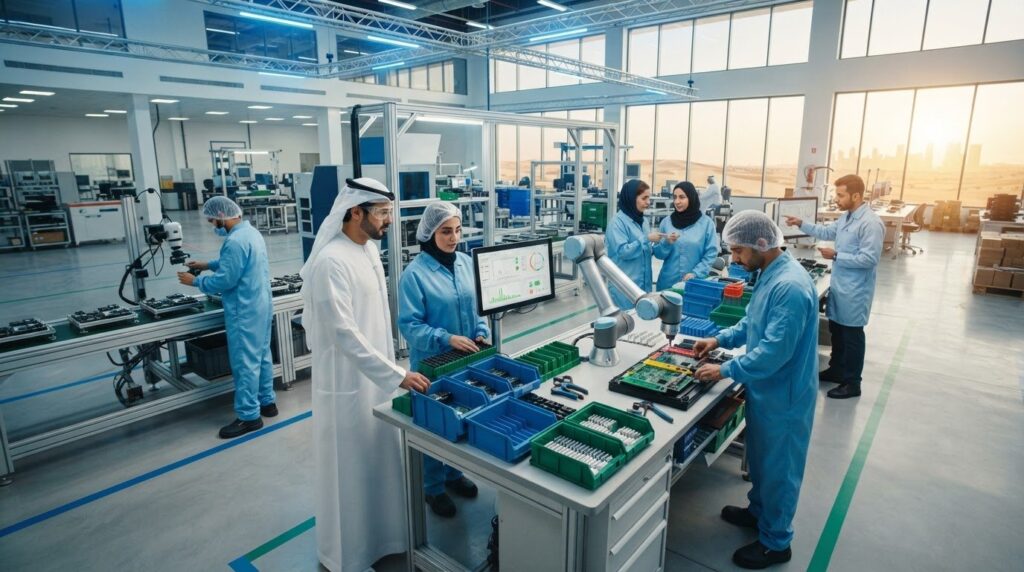
A resilient automation architecture consists of three distinct yet interconnected layers. The physical layer involves the deployment of cobots, AMRs, and high-fidelity sensors that handle the “dirty, dull, or dangerous” tasks. Above this sits the control layer, where PLC and SCADA systems orchestrate every movement with microsecond precision. Finally, the intelligence layer uses AI-powered analytics to transform raw machine data into actionable insights, bridging the gap between the factory floor and executive strategy through comprehensive MES integration.
Economic Drivers for Automation in the GCC
Regional economic pressures are accelerating the adoption of factory automation solutions Dubai. With the UAE industrial automation market projected to grow at a CAGR of 12.2% through 2033, the motivation is clear. Addressing labor shortages and rising operational costs is a top priority for the 64% of UAE companies that planned to increase automation spending in 2025. National programs like “Make it in the Emirates” provide the necessary incentives, encouraging manufacturers to localize supply chains through advanced, autonomous production methods that guarantee precision and reliability across every unit produced.
Robotic Integration: Scaling Production with Cobots and AMRs
Scaling production in the modern era requires a departure from rigid, static machinery. Integrating advanced factory automation solutions Dubai allows enterprises to achieve a level of flexibility previously reserved for small-scale operations. While traditional industrial robots excel at high-speed, high-volume tasks in isolated environments, they often lack the adaptability needed for dynamic production floors. The rapid expansion of the industrial automation sector in the Middle East highlights a growing preference for systems that can evolve alongside business needs. This shift is most visible in the rise of collaborative robots and autonomous mobile platforms that bridge the gap between human precision and machine endurance.
The distinction between traditional and collaborative systems is fundamental to your ROI. Traditional robots require expensive safety fencing and dedicated floor space, often costing between $40,000 and $150,000 for a fully integrated setup. In contrast, next-gen cobots are designed to work alongside humans, using advanced force-torque sensors to halt movement instantly upon contact. This eliminates the “siloed” approach to manufacturing, allowing you to optimize existing floor plans without massive structural changes. Beyond the assembly line, specialized service robots now handle hygiene and security. Autonomous cleaning and surveillance robots ensure your facility meets the strict biosecurity protocols increasingly mandated by regional authorities, providing 24/7 coverage without increasing labor overhead.
Collaborative Robots (Cobots) in Manufacturing
Shaping the future of robotics, cobots offer unparalleled versatility in palletizing, pick-and-place, and intricate assembly tasks. Their safety features allow for human-robot proximity, fostering a hybrid workforce where machines handle repetitive strain while humans focus on quality control. These systems are no longer just tools; they’re intelligent partners that can be redeployed across different lines in minutes. For a deeper look at how these technologies are reshaping the GCC, refer to our strategic guide to collaborative robots for deep implementation insights.
Autonomous Mobile Robots (AMRs) vs. AGVs
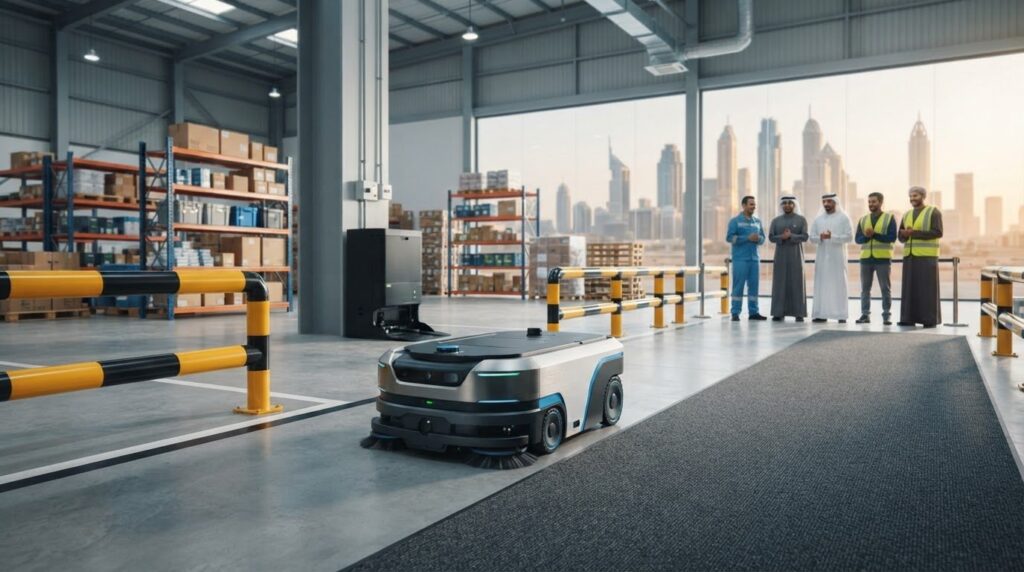
The transition from Automated Guided Vehicles (AGVs) to Autonomous Mobile Robots (AMRs) marks the end of fixed-path logistics. Unlike AGVs, which rely on magnetic strips or wires, AMRs use AI-powered SLAM (Simultaneous Localization and Mapping) to navigate around obstacles in real-time. Autonomous Mobile Robots (AMRs) serve as the nervous system of modern factory logistics. By integrating these units with your warehouse management systems, you create a seamless flow of materials that responds to live production data. Exploring a customized robotics roadmap can help you identify the specific integration points that will yield the highest throughput for your facility.
Optimising Logistics through ASRS and Control System Integration
Efficiency in the industrial sector isn’t just about how fast you produce; it’s about how effectively you move and store materials. In high-density environments, implementing factory automation solutions Dubai requires a seamless link between physical storage and digital control. Fragmented systems that don’t communicate are the primary cause of logistics bottlenecks. By integrating Automated Storage and Retrieval Systems (ASRS) with sophisticated PLC and SCADA frameworks, you create a unified ecosystem that eliminates human error and maximizes throughput. This integration ensures that inventory management is no longer a reactive process but a predictive one. Delivering excellence in logistics means ensuring that every pallet and part is accounted for in real time, transforming your warehouse from a cost center into a high-speed production asset.
ASRS: The Backbone of High-Density Warehousing
Vertical space is a finite asset in the UAE industrial landscape. ASRS technology allows you to reclaim up to 85% of wasted floor space by utilizing the full height of your facility. Whether you deploy high-speed shuttle systems for small parts or mini-load technology for heavier payloads, the result is the same: increased density and faster retrieval. With the global ASRS market projected to reach $10.13 billion by 2026, the shift toward high-bay automation is a verified industry standard. These systems do more than store goods; they reduce the footprint of your storage areas, allowing you to expand production lines without moving to a larger facility. Automated warehouses also offer significant energy efficiency benefits, as robotic retrieval units operate with precision in environments that don’t require the same lighting or climate control as human-occupied zones.
Unified Control with PLC and SCADA
A physical robot is only as effective as the logic driving it. Centralizing your monitoring through PLC and SCADA integration provides a single source of truth for your entire operation. This intelligence layer allows you to anticipate hardware failures before they occur. Using SCADA data for predictive maintenance reduces the risk of unplanned downtime, which is critical for facilities aiming for 24/7 operational continuity. We advocate for vendor-neutral integration infrastructures to avoid proprietary lock-in. This approach ensures your facility remains flexible and capable of adopting next-gen factory automation solutions Dubai as they emerge. Standardizing communication protocols like OPC UA or MQTT is the only way to guarantee hardware-software interoperability in a future-ready enterprise. By architecting a system where the control layer and the physical layer speak the same language, you eliminate the data silos that traditionally hinder industrial scaling.
Strategic Selection: Evaluating Factory Automation Partners
Identifying the right partner for factory automation solutions Dubai requires looking beyond the initial price tag. You aren’t just purchasing a cobot or an ASRS unit; you’re investing in an integration infrastructure that must remain operational for a decade or more. An “Authorized Partner” status with global leaders isn’t just a badge of legitimacy. It’s a non-negotiable requirement that guarantees access to genuine parts, proprietary software updates, and direct manufacturer support. This status separates high-level technological architects from simple hardware vendors who lack the intellectual framework to solve complex industrial challenges. Without this verified connection, your facility risks becoming a collection of isolated machines rather than a unified, future-ready enterprise.
End-to-end robotics expertise is the only way to ensure a successful deployment. This journey begins with a visionary design phase and extends through to post-commissioning support. Local GCC regional experience is equally critical. Navigating the unique regulatory standards of the UAE, such as the 2026 biosecurity protocols for food safety or the National ICV program requirements, requires a partner who understands the local economic context. A geographically strategic partner acts as a bridge, connecting global technological breakthroughs with your specific industrial needs. They ensure your automation architecture is modular and scalable, allowing you to expand your throughput without the need for significant downtime or structural overhauls.
The Technical Audit: Questions to Ask Your Integrator
Conducting a rigorous technical audit is the first step in vetting a potential partner. Don’t settle for vague promises of “increased efficiency.” Instead, ask specific questions about their experience with PLC/SCADA security best practices. Since cyber threats to industrial control systems are an increasing risk, your integrator must prioritize secure industrial networking. Request a detailed ROI calculation for any cobot or AMR implementation. A transparent partner will provide a breakdown of integration costs versus long-term gains in safety and throughput. Finally, verify their capability for 24/7 technical support and remote diagnostics. If a system fails during a peak production cycle, you need a partner who can resolve the issue immediately through secure, remote access.
Future-Proofing Your Investment
Architecting a future-ready enterprise means ensuring your current systems are compatible with the AI-driven technologies of the next decade. Modular design is essential because it allows for phased automation rollouts. This approach lets you automate high-priority zones first before scaling across the entire facility as your budget allows. When evaluating a partner’s capability, check their portfolio for humanoid service robot integration. While your immediate need might be for ASRS or palletizing, a partner capable of deploying humanoid systems demonstrates a level of high-tech competence that ensures they can handle any industrial challenge. If you’re ready to begin your transformation, you can consult with our robotics architects to design a tailored roadmap for your facility.
EdNex Automation: Delivering End-to-End Robotics Expertise
EdNex Automation acts as the vital bridge between global technological breakthroughs and the specific industrial requirements of the GCC. As a Technological Architect, we don’t simply supply machinery; we provide the intellectual framework necessary to implement complex factory automation solutions Dubai. Our status as an authorized partner for global leaders ensures that every deployment is backed by expert reliability and best-in-class support. Choosing EdNex is a commitment to becoming a Future-Ready Enterprise, capable of navigating the shifting economic landscape of 2026 and beyond. We understand the gravity of industrial transformation and offer the precision required to succeed.
Our portfolio is comprehensive, covering the entire spectrum of Industry 4.0. From high-precision collaborative robots and autonomous mobile robots to sophisticated ASRS and SCADA integration infrastructures, we deliver transformative automation. Our specialized division for digital transformation ensures that your physical assets are connected to an intelligent layer of AI-powered analytics. This holistic approach allows us to optimize every facet of your facility, reducing risk while maximizing throughput. By aligning with the UAE’s goal to increase the robotics sector’s contribution to the GDP to 9% by 2032, we help you stay ahead of national mandates and global trends.
Transformative Solutions for Diverse Sectors
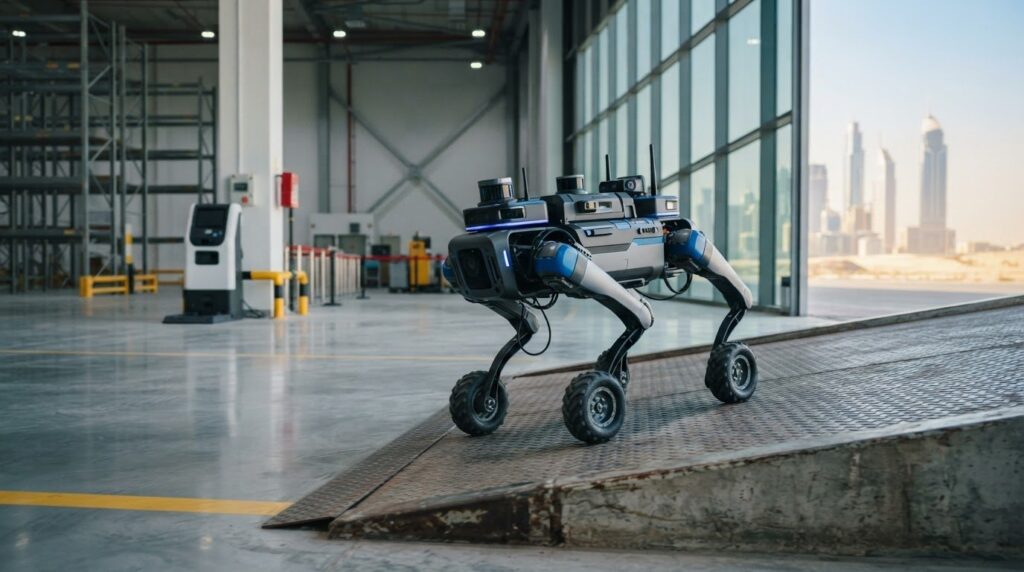
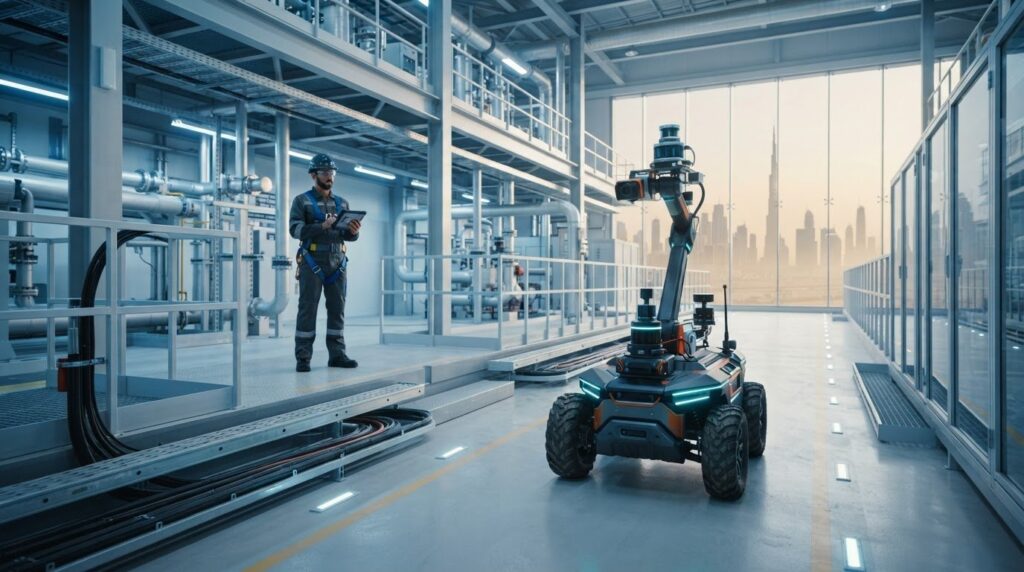
Delivering excellence across varied environments, we provide tailored automation for manufacturing, logistics, oil and gas, and commercial facilities. We act as a system systematizer, bringing order, safety, and efficiency to complex environments through controlled innovation. Whether you require inspection robots for hazardous zones or autonomous cleaning units for large-scale warehouses, our solutions are designed for seamless integration. EdNex Automation delivers End-to-End Robotics Expertise that transforms traditional facilities into high-performance industrial powerhouses.
Start Your Automation Journey Today
Shaping the future of robotics begins with a clear, actionable strategy. We offer specialized consultation services to help you build a digitization roadmap that accounts for your specific operational constraints and growth targets. By accessing our network of authorized global technology partners, you gain the advantage of next-gen hardware and AI-powered software. Don’t let fragmented legacy systems hinder your ability to scale in a market projected to reach USD 10.8 billion by 2033. Contact EdNex Automation to architect your future-ready facility and secure your place at the cutting edge of the UAE’s industrial evolution.
Architecting the Future of UAE Industrial Excellence
The shift toward a fully autonomous industrial sector is a strategic necessity for regional survival. Implementing factory automation solutions Dubai allows you to transform fragmented manual processes into a unified, high-throughput ecosystem. We’ve established that the synergy between collaborative robotics and intelligent storage systems creates a foundation for unprecedented scalability. Success in this new era requires more than just high-tech hardware; it demands a partnership with a technological architect who understands both local regulatory standards and global innovation.
EdNex Automation provides the intellectual framework and end-to-end expertise required to navigate these complexities. As an authorized partner of global robotics leaders, we offer a national UAE support and commissioning network that ensures your investment is protected and optimized. It’s time to move beyond legacy limitations and embrace a future-ready outlook that prioritizes safety, precision, and 24/7 operational continuity. Your facility’s transformation into a next-gen powerhouse is within reach.
Consult with EdNex Automation to Design Your Integrated Factory Ecosystem
Frequently Asked Questions
What are the main types of factory automation solutions available in the UAE?
The primary factory automation solutions Dubai enterprises deploy include collaborative robots (cobots) for precise assembly, Autonomous Mobile Robots (AMRs) for material transport, and Automated Storage and Retrieval Systems (ASRS) for high-density warehousing. These physical systems are orchestrated by a control layer of PLC and SCADA integration. Specialized service robots, including humanoid, inspection, and cleaning units, are also gaining traction in highly regulated industrial environments.
How much do factory automation solutions cost to implement?
Implementation costs vary based on complexity and scale. A standalone cobot arm typically ranges from $25,000 to $60,000, while a fully integrated system including tooling and training costs between $40,000 and $150,000. Autonomous Mobile Robots (AMRs) generally start at $50,000 for entry-level transport models and can exceed $250,000 for custom-engineered, heavy-duty production systems. Annual maintenance is estimated at $2,000 to $8,000 per unit.
What is the typical ROI period for collaborative robots (cobots)?
Most industrial enterprises realize a full return on investment for cobots within 12 to 24 months. This period is driven by immediate reductions in labor overhead, improved precision, and the ability to operate 24/7 without fatigue. Because cobots don’t require expensive safety fencing, the initial integration costs are significantly lower than traditional industrial robots, accelerating the break-even point for facilities of all sizes.
Can factory automation solutions be integrated with my existing legacy machinery?
Yes, sophisticated factory automation solutions Dubai are designed to bridge the gap between legacy hardware and modern digital ecosystems. Through PLC and SCADA integration, we can extract data from older machines and bring them into a unified control layer. This approach allows for a phased modernization strategy, where you can add sensors and industrial networking to existing assets to enable predictive maintenance without a total facility overhaul.
What is the difference between an AMR and an AGV in a factory setting?
The fundamental difference lies in navigation intelligence. Automated Guided Vehicles (AGVs) follow fixed paths defined by magnetic strips or wires and must stop if they encounter an obstacle. In contrast, Autonomous Mobile Robots (AMRs) use AI-powered SLAM technology to navigate dynamically. AMRs can detect obstacles and calculate alternative routes in real time, making them far more effective for flexible production environments where floor layouts change frequently.
Is factory automation only for large-scale manufacturing plants?
Automation is increasingly accessible to small and medium-sized enterprises (SMEs) thanks to modular and collaborative technologies. Cobots and AMRs offer a lower entry cost and smaller footprint than traditional heavy-duty robotics. These systems allow smaller facilities to scale throughput and maintain quality standards without the massive capital expenditure traditionally associated with large-scale manufacturing. Modular ASRS units also help smaller warehouses maximize limited vertical space.
How does SCADA integration improve factory efficiency?
SCADA integration acts as the brain of the facility, providing a centralized dashboard for real-time monitoring and data collection. By visualizing every aspect of the production cycle, plant managers can identify bottlenecks and performance dips instantly. This transparency enables predictive maintenance, where SCADA data anticipates hardware failures before they cause downtime. It’s the essential tool for transforming raw machine data into actionable operational intelligence.
What safety standards must factory automation solutions meet in the GCC?
Systems must adhere to international safety standards such as ISO 10218 for industrial robots and ISO/TS 15066 for collaborative applications. In the GCC, facilities must also comply with regional mandates like the 2026 ADAFSA biosecurity protocols for food production, which require automated monitoring. Ensuring your technical partner is authorized and familiar with UAE-specific regulatory frameworks is critical for maintaining legal and operational compliance.