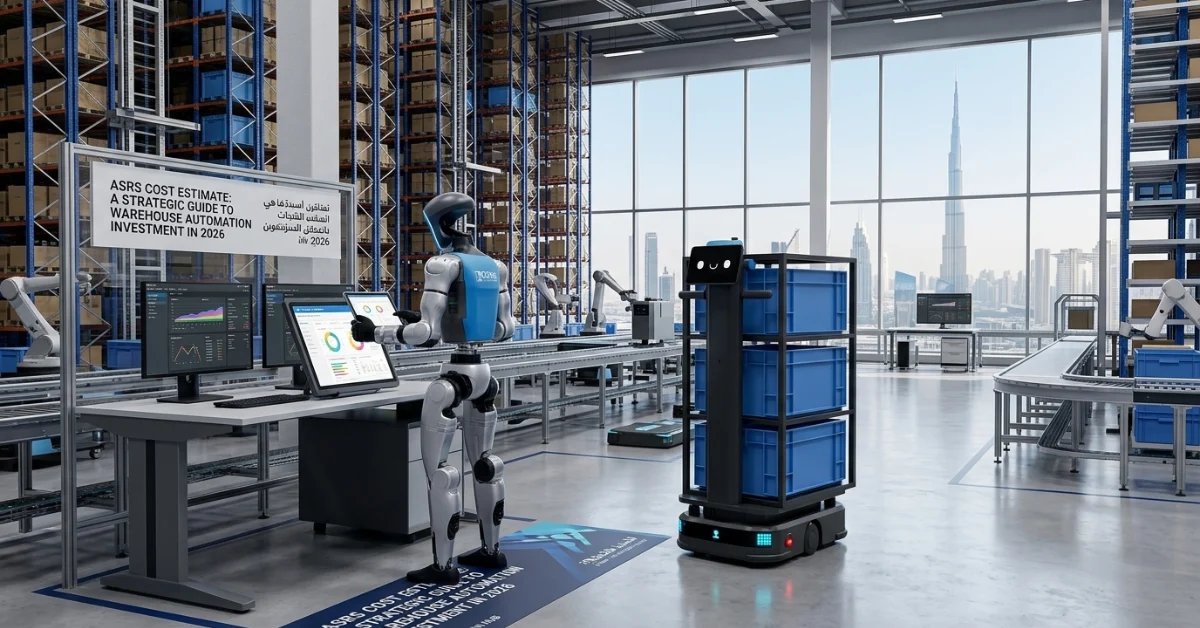
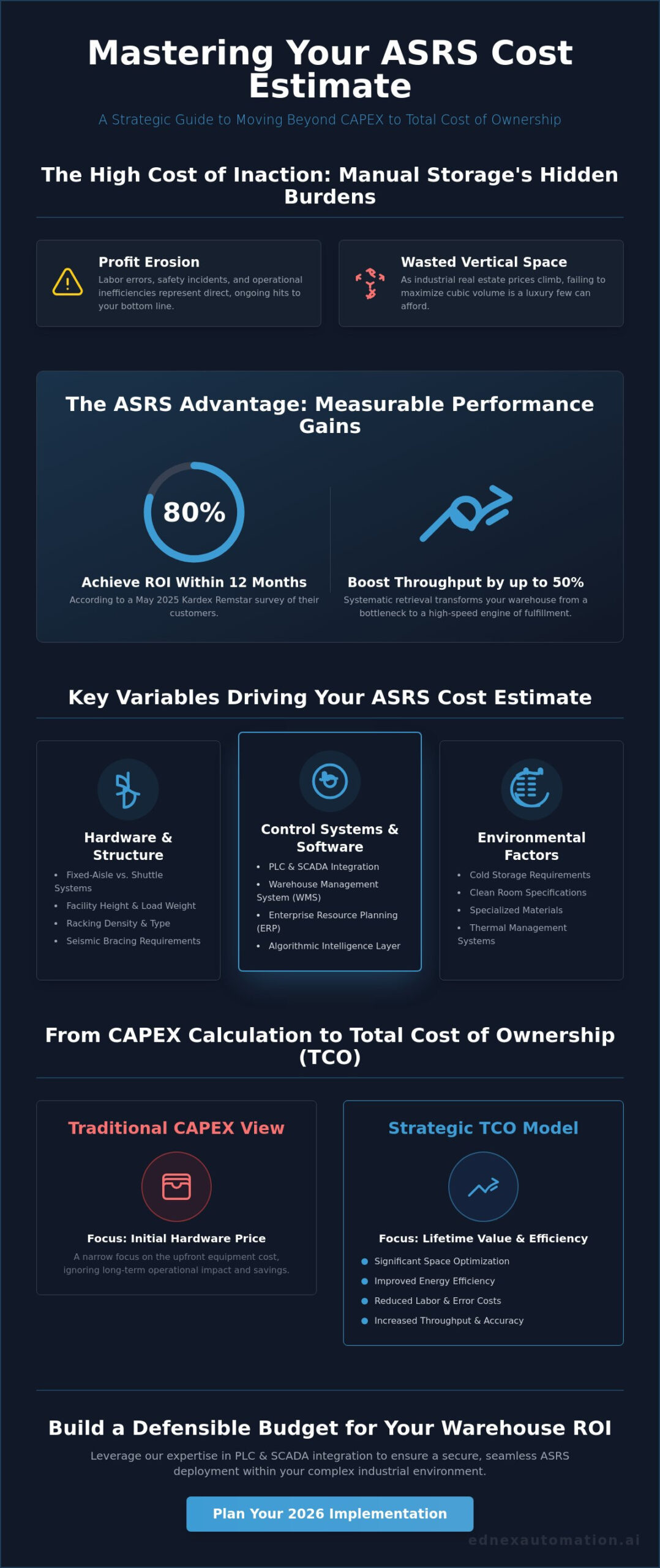
What if your largest capital expenditure wasn’t a cost at all, but a calculated acquisition of future floor space? Developing a precise ASRS cost estimate requires looking past the sticker price of hardware to analyze the long-term throughput-per-square-meter efficiency of your facility. You’re likely facing the pressure of high initial investment and the complex task of quantifying intangible benefits for board-level approval. A May 2025 survey by Kardex Remstar indicated that 80% of their customers achieved a return on investment within the first 12 months, emphasizing that efficiency is a measurable outcome of intelligent design.
Industry leaders often prioritize risk mitigation when evaluating how these autonomous systems will integrate with legacy ERP or WMS infrastructure. Leveraging advanced modeling to predict operational outcomes, this guide will empower you to master the financial variables of automation so you can build a defensible budget that justifies your warehouse ROI. We’ll explore the price-to-performance ratios of various high-density technologies and provide a clear roadmap for a successful 2026 implementation.
Key Takeaways
- Recognize the transition from manual storage to high-density autonomous systems as a fundamental requirement for maintaining long-term industrial competitiveness.
- Develop a precise ASRS cost estimate by analyzing the critical interplay between structural engineering requirements and advanced software integration.
- Evaluate various ASRS architectures to ensure the selected technology aligns perfectly with your specific SKU velocity and volumetric throughput goals.
- Transition from simple CAPEX calculations to a comprehensive Total Cost of Ownership model that factors in energy efficiency and significant space optimization.
- Leverage regional expertise in PLC and SCADA integration to ensure secure, seamless deployment within complex, modern industrial environments.
The Economics of Automated Storage and Retrieval Systems (ASRS)
Industrial evolution isn’t a choice; it’s a structural necessity for organizations aiming to survive the next decade of disruption. Automated Storage and Retrieval Systems (ASRS) represent the convergence of mechanical precision and algorithmic intelligence, serving as a pillar of modern industrial digital transformation. In the UAE, the transition from traditional manual racking to high-density autonomous storage is accelerating as logistics hubs align with 2026 national manufacturing objectives. An accurate ASRS cost estimate serves as a strategic roadmap rather than a simple price tag. It bridges the gap between initial capital expenditure (CAPEX) and the long-term operational expenditure (OPEX) reductions that define a successful deployment.
A sophisticated ASRS cost estimate must account for the entire lifecycle of the machinery. While the hardware represents a significant portion of the budget, the true value lies in the software integration and the resulting reduction in energy and labor costs. As global supply chains become more volatile, these systems provide a predictable, scalable foundation that supports the aggressive growth targets set by regional economic visions.
Why Manual Storage is Costing Your Business More
Manual storage systems carry invisible burdens that erode profitability over time. Labor errors, safety incidents, and general inefficiency represent direct hits to the bottom line that are often difficult to quantify until they’re eliminated. As industrial real estate prices in key economic zones continue to climb, wasting vertical space becomes a luxury few can afford. ASRS technology addresses these vulnerabilities by maximizing cubic volume and mitigating the volatility of labor markets. It’s not just about replacing workers; it’s about protecting your facility from the rising costs of human-centric operations in critical logistics hubs.
The Strategic Value of High-Density Automation
High-density automation isn’t just about storage; it’s about speed and precision. Systematic retrieval can enhance facility throughput by up to 50% compared to traditional methods. Ignoring these advancements creates a “Cost of Inaction” that leaves businesses vulnerable to more agile competitors who have already embraced autonomous workflows. By deploying these systems, you’re positioning your organization as a leader in regional industrial competitiveness. This evolution ensures that your warehouse is no longer a bottleneck but a high-speed engine of fulfillment that meets the rapid demands of 2026 and beyond.
Key Variables Influencing Your ASRS Cost Estimate
Developing a precise ASRS cost estimate requires a granular understanding of how mechanical hardware, control software, and physical environmental factors converge. This calculation is rarely linear; it reflects the engineering complexity required to achieve specific throughput targets within a defined footprint. While hardware often dominates initial budget discussions, the intelligence layer and structural requirements frequently dictate the final investment level. Organizations must move beyond comparing equipment lists to analyzing how each variable contributes to long-term operational resilience.
Facility height and load weight represent two of the most significant structural cost drivers. As vertical density increases, the engineering requirements for rack-supported buildings or high-bay silos become more rigorous, necessitating specialized foundations and seismic bracing. Environmental conditions also play a critical role, as ASRS for cold storage or clean-room applications requires specialized materials and thermal management systems that naturally increase the initial expenditure compared to standard ambient storage.
Hardware Components and Structural Requirements
Choosing between fixed-aisle cranes and flexible shuttle systems involves balancing throughput speed against capital intensity. Fixed-aisle systems offer massive vertical scale, while shuttles provide high-velocity SKU access across multiple levels. Each choice impacts the racking density and the type of pallet handling equipment needed. Precise structural engineering ensures these systems operate safely at peak speeds, protecting both the inventory and the infrastructure from mechanical fatigue over a 20-year lifecycle.
Control Systems: PLC and SCADA Integration
Sophisticated PLC and SCADA integration forms the nervous system of any automated warehouse, yet it’s often undervalued in preliminary estimates. Custom programming is essential to ensure the ASRS communicates flawlessly with floor-level robotics and existing enterprise software. This digital architecture manages real-time data flow, allowing for predictive maintenance and autonomous error correction. Investing in bespoke system architecture rather than off-the-shelf licensing often yields better long-term performance, a specialty that regional integrators provide to ensure local technical support and security.
Labor, Installation, and Commissioning
Professional commissioning involves more than just assembly; it’s a rigorous testing phase that guarantees 99.9% retrieval accuracy before the system goes live. According to insights from MHI’s ASRS Industry Group, the expertise of the system integrator is vital for navigating the complexities of multi-vendor environments. You must also factor in the cost of safety certifications and compliance with UAE industrial standards. These regulatory requirements ensure that your investment meets global safety benchmarks while remaining optimized for local operational conditions.
Comparing ASRS Architectures: Cost vs. Performance
Navigating the complex landscape of automation requires a rigorous analysis of how different mechanical architectures impact your long-term financial health. Selecting the ideal system isn’t merely a matter of hardware procurement; it’s a strategic alignment of technology with your specific SKU velocity and volumetric demands. In the booming market for warehouse automation, the disparity between a cost-per-bin and a cost-per-pallet model can fundamentally alter your ASRS cost estimate. While the most accessible entry point might seem attractive, a failure to account for modular scalability often results in higher long-term OPEX as your facility outgrows its initial configuration.
Strategic planners must evaluate the price-to-performance ratio by calculating the throughput-per-square-meter of each potential architecture. This ensures that the chosen system doesn’t just fit the current budget but supports future expansion without requiring a total infrastructure overhaul. Whether you’re managing small electronics or heavy industrial components, the architecture you select today will dictate your facility’s operational ceiling for the next two decades.
Vertical Lift Modules (VLM) and Carousels
Vertical Lift Modules function as the primary entry point for organizations targeting small parts and high-pick frequency. By utilizing a footprint-to-storage ratio that maximizes vertical space, these systems provide a rapid return on investment for standalone units. The cost breakdown for VLMs typically reflects their mechanical simplicity compared to larger autonomous systems, yet they remain a potent tool for optimizing inventory density. Integrating these units into a broader facility workflow allows for systematic retrieval that drastically reduces the search time associated with manual picking.
Shuttle Systems and Mini-Load ASRS
Shuttle systems represent a significant escalation in both technical complexity and throughput potential. These robots provide high-speed retrieval for case-level and pallet-level storage, operating across multiple levels to ensure constant SKU availability. When developing an ASRS cost estimate for shuttle architectures, you must account for the intelligence layer required to manage a fleet of autonomous vehicles. For a detailed strategic comparison of how these high-velocity robotic engines stack up against traditional automation, explore our analysis of ASRS shuttle technology for UAE industrial automation. While mini-load systems offer superior throughput compared to traditional cranes, their capital intensity is balanced by the massive reduction in cycle times and the ability to handle high-volume, high-velocity order profiles.
Unit Load Systems for Heavy Pallet Storage
Engineering for massive loads requires heavy-duty industrial infrastructure capable of supporting multi-ton pallets with absolute precision. Unit load systems are designed for long-term durability, utilizing high-quality steel and high-torque motors to minimize maintenance interruptions. These systems frequently serve as the foundation for end-of-line operations, where integration with Collaborative Robots (Cobots) ensures seamless palletizing and dispatch. By investing in robust unit load technology, you’re securing a 20-year asset that maintains its operational integrity even under the most demanding industrial conditions.
Calculating Total Cost of Ownership (TCO) and ROI
Analyzing the long-term viability of automation requires a shift from transactional thinking to lifecycle management. Total Cost of Ownership (TCO) represents the aggregate sum of system acquisition, operational energy usage, and proactive maintenance cycles over a 15-year horizon. While the initial ASRS cost estimate may appear substantial; it functions as a strategic labor hedge that protects your organization against future wage inflation and regional labor market volatility. By fixing your fulfillment costs today, you insulate your operations from the variable expenses that typically erode manual warehousing margins.
Energy consumption and routine maintenance are often overlooked variables that significantly influence the TCO. Modern systems utilize regenerative braking and intelligent power management to minimize utility draws, which is a critical consideration given the industrial utility rates in the UAE. Proactive maintenance protocols, driven by real-time data from integrated sensors, ensure that minor mechanical wear doesn’t escalate into costly system downtime. This systematic approach to maintenance transforms a potential liability into a predictable operational expense, ensuring the system’s longevity and reliability.
The ROI Timeline: What to Expect
Payback periods within the UAE industrial sector typically range between 3 and 5 years for large-scale deployments. This timeline is accelerated by the elimination of human error and the substantial reduction in product damage associated with manual handling. Utilizing predictive maintenance through sophisticated PLC and SCADA systems extends the operational life of your machinery, ensuring that the system remains an asset well beyond its initial payback period. Achieving 99.9% accuracy isn’t just a performance metric; it’s a direct contribution to your bottom line through reduced returns and improved customer trust.
Space Optimization and Real Estate Savings
Building “up” rather than “out” represents one of the most profound financial advantages of automated storage. ASRS technology can reduce your storage footprint by up to 85%, allowing you to bypass the exorbitant costs of facility expansion or new real estate acquisition. Reallocating this saved floor space for higher-value activities like manufacturing or assembly transforms your warehouse into a multi-functional production hub. This density allows for a higher concentration of inventory within a smaller, climate-controlled zone, further reducing cooling costs in the regional heat. If you’re ready to quantify these savings for your facility, consult with an automation expert to refine your investment strategy.
Strategic Implementation with EdNex Automation
Achieving industrial excellence requires more than just high-spec machinery; it demands a technical partner capable of translating visionary goals into operational reality. EdNex Automation provides the intellectual and technical framework necessary to bridge the gap between global technological breakthroughs and the specific industrial requirements of the UAE. While your initial ASRS cost estimate provides the financial baseline, our role is to ensure that the resulting deployment delivers a measurable competitive advantage. We align bespoke system architecture with Industry 4.0 standards. This transforms warehouse facilities into intelligent, autonomous ecosystems that meet the rigorous demands of 2026.
A critical component of our implementation strategy involves the secure integration of PLC and SCADA systems. We don’t just connect machines; we build secure digital environments that protect your operational data from external threats. This high-level technical oversight ensures that your automated storage system communicates flawlessly with your existing ERP, creating a unified flow of information across the entire supply chain. By prioritizing cybersecurity alongside mechanical efficiency, we deliver a solution that is as resilient as it is productive.
Our Methodical Approach to ASRS Integration
Our integration methodology begins with an exhaustive site audit to identify throughput bottlenecks and structural constraints. This data-driven approach informs a technical design that prioritizes long-term scalability and security. To ensure your project follows a proven framework from concept to commissioning, review our comprehensive ASRS design and implementation checklist for UAE industrial excellence. We ensure your infrastructure is future-proofed for seamless integration with Autonomous Mobile Robots (AMRs) and other floor-level robotics. From initial CAD modeling to final commissioning, our engineers maintain a focus on risk mitigation and operational continuity. It’s a start-to-finish commitment that doesn’t end when the power turns on.
Why a Regional Partner Matters
Working with a regional integrator offers distinct advantages in navigating the UAE’s specific regulatory and industrial landscape. Our consultants provide direct access to technical expertise that generic global vendors often lack. We ensure your system complies with local safety standards and security protocols. Leveraging official certifications and strategic global alliances, we provide the project legitimacy required for board-level approval. This regional proximity ensures that your ASRS cost estimate remains grounded in reality, backed by a technical partner committed to your long-term success. If you are ready to modernize your infrastructure, connect with our engineering team to begin your transformation.
Securing Your Industrial Future Through Intelligent Automation
Mastering the complexities of warehouse automation requires a shift from viewing technology as an expense to recognizing it as a foundational asset. By calculating a precise ASRS cost estimate, you’re not just budgeting for machinery; you’re engineering a scalable environment that maximizes every cubic meter of your facility. We’ve explored how high-density storage reduces footprints by up to 85% and how sophisticated PLC and SCADA integration protects your operational integrity. These systems provide the necessary resilience to thrive in the competitive landscape of 2026.
Leveraging our status as an official Industry 4.0 Integration Partner, EdNex Automation provides the intellectual framework and comprehensive start-to-finish project management required for such a transformation. Our deep expertise in PLC/SCADA and robotic ecosystems ensures that your investment is future-proofed against the shifting demands of global logistics. It’s time to move beyond legacy limitations and embrace the efficiency of autonomous retrieval. Request a Bespoke ASRS Cost Estimate from EdNex Automation to begin your journey toward a fully optimized, high-performance warehouse. Your facility’s evolution into a modern industrial powerhouse starts with a single, strategic decision today.
Frequently Asked Questions
How much does a basic ASRS system cost for a medium-sized warehouse?
The financial requirements for a basic system depend on your SKU volume, desired throughput, and the specific mechanical architecture chosen for the facility. Developing a precise ASRS cost estimate requires a detailed analysis of your vertical height and load weights. Because every industrial environment has unique constraints, a technical audit is necessary to determine the most efficient configuration for your specific operational goals.
What is the average ROI period for automated storage systems in the UAE?
Payback periods for industrial-scale systems in the UAE typically range between 3 and 5 years. However, some segments see much faster results depending on their labor intensity and space constraints. A May 2025 survey of over 100 warehouse leaders showed that 80% of Kardex Remstar customers achieved a return on investment within the first 12 months. These timelines are accelerated by the elimination of manual errors and significant floor space optimization.
Can ASRS be integrated into an existing warehouse without a complete overhaul?
Integration into existing brownfield facilities is entirely possible using modular technologies like Vertical Lift Modules or shuttle systems. These solutions often fit within current footprints without requiring structural expansion or a total facility redesign. We utilize sophisticated PLC and SCADA integration to ensure new automation communicates seamlessly with your legacy WMS or ERP systems, minimizing operational disruption during the transition.
What are the main maintenance costs associated with ASRS over its lifecycle?
Primary lifecycle expenses include routine mechanical inspections, sensor calibration, and software optimization to ensure peak performance. Utilizing predictive maintenance allows you to address component wear before it leads to system downtime. This proactive approach transforms maintenance into a predictable operational expense, ensuring that your ASRS cost estimate remains stable over a 15-year or 20-year horizon.
Does ASRS work for cold storage or temperature-controlled environments?
Specialized systems are engineered specifically for the rigors of cold storage and climate-controlled logistics. These configurations use thermal-resistant alloys and low-temperature lubricants to maintain 99.9% retrieval accuracy in sub-zero environments. While these specialized materials require a higher initial investment, they significantly reduce the energy loss associated with manual door operations in cold rooms.
What is the difference between a Mini-Load and a Unit-Load ASRS in terms of price?
Unit-Load systems are designed for heavy pallet storage and require robust structural racking, whereas Mini-Load systems focus on high-velocity case and tote handling. Price differences reflect the mechanical torque and structural density required for each application. Unit-Load investments scale with the weight of the inventory, while Mini-Load costs are often driven by the speed and quantity of the retrieval robots.
How does ASRS software (WMS/WCS) affect the total cost estimate?
Software architecture represents the intelligence layer and can significantly influence the total investment through licensing fees or bespoke programming requirements. Custom WCS integration ensures that your storage hardware interacts efficiently with other robotics, such as AMRs or cobots. High-quality software reduces long-term costs by optimizing retrieval paths and providing real-time inventory visibility across your organization.
Is it possible to scale an ASRS system as my business grows?
Scalability is a core feature of modern modular architectures, allowing businesses to expand their storage capacity as throughput demands increase. You can add more shuttle robots or extend racking aisles without a complete system redesign. This phased approach allows for a controlled capital rollout, ensuring that your automation evolves alongside your market share and operational complexity.