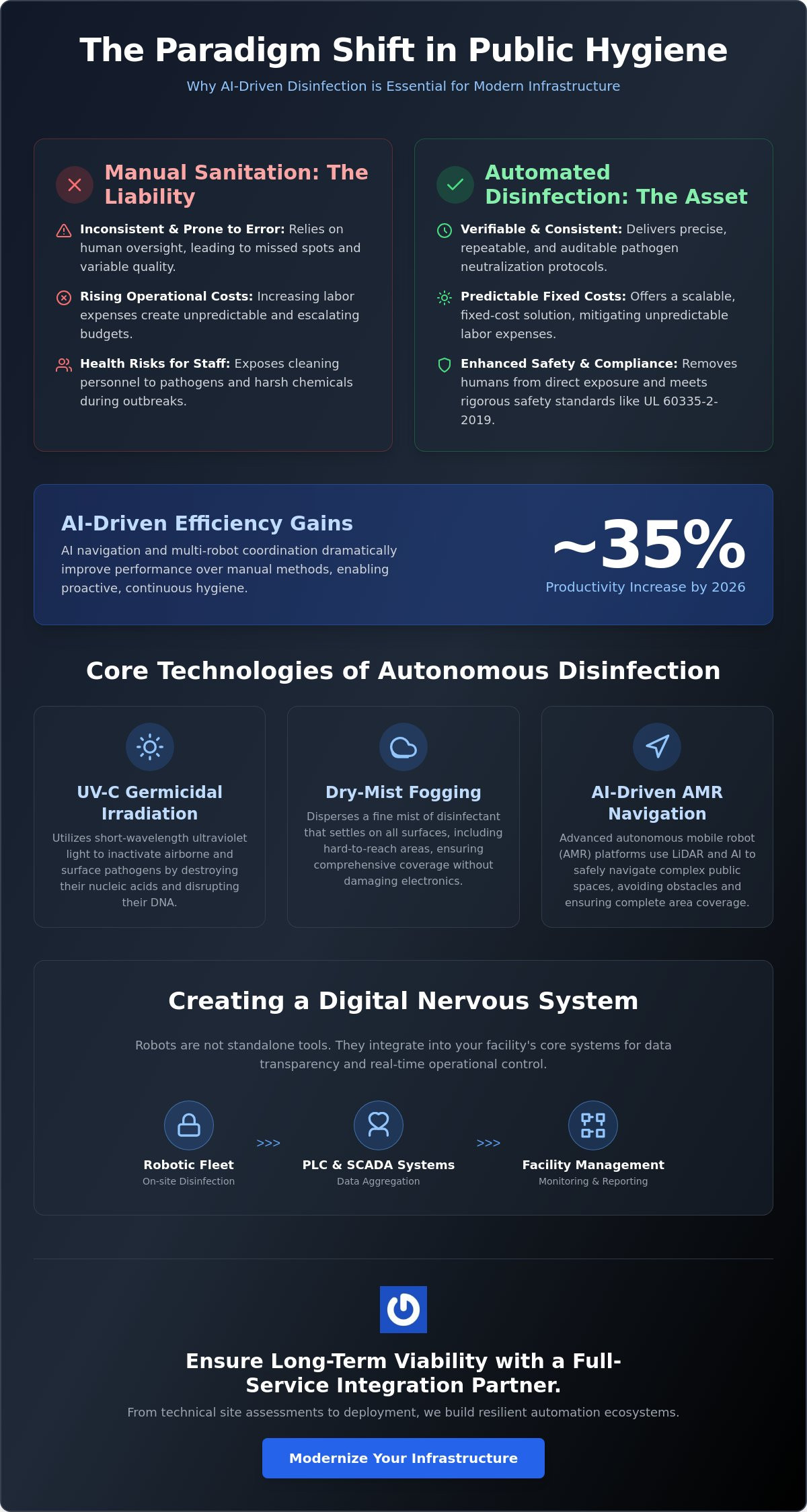
With AI-driven navigation and multi-room fleet coordination improving cleaning cycle productivity by nearly 35% in 2026, the reliance on manual sanitation is quickly becoming a significant operational liability. You’ve likely recognized that rising labor costs and the inherent inconsistency of manual protocols make it nearly impossible to maintain the rigorous, verifiable standards required for modern public health infrastructure. Relying on human oversight for repetitive, high-stakes sterilization tasks is no longer a viable strategy for large-scale facilities.
This strategic integration guide demonstrates how automated disinfection robots for public spaces are transforming from simple tools into sophisticated assets linked directly to a facility’s digital nervous system. By leveraging advanced autonomous mobile robots and integrating them with centralized SCADA or PLC systems, organizations can achieve a verifiable disinfection protocol that meets the UL 60335-2-2019 safety standard. We’ll examine the technical frameworks and multi-modal technologies necessary to modernize your sanitation infrastructure while ensuring long-term operational viability through visionary automation.
Key Takeaways
- Understand the shift from reactive maintenance to proactive hygiene by deploying AI-driven autonomous mobile robots that function as a fundamental layer of public health infrastructure.
- Evaluate the efficacy of multi-modal payloads, including UV-C and dry-mist fogging, to ensure automated disinfection robots for public spaces deliver comprehensive and verifiable pathogen neutralization.
- Learn how to bridge the gap between standalone hardware and facility management by linking robotic fleets to centralized PLC and SCADA systems for real-time monitoring and data transparency.
- Discover a strategic framework for matching specific robotic capabilities to the high-traffic demands and architectural complexities of transportation hubs and commercial retail environments.
- Explore the necessity of a full-service integration partner to oversee technical site assessments and the deployment of complex robotic ecosystems that ensure long-term business viability.
The Paradigm Shift in Public Hygiene: Why Automated Disinfection Robots are Essential in 2026
In 2026, the concept of public hygiene has evolved from a cosmetic necessity into a data-driven industrial requirement. Automated disinfection robots for public spaces represent the pinnacle of this evolution, serving as AI-driven Autonomous Mobile Robots (AMRs) equipped with specialized payloads designed to neutralize pathogens at the molecular level. Unlike the static cleaning methods of the past, these systems operate as active participants in a facility’s safety protocol. They don’t just clean; they provide a verifiable layer of protection that manual labor cannot consistently achieve.
Moving beyond reactive cleaning, which only addresses visible soil after an event, proactive autonomous hygiene ensures that high-traffic environments remain sterile throughout the operational cycle. Manual sanitation often fails due to human error and the significant health risks posed to cleaning staff during outbreaks. By removing the human element from the direct exposure path, facilities can maintain a higher standard of safety without compromising personnel health. A modern disinfection robot provides a level of consistency that manual labor simply cannot replicate, utilizing precise algorithms to ensure every square centimeter of a surface receives the necessary dosage of neutralizing agent.
Integrating these systems into the national infrastructure of the UAE requires a deep understanding of the 2026 regulatory landscape. While global standards like UL 60335-2-2019 provide the technical baseline, regional authorities now prioritize verifiable data over manual checklists. This shift toward digital transparency means that any sanitation protocol must be auditable, repeatable, and integrated into the broader facility management ecosystem to meet evolving public safety mandates.
Defining the Autonomous Disinfection Standard
Differentiating between a standard robotic floor scrubber and a specialized disinfection unit is essential for any facility manager. While scrubbers focus on aesthetic cleanliness, automated disinfection robots for public spaces are precision instruments designed for pathogen eradication. These units utilize advanced sensors to detect human presence, pausing operations to ensure safety while maintaining a rigorous schedule that human teams can’t sustain. Maintaining this level of continuous hygiene is vital for national infrastructure resilience, as it prevents public spaces from becoming vectors for disease. Autonomous disinfection is a mission-critical component of modern facility management that bridges the gap between architectural design and public safety.
The Economic Imperative for Automation
Rising labor costs and the scarcity of specialized sanitation staff have made manual maintenance an unpredictable and rising expense. Automation offers a fixed-cost solution that scales effortlessly with the size of the facility, providing a predictable budgetary framework for stakeholders. By reducing the frequency of deep-clean shutdowns and improving public trust through visible, high-tech safety measures, organizations see a rapid return on investment. The reduction in long-term operational overhead, combined with the mitigation of liability risks, positions autonomous systems as the only viable path forward for large-scale public environments.
Core Technologies Driving Autonomous Disinfection: From UV-C to AMR Navigation
The convergence of advanced robotics and microbiology has accelerated the adoption of disinfection robots across high-traffic sectors. Engineered for high-stakes environments, automated disinfection robots for public spaces utilize a trifecta of neutralization technologies. These systems integrate UV-C radiation, dry-mist chemical fogging, and HEPA air filtration into a single, cohesive platform. By utilizing swappable payloads, a single robotic base can transition between these modalities, ensuring that facility managers don’t need to maintain separate fleets for different hygiene requirements. These systems don’t just move; they think. By integrating multi-modal payloads with high-fidelity sensory arrays, these robots provide a level of operational flexibility previously reserved for laboratory environments.
Pathogen Neutralization: UV-C vs. Chemical Fogging
Delivering a lethal dose of 254nm wavelength light, UV-C modules effectively dismantle the DNA and RNA of multi-drug resistant organisms in seconds. While light-based systems are peerless for line-of-sight surfaces, dry-mist fogging addresses the limitations of shadows by dispersing a fine aerosol that permeates textured materials and complex geometries. Hybrid models represent the 2026 gold standard, simultaneously scrubbing the air through medical-grade HEPA filters while treating surfaces with both photons and chemistry. This dual-action approach ensures a sterilization rate that exceeds 99.9999% across all treated zones.
Advanced AMR Navigation and Safety Protocols
Leveraging Simultaneous Localization and Mapping (SLAM), autonomous mobile robots now navigate high-traffic terminals with surgical precision. Utilizing 2026-gen LiDAR and 3D depth cameras, these systems process environmental data via edge computing to predict human movement patterns before they occur. Modern LiDAR arrays provide a 360-degree field of view, detecting obstacles with millimeter accuracy at ranges exceeding 30 meters. When paired with 3D depth cameras, the robot distinguishes between static pillars and dynamic human actors, adjusting its velocity and path in real-time. This safety-first architecture ensures zero-collision paths even in the densest crowds. If you’re seeking to implement these advanced systems within your current infrastructure, consulting with an expert on bespoke robotic integration is the first step toward modernization.
Strategic Integration: Connecting Disinfection Robots with PLC and SCADA Systems
Operating in isolation, standalone robotic units often create data silos that prevent facility managers from achieving a truly optimized hygiene strategy. While a single robot might perform its task adequately, it lacks the contextual awareness of the broader building environment, leading to inefficiencies and uncoordinated coverage. Transitioning from isolated hardware to an integrated industrial asset requires a sophisticated digital framework. By leveraging professional PLC and SCADA integration services, organizations can transform their automated disinfection robots for public spaces into a synchronized fleet that responds dynamically to real-time facility needs.
Centralized Command and Control via SCADA
Utilizing SCADA dashboards allows facility managers to access a “single pane of glass” view of their entire robotic ecosystem. This high-level visibility facilitates the triggering of automated disinfection cycles based on occupancy sensors or pre-defined intervals, ensuring high-traffic zones receive priority treatment. Implementing PLC logic ensures that all robots immediately return to their designated docking stations during emergency procedures or fire alarms. This level of control moves hygiene from a manual task to a programmed industrial process, reducing the need for constant human intervention and lowering long-term overhead.
Data Logging for Regulatory Compliance
Generating verifiable “heat maps” of disinfected areas provides the objective proof of hygiene required by modern health authorities. As noted in a recent International Federation of Robotics report, the expansion of robotic sanitation into airports and hotels has increased the demand for automated compliance reporting. Integrated systems eliminate manual data entry by logging every square meter treated, creating an immutable record of sterilization efficacy. Leveraging digital twins further optimizes this process, allowing engineers to simulate and refine disinfection routes before a single robot is deployed on the floor. This methodical approach ensures that automated disinfection robots for public spaces operate at peak efficiency while meeting the most stringent regulatory standards.
Operational Selection Framework: Matching Robotic Capabilities to Public Space Requirements
Selecting automated disinfection robots for public spaces requires a methodical assessment of environmental variables and throughput requirements. It isn’t just about purchasing a device. It involves engineering a solution that aligns with specific architectural constraints and usage patterns. Different sectors demand distinct robotic profiles, ranging from high-torque industrial bases for logistics hubs to sleek, interactive units for luxury retail environments. A failure to match the machine’s capability to the space’s demand leads to operational bottlenecks and diminished ROI.
High-Traffic Transportation and Logistics Hubs
High-speed terminals like airports or metro stations demand 24/7 operational readiness. These environments require robots with high-capacity battery systems and the ability to interface with building infrastructure, such as automated gates and elevators, to ensure multi-level coverage. Scaling these operations often necessitates the use of autonomous cleaning robots that combine heavy-duty scrubbing with pathogen neutralization. This multi-functional approach ensures that high-traffic zones remain both physically clean and biologically sterile without doubling the fleet size. Efficiency in these hubs is measured by square meters treated per hour, making high-speed navigation and rapid charging stations essential for maintaining national infrastructure resilience.
Hospitality and Commercial Retail Spaces
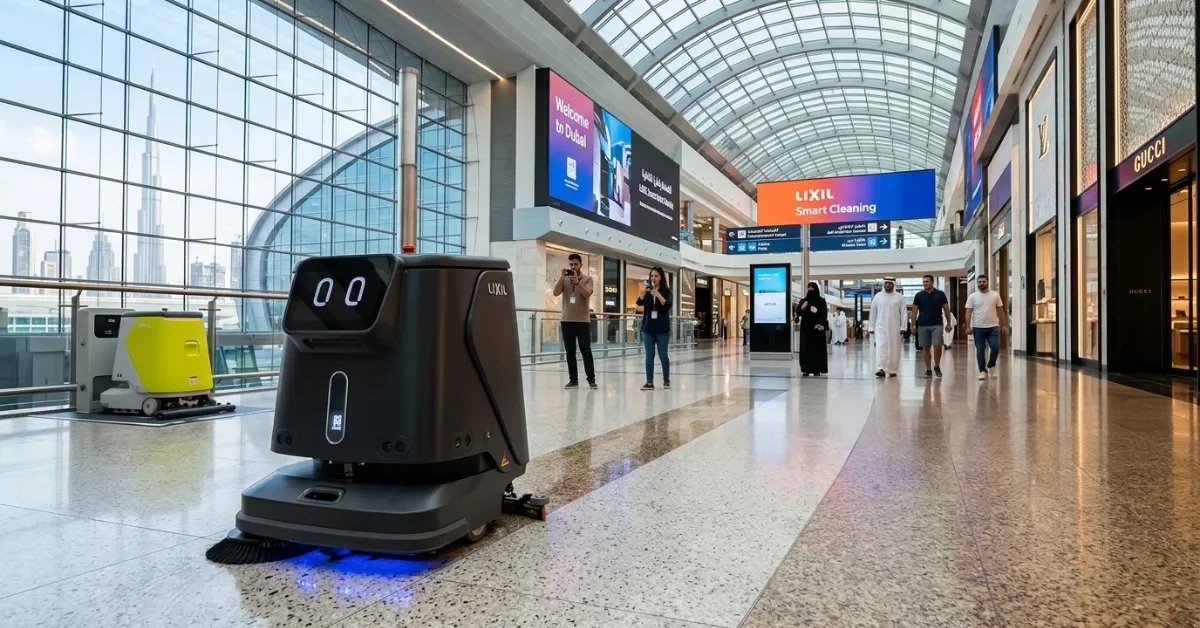
In malls, showrooms, and hotels, the robot acts as a visible ambassador of safety. Aesthetics and noise reduction are critical here. Incorporating “social robotics” features, such as humanoid-like interaction or intuitive screen interfaces, helps bridge the gap between high-tech safety and public comfort. Operating during business hours requires silent drive systems to avoid disrupting the retail experience. Balancing visible hygiene with customer privacy is a delicate task. Modern units utilize advanced computer vision to anonymize faces in data logs, ensuring compliance with privacy regulations while maintaining a high-tech presence. This ensures that automated disinfection robots for public spaces enhance the customer experience rather than detract from it.
When evaluating your hardware options, prioritize units with high ingress protection (IP) ratings to ensure durability against repeated chemical exposure. Software flexibility is equally vital. Your chosen platform must allow for rapid route remapping as floor layouts change. For a comprehensive analysis of how these systems fit your specific facility, you can request a technical site assessment from our automation experts to ensure your investment delivers the expected ROI through reduced downtime and improved public trust.
The EdNex Advantage: Comprehensive Automation for a Nationally Resilient Infrastructure
Establishing a new standard for national infrastructure resilience, EdNex Automation serves as the definitive partner for organizations transitioning toward fully autonomous hygiene protocols. We operate as a visionary integrator, providing the intellectual framework necessary to deploy automated disinfection robots for public spaces within complex industrial environments. Our approach isn’t limited to equipment delivery; it encompasses a holistic strategy that aligns global technological breakthroughs with the specific economic and operational needs of the UAE. By positioning our clients at the cutting edge of innovation, we ensure their facilities are equipped to handle the rigorous demands of modern public health.
Providing more than just hardware, our team delivers a comprehensive, start-to-finish expertise that begins with a rigorous technical site assessment. We bridge the gap between sophisticated machinery and practical application by ensuring every unit is fully synchronized with existing building management systems. Adhering to official certifications and global safety standards, EdNex provides the legitimacy and reliability required for large-scale industrial transformation. Our status as a high-level consultant ensures that your automation journey is methodical, secure, and geared toward delivering tangible business outcomes.
End-to-End Robotic Lifecycle Management
Executing a bespoke integration process, EdNex ensures a zero-downtime transition during the deployment of robotic fleets. We don’t believe in a one-size-fits-all approach; instead, we customize every implementation to the specific architectural and data requirements of your facility. Our nationwide technical support network provides preventative maintenance and real-time troubleshooting, ensuring that your automated disinfection robots for public spaces remain operational 24/7 without interruption. Beyond the technology itself, we support the UAE’s digital transformation by upskilling facility teams. This empowerment allows your personnel to transition from manual tasks to high-level system supervision, ensuring the long-term success of your robotic ecosystem.
Future-Proofing Your Facility with EdNex
Designing for longevity, EdNex solutions are built to scale alongside your organization’s growth. Whether you’re deploying a single unit or managing multi-site robotic armies, our centralized control frameworks provide the flexibility needed to evolve as new challenges arise. Ensuring long-term business viability, our services frame robotic acquisition as a necessary evolution for any organization wishing to remain competitive. As service requirements become more complex, clients also gain access to the latest innovations in humanoid robots for sale UAE for advanced service and interaction roles. This forward-looking perspective ensures that your facility stays ahead of the curve. Contact EdNex Automation today to design your facility’s autonomous hygiene roadmap and secure your operational future.
Securing the Future of Public Health Through Intelligent Automation
Leading the transition from manual sanitation to proactive, autonomous hygiene, organizations are embracing a necessary evolution for modern facility management. By integrating automated disinfection robots for public spaces into centralized SCADA and PLC systems, facilities replace inconsistent protocols with verifiable, data-driven security. It’s a strategic shift that ensures sanitation is no longer a reactive task but a core component of a facility’s digital nervous system. This integration eliminates data silos and provides the transparency required for regulatory compliance in high-traffic environments.
As a specialized division of the EdNex group focused on Industry 4.0, we provide the technical expertise required for seamless PLC, SCADA, and ASRS integration. Our comprehensive range of AMRs and cleaning robots allows for bespoke solutions that address the unique architectural challenges of transportation hubs and commercial spaces. Design your autonomous hygiene strategy with EdNex Automation to ensure your infrastructure remains resilient and competitive in an increasingly automated world. We’re ready to help you lead this industrial transformation with confidence and precision.
Frequently Asked Questions
How do automated disinfection robots navigate around people in crowded public spaces?
Robots utilize a sophisticated combination of LiDAR sensors, 3D depth cameras, and SLAM (Simultaneous Localization and Mapping) algorithms to navigate high-traffic zones with surgical precision. These systems provide a 360-degree field of view, allowing the unit to detect and predict human movement patterns with millimeter accuracy. By processing environmental data via edge computing, the robot adjusts its velocity and path instantly to maintain zero-collision safety in dynamic environments.
Are UV-C disinfection robots safe to use while the public is present?
Standard 254nm UV-C light is not safe for direct human exposure, which is why these robots are equipped with redundant occupancy sensors and fail-safe shutoff mechanisms. If the robot detects a person within a pre-defined safety radius, it immediately terminates the UV-C emission to prevent accidental exposure. For environments requiring continuous operation while the public is present, air-scrubbing HEPA modules or specialized far-UVC technologies are typically utilized instead.
What is the typical battery life and charging time for an industrial disinfection robot?
Industrial-grade systems typically offer between 4 to 8 hours of continuous operational runtime on a single charge, depending on the payload intensity. When the battery reaches a critical threshold, the robot autonomously returns to its docking station for rapid charging, which usually takes 2 to 4 hours to reach full capacity. This autonomous cycle ensures that automated disinfection robots for public spaces remain mission-ready without requiring manual intervention or oversight.
Can these robots be integrated with my existing Building Management System (BMS)?
Integration with existing Building Management Systems is a fundamental capability of modern industrial robotics. By utilizing standardized communication protocols such as BACnet or Modbus, these units link directly to centralized PLC and SCADA frameworks. This connectivity allows facility managers to trigger disinfection cycles based on real-time occupancy data or emergency fire alarm states, ensuring a synchronized response across the entire facility infrastructure.
How do I verify that the robot has actually neutralized pathogens in a specific area?
Pathogen neutralization is verified through integrated data logging and the generation of digital heat maps that track dosage and coverage in real time. These systems record the exact duration and intensity of the disinfection modality applied to every square meter of the facility, providing an auditable trail for health authorities. For physical validation, operators can utilize UV-C dosimeter cards or chemical indicator strips that change color upon reaching the required neutralization threshold.
What kind of maintenance do autonomous disinfection robots require?
Maintenance protocols focus on the upkeep of sensory arrays, disinfection payloads, and mechanical drive components to ensure long-term reliability. Regular tasks include cleaning LiDAR lenses, replacing UV-C lamps after their rated lifespan, and refilling chemical reservoirs for fogging units. Automated software updates and remote diagnostics further minimize downtime by identifying potential hardware issues before they lead to a significant operational failure.
How much can a facility expect to save by switching from manual to automated disinfection?
Facilities realize substantial savings by reducing the high labor costs and high turnover rates associated with manual sanitation teams. Automation provides a predictable, fixed operational expense while optimizing the use of disinfectants and energy through precision application. By mitigating the risk of health-related shutdowns and improving public trust, organizations see a rapid return on investment through enhanced operational continuity and reduced overhead.
While industrial automation focuses on large-scale environments, the same principles of professional maintenance apply to residential and commercial driveways; to explore these standards, read more about expert services from Ehrman’s Power Wash.
Can one robot handle multiple types of disinfection, such as UV and fogging?
Modern platforms are designed with swappable payloads that allow a single robotic base to perform multiple types of disinfection depending on the zone’s requirements. Hybrid models can simultaneously utilize UV-C radiation for line-of-sight surfaces and dry-mist fogging for complex, shadowed areas. This versatility ensures that automated disinfection robots for public spaces can be customized to meet the shifting hygiene requirements of different facility zones without needing multiple specialized fleets.