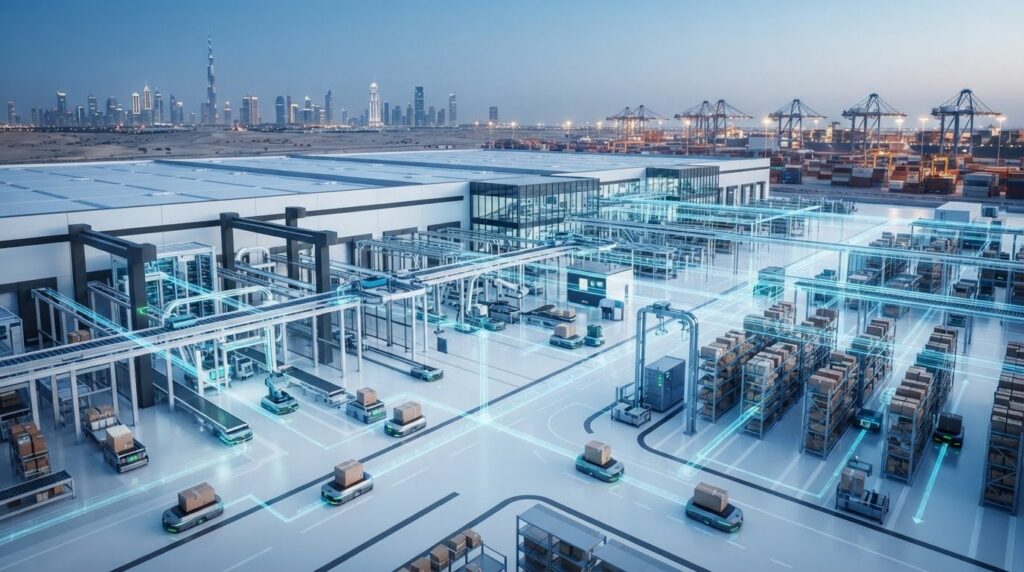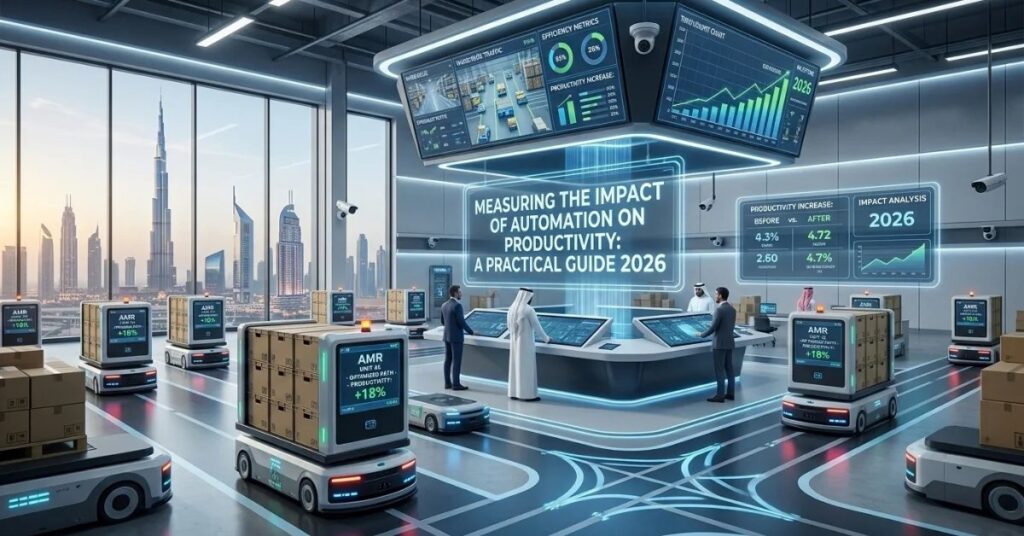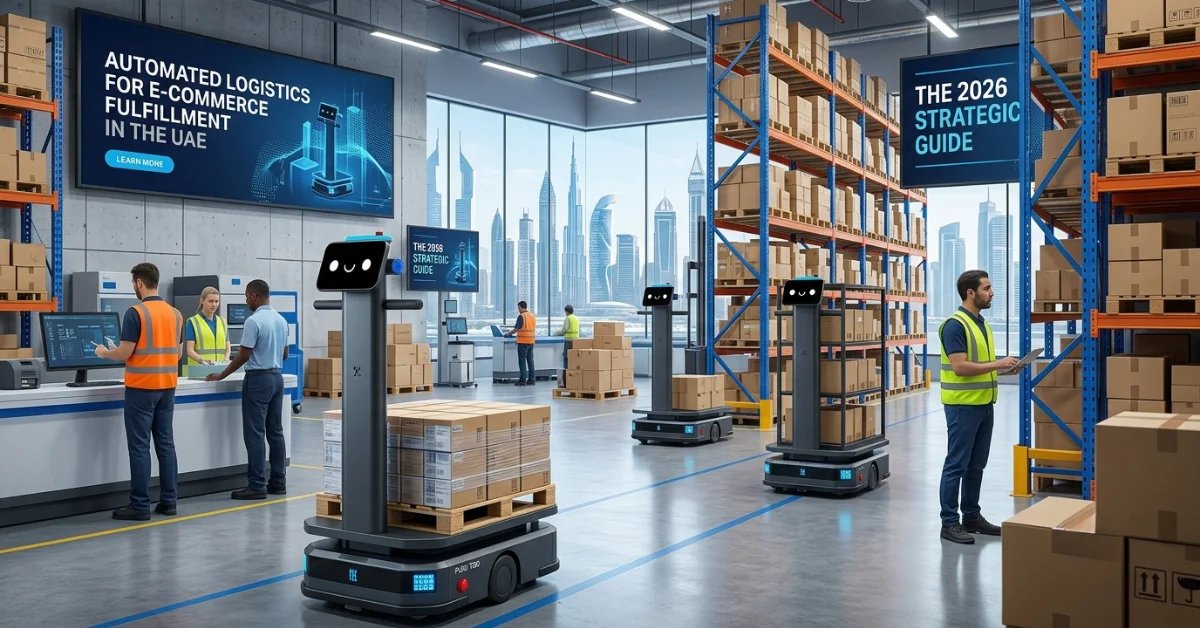
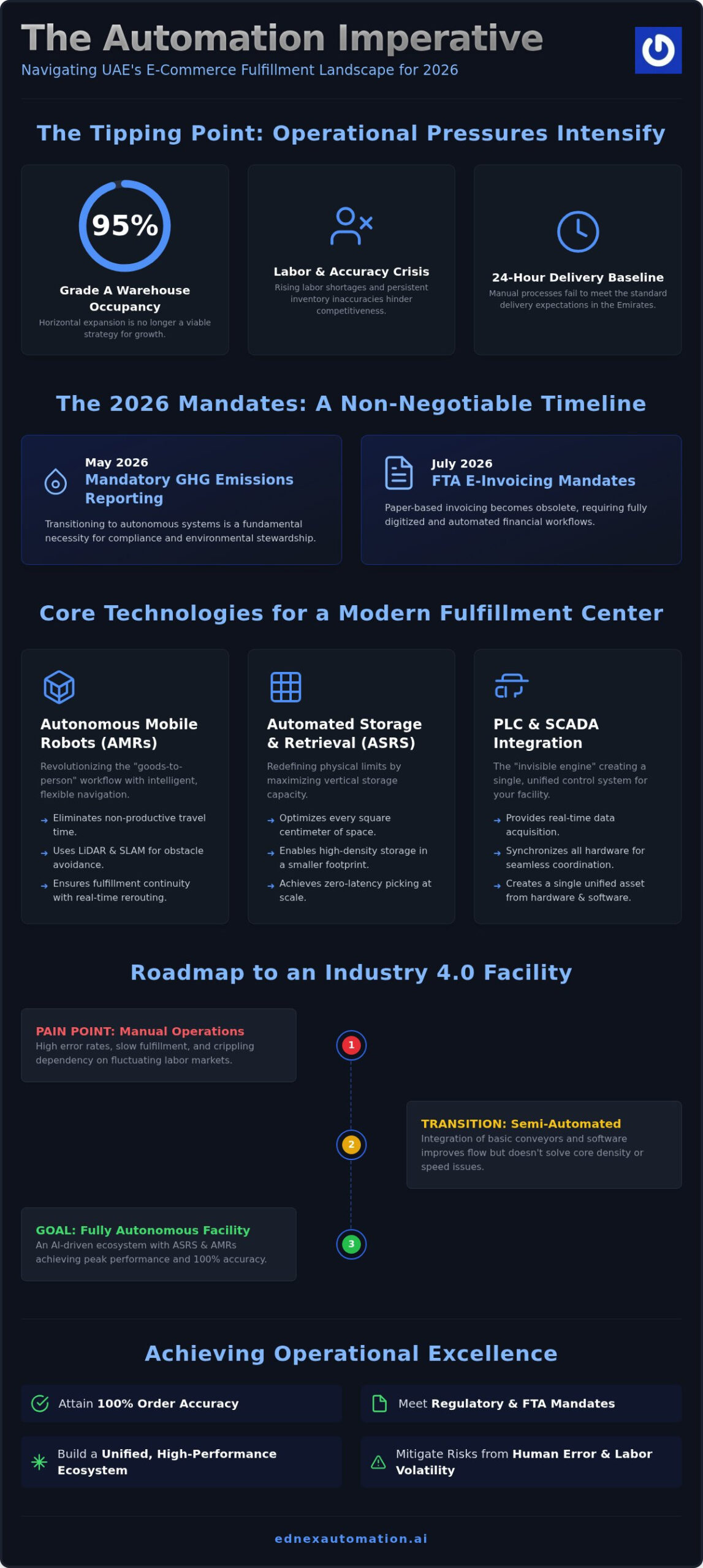
With Grade A warehouse occupancy across the Emirates hitting a staggering 95%, the traditional model of horizontal expansion is no longer a viable strategy for regional growth. Integrating the advanced automated logistics for e-commerce fulfillment UAE enterprises now demand is the only pathway to bypass the constraints of rising labor shortages and persistent inventory inaccuracies. Transitioning to autonomous systems serves as a fundamental necessity for organizations aiming to maintain 100% order accuracy while meeting the strict May 2026 deadline for mandatory GHG emissions reporting.
You recognize that manual processes can’t keep pace with the rapid order cycles your global competitors are setting, particularly as paper-based invoicing becomes obsolete under the July 2026 FTA mandates. This strategic guide provides the technical framework to transform your fulfillment center through the deployment of Autonomous Mobile Robots (AMRs), high-density ASRS, and sophisticated PLC integration. We’ll examine the specific methodologies for building a scalable infrastructure that converts operational complexity into a streamlined, high-performance ecosystem designed for the 2026 industrial landscape.
Key Takeaways
- Establish why the 24-hour delivery baseline in the Emirates necessitates a shift toward a visionary, high-tech fulfillment ecosystem.
- Explore the technical advantages of deploying AMRs and ASRS to achieve automated logistics for e-commerce fulfillment UAE, focusing on vertical space optimization and picking speed.
- Understand the critical function of PLC and SCADA integration in creating a unified control system for real-time data acquisition and hardware coordination.
- Execute a structured roadmap for transitioning from manual operations to a bespoke, scalable architecture that supports rapid national growth.
- Leverage the expertise of a technical partner to ensure 100% order accuracy and a seamless transition to a fully modernized Industry 4.0 facility.
The Evolution of Automated Logistics for E-commerce Fulfillment in the UAE
Positioning the UAE as a global logistics powerhouse, the recent surge in e-commerce demand has catalyzed a radical shift in operational architecture. The traditional reliance on manual labor is rapidly giving way to a synchronized ecosystem where robotics, software, and data converge to manage the entire fulfillment cycle. Implementing Logistics Automation at this scale is no longer an optional upgrade for ambitious brands. It’s a fundamental requirement to meet the 24-hour delivery baseline that UAE consumers now expect as standard. As warehouse occupancy in Grade A facilities remains at a critical 95%, the evolution from manual hubs to semi-automated centers, and eventually fully autonomous “dark warehouses,” represents the necessary path toward operational efficiency. This transformation aligns directly with the UAE National Strategy for Artificial Intelligence, ensuring that regional infrastructure remains at the cutting edge of global trade.
The Economic Mandate for Automation
Harnessing the power of intelligent systems, regional leaders are addressing the rising costs of traditional warehouse labor through systematic modernization. During high-traffic events like Black Friday, the risk of human error in inventory management often leads to catastrophic order inaccuracies and lost revenue. By adopting automated logistics for e-commerce fulfillment UAE companies can mitigate these risks, ensuring that peak season volumes don’t compromise service quality. This shift builds essential supply chain resilience, allowing businesses to remain competitive even when faced with sudden market shifts or labor fluctuations. It’s about creating a predictable, high-output environment that functions independently of external labor pressures.
Key Components of a Modern Fulfillment Center
Modern fulfillment centers utilize a sophisticated hierarchy of technology that begins with basic conveyors and ascends to intelligent, autonomous robotics. Rather than viewing hardware and software as separate entities, successful integrators treat them as a single unified asset. This integration allows for a seamless flow of information from the moment an order is placed to the final dispatch. In the context of 2026 UAE standards, automated fulfillment is defined as a fully integrated, AI-driven ecosystem that utilizes ASRS and AMRs to achieve zero-latency picking and 100% inventory transparency.
- Robotic Autonomy: Systems that navigate and interact with their environment without human intervention.
- Software Intelligence: Algorithms that optimize routing and inventory placement in real-time.
- Data Synergy: The continuous exchange of information between the warehouse floor and the management suite.
Establishing this technical framework ensures that your operations aren’t just faster, but also significantly more reliable. By focusing on bespoke integration, you can transform your facility into a high-performance hub that supports rapid national growth and long-term business viability.
Core Technologies: AMRs and ASRS in Fulfillment
Achieving operational excellence in the modern supply chain requires more than just high-level strategy; it demands the deployment of hardware that can adapt to the fluid nature of regional trade. The integration of autonomous mobile robots and high-density storage systems is now foundational to automated logistics for e-commerce fulfillment UAE leaders prioritize. These technologies don’t just replace manual effort. They redefine the physical limits of the warehouse by optimizing every square centimeter of available space and every second of the order cycle.
Autonomous Mobile Robots (AMRs) for Dynamic Picking
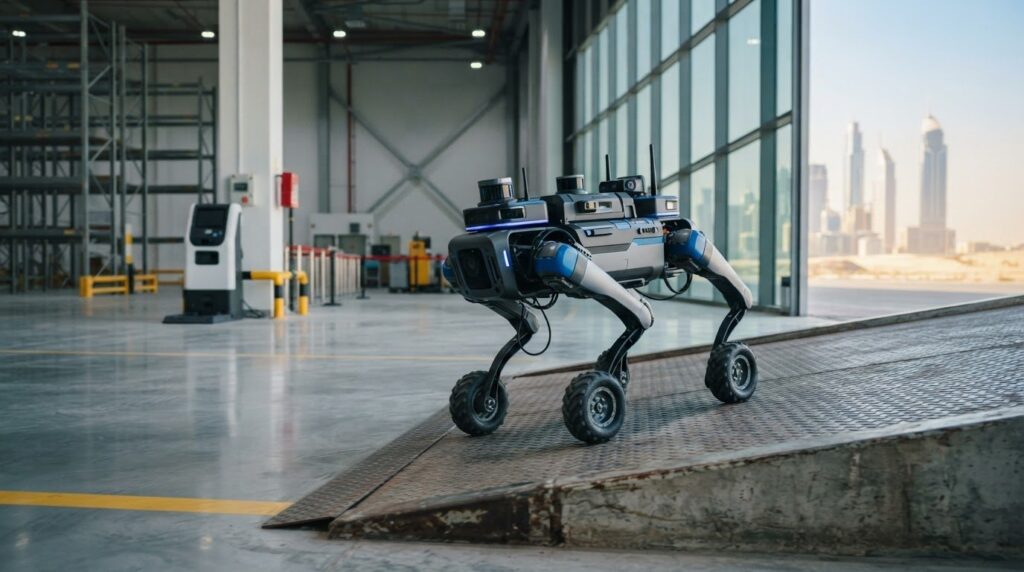
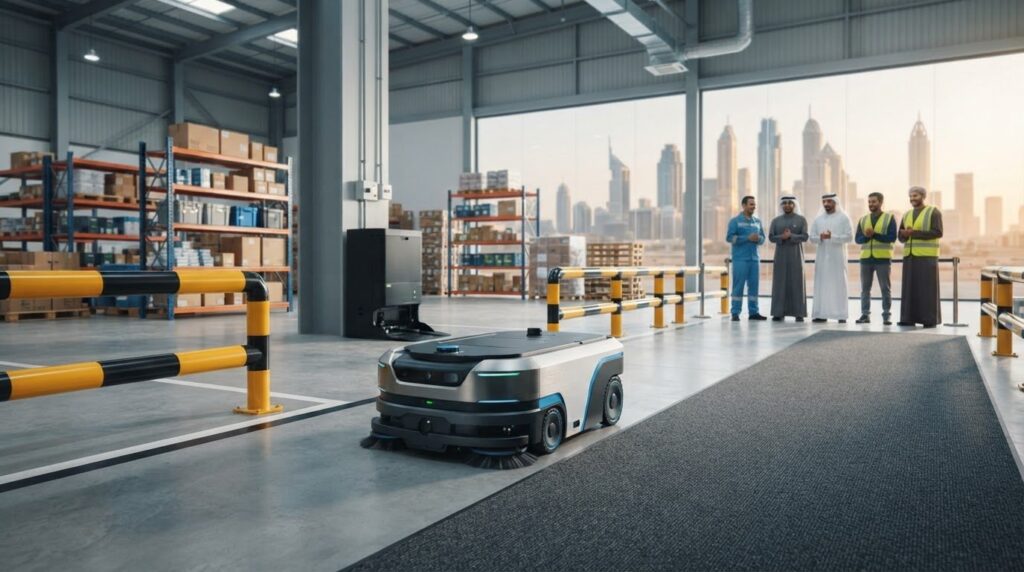
Utilizing advanced onboard intelligence, AMRs have revolutionized the “goods-to-person” picking workflow by eliminating the non-productive travel time associated with manual retrieval. Unlike traditional Automated Guided Vehicles (AGVs) that rely on fixed magnetic strips or wires, modern AMRs leverage LiDAR and Simultaneous Localization and Mapping (SLAM) technology to navigate complex environments autonomously. This flexibility allows them to reroute in real-time if an obstacle is detected, ensuring that fulfillment never grinds to a halt. By deploying these intelligent units, facilities can scale their throughput during peak seasons without the need for permanent, rigid infrastructure changes.
Maximizing Capacity with ASRS
Addressing the challenge of 95% warehouse occupancy in the UAE, automated storage and retrieval systems (ASRS) allow organizations to expand vertically rather than horizontally. These systems utilize high-speed cranes or shuttles to manage inventory in high-density racks that can reach the full height of a facility. Industry benchmarks indicate that ASRS can reduce retrieval times by up to 80% compared to traditional manual bin picking, significantly accelerating the dispatch process. This density is critical in urban micro-fulfillment centers where real estate costs are at a premium and every cubic meter must be utilized for maximum ROI.
Determining the optimal balance between AMRs and fixed ASRS infrastructure depends on your specific product mix and order velocity. Recent academic research on e-commerce logistics highlights that the synergy between fixed and mobile automation is the primary driver of long-term sustainability and operational resilience. While ASRS provides the density needed for bulk storage, AMRs offer the agility required for rapid sorting and last-mile preparation. Implementing these systems in a collaborative environment ensures that human staff can focus on high-value supervisory tasks while robots handle the repetitive, high-volume movements. To identify the specific configuration that best suits your facility, you can explore tailored integration options through EdNex Automation’s technical solutions.
The Invisible Engine: PLC and SCADA Integration
While the physical presence of AMRs and ASRS defines the modern warehouse floor, these systems cannot achieve peak performance without a sophisticated industrial control layer. Providing the intellectual framework for hardware coordination, Programmable Logic Controllers (PLCs) and Supervisory Control and Data Acquisition (SCADA) systems function as the central nervous system of the facility. Implementing automated logistics for e-commerce fulfillment UAE enterprises require involves more than just purchasing robots; it demands a unified digital architecture that synchronizes every movement in real-time. This invisible engine ensures that disparate hardware components communicate fluently, converting raw mechanical power into a disciplined, high-velocity fulfillment operation.
Orchestrating Complex Workflows
Leveraging high-speed processing capabilities, PLC systems serve as the primary interface for synchronizing conveyors, high-speed sorters, and robotic arms into a single, cohesive workflow. In an environment where 24-hour delivery is the baseline, even a micro-second of latency can lead to bottlenecks that ripple through the entire supply chain. Utilizing professional PLC and SCADA integration services allows for the creation of bespoke logic sequences tailored to the specific SKU profiles and throughput requirements of the UAE market. This level of customization ensures that the hardware doesn’t just move; it anticipates the next step in the fulfillment cycle with clinical precision.
Data-Driven Decision Making with SCADA
SCADA systems provide the necessary visibility for high-level oversight, offering real-time data acquisition that identifies operational friction before it impacts the bottom line. By integrating SCADA with an existing Warehouse Management System (WMS), operators gain total transparency over every asset, from the energy consumption of individual motors to the real-time location of every AMR. SCADA systems mitigate operational risks in temperature-controlled environments by maintaining precise climate parameters and triggering automated alerts before thermal fluctuations compromise sensitive inventory. This capability is particularly vital for the UAE’s growing cold-chain e-commerce sector, where environmental stability is non-negotiable.
Bespoke integration proves superior to “out-of-the-box” software solutions because it allows for the implementation of predictive maintenance protocols. Rather than reacting to mechanical failures, these systems analyze vibration and thermal data to predict when a component requires service. This proactive approach eliminates unplanned downtime, ensuring that the facility remains operational 24/7 to meet the demands of a high-growth economy. As businesses face the May 2026 deadline for mandatory GHG emissions reporting, the data captured by SCADA also provides the empirical evidence needed for environmental compliance, positioning the organization as a responsible leader in the Industry 4.0 transition.
Roadmap to Implementation: From Manual to Automated
Transitioning to an autonomous environment requires a methodical, four-phase approach that prioritizes long-term business viability over rapid, superficial fixes. Implementing the automated logistics for e-commerce fulfillment UAE enterprises now require begins with an empirical assessment of existing workflows. Identifying these “automation-ready” segments, such as repetitive sorting or high-frequency picking, allows for a targeted deployment that yields immediate performance gains. Once the audit is complete, the focus shifts to designing a bespoke architecture that balances the high-density storage of ASRS with the dynamic agility of AMRs. This phase ensures that the technical integration of PLC and SCADA systems aligns perfectly with the physical movement of goods. During the third phase, rigorous testing of low-latency communication protocols is essential to prevent bottlenecks. Finally, scaling and continuous optimization utilize real-world throughput data to refine the system, ensuring it adapts to changing market demands.
Calculating ROI in Automated Logistics
Establishing a clear financial rationale for high-tech systems extends beyond simple labor savings. In the regional market, the ability to maximize vertical space through ASRS provides a tangible financial advantage, especially as real estate costs continue to climb. Factoring in 100% order accuracy and improved customer retention rates during peak seasons further accelerates the payback period. Additionally, automated systems provide the precise data tracking required to meet the May 30, 2026, deadline for mandatory Greenhouse Gas (GHG) emissions reporting. The “cost of doing nothing” is particularly steep in a digitizing economy where late-movers risk obsolescence due to rising operational overheads and an inability to meet 24-hour delivery baselines. Investing in automation is a strategic evolution that secures long-term profitability.
Strategic Human-Robot Collaboration
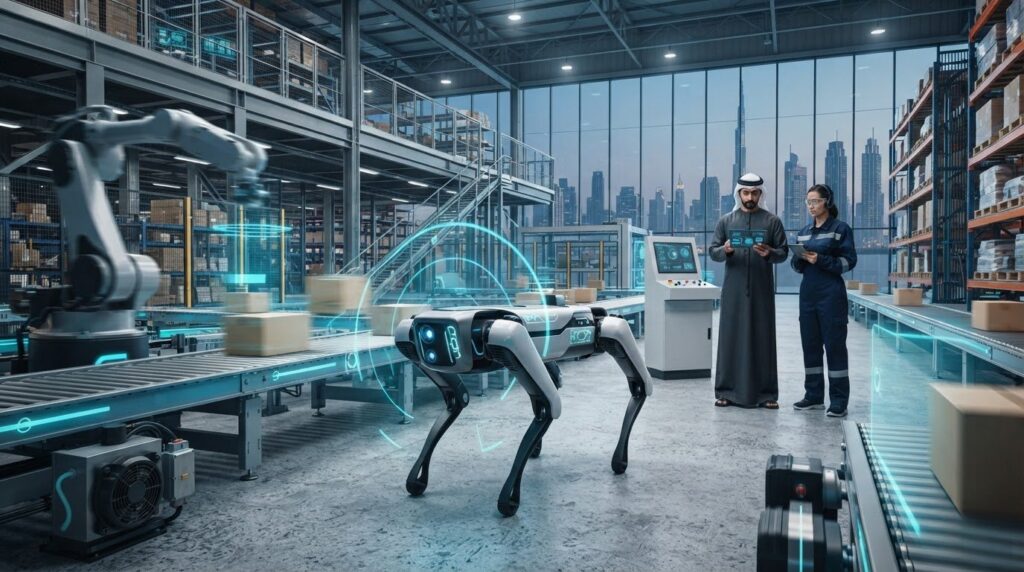
Integrating robotics doesn’t eliminate the human element; it elevates it. Upskilling the workforce to manage and maintain complex systems is a critical component of the Industry 4.0 transition. The deployment of collaborative robots UAE logistics managers are now adopting allows for safe, side-by-side interaction during packing and inspection tasks. These cobots handle repetitive motions with surgical precision, freeing human operators to focus on high-level supervisory roles and system optimization. Organizations ready to begin this transition can consult with our technical integration experts to develop a customized automation roadmap.
EdNex Automation: Leading the Industry 4.0 Transition in the UAE
Acting as a strategic bridge between global technological breakthroughs and regional industrial requirements, EdNex Automation provides the intellectual framework necessary for large-scale industrial transformation. Our specialized division, established in 2018, delivers comprehensive start-to-finish expertise that encompasses everything from intricate PLC programming to the deployment of Autonomous Mobile Robots (AMRs). We understand that automated logistics for e-commerce fulfillment UAE organizations require must be both modular and scalable, ensuring long-term business viability in an increasingly competitive market. By positioning ourselves as a high-level consultant rather than a simple equipment vendor, we ensure that your transition to Industry 4.0 is systematic, deliberate, and highly efficient. We don’t just provide tools; we engineer the future of your supply chain.
Why Partner with a UAE-Based Integrator?
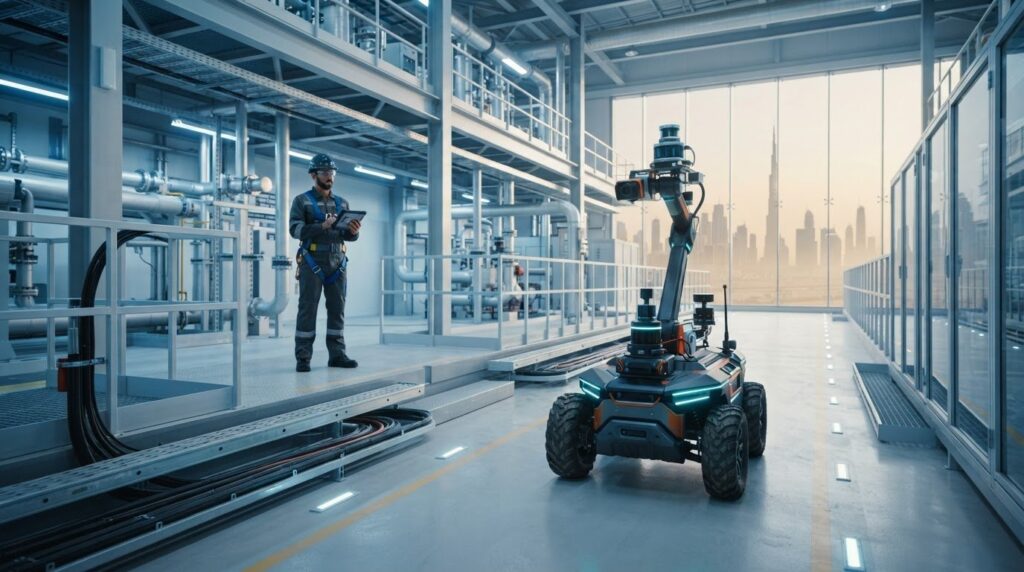
Partnering with a regional integrator offers the distinct advantage of on-the-ground technical support and a profound understanding of local economic regulations. Our proven track record includes the successful deployment of high-density ASRS and advanced robotic surveillance systems tailored to the specific climatic and operational challenges of the Middle East. Holding official certifications and maintaining alliances with global technology leaders, EdNex Automation serves as a marker of legitimacy and reliability for your infrastructure projects. We provide the regional expertise required to navigate the complexities of the UAE’s National Strategy for Artificial Intelligence while ensuring your facility remains at the forefront of innovation. Local presence isn’t just about proximity; it’s about shared economic goals and immediate technical accountability.
Taking the Next Step Toward Autonomy
Initiating your facility’s evolution begins with a professional consultation designed to identify high-impact automation opportunities within your existing workflow. We advocate for a modular approach, allowing you to start with targeted robotic integrations and scale your autonomous capabilities as your business growth dictates. This controlled method of innovation ensures operational stability while building a foundation for future competitiveness. Securing your organization’s future in the 2026 landscape requires more than just tools; it requires a partnership with an industry pioneer who understands the gravity of industrial-scale change. The transition is inevitable. Early adoption is the only way to maintain your market lead.
- Technical Consulting: In-depth operational audits to identify automation-ready segments.
- Bespoke Integration: Custom PLC and SCADA architectures designed for your specific SKU profiles.
- Lifecycle Support: Ongoing maintenance and system optimization to ensure 24/7 operational uptime.
By choosing a partner committed to long-term business viability, you ensure that your investment in automated logistics for e-commerce fulfillment UAE remains a high-performance asset for years to come. Contact EdNex Automation today to begin your journey toward a fully modernized, Industry 4.0 compliant fulfillment center.
Strategizing for a Fully Autonomous Future
Recognizing the urgency of the 2026 industrial mandates, forward-thinking organizations are already shifting toward a hardware-software synergy that ensures long-term viability. Integrating advanced automated logistics for e-commerce fulfillment UAE systems allows businesses to bypass the limitations of physical real estate while maintaining the precision required for high-velocity trade. By combining high-density ASRS with the dynamic agility of AMRs, you can achieve the throughput necessary to meet the 24-hour delivery baseline that regional consumers now expect.
Providing national coverage for technical support, EdNex Automation acts as an official integrator for Industry 4.0 solutions. We leverage specialized PLC and SCADA expertise to ensure your infrastructure isn’t just automated, but intelligently orchestrated for maximum ROI. Transitioning to these systems today secures your competitive standing and ensures compliance with upcoming GHG reporting deadlines. The path to operational excellence and scalable growth starts with a deliberate, expert-led integration strategy.
Consult with our Automation Experts to scale your UAE fulfillment and transform your facility into a leader of the regional digital economy. Your evolution into a high-performance fulfillment hub is the next logical step for sustained success.
Frequently Asked Questions
What is the difference between AMRs and AGVs for e-commerce?
AMRs utilize onboard sensors and LiDAR technology to navigate dynamic environments autonomously, whereas AGVs require fixed infrastructure like magnetic strips or wires. This fundamental difference allows AMRs to reroute around obstacles in real-time, providing the agility necessary for the fluid workflows found in modern e-commerce hubs.
How much does it cost to automate a warehouse in the UAE?
Total investment for warehouse automation varies significantly based on the facility’s scale and the specific technologies integrated into the workflow. Organizations should evaluate these expenditures against long-term operational savings, including reduced labor dependency and the optimization of Grade A warehouse space where occupancy remains at 95%.
Can automated logistics systems integrate with my existing Shopify or Magento store?
Modern automated logistics for e-commerce fulfillment UAE systems are designed to interface seamlessly with major platforms like Shopify and Magento through robust API layers. This synchronization ensures that order data flows directly into the warehouse control system, maintaining 100% inventory accuracy across all sales channels.
What is the role of PLC and SCADA in a robotic warehouse?
PLCs function as the industrial logic layer that executes precise mechanical movements, while SCADA provides the supervisory interface for real-time data acquisition and system monitoring. This combination creates a unified control environment that allows operators to identify bottlenecks and optimize throughput from a centralized dashboard.
How long does it take to implement an ASRS system?
Implementation timelines depend on the specific architectural complexity and the density of the storage requirements. A phased deployment strategy ensures that technical integration and testing occur systematically, allowing for a controlled transition that minimizes disruption to ongoing fulfillment activities.
Is automation suitable for small to medium-sized e-commerce businesses?
Modular automation solutions allow SMEs to implement scalable technology that expands in alignment with their growth trajectory. By starting with targeted AMR deployments or small-scale robotic picking, smaller organizations can achieve significant efficiency gains without the need for a total facility overhaul.
What maintenance is required for autonomous mobile robots?
Maintenance for AMRs involves routine sensor calibration and hardware inspections to ensure peak navigational performance. Utilizing SCADA-driven data allows for a shift toward predictive maintenance, where system alerts identify potential component wear before it results in unplanned operational downtime.
Does EdNex Automation provide training for our existing staff?
We provide comprehensive technical upskilling as a core component of our full-service integration approach. This training ensures that your existing workforce is fully equipped to manage, monitor, and maintain the advanced robotic systems, facilitating a smooth transition to an Industry 4.0 environment.