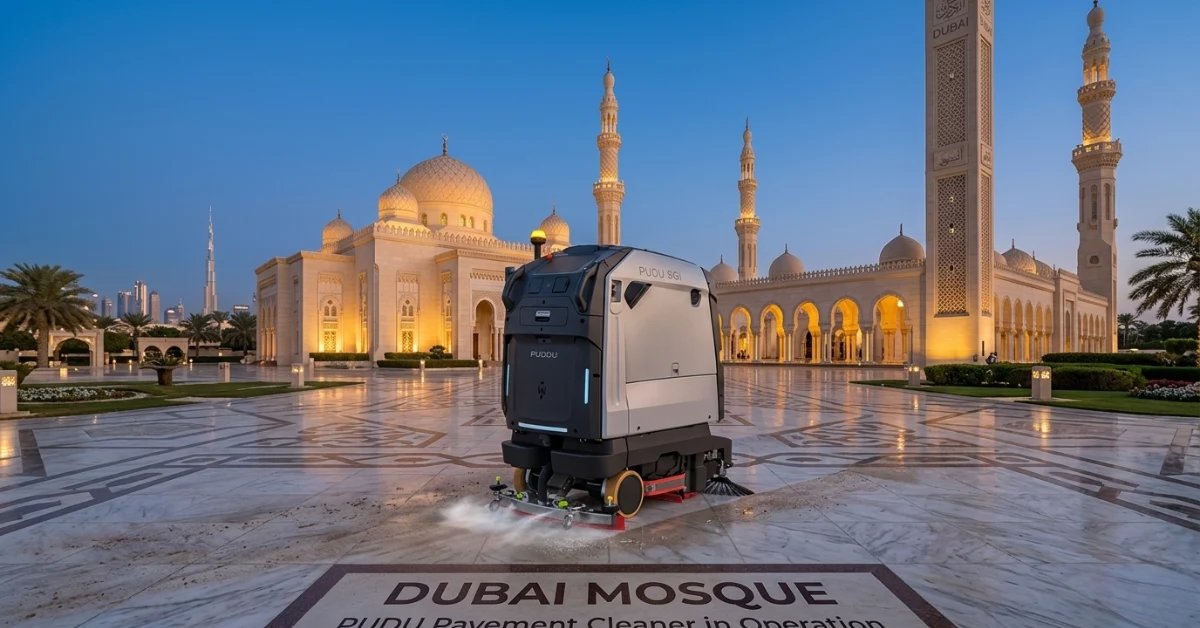
By 2030, the UAE cleaning robot market is projected to reach AED 820.5 million, marking a decisive shift toward high-tech infrastructure maintenance. You’ve likely found that traditional manual labor is increasingly incapable of meeting the rigorous demands of the Emirates’ climate. High turnover rates and the impact of extreme heat on human productivity make outdoor cleaning automation a critical requirement for any resilient industrial operation. Relying on autonomous systems ensures that your facility maintains elite standards while mitigating the risks associated with manual workforce dependency.
We recognize that balancing operational costs against the need for consistent cleanliness in sand-heavy environments is a constant challenge for modern managers. This analysis promises to show you how autonomous outdoor cleaning is transforming large-scale facility management through advanced robotics and AI-driven efficiency. We’ll examine the strategic transition toward 24/7 automated fleets and the specific technological frameworks that ensure long-term business viability in the Gulf region.
Key Takeaways
- Analyze the critical evolution from basic machinery to fully intelligent outdoor cleaning automation systems that define the 2026 UAE industrial landscape.
- Evaluate the integration of LiDAR and SLAM technologies for precise navigation through dynamic and challenging outdoor environments without human oversight.
- Identify how autonomous fleets serve as mobile IoT nodes, delivering actionable data-driven insights for proactive facility management and maintenance.
- Implement a strategic roadmap for scaling your robotic fleet, beginning with comprehensive facility audits to mitigate environmental risks and optimize hardware selection.
- Leverage bespoke integration expertise to align advanced robotic capabilities with specific industrial requirements, ensuring measurable ROI and long-term business viability.
Defining Outdoor Cleaning Automation: The 2026 Landscape
The landscape of urban maintenance is undergoing a fundamental transformation. Leveraging the UAE’s Artificial Intelligence Strategy 2031, industries are moving beyond simple mechanical assistance toward comprehensive self-governance. While the traditional Street sweeper required constant human intervention, the 2026 standard demands fully autonomous mobile robots (AMRs) capable of navigating complex environments. This isn’t just a technological upgrade; it’s a strategic necessity for national industrial resilience. By adopting outdoor cleaning automation, facilities align themselves with a future where operational efficiency is decoupled from manual labor constraints.
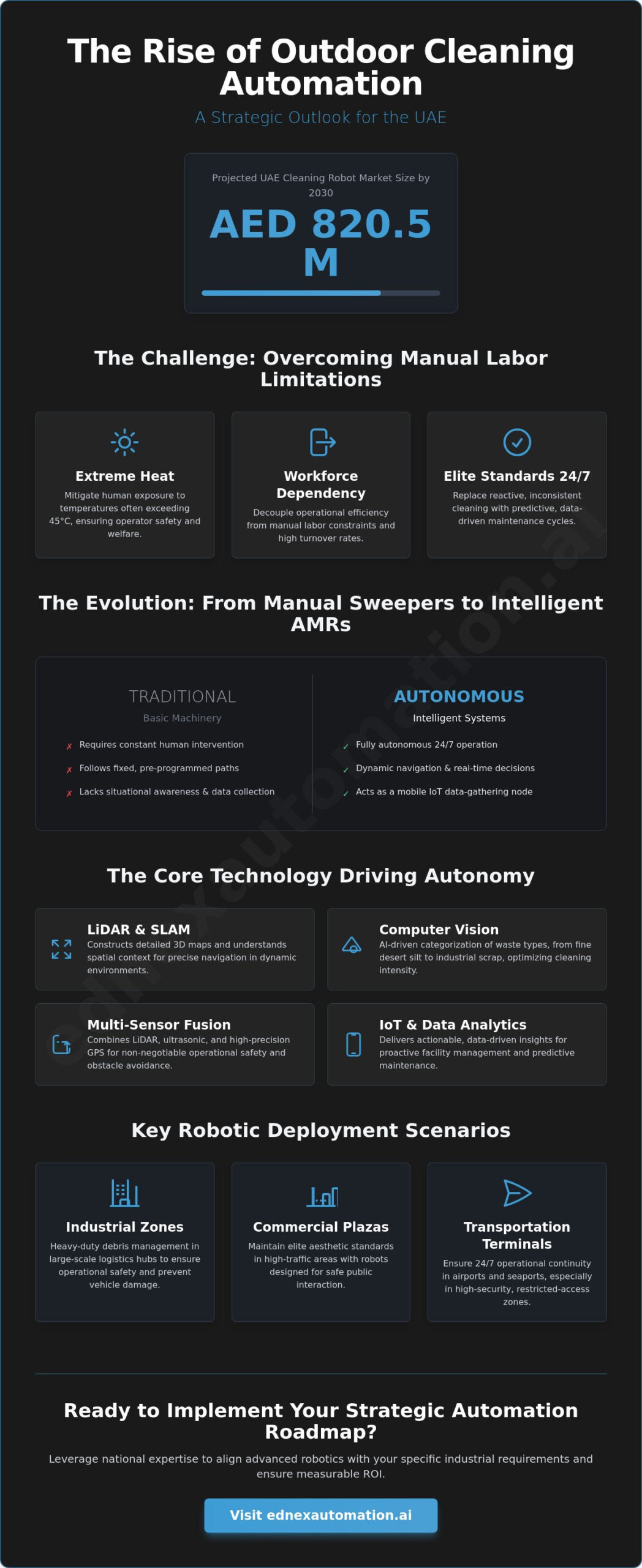
Distinguishing between basic robotic tools and advanced AMRs is vital for any facility manager. Basic tools follow pre-programmed paths and lack situational awareness. In contrast, modern autonomous systems utilize sophisticated SLAM and LiDAR technology to make real-time decisions, identifying obstacles and optimizing routes dynamically. With the UAE cleaning robot market projected to reach approximately AED 820.5 million by 2030, 2026 has become the tipping point where these systems move from experimental trials to standard operational protocols across the commercial sector.
The Shift from Manual to Autonomous Urban Maintenance
Facing record labor turnover and extreme environmental stressors, UAE facility managers are prioritizing human safety and operational consistency. Deploying autonomous systems allows organizations to mitigate the risks of human exposure to temperatures that often exceed 45°C. This transition replaces reactive, labor-intensive cleaning with predictive maintenance cycles. By utilizing robots as mobile sensors, businesses shift from cleaning when visible dirt appears to data-driven optimization. It’s a method that guarantees elite standards without the inconsistencies of human fatigue or environmental hazards.
Key Scenarios for Outdoor Robotic Deployment
Different environments demand specialized robotic integration to achieve measurable ROI. Across the Emirates, three primary sectors are leading this adoption:
- Industrial Zones: Large-scale logistics hubs require heavy-duty debris management to ensure operational safety and prevent vehicle damage. Facilities operating across vast industrial parks can benefit significantly from a dedicated robotic street sweeper UAE strategy, which shifts operations from reactive manual labor to predictive, high-tech asset management capable of covering over 120,000 square meters on a single charge.
- Commercial Plazas: High-traffic recreational areas demand elite aesthetic standards while requiring robots that can interact safely with the public. Retail environments in particular benefit from robotic cleaning solutions for malls, which deliver consistent hygiene across millions of square feet while significantly reducing operational expenditure.
- Transportation Terminals: Airports and sea ports utilize autonomous fleets to maintain 24/7 continuity in high-security zones where human access is often restricted.
Implementing outdoor cleaning automation in these scenarios doesn’t just improve hygiene. It supports the UAE’s broader sustainability goals, as seen in Abu Dhabi’s recent 40% reduction in carbon emissions through smart fleet management. Organizations that integrate these systems today are securing their competitive edge for the next decade of industrial evolution.
The Technology Stack Behind Autonomous Outdoor Cleaning
Achieving reliable outdoor cleaning automation requires a sophisticated convergence of aerospace-grade hardware and advanced machine learning. While indoor robots operate in controlled environments, outdoor systems must process a chaotic influx of data from shifting shadows, moving vehicles, and unpredictable weather patterns. The modern stack relies on high-definition LiDAR and Simultaneous Localization and Mapping (SLAM) to construct detailed 3D environments in real-time. These systems don’t just follow a path; they understand their spatial context with surgical precision.
Computer Vision serves as the cognitive layer, allowing the robot to categorize waste types across industrial and urban zones. By training on vast datasets of regional debris, from fine desert silt to heavy industrial scrap, AI-driven systems optimize their cleaning intensity based on the specific material detected. This intelligent resource allocation ensures that water and battery power are conserved for high-impact zones, reflecting a methodical approach to large-scale facility maintenance. It’s a level of intelligence that turns a simple cleaning tool into a sophisticated industrial asset.
Advanced Navigation and Obstacle Avoidance
Operational safety in public spaces is non-negotiable. Modern AMRs utilize multi-sensor fusion, combining LiDAR with ultrasonic sensors and high-precision GPS to maintain centimeter-level accuracy. This redundancy allows for real-time path planning, where the robot instantly recalculates its route to avoid sudden foot traffic or heavy machinery. Integrating bespoke robotic solutions into your existing infrastructure ensures that these safety protocols meet the highest international standards, such as ISO 10218, without compromising on cleaning frequency.
Ingress Protection and Environmental Resilience
Engineering for the UAE requires addressing the twin challenges of high-salinity coastal air and extreme desert heat. Robots must adhere to strict IP65 or IP67 ratings to prevent fine sand particles from compromising internal components. Effective thermal management systems are equally critical, utilizing active cooling to protect sensitive electronics when ambient temperatures peak. To maintain operational continuity, self-cleaning mechanisms for optical sensors are often integrated, ensuring the robot’s vision remains clear even during sandstorms or high-humidity cycles.
Energy management has also evolved to support the nation’s sustainability vision. Many systems now feature solar-integrated charging stations and high-density lithium-ion batteries designed for long-life cycles. These advancements ensure that your fleet remains operational across 24/7 schedules, delivering a measurable ROI through reduced energy costs and minimized downtime. This technological framework isn’t just about cleaning; it’s about building a durable, intelligent infrastructure for the future of the Emirates.
Strategic Benefits and 2026 Trend Analysis
Deploying outdoor cleaning automation isn’t merely a tactical choice; it’s a strategic pivot toward long-term business viability in the Emirates. As the UAE cleaning robot market moves toward a projected revenue of AED 820.5 million by 2030, the focus has shifted from simple debris removal to measurable operational optimization. Organizations now achieve a higher cleaning frequency without the variable costs associated with manual labor. This steady operational flow ensures that large-scale facilities maintain elite standards 24/7, providing a level of consistency that manual teams can’t replicate in extreme environments.
Beyond physical cleanliness, these autonomous mobile robots function as mobile IoT nodes. They capture critical environmental data, transforming a routine maintenance task into a sophisticated facility inspection process. By utilizing cleaning robots as sensors, managers gain real-time visibility into infrastructure health, identifying potential issues before they escalate into costly repairs. This data-driven approach aligns perfectly with the UAE’s vision for smart, responsive industrial hubs where every asset contributes to a larger ecosystem of intelligence.
The Rise of Robots-as-a-Service (RaaS)
The financial framework for adopting advanced technology is shifting from heavy capital expenditure (CAPEX) to flexible operating expenditure (OPEX). Subscription-based models are lowering the barrier to entry for large facilities, allowing for rapid scaling without massive upfront investments. This RaaS model ensures that your organization always has access to the latest software updates and hardware iterations. It’s a method that prioritizes continuous improvement, ensuring your robotic fleet evolves alongside the rapid pace of technological breakthroughs in the region.
Integration with Smart City Infrastructure
Modern outdoor cleaning robots don’t operate in isolation; they connect directly to centralized SCADA systems for facility-wide monitoring. This integration allows for automated reporting and compliance audits, generating detailed cleanliness logs without manual input. Many systems now act as environmental monitors, tracking air quality and temperature gradients while they navigate their routes. This multi-functional capability supports the UAE’s sustainability goals, as evidenced by Abu Dhabi’s smart cleaning fleet which contributed to a 40% reduction in carbon emissions between 2024 and 2025.
Transitioning to an automated model also necessitates a shift in workforce strategy. Human staff are no longer tied to manual labor in high-heat conditions; instead, they’re reskilled to supervise and manage complex robotic fleets. This evolution doesn’t just improve safety; it enhances the professional value of the workforce, moving them into high-tech roles that support the nation’s knowledge-based economy. It’s a comprehensive transformation that secures both operational efficiency and environmental responsibility for the modern industrial era.
Implementation Roadmap: Scaling Your Autonomous Fleet
Scaling an autonomous fleet is a systematic evolution that demands more than just hardware procurement; it requires a structured integration strategy. Transitioning from a single pilot unit to a comprehensive network of machines ensures that your facility achieves maximum ROI while maintaining the elite standards expected in the Emirates. This roadmap provides the intellectual framework necessary for successful implementation, moving your organization from reactive maintenance to a state of controlled, deliberate innovation.
Step 1: Conduct a comprehensive facility audit. Identifying high-impact cleaning zones and understanding the frequency of debris accumulation is the foundation of any deployment.
Step 2: Select hardware based on environmental stressors. In the UAE, choosing machines with superior ingress protection against fine desert silt is non-negotiable.
Step 3: Execute Pilot programs. Proof of Concept (PoC) testing in controlled environments allows you to validate performance before committing to a wide-scale rollout.
Step 4: Move to full-scale integration. This phase focuses on staff training for fleet orchestration, ensuring your team can manage multiple units simultaneously.
Conducting a Technical Site Assessment
Ensuring 24/7 uptime requires a deep dive into the physical and digital infrastructure of your site. Evaluating connectivity requirements is paramount; robots depend on reliable 5G or Wi-Fi networks for real-time monitoring and remote intervention. You must also identify optimal charging station locations and ‘no-go’ zones where robotic presence might interfere with critical industrial operations. Mapping surface gradients and drainage systems is equally vital, as these factors directly impact cleaning path efficiency and water recovery in scrubbers. This level of preparation ensures that outdoor cleaning automation delivers on its promise of consistent, high-level hygiene.
Orchestrating a Multi-Robot Fleet
The true power of outdoor cleaning automation is realized when different robot types work in harmony. Managing a multi-robot fleet involves using a centralized dashboard to monitor the health and performance of every unit across your facility. Coordinating collaborative cleaning-where heavy-duty sweepers clear large debris followed by precision scrubbers for fine dust-provides a total hygiene solution that manual teams can’t match. Learn how to scale with autonomous mobile robots to ensure your organization remains at the forefront of industrial innovation.
Implementing these systems requires a technical partner who understands the specific challenges of the regional market. If you’re ready to modernize your facility maintenance and reduce your dependency on manual labor, consult with our automation experts today to design a bespoke fleet strategy that fits your unique infrastructure needs.
The EdNex Advantage: National Expertise in Outdoor Automation
Establishing a leadership position in the Emirates requires more than just acquiring advanced machinery; it demands a technical partner capable of orchestrating a comprehensive automation ecosystem. EdNex Automation provides the intellectual and engineering framework necessary to move beyond standalone equipment toward fully integrated industrial environments. By linking autonomous mobile robots with Automated Storage and Retrieval Systems (ASRS) and PLC/SCADA frameworks, we ensure that outdoor cleaning automation becomes a seamless component of your facility’s broader modernization strategy. This holistic approach guarantees that every robotic asset contributes to a unified, data-driven operational flow.
Providing end-to-end technical support is a cornerstone of our service delivery model. We guide organizations through every phase of the lifecycle, from initial site audits and bespoke integration to long-term maintenance and software optimization. Our engineering teams don’t just deploy robots; they build resilient infrastructures designed to thrive in the unique environmental stressors of the Gulf. This commitment to technical excellence ensures that your investment remains viable as regional standards and technological capabilities continue to evolve.
Bridging Global Innovation and Regional Needs
Leveraging strategic alliances with global technology pioneers, we carefully select and certify hardware that meets strict national industrial standards. This rigorous vetting process ensures that every system we deploy is optimized for the high-heat and high-salinity conditions characteristic of the UAE. We’re dedicated to driving the nation’s Industry 4.0 transformation by providing the tools and expertise necessary for manufacturing and logistics sectors to remain globally competitive. You can explore our full range of collaborative robots UAE to understand how we bridge the gap between global breakthroughs and regional industrial requirements.
Start Your Automation Journey with EdNex Automation
Navigating the transition to autonomous maintenance requires a clear understanding of financial impact and operational ROI. We offer specialized consulting services to help you determine the commercial floor cleaning robot price and long-term value for your specific site. Beyond the initial acquisition, our partners benefit from a robust regional logistics network that provides certified technical support and immediate access to spare parts. This localized expertise minimizes downtime and ensures that your outdoor cleaning automation fleet maintains peak performance throughout its operational life.
Securing your facility’s future starts with a deliberate shift toward intelligent, self-governing systems. If you’re ready to redefine your maintenance standards and achieve measurable efficiency gains, contact our engineering team for a visionary assessment of your facility’s automation potential. We provide the technical expertise and regional insight necessary to transform your outdoor maintenance into a high-tech industrial asset.
Securing Industrial Resilience Through Autonomous Innovation
The transition toward fully autonomous urban maintenance is no longer a peripheral consideration; it’s a fundamental requirement for the long-term viability of UAE industries. By adopting outdoor cleaning automation, organizations decouple their facility standards from the constraints of manual labor and extreme environmental stressors. This strategic shift transforms routine maintenance into a sophisticated data-gathering operation, delivering the intellectual framework needed for true Industry 4.0 integration. Organizations that embrace these systems today ensure their competitive standing in a region that prioritizes technological leadership and sustainable growth.
Utilizing our official certification with global robotic leaders, we offer the technical framework required for seamless implementation across complex infrastructures. We bridge the gap between global breakthroughs and regional needs through our deep expertise in PLC and SCADA integration and a robust national support network for industrial maintenance. Partner with EdNex for Advanced Outdoor Automation to begin your facility’s evolution today. We’re ready to help you navigate this transformative landscape with precision and confidence.
Frequently Asked Questions
What is the primary difference between indoor and outdoor cleaning robots?
Outdoor systems are engineered with high Ingress Protection (IP) ratings and ruggedized chassis to withstand environmental stressors that indoor units don’t encounter. While indoor robots operate on level surfaces with controlled lighting, outdoor units utilize long-range LiDAR and high-precision GPS to navigate uneven terrain and shifting sunlight. This structural resilience ensures that outdoor cleaning automation remains effective across expansive industrial yards and public plazas.
Can outdoor cleaning robots operate in extreme heat and sandstorms?
Yes, industrial-grade robots are specifically designed with active thermal management systems to maintain operational integrity in temperatures exceeding 45°C. These units also feature sealed components with IP65 or IP67 ratings to prevent fine desert silt from infiltrating sensitive electronics during sandstorms. Such engineering ensures that the fleet continues to meet hygiene standards even during the most challenging UAE weather cycles.
How do autonomous cleaning robots handle obstacles like pedestrians or parked cars?
Autonomous robots utilize multi-sensor fusion, combining LiDAR, ultrasonic sensors, and computer vision to maintain 360-degree situational awareness. This allows the system to identify and categorize moving objects, such as pedestrians or vehicles, and recalculate its path in real-time to ensure zero-collision performance. These safety protocols are essential for maintaining operational continuity in high-traffic commercial zones and transportation terminals.
What is the typical ROI period for an outdoor cleaning automation system?
The ROI for an automated system is typically realized through a significant reduction in variable labor costs and an increase in cleaning frequency. While the specific period depends on the scale of the facility, organizations often see measurable returns by shifting from reactive manual cleaning to a 24/7 automated model. This transition mitigates the financial risks associated with high labor turnover and environmental productivity losses.
Do I need to modify my facility’s infrastructure to support robotic cleaning?
Most facilities require minimal structural modifications, primarily focusing on the installation of autonomous docking stations and ensuring robust network connectivity. Establishing reliable 5G or Wi-Fi coverage is critical for real-time monitoring and fleet orchestration. We conduct technical site assessments to identify optimal charging locations and ensure that the existing infrastructure can support the power requirements of a large-scale robotic fleet.
How often do outdoor cleaning robots require maintenance or manual intervention?
Modern autonomous robots are designed for high uptime, typically requiring only brief daily checks to ensure sensors are clear of dust and debris. Mechanical maintenance cycles are scheduled based on operational hours, similar to traditional industrial machinery but with fewer moving parts. This systematic approach ensures that manual intervention is kept to a minimum, allowing your team to focus on high-level fleet supervision.
Are there specific regulations for operating autonomous robots in public spaces in the UAE?
The UAE has established a robust regulatory framework, including Ras Al Khaimah Law No. (1) of 2026 and Dubai RTA legislation, to govern the trial and operation of autonomous systems. All deployments must adhere to international safety standards such as ISO 10218 and ISO/TS 15066 for collaborative robotics. These regulations ensure that outdoor cleaning automation is integrated into public and industrial spaces with strict adherence to cybersecurity and data governance protocols.