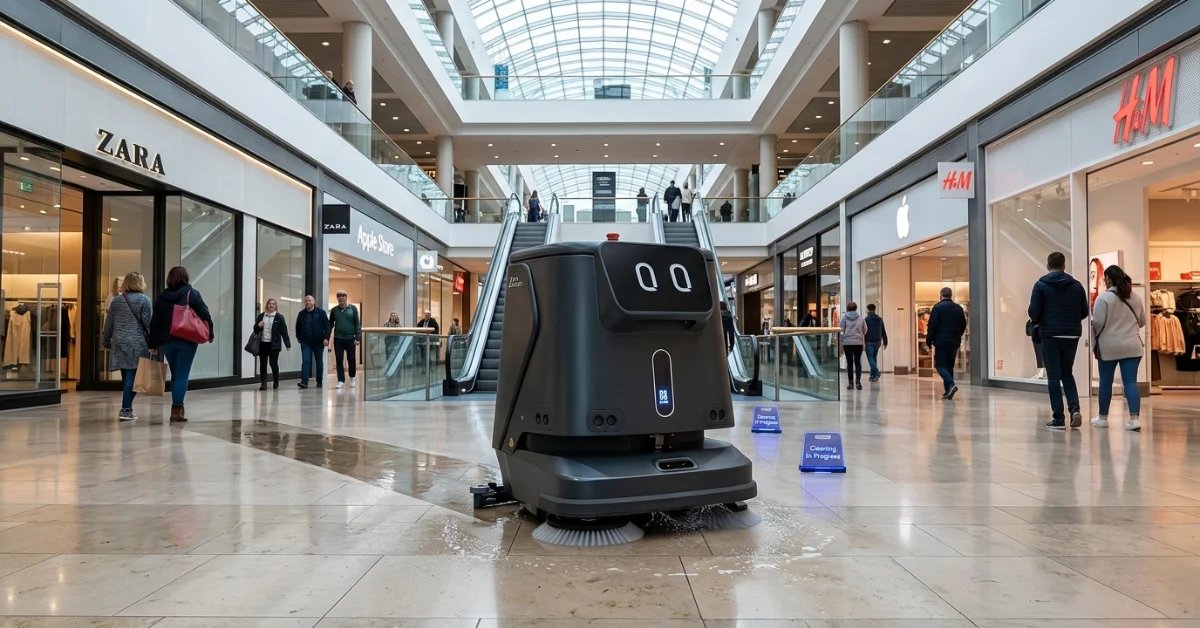
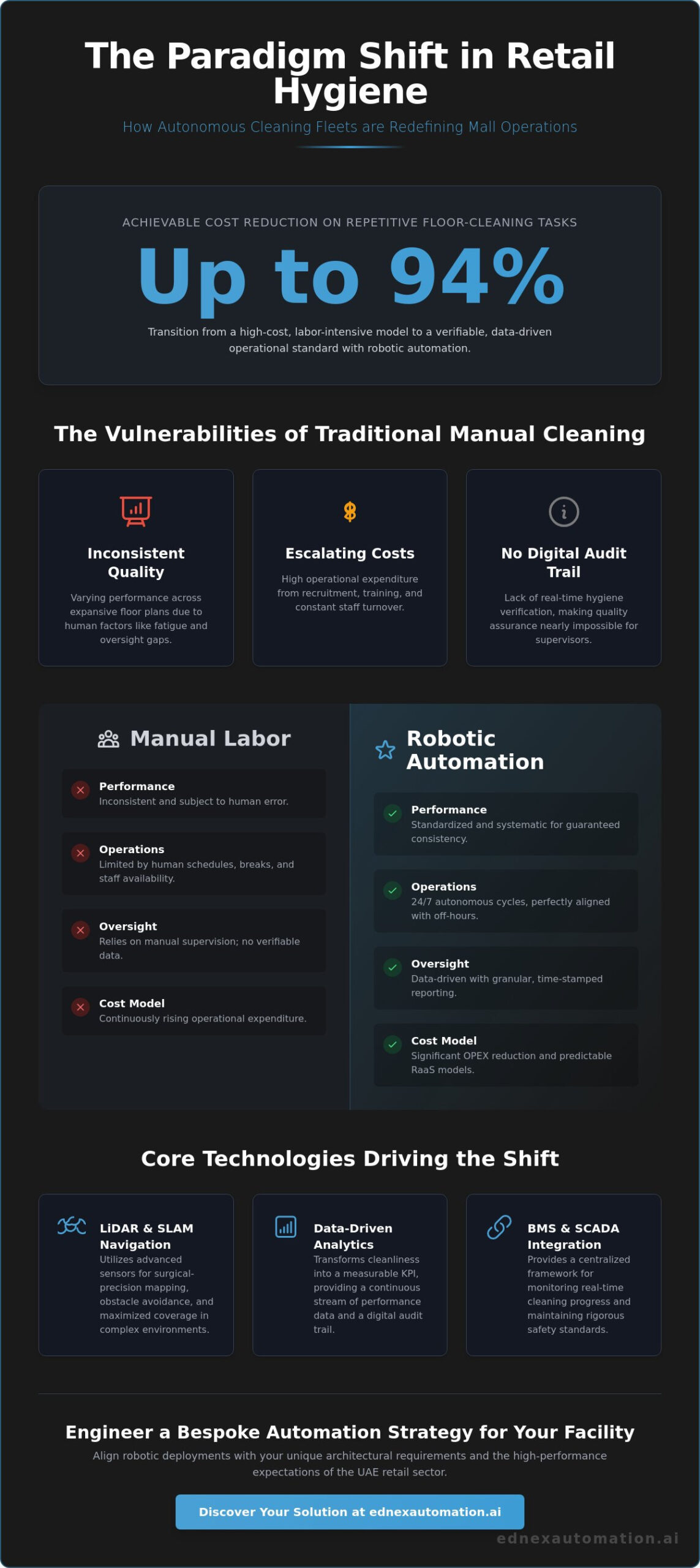
Achieving a cost reduction of up to 94% on repetitive floor-cleaning tasks has transitioned from a visionary ambition to a verifiable operational standard for modern retail hubs. Implementing robotic cleaning solutions for malls is now the definitive strategy for facility leaders who must navigate the dual pressures of rising labor costs and the logistical complexity of supervising manual crews during off-hours. You’ve likely recognized that maintaining consistent hygiene across millions of square feet requires a level of precision that traditional manual labor simply can’t sustain.
This strategic guide demonstrates how autonomous cleaning fleets transform retail hygiene into a data-driven asset while significantly lowering your operational expenditure. We’ll analyze the latest 2026 hardware innovations, the shift toward flexible Robotics-as-a-Service models, and the technical integration of these systems into your existing facility management software. By adopting this Industry 4.0 approach, you’ll position your organization as a leader in the UAE’s evolving retail infrastructure, ensuring long-term viability through controlled and deliberate innovation.
Key Takeaways
- Understanding the shift from labor-intensive models to data-driven hygiene management allows facility managers to eliminate inconsistencies and mitigate rising operational overhead.
- Implementing diverse robotic cleaning solutions for malls enables a specialized approach to maintenance, utilizing task-specific units for high-gloss atriums and complex food court layouts.
- Selecting the optimal fleet requires a technical assessment of navigation intelligence and autonomous docking capabilities to ensure uninterrupted service cycles in large-scale environments.
- Leveraging SCADA and Building Management System integration provides a centralized framework for monitoring real-time cleaning progress and maintaining rigorous safety standards.
- Engineering a bespoke automation strategy ensures that robotic deployments align perfectly with the complex architectural requirements and high-performance expectations of the UAE retail sector.
The Paradigm Shift in Retail Hygiene: Why Malls are Transitioning to Autonomous Systems
The transition to robotic cleaning solutions for malls represents a fundamental restructuring of facility management. In the hyper-competitive UAE retail landscape, maintaining pristine environments across millions of square feet requires an engineering-minded approach that manual labor cannot consistently replicate. Moving beyond traditional janitorial services, modern mall operators are embracing a data-driven hygiene model that treats cleanliness as a measurable KPI rather than an anecdotal outcome. This evolution is driven by the sheer scale of regional infrastructure, where the logistical burden of supervising manual cleaning during off-hours often leads to inconsistent quality and escalating operational expenditure.
Shifting to autonomous systems mitigates the inherent risks of unsupervised night-shift cleaning operations. While manual crews often face high staff turnover and varying levels of training, robotic fleets deliver a standardized performance that remains unaffected by human fatigue or oversight gaps. This systematic approach ensures that every square meter of high-traffic flooring meets rigorous safety and aesthetic standards before the first customer arrives.
The Limitations of Traditional Manual Cleaning
Janitorial frameworks in massive retail spaces often face inherent systemic failures. Relying on human labor for repetitive, large-scale floor maintenance introduces several critical vulnerabilities:
- Inconsistency in cleaning quality across expansive floor plans;
- High operational costs tied to recruitment, training, and escalating staff turnover;
- The absence of real-time hygiene verification for management stakeholders.
Without a digital audit trail, facility managers struggle to confirm if specific zones were treated to the required standard. This lack of transparency is particularly problematic in the UAE’s massive retail complexes, where the physical scale makes manual inspection nearly impossible for a single supervisor. Autonomous systems solve this by providing granular, time-stamped reporting for every cleaning cycle.
The Strategic Advantage of 24/7 Autonomous Operation
Deploying autonomous fleets allows for uninterrupted cleaning cycles that align perfectly with mall operating hours. These units don’t require breaks and can be programmed to prioritize high-traffic zones during peak times or deep-clean atriums during the early morning hours. By removing the constraints of human scheduling, malls maintain a baseline of hygiene that’s impossible to achieve with manual labor alone.
These systems navigate complex environments with surgical precision by utilizing advanced robotic cleaning technologies. Leveraging LiDAR and SLAM (Simultaneous Localization and Mapping), these machines avoid obstacles and map routes that maximize coverage while minimizing energy consumption. Autonomous cleaning represents a sophisticated fusion of robotics and real-time data analytics.
By adopting robotic cleaning solutions for malls, facility leaders effectively transform their maintenance department into a high-tech operational asset. These systems provide a continuous stream of performance data, allowing for immediate intervention if a deviation from the cleaning protocol occurs. This shift doesn’t just replace labor; it optimizes the entire facility ecosystem for the Industry 4.0 era.
Core Technologies: A Roundup of Advanced Robotic Cleaning Solutions for Malls
Transitioning from manual janitorial models to a sophisticated fleet management strategy requires a granular understanding of specialized machinery. Modern robotic cleaning solutions for malls are no longer monolithic tools; they’re engineered as task-specific assets designed to address the unique topographical challenges of large-scale retail environments. By categorizing these units by functionality, ranging from heavy-duty scrubbers to precision vacuum systems, facility managers can implement a heterogeneous fleet that maintains a consistent aesthetic across diverse zones. Integrating multi-function units further optimizes this approach, allowing a single platform to handle varying floor types without requiring manual reconfiguration.
Deploying specialized robots for food courts versus high-gloss atriums ensures that each environment receives the appropriate level of care. Food courts, characterized by high debris volume and frequent liquid spills, necessitate robust scrubbing power and high-capacity waste management. Conversely, grand atriums and luxury corridors demand precision polishing to maintain the reflective finish of premium marble or granite. For those seeking to expand their operational scope, investigating bespoke fleet integration provides a clear path toward comprehensive facility modernization.
Autonomous Floor Scrubbers and Polishers
Heavy-duty autonomous scrubbers represent the backbone of mall maintenance, specifically engineered for the high-traffic granite and marble surfaces found in regional retail hubs. These units frequently incorporate Active-DryTec capabilities, ensuring immediate floor drying to mitigate the risk of slip-and-fall incidents in busy thoroughfares. By utilizing advanced pressure sensors and variable water-flow technology, these robots adapt their cleaning intensity based on the soil level detected. For a more technical analysis of these systems, facility leaders should explore our guide on autonomous cleaning robots, which details the industrial specifications required for continuous operation.
Intelligent Vacuuming and Dust Control
Maintaining air quality within enclosed retail spaces is a critical component of the modern shopping experience. Intelligent vacuuming units equipped with HEPA filtration systems don’t just remove visible debris; they capture microscopic allergens and dust particles that compromise indoor air health. These robots utilize edge-cleaning technology to ensure thoroughness in narrow corridors and corners that traditional machines often miss. Key features include:
- Adaptive suction power that automatically increases when transitioning from hard floors to carpeted play areas;
- Advanced sensor arrays that detect and navigate around temporary kiosks or seasonal displays;
- Real-time debris sensing to prioritize areas with higher concentrations of dust.
Extending these capabilities beyond the interior, the emergence of outdoor cleaning automation now addresses mall perimeters and parking structures. These ruggedized units are designed to withstand the UAE’s environmental conditions while clearing sand, litter, and debris from expansive exterior surfaces. For facilities seeking to address the full scope of exterior hygiene, a dedicated robotic street sweeper UAE strategy provides the authoritative framework for managing desert sand and extreme temperature challenges across vast perimeter areas. Implementing such comprehensive robotic cleaning solutions for malls ensures that the customer’s high-standard experience begins the moment they enter the property perimeters.
Strategic Evaluation Criteria: Selecting the Right Fleet for High-Traffic Environments
Selecting high-performance robotic cleaning solutions for malls requires a rigorous technical audit of navigation intelligence and sensor architecture. While LiDAR provides precise spatial mapping in structured environments, vision-based systems leverage camera arrays and AI to identify dynamic obstacles like shopping carts or temporary kiosks. Integrating both technologies creates a redundant navigation layer that’s essential for maintaining safety in crowded thoroughfares. Beyond navigation, assessing battery density and autonomous docking capabilities ensures that the fleet remains operational during peak hours without requiring manual intervention for charging or tank depletion.
Safety sensor redundancy in high-density retail spaces hinges on a multi-layered detection approach. Modern units employ ultrasonic sensors for transparent obstacle detection combined with physical bumpers as a final fail-safe. This engineering-led focus on safety isn’t just a technical requirement; it’s a fundamental necessity for protecting patrons and mall assets in unpredictable, high-traffic environments. These systems must demonstrate zero-collision performance under various lighting conditions and floor reflectivities to be considered viable for premium retail assets.
Operational ROI and Cost Efficiency
Facility managers who analyze the long-term viability of an autonomous fleet must look beyond the initial acquisition. Calculating the total cost of ownership involves evaluating the reduction in labor turnover and the optimization of chemical consumables through precision dosing systems. According to industry reports from late 2025, robotic automation can lead to a cost reduction of up to 94% on repetitive floor-cleaning tasks. For a detailed breakdown of these variables, our commercial floor cleaning robot price analysis provides a framework for evaluating investment scales. Additionally, the presence of automated, time-stamped cleaning reports can positively influence insurance premiums by providing verifiable proof of maintenance and risk mitigation.
Environmental Adaptability and Sustainability
Regional environmental factors in the UAE demand systems that can manage the transition between climate-controlled interiors and humid entryways. Dust and sand infiltration are constant challenges that require high-efficiency filtration and robust sealing of internal components to prevent mechanical failure. To address perimeter maintenance and parking structures, implementing outdoor cleaning automation ensures that abrasive particles are captured before they’re tracked into the main mall area. These systems often feature water recycling modules that drastically reduce the environmental footprint of large-scale operations, aligning facility management with regional sustainability mandates and ESG goals.
Operational Integration: Human-Robot Collaboration and Safety Standards
Success in deploying robotic cleaning solutions for malls depends on moving beyond standalone hardware toward a fully unified facility ecosystem. Integrating these autonomous fleets into existing Building Management Systems (BMS) allows operators to synchronize hygiene cycles with real-time occupancy data. This level of technical oversight transforms a simple cleaning task into a sophisticated industrial process that’s monitored, measured, and optimized for maximum efficiency. By treating robots as networked assets rather than isolated tools, mall managers can ensure that every cleaning cycle contributes to a broader strategy of operational excellence.
BMS and SCADA Synergy
Centralizing control through PLC and SCADA integration services provides facility managers with a comprehensive view into their entire automation architecture. By leveraging SCADA (Supervisory Control and Data Acquisition), you can monitor real-time cleaning progress, battery health, and consumable levels across the entire mall floor plan. This data synergy enables the use of foot-traffic heatmaps to redirect robots to high-congestion zones immediately after peak periods. Automated alerts ensure that maintenance teams are only dispatched when a robot requires a refill or a filter change, which significantly reduces wasted man-hours and prevents downtime.
Adopting these integrated frameworks ensures that your automation strategy remains scalable as your facility needs evolve. With the UAE cleaning robot market projected to grow at a CAGR of 12% to reach $500 million by 2030, the ability to manage complex fleets via centralized software will distinguish elite retail operators from their competitors. To begin your journey toward unified facility management, explore our comprehensive automation integration options.
Safety Protocols in Public Spaces
Implementing human-robot collaboration protocols is critical for daytime operations where robots must navigate around thousands of shoppers. These systems don’t just rely on a single sensor; they employ a redundant array of 3D cameras, LiDAR, and ultrasonic sensors to ensure zero-collision performance. Compliance with international standards such as IEC 63327 and ISO 10218 is non-negotiable for mall environments. These standards dictate specific stopping distances and obstacle detection capabilities that protect both the equipment and the public in high-traffic retail corridors.
Training staff to work effectively alongside autonomous mobile robots (AMRs) is the final pillar of successful integration. Janitorial teams transition from manual laborers to fleet supervisors who manage the robots’ deployment and handle complex edge cases that automation can’t yet solve. Standardized audible and visual warnings, combined with accessible emergency stop mechanisms, create a safe environment where technology and human expertise coexist. This collaborative model ensures that hygiene standards remain impeccable without disrupting the customer journey, setting a new benchmark for retail maintenance.
The EdNex Advantage: Engineering Bespoke Cleaning Automation for the UAE
Establishing a strategic partnership with EdNex Automation ensures that your transition to high-tech facility management is guided by a visionary industry leader rather than a simple equipment vendor. Providing the intellectual framework necessary for large-scale industrial transformation, EdNex delivers bespoke fleet engineering that accounts for the specific architectural nuances and environmental demands of UAE retail hubs. Our start-to-finish expertise encompasses everything from initial technical integration to localized support, ensuring that your robotic cleaning solutions for malls operate at peak efficiency from the moment of deployment. By aligning your facility with our forward-thinking methodology, you secure the long-term operational viability required to remain competitive in an increasingly automated economy.
We don’t just provide tools; we orchestrate a systematic reorganization of your maintenance ecosystem. This comprehensive approach distinguishes EdNex from competitors who offer single-point products without the underlying infrastructure for fleet-wide success. Integrating cleaning robots alongside other advanced systems like Automated Storage and Retrieval Systems (ASRS) or surveillance robots creates a cohesive, high-performance environment where every autonomous unit contributes to the mall’s overarching efficiency goals.
Consultative Approach to Automation
Our engagement begins with a rigorous consultative process designed to map your facility’s specific workflows and identify optimization opportunities. Conducting a detailed site assessment allows our engineers to recommend the ideal mix of hardware, whether your space requires heavy-duty scrubbers for vast atriums or agile AMRs for intricate corridor layouts. We prioritize the selection of best-in-class machinery backed by global certifications, ensuring that every unit meets the highest safety and performance standards. This methodical planning phase guarantees a seamless deployment with minimal disruption to your daily mall operations, allowing you to transition to autonomous systems without compromising the shopper experience.
Regional Expertise and Support
Operating within the unique economic and environmental context of the GCC requires more than just global technology; it demands localized technical mastery. EdNex provides national coverage for maintenance and troubleshooting, ensuring that your investment is protected by a reliable technical partner who understands the gravity of facility downtime. We deliver continuous system updates and software patches, keeping your fleets at the technological forefront as AI and sensor capabilities evolve. Leading the charge in regional modernization, EdNex acts as the strategic bridge connecting global technological breakthroughs with the specific industrial and economic requirements of the UAE. This regional focus ensures that your robotic cleaning solutions for malls are ruggedized for local conditions while benefiting from world-class innovation.
Future-Proofing Retail Assets through Strategic Automation
Transitioning to autonomous hygiene management represents a critical pivot toward long-term operational viability in the competitive UAE retail sector. By moving beyond manual constraints, you unlock the ability to maintain consistent, measurable standards that scale with your facility’s growth. Integrating task-specific fleets with Building Management Systems ensures that every cleaning cycle is optimized for foot traffic and efficiency, effectively reducing your total operational expenditure.
EdNex Automation acts as your technical partner in this transformation, providing the start-to-finish expertise necessary for complex system deployment. Our official certification status and strategic alliances with global innovators allow us to deliver bespoke robotic cleaning solutions for malls that are ruggedized for regional demands. We provide the comprehensive framework needed to bridge global breakthroughs with your specific infrastructure requirements. Consult with our automation experts to design your mall’s cleaning fleet and secure your status as a visionary leader in UAE Industry 4.0. The path to a more efficient, data-driven facility starts with a single, deliberate step toward controlled innovation.
Frequently Asked Questions
How do robotic cleaning solutions handle large crowds in malls?
Autonomous units utilize redundant sensor arrays, including LiDAR, 3D cameras, and ultrasonic sensors, to navigate safely through high-density pedestrian traffic. These systems detect dynamic obstacles in real-time and adjust their trajectory or stop instantly to ensure zero-collision performance. This advanced perception layer allows robotic cleaning solutions for malls to operate during peak hours without compromising shopper safety or comfort.
What is the typical ROI for an autonomous cleaning fleet in a retail environment?
Operational ROI is primarily driven by a significant reduction in labor expenditure and the optimization of chemical consumables. Verified industry reports from late 2025 demonstrate that automation can reduce costs for repetitive floor maintenance by up to 94%. Beyond direct savings, the intellectual framework of automated reporting helps mitigate liability risks and decreases the high costs associated with manual staff turnover.
Can cleaning robots integrate with our existing Building Management System (BMS)?
Modern autonomous fleets are engineered for seamless PLC and SCADA integration, allowing for centralized oversight within your existing infrastructure. This connectivity enables facility managers to monitor fleet health, battery status, and cleaning progress from a single dashboard. By linking with a BMS, you can synchronize cleaning cycles with real-time occupancy data to prioritize high-traffic zones as needed.
How do autonomous scrubbers ensure floor safety and prevent slips?
High-performance scrubbers employ specialized suction systems and high-grade squeegees to leave surfaces bone-dry immediately after the cleaning pass. These machines frequently incorporate moisture sensors to regulate water flow, preventing over-saturation on premium marble or granite surfaces. This precision engineering significantly reduces the risk of slip-and-fall incidents, protecting the mall’s long-term business viability and public reputation.
What maintenance is required for industrial cleaning robots?
Daily maintenance typically involves basic tasks such as cleaning sensor lenses, emptying recovery tanks, and inspecting brush heads for debris. Most systems feature intelligent diagnostic software that provides automated alerts for consumable refills or scheduled technical check-ups. Localized support from a reliable technical partner ensures that any complex mechanical requirements are addressed with minimal disruption to your facility’s operations.
Are these robots capable of cleaning both carpeted and hard floor surfaces?
Multi-function autonomous units feature adaptive brush technology and variable suction power designed to handle diverse flooring materials. These machines automatically detect the transition from hard-surface atriums to carpeted play areas, adjusting their cleaning parameters without human intervention. This versatility ensures a consistent hygiene standard across the entire retail floor plan while reducing the need for multiple specialized machines.
How does the robot handle obstacles like temporary kiosks or displays?
Leveraging SLAM (Simultaneous Localization and Mapping) technology, robots update their internal environment maps in real-time as they move. They identify temporary structures or seasonal displays as dynamic obstacles and recalculate their path to maximize coverage while avoiding contact. This ensures that even the most complex and changing retail layouts receive thorough maintenance without requiring manual re-mapping.
What happens if the robot loses its internet connection during a cycle?
Robots utilize localized edge processing to continue their pre-programmed cleaning tasks even if the network connection is interrupted. The unit stores all performance data and hygiene verification logs internally, synchronizing this information with the cloud once connectivity is restored. This technical redundancy ensures that your robotic cleaning solutions for malls remain operational and autonomous regardless of temporary network fluctuations.