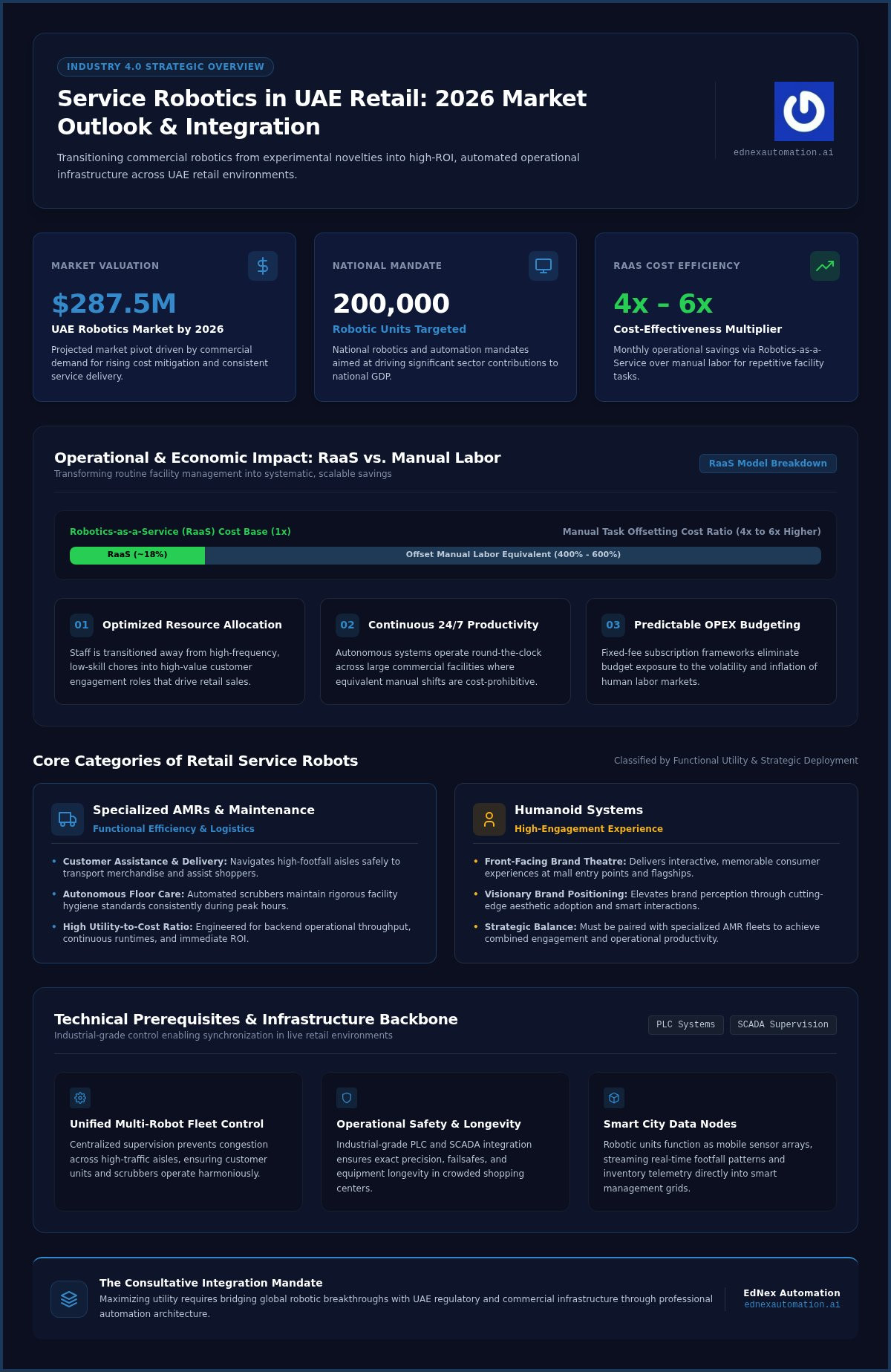
By 2026, the UAE intelligent robotics market is projected to reach $287.5 million, representing a critical pivot point for commercial enterprises seeking to mitigate rising operational costs and inconsistent service delivery. Leveraging the momentum of national robotics and automation mandates, forward-thinking retailers are rapidly deploying service robots for retail UAE to manage sprawling facilities with a precision that manual labor cannot match. You’ve likely observed that maintaining high hygiene standards and consistent customer engagement during peak hours is increasingly difficult without the support of intelligent, autonomous systems.
You understand that long-term business viability in this landscape requires more than just high-tech aesthetics; it demands a systematic overhaul of facility management through professional integration. This strategic guide explores how advanced service robotics are transforming the regional retail landscape from simple novelties into high-ROI operational assets. We will examine the core categories of available hardware, the nuances of humanoid engagement versus AMR efficiency, and the critical role of industrial-grade control systems in ensuring seamless implementation.
Key Takeaways
- Recognize the 2026 evolution of service robots for retail UAE from experimental novelties into essential operational infrastructure designed to mitigate rising labor costs.
- Differentiate between the high-engagement theatre of humanoid systems and the functional efficiency of specialized autonomous mobile robots to maximize your facility’s utility-to-cost ratio.
- Assess the critical role of maintenance and logistics units in maintaining hygiene standards and operational flow across large-scale retail environments.
- Master the technical prerequisites for successful deployment, including the necessity of professional PLC and SCADA integration for robust fleet management and system longevity.
- Leverage a consultative partnership model to bridge global technological breakthroughs with the specific regulatory and infrastructure demands of the regional market.
Modernizing Retail Operations with Service Robots in the UAE
Positioning at the forefront of global innovation, professional service robots are defined as autonomous systems engineered to support human tasks in commercial and customer-facing environments. By 2026, the regional retail sector has successfully transitioned these technologies from experimental pilot programs into essential components of retail infrastructure. This evolution is driven by national robotics and automation mandates, which target the deployment of 200,000 robotic units to ensure the sector contributes significantly to the national GDP. For stakeholders, the primary objective is no longer just about novelty; it’s about achieving a precise balance between high-engagement customer experiences and backend operational efficiency.
Implementing service robots for retail UAE involves a sophisticated understanding of how automation interfaces with existing facility workflows. The current landscape favors systems that provide tangible utility, moving away from stand-alone gadgets toward integrated fleets that communicate with smart city frameworks. This shift ensures that every unit deployed serves a specific, data-driven purpose within the broader Industry 4.0 transformation, securing long-term business viability in a highly competitive market.
Addressing Labor Challenges and Operational Costs
Operationalizing autonomous systems allows retailers to mitigate the rising costs associated with manual facility management in large-scale shopping environments. Statistics from 2026 indicate that Robotics-as-a-Service (RaaS) deployments are approximately 4x to 6x more cost-effective per month than the manual labor roles they offset for repetitive tasks. By automating floor care and delivery, organizations achieve several key outcomes:
- Optimized Resource Allocation: Transitioning staff from high-frequency, low-skill tasks to high-value customer engagement roles that drive sales.
- Continuous Productivity: Enabling 24/7 operations in large facilities where manual shifts would be cost-prohibitive.
- Predictable OPEX: Utilizing fixed-fee subscription models to manage budgets without the volatility of human labor markets.
The Strategic Shift Toward Industry 4.0 in Retail
Integrating service robots for retail UAE into active environments transforms a physical store into a node within a smart city ecosystem. These robotic fleets act as mobile sensors, collecting granular data on foot traffic and inventory levels that inform real-time business decisions. Establishing a visionary brand image through high-tech adoption is merely the entry point; the true value lies in the backend reliability provided by PLC and SCADA integration services. These industrial-grade control systems ensure that robotic fleets operate with the precision required for high-footfall mall environments, securing operational safety through controlled and deliberate innovation.
Core Categories of Retail Service Robots and Their Applications
Selecting the appropriate service robots for retail UAE requires a rigorous categorization based on functional utility rather than aesthetic appeal. The International Federation of Robotics reports that professional service units are seeing a global boom, particularly as the Robot-as-a-Service (RaaS) model matures in 2026. Within the regional market, successful deployments are characterized by multi-robot fleets that operate under a unified control system. This architecture ensures that customer assistance units, maintenance scrubbers, and logistics AMRs work in synchronization. This prevents congestion in high-traffic aisles while maintaining a steady operational flow across massive commercial facilities.
Autonomous Delivery and Customer Assistance Robots
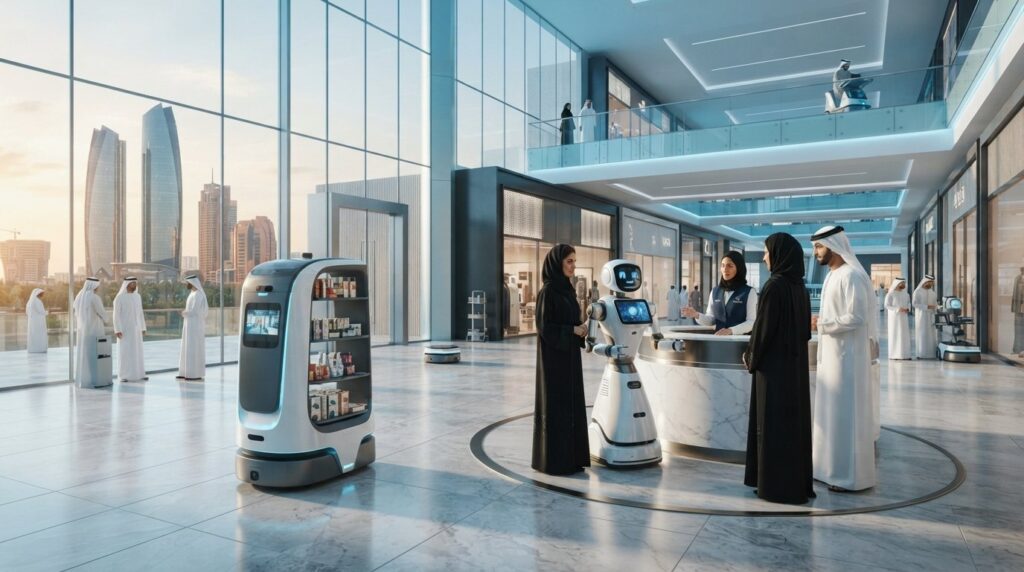
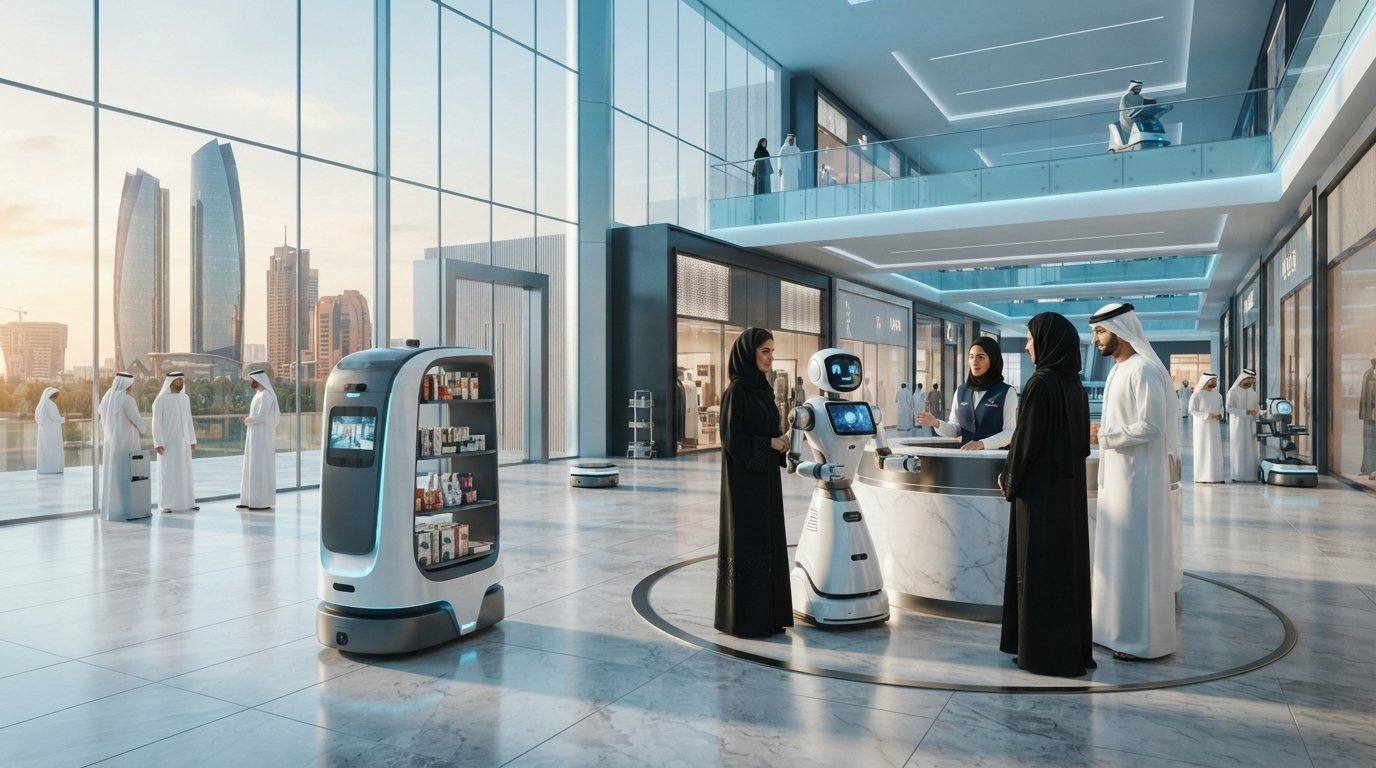
Advanced autonomous mobile robots (AMRs) have fundamentally modernized mall logistics by handling both front-facing wayfinding and behind-the-scenes material transport. Shoppers now interact with intelligent guidance units that navigate complex, multi-level layouts with precision. Simultaneously, delivery robots manage the internal flow of goods between storage warehouses and individual retail outlets, reducing the need for manual carts on the shop floor. This system often extends to the facility’s exterior, where last-mile delivery units transport heavy purchases directly to shoppers’ vehicles in parking areas. By automating these repetitive transport tasks, retailers can significantly reduce the physical burden on staff and improve the overall pace of commercial operations.
Automated Floor Maintenance and Hygiene Systems
The integration of autonomous cleaning robots is now a non-negotiable standard for maintaining the vast floor areas of modern retail centers. These industrial-grade scrubbers outperform manual cleaning teams by providing consistent, 24/7 hygiene coverage without the variability of human performance. Equipped with sophisticated LiDAR sensors, they safely navigate around shoppers during peak hours, ensuring that high-traffic zones remain pristine at all times. This technology provides facility managers with digital proof of service, documenting every sanitized area to meet strict health and safety protocols. Transitioning to automated maintenance not only lowers manual labor costs but also ensures that the physical environment reflects the premium nature of the brand. To determine which robotic architecture best suits your specific floor plan, consulting with a technical integration partner is a vital step in your modernization strategy.
Humanoid Robots vs. Specialized AMRs: Choosing Your Strategy
Deciding between humanoid architectures and specialized autonomous mobile robots (AMRs) requires a cold analysis of operational goals versus marketing objectives. While humanoids offer unparalleled brand theater, AMRs deliver the raw functional power necessary for large-scale facility management. According to the World Robotics report on service robots, the surge in professional service robot adoption is increasingly bifurcated between these two strategic paths. Retailers must evaluate the cost-to-utility ratio; bipedal systems command higher capital investment but offer a psychological impact that wheeled units can’t match in high-margin luxury environments. For many enterprises, the most effective service robots for retail UAE strategy involves a hybrid fleet where form follows function.
Humanoid Robots for Brand Engagement and Information
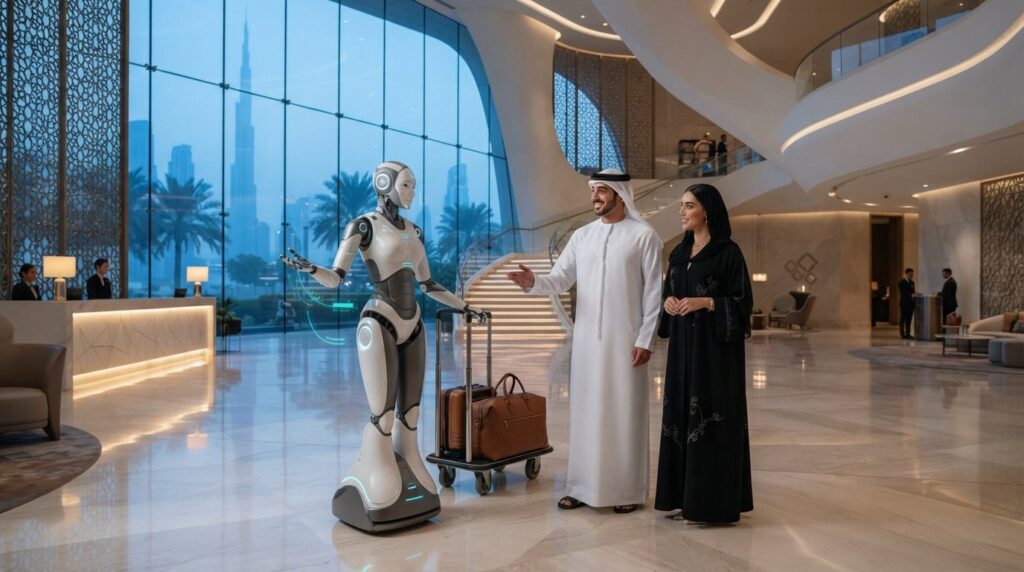
Enterprises seeking humanoid robots for sale UAE often prioritize experiential retail over backend logistics. These units serve as multilingual ambassadors, providing concierge-level support to the diverse demographic found in regional shopping hubs. Natural human-robot interaction requires high-tier AI compute and sophisticated degrees of freedom to mimic human gestures effectively. When deployed as high-tech ambassadors, humanoids don’t just provide information; they establish a visionary brand identity that resonates with tech-savvy consumers. This psychological connection is vital for flagship stores where the objective is to create a memorable brand narrative rather than just moving inventory.
AMRs for Logistics and Inventory Management
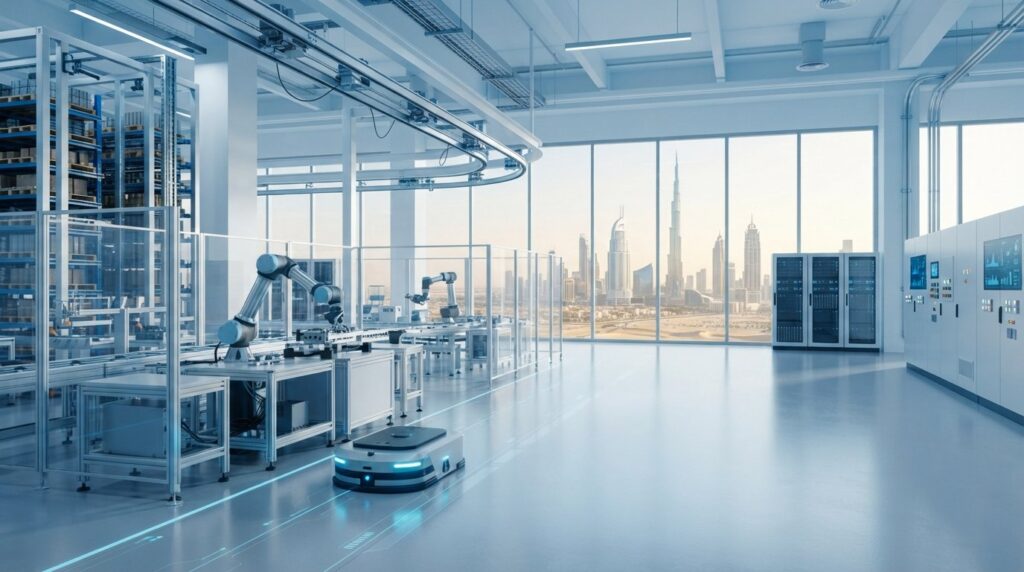
In contrast, the deployment of service robots for retail UAE in logistics roles focuses entirely on operational efficiency and reliability. Specialized AMRs excel at real-time inventory tracking and shelf monitoring, tasks that require steady locomotion and high-accuracy LiDAR sensors rather than human-like form factors. These units streamline the movement of goods across massive retail hubs, ensuring that stock levels remain optimized without human intervention. The true operational strength of these systems is realized through their integration with automated storage and retrieval systems (ASRS). This synergy creates a closed-loop automation environment where goods move seamlessly from the warehouse to the shelf, significantly reducing manual labor overhead and error rates. By prioritizing these functional assets, retailers ensure long-term business viability through controlled and deliberate innovation.
Strategic Implementation: Integrating Robotics into Live Retail Environments
Transitioning from theoretical acquisition to live deployment requires a methodical architectural approach to ensure that autonomous fleets don’t disrupt the shopper journey. Successfully integrating service robots for retail UAE into high-footfall environments depends on more than just high-tier hardware; it requires a robust digital foundation capable of managing real-time navigation and task prioritization. By establishing a phased rollout strategy, retailers can mitigate operational risks while acclimating both staff and customers to the presence of intelligent systems. This process begins with a comprehensive facility mapping exercise, followed by the deployment of robust network infrastructure to support constant data exchange between the units and the central control hub.
Safety Protocols and Public Interaction Management
Prioritizing human safety is the most critical factor when introducing robotic units into crowded mall aisles. Modern systems utilize advanced LiDAR and multi-camera sensor arrays to achieve 360-degree obstacle avoidance, ensuring that units react instantaneously to unpredictable pedestrian movements. Designing interaction flows that emphasize human comfort involves programming robots to maintain respectful distances and utilize intuitive signaling for path intentions. Beyond hardware sensors, managing public perception requires transparent communication regarding the robot’s function and the presence of clearly marked emergency stop protocols. Remote monitoring requirements ensure that human supervisors can intervene via teleoperation if a unit encounters a complex environmental edge case, maintaining safety without halting operations.
Connectivity and Backend System Integration
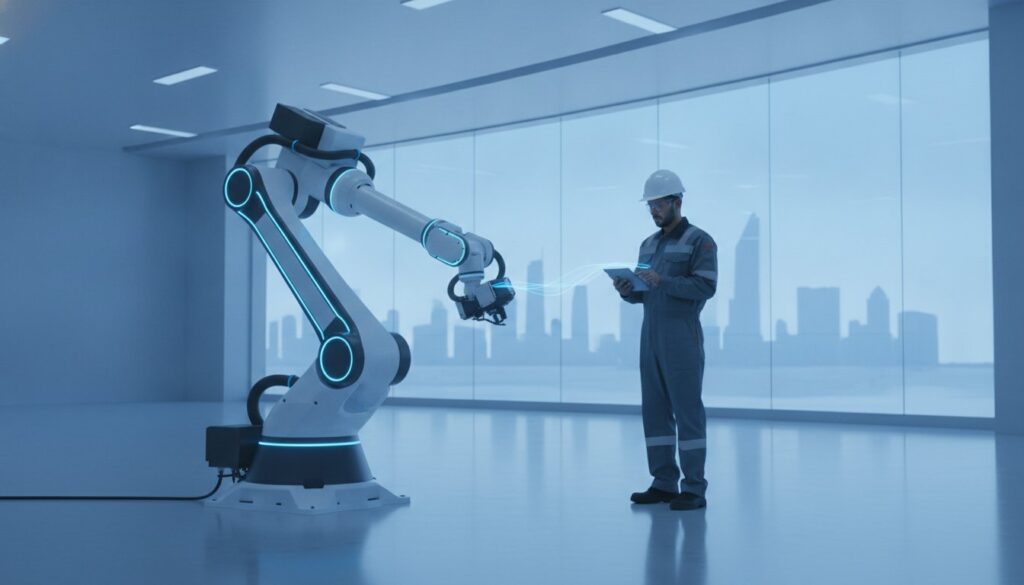
Executing a high-performance service robots for retail UAE strategy relies heavily on the underlying communication layer, specifically the low latency provided by 5G and Wi-Fi 6 infrastructure. These networks allow robotic fleets to interface directly with existing Warehouse Management Systems (WMS), creating a unified data loop that optimizes stock replenishment and shelf auditing. Utilizing PLC and SCADA integration services provides the central nervous system for these operations, offering real-time data visualization through centralized dashboards. This level of integration ensures that every robotic movement is recorded and analyzed, allowing for continuous optimization of fleet performance. Safeguarding these autonomous systems within retail networks also necessitates rigorous cybersecurity protocols to prevent unauthorized access to sensitive operational data. To ensure your facility infrastructure is prepared for these advanced requirements, you should consult with our integration experts to design a bespoke automation roadmap.
EdNex Automation: Your Partner for Retail Robotics in the UAE
Positioning as the essential bridge between global technological breakthroughs and regional industrial needs, EdNex Automation provides the intellectual framework required for large-scale robotic deployment. Since our establishment in 2018, we’ve functioned as a systematic organizer that brings order, safety, and efficiency to complex commercial environments. Implementing service robots for retail UAE requires more than just acquiring machinery; it demands a partner who understands the gravity of industrial transformation and the nuances of the regional economic territory. We ensure that every system deployed aligns with national digital transformation goals while adhering to strict regulatory standards, including TDRA spectrum approvals and ECAS electrical safety certifications.
Bespoke Integration and Technical Support
Delivering high-level solutions involves customizing robotic behaviors to reflect specific brand identities and operational workflows. We don’t simply provide equipment; we offer a comprehensive, start-to-finish approach that includes physical facility mapping and network architecture optimization. Our technical teams provide on-site support and preventative maintenance to ensure the longevity of your robotic fleets, mitigating the risks of downtime in high-traffic retail hubs. Furthermore, we prioritize the human element of automation by training retail staff to work effectively alongside collaborative robotic systems. This transition ensures that your workforce can shift from repetitive manual labor to high-value customer engagement, maximizing the utility of your human and robotic assets simultaneously.
Future-Proofing Your Retail Infrastructure
Adopting a forward-looking perspective is vital for any organization wishing to remain competitive in an increasingly automated market. We design scalable automation strategies that allow your robotic footprint to expand in alignment with your business growth, utilizing modular architectures that simplify future hardware and software upgrades. This methodical approach ensures that your initial investment remains a viable asset as technology evolves, rather than becoming a legacy burden. By integrating your fleet with existing enterprise systems, we transform your physical stores into data-rich environments where every robotic interaction provides actionable business intelligence. Retail automation ROI is a factor of both cost-saving and data-driven optimization. Stakeholders who view these systems as a long-term strategic evolution rather than a temporary acquisition will secure a significant advantage in the 2026 retail landscape.
Securing Long-Term Viability in the Automated Retail Era
Transitioning toward a fully automated retail environment requires a deliberate shift from viewing technology as a marketing novelty to treating it as essential operational infrastructure. By 2026, the successful deployment of service robots for retail UAE has become a hallmark of organizations that prioritize high-ROI assets and data-driven optimization. You’ve seen how the strategic selection between humanoid engagement and AMR efficiency, supported by robust PLC and SCADA integration, creates a scalable framework for future growth. Maintaining a competitive edge in this landscape demands a partner with the intellectual framework to bridge global innovation with local regulatory requirements.
As a specialized Industry 4.0 division, EdNex Automation leverages official certifications and global alliances to deliver end-to-end integration and support across the territory. We provide the technical expertise necessary to transform your commercial facilities into high-performance smart environments. It’s time to evolve your operational model and embrace the transformative power of advanced robotics. Partner with EdNex Automation to modernize your retail operations and lead the next wave of industrial transformation with confidence.
Frequently Asked Questions
Are service robots safe for use in crowded UAE shopping malls?
Yes, advanced service robots utilize industrial-grade sensor arrays and LiDAR to ensure safe navigation in high-footfall environments. These systems provide 360-degree situational awareness, allowing units to detect and avoid unpredictable pedestrian movements instantaneously. Implementing service robots for retail UAE requires these fail-safe protocols to maintain public safety while optimizing operational flow. Such controlled innovation ensures that autonomous units interact seamlessly with shoppers, adhering to the strict safety standards mandated by national regulatory frameworks.
How do service robots integrate with existing retail inventory systems?
Integration is achieved by connecting robotic fleets directly to existing Warehouse Management Systems (WMS) and Enterprise Resource Planning (ERP) platforms. Utilizing robust Wi-Fi 6 or 5G connectivity, these units facilitate real-time data loops that inform inventory tracking and shelf replenishment. This synchronization ensures that backend logistics remain optimized without human intervention. By establishing a unified digital ecosystem, retailers can leverage autonomous mobile robots to provide granular insights into stock levels and traffic patterns across vast floor areas.
What is the typical battery life and charging requirement for retail AMRs?
Most industrial-grade retail AMRs offer a battery life ranging from 8 to 12 hours on a single charge. These systems are designed with autonomous docking capabilities, allowing them to return to charging stations during low-traffic periods or when power levels drop below a specific threshold. This opportunistic charging strategy ensures continuous availability throughout a 24-hour cycle. By managing energy consumption through intelligent software, robotic fleets maintain high operational uptime in large-scale commercial facilities without requiring manual intervention.
Can humanoid robots communicate in multiple languages for international tourists?
Humanoid robots are engineered with sophisticated AI-driven natural language processing to facilitate multilingual communication with international tourists. These units act as high-tech ambassadors, providing concierge-level support in diverse languages to match the regional demographic. By leveraging cloud-based translation services, they offer real-time assistance for wayfinding and product inquiries. This capability enhances the psychological impact of customer interactions, establishing a visionary brand image that resonates with tech-savvy consumers in luxury retail environments across the territory.
What kind of maintenance do autonomous cleaning robots require in large facilities?
Autonomous cleaning robots require minimal but consistent daily maintenance, primarily involving the refilling of clean water tanks and the disposal of wastewater. Technical staff must also perform routine sensor calibration and brush cleaning to ensure optimal performance. Adopting a preventative maintenance schedule, backed by professional integration support, extends the longevity of these industrial-grade units. These systems provide digital proof of service, allowing facility managers to monitor hygiene standards across large commercial spaces through centralized dashboards.
Is it better to buy or lease service robots for a retail business in the UAE?
In 2026, many organizations prefer the Robotics-as-a-Service (RaaS) model over outright capital purchases to maintain long-term business viability. Leasing through RaaS allows retailers to fund deployments via operational budgets, bundling maintenance and software updates into a predictable monthly fee. This approach mitigates the risks of technological obsolescence by allowing for modular upgrades. Conversely, high-margin flagship stores might choose to buy specialized humanoid units to establish a permanent high-tech presence, depending on their specific financial and strategic objectives.
How do retail robots handle complex navigation like elevators or ramps?
Modern retail robots manage complex navigation by interfacing with smart building infrastructure via IoT protocols. By communicating directly with automated elevators and turnstiles, these units can transition between floors and restricted zones without human assistance. Sophisticated LiDAR SLAM mapping allows them to negotiate ramps and reflective surfaces, such as marble flooring, with high precision. This level of autonomy ensures that delivery and cleaning robots can access every corner of a multi-level shopping environment while maintaining consistent operational speed.
What is the role of PLC and SCADA in managing a fleet of retail robots?
PLC and SCADA systems serve as the central nervous system for managing a fleet of service robots for retail UAE. These industrial-grade control systems provide real-time data visualization and centralized command, ensuring that multiple units operate in synchronization without congestion. By integrating robotic telemetry into a SCADA dashboard, facility managers gain a comprehensive overview of fleet health and task completion. This intellectual framework is essential for achieving the high-level coordination required for large-scale industrial transformation and operational efficiency.