Identifying the precise intersection between human dexterity and mechanical consistency is now the baseline for industrial survival in the Gulf. You’ve likely recognized that the high technical barrier to deploying collaborative robots UAE often stems from the perceived complexity of legacy system synchronization and the rigor of safety certification. While many organizations view automation as a disruptive force, we see it as a systematic opportunity to refine your operational architecture through controlled innovation and bespoke integration.
This guide serves as your technical blueprint for mastering the transition to a fully integrated Industry 4.0 ecosystem. We’ll detail the protocols for aligning robotic assets with PLC and SCADA systems, ensuring your facility meets the rigorous safety requirements of ISO/TS 15066 without sacrificing throughput. By the end of this analysis, you’ll possess the intellectual framework necessary to deploy sophisticated workflows that reduce downtime and secure your organization’s position within the UAE’s rapidly evolving economic landscape. We’ll move beyond simple hardware acquisition to focus on the delivery of high-level solutions that drive measurable ROI and future-proof your industrial infrastructure.
Key Takeaways
- Transitioning from traditional caged automation to fenceless environments requires implementing the four standard modes of safe human-robot interaction defined by ISO standards.
- Synchronizing collaborative robots UAE with centralized PLC and SCADA controllers ensures real-time performance monitoring and total operational transparency.
- Evaluating the strategic advantages of power-limited systems allows you to reduce facility footprint and lower the technical barriers of legacy industrial programming.
- Mastering the technical integration of robotic assets with ASRS and SCADA infrastructure builds a cohesive, high-efficiency Industry 4.0 ecosystem.
- Applying a systematic end-to-end methodology bridges the gap between global technological breakthroughs and your specific regional industrial requirements.
The Evolution of Collaborative Robots in the UAE Industrial Sector
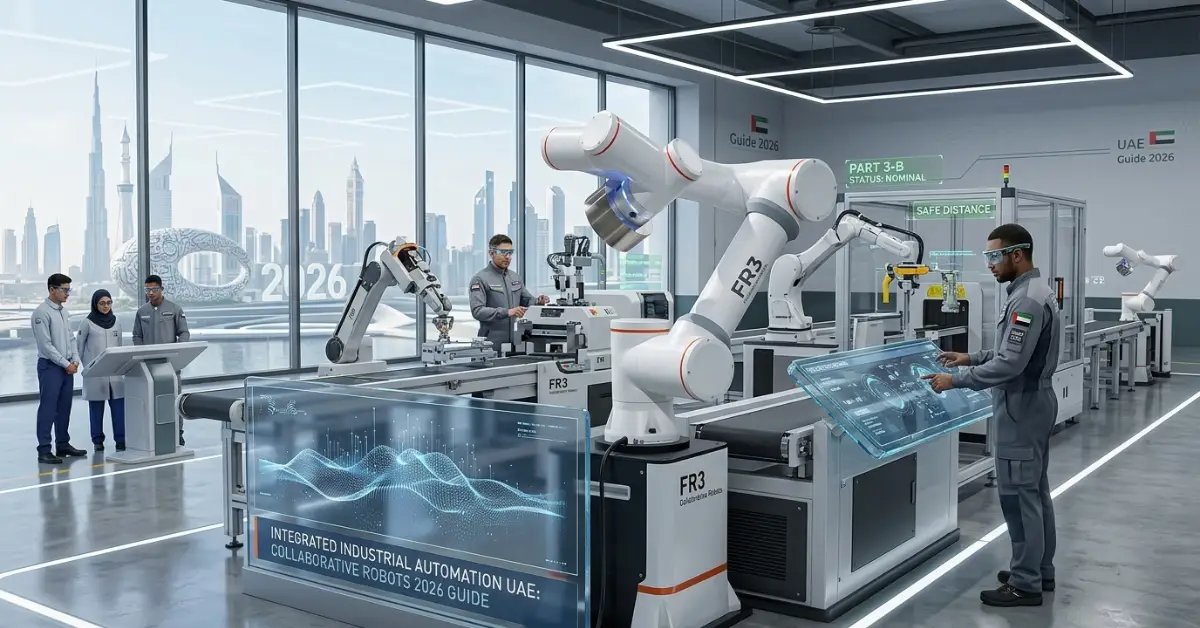
Adhering to international safety standards such as ISO 10218 and ISO/TS 15066, modern industrial environments are transitioning from restrictive safety cages to fluid, fenceless production lines. Central to this transformation is the Collaborative Robot (Cobot), a power-limited and sensor-rich system engineered for direct, safe proximity to human operators. By utilizing embedded force-torque sensors and advanced vision systems, these units eliminate the physical barriers that once defined automation. As we progress through 2026, the adoption of collaborative robots UAE has reached a critical tipping point, driven by the technical maturation of AI-driven path optimization and a national push for industrial modernization. This evolution isn’t merely a hardware upgrade; it’s a fundamental reimagining of the industrial floor where the machine adapts to the human, not the reverse.
The Philosophy of Human-Robot Collaboration
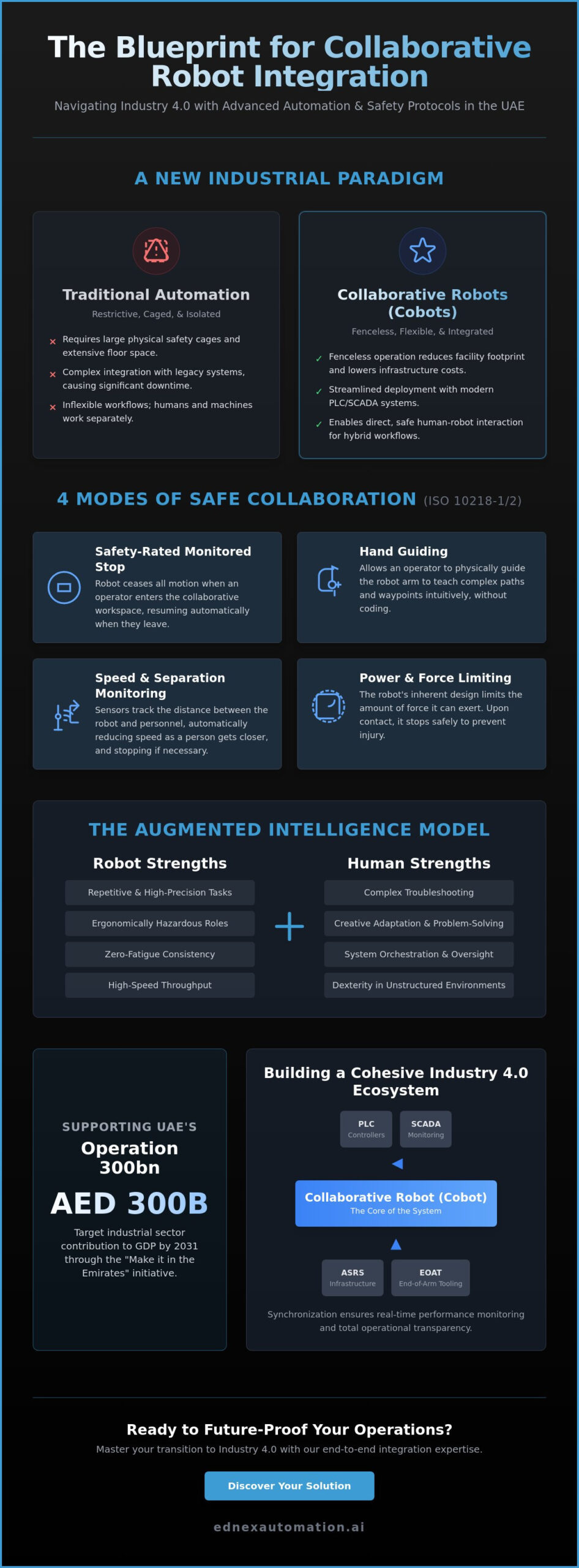
Transitioning from “Automation vs. Human” to “Augmented Intelligence” allows facilities to capitalize on the unique strengths of both parties. While robots excel at repetitive, high-precision, or ergonomically hazardous roles, humans provide the critical thinking required for complex troubleshooting and creative adaptation. Human-robot collaboration is a hybrid work model where robotic precision meets human problem-solving. To better understand and optimize these interactions through behavioral data, you can visit Ergoneers for professional research platforms. By offloading monotonous physical strain to robotic assets, organizations don’t just improve throughput; they elevate the human role to that of a system orchestrator. This synergy ensures that high-precision tasks are executed with zero fatigue while maintaining the flexibility that only a human workforce can provide.
Economic Drivers for National Industrial Growth
Integrating these advanced systems directly supports the UAE’s “Operation 300bn” strategy, which aims to increase the industrial sector’s contribution to the GDP to AED 300 billion by 2031. Through the “Make it in the Emirates” initiative, the government provides a framework that encourages local manufacturing excellence and technological self-reliance. Collaborative systems enable SMEs to compete with global industrial giants by leveraging collaborative robots UAE to achieve scalable automation without requiring massive facility overhauls or specialized structural modifications. The impact of government incentives, including the specialized AI and Robotics business licenses, has significantly accelerated adoption by lowering the initial technical and financial barriers. This strategic alignment ensures that regional industries remain competitive while fostering a high-tech, value-driven labor market capable of sustaining long-term economic diversification.
To complement physical automation with digital growth strategies, visit Global AI Reps to see how AI-driven lead generation can further enhance your industrial competitiveness.
Technical Architecture and Safety Protocols for Collaborative Systems
Deploying collaborative robots UAE requires a deep understanding of the four distinct operational modes established by ISO 10218-1/2. These modes, which include safety-rated monitored stop, hand guiding, speed and separation monitoring, and power and force limiting, define the interaction parameters between human and machine. While a monitored stop ensures the robot remains stationary when an operator enters the workspace, hand guiding allows for intuitive, manual teaching of complex paths. Speed and separation monitoring (FSM) utilizes advanced sensors to modulate velocity based on the proximity of personnel, ensuring that the system slows or halts before contact occurs. Power and Force Limiting (PFL) utilizes internal sensors to restrict impact energy, providing the ultimate layer of fenceless protection for mixed-workforce environments.
Successful engineering of a safe collaborative environment involves more than just the robotic arm; the end-of-arm tooling (EOAT) plays a pivotal role in overall application safety. Sharp edges or high-heat grippers can negate the inherent safety of a PFL-enabled arm, necessitating a holistic risk assessment of the entire workpiece and tool assembly. When selecting assets, engineers must balance payload capacity against reach requirements to optimize throughput. For UAE manufacturing applications, finding this “sweet spot” ensures that the robot can handle necessary weights without requiring excessive speed reductions that might compromise ROI. For organizations seeking to define these technical parameters, exploring bespoke robotic integration is a necessary step in the planning phase.
Safety Certification and Compliance Standards
Adhering to ISO 10218 and ISO/TS 15066 is non-negotiable for national facility safety and legal compliance. These standards emphasize that safety is a property of the entire application, requiring rigorous risk assessments that account for every potential human-machine contact point. Integrating redundant safety sensors and standardized emergency stop protocols creates a fail-safe architecture that protects the workforce while maintaining operational continuity. Referencing OSHA robotics safety standards provides a foundational framework for establishing these protocols in a globalized industrial context, ensuring your facility meets international benchmarks for workplace protection.
Intelligent Vision and AI-Driven Adaptation
Systems utilizing 3D vision empower collaborative robots UAE to navigate dynamic, unpredictable environments with high degrees of autonomy. These systems capture spatial data in real-time, allowing the robot to identify obstacles and adjust its trajectory without human intervention. AI-enhanced cobots can adjust their force and speed in milliseconds based on human proximity. Beyond immediate safety, AI integration facilitates predictive maintenance by analyzing torque and vibration data to preempt mechanical failures. This level of intelligence transforms a static tool into an adaptive partner, capable of real-time path optimization that maximizes efficiency in high-density production zones.
Strategic Evaluation: Cobots vs. Traditional Industrial Automation
Selecting the optimal automation architecture requires a rigorous comparison between raw mechanical speed and contextual adaptability. Traditional 6-axis industrial robots remain the standard for high-velocity, high-volume production, yet their requirement for expansive safety fencing creates a significant footprint challenge in modern, space-constrained facilities. By eliminating these physical barriers through integrated sensors, collaborative robots UAE allow for a fenceless layout that maximizes every square meter of the production floor. This shift from “caged” environments to open-plan workflows facilitates a more dynamic interaction between human labor and robotic precision, particularly when these assets must synchronize with other autonomous systems like AMRs or ASRS. While traditional robots offer superior raw speed, the flexibility of a cobot to operate safely alongside personnel provides a strategic advantage in facilities where human intervention is frequently required.
Analyzing the programming barrier reveals another critical differentiator that impacts long-term operational agility. Traditional robots typically require specialized, code-based industrial programming that often necessitates external consultancy for every process change. Conversely, cobots utilize “lead-through” teaching, allowing on-site technicians to manually guide the arm through desired paths. This intuitive interface reduces the deployment timeline from weeks to days, providing a level of agility that traditional systems can’t match. When you evaluate the cost-benefit of safety fencing versus integrated collaborative sensors, the reduction in structural costs and the gain in layout flexibility often favor the collaborative model for modern enterprise needs.
Total Cost of Ownership (TCO) Framework
Factoring in integration, maintenance, and energy consumption over a 5-year cycle, the TCO analysis reveals that cobots often provide a more sustainable investment for agile manufacturing. While traditional robots might offer a lower initial hardware price point, the hidden costs of safety infrastructure and specialized programming labor often equalize the investment. Calculating the “Flexibility Premium” is essential; it represents the tangible value of being able to repurpose a robot for a new task in just hours. When you compare the ROI of collaborative robots UAE against traditional manual assembly lines, the reduction in ergonomic injuries and the consistency of output provide a clear economic advantage that supports long-term business viability.
Application Matrix: Matching Tech to Task
Designing a production flow requires matching the specific technology to the operational demand. High-mix, low-volume (HMLV) production is the definitive stronghold for cobots, where their ease of reconfiguration allows for rapid product changeovers without extensive downtime. For high-volume, low-mix (HVLM) environments, the raw cycle speed of traditional 6-axis robots still provides a throughput advantage that justifies the larger footprint. Successful facilities often deploy hybrid lines, utilizing traditional robots for heavy-duty palletizing while tasking cobots with intricate, human-adjacent assembly. This multi-layered approach ensures that the facility remains responsive to market shifts while maintaining peak efficiency through controlled and deliberate innovation.
Integrating Cobots with PLC, SCADA, and ASRS Infrastructure
Breaking the siloed approach to automation requires establishing a bidirectional data flow between robotic controllers and the facility’s central nervous system. Integrating collaborative robots UAE into existing PLC (Programmable Logic Controller) architectures ensures that every movement is synchronized with the broader production cycle. By utilizing PLC and SCADA integration services, organizations can transition from isolated mechanical units to a cohesive, software-defined infrastructure. This connectivity allows for the monitoring of motor torque, cycle times, and error logs in real-time, feeding a unified data dashboard that tracks Overall Equipment Effectiveness (OEE) across the entire enterprise. Establishing these protocols ensures that a cobot isn’t just a tool, but an intelligent node within a responsive network.
Expanding this network to include automated storage and retrieval systems creates a seamless “goods-to-robot” workflow where the cobot acts as the precise interface for high-density inventory management. Synchronizing these systems ensures that robotic pick-and-place operations are perfectly timed with the arrival of storage bins, eliminating latency and maximizing throughput. Through bespoke communication bridges, the SCADA system can trigger specific cobot subroutines based on real-time inventory demands, creating an autonomous loop that requires minimal human oversight. This level of integration is essential for facilities aiming to achieve the high-speed accuracy required in modern logistics and manufacturing hubs.
The Connected Factory: Cobots and AMR Synergy
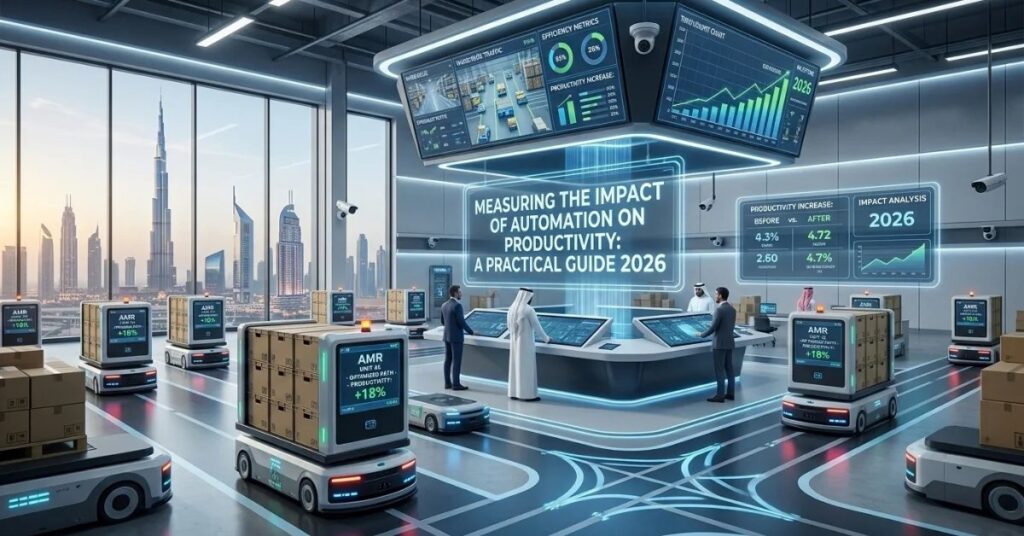
Deploying cobots on autonomous mobile robots introduces the concept of mobile manipulation, where the robotic arm is no longer tethered to a single workstation. This integration allows for a dynamic allocation of tasks, where the mobile base handles horizontal transport while the collaborative arm executes complex assembly or kitting operations on the move. Managing fleet traffic and task allocation through a centralized SCADA interface provides the visibility needed to prevent congestion and optimize pathing in real-time. Integrated workflows of this nature have been shown to reduce material handling time by up to 40% by eliminating manual transfer points and static staging areas.
Data-Driven Optimization and Industrial IoT (IIoT)
Leveraging cobot telemetry through Industrial IoT (IIoT) protocols enables a shift from reactive to predictive maintenance strategies. By analyzing internal sensor data, such as joint temperature and current draw, engineers can identify impending bottlenecks or mechanical wear before they result in operational failure. Cloud-based monitoring platforms further extend this capability, allowing for the centralized oversight of multi-site industrial operations across the region. SCADA integration allows for the remote orchestration of cobot fleets across large-scale facilities. To secure your facility’s competitive edge through advanced networking, you can explore our full-service integration solutions to begin your transformation.
Optimizing Deployment: The EdNex Approach to Industrial Transformation
Achieving a successful transition to automated workflows requires more than a simple equipment acquisition; it necessitates a technical partner who provides the intellectual framework for long-term integration. We position ourselves as a bridge-builder, connecting global technological breakthroughs in collaborative robots UAE with the specific economic and industrial requirements of the region. Our methodology moves beyond the role of a vendor to act as a systematic organizer of your facility’s evolution. By delivering high-level solutions that encompass process analysis, custom integration, and SCADA synchronization, we ensure that every robotic asset serves a precise functional purpose within your broader infrastructure. This comprehensive, start-to-finish expertise is what separates a disruptive implementation from a controlled and deliberate modernization of your industrial floor.
Empowering your workforce is a critical pillar of our deployment strategy. We provide customized training programs designed to transition your personnel from manual, repetitive tasks to the roles of system orchestrators and supervisors. This human-centric approach ensures that the introduction of robotic precision enhances, rather than replaces, the value of your human capital. By fostering a culture of technical proficiency, your organization becomes more resilient and capable of managing the sophisticated workflows that define Industry 4.0. Our goal is to provide the tools and the knowledge necessary for your team to maintain peak operational efficiency without constant external intervention.
The Feasibility and ROI Roadmap
Performing a comprehensive audit of current manual processes allows us to identify specific inefficiencies where automation delivers the highest immediate impact. We focus on identifying “Quick Win” applications, such as high-precision assembly or repetitive kitting, that offer a rapid return on investment and prove the viability of collaborative systems. Designing a scalable automation architecture ensures that your facility can grow in alignment with market demands. This phased approach mitigates the risks associated with large-scale transformation, allowing for a steady, logical progression toward a fully autonomous ecosystem. We prioritize long-term business viability by ensuring every deployment is grounded in measurable data and technical reality.
Long-Term Technical Support and Partnership
Securing the continuous viability of your robotic assets requires a commitment to ongoing technical excellence and maintenance. We provide certified technical support to resolve complex infrastructure challenges and minimize operational downtime. Maintaining your competitive edge involves continuous firmware and AI updates that keep your collaborative robots UAE at the cutting edge of modern intelligence. This persistent optimization ensures that your systems adapt to new production requirements and evolving safety standards over time. To begin your journey toward a fenceless, high-efficiency production environment, you can partner with EdNex Automation to architect your Industry 4.0 future and secure your facility’s place in the global industrial landscape.
Securing Your Industrial Competitive Edge through Integrated Automation
Mastering the technical integration of collaborative robots UAE is no longer a luxury for regional manufacturers; it’s a fundamental requirement for long-term survival in an increasingly autonomous global market. By prioritizing fenceless safety protocols and seamless PLC synchronization, your organization can achieve the operational agility necessary to meet the ambitious goals of Operation 300bn. Implementing these advanced systems requires a systematic approach that balances robotic precision with human problem-solving, ensuring every deployment drives measurable ROI and remains future-proof against technological shifts.
As an Authorized Gold Partner of leading global robotics brands with a specialized division for Industry 4.0 and digital transformation, we provide the intellectual framework and technical expertise needed to modernize your infrastructure. Our proven track record in PLC, SCADA, and ASRS integration ensures that your transition to a connected factory is both controlled and deliberate. Consult with our integration experts to build your collaborative robot strategy today. We’re ready to help you architect a more efficient, safer, and highly competitive industrial future.
Frequently Asked Questions
Is a collaborative robot safe enough to work without a safety cage?
Collaborative systems are engineered to operate without physical barriers provided a comprehensive risk assessment is performed according to ISO/TS 15066 standards. Safety is a property of the entire application, including the robot, end-effector, and workpiece. By utilizing power and force limiting (PFL) or speed and separation monitoring (FSM), these systems detect human proximity and adjust their behavior in milliseconds to prevent injury and maintain a fenceless environment.
Can cobots be integrated with existing legacy PLC systems?
Seamless integration with legacy PLC and SCADA infrastructure is achievable through standardized communication protocols like Modbus TCP, EtherNet/IP, or Profinet. By utilizing specialized integration services, organizations establish a bidirectional data flow between the robotic controller and the facility’s central nervous system. This connectivity ensures that robotic assets remain synchronized with the broader production cycle while providing real-time performance telemetry for centralized monitoring and control.
How much does a collaborative robot cost to implement in the UAE?
Implementation costs vary significantly based on the complexity of the integration, the required payload, and the sophistication of the end-of-arm tooling. Investors should consider the total cost of ownership (TCO) including feasibility studies, customized programming, and safety certification. Strategic deployment of collaborative robots UAE often results in lower structural costs compared to traditional automation because the absence of safety fencing reduces the required facility footprint.
What is the maximum payload capacity for modern collaborative robots?
Modern collaborative systems have advanced to handle payloads reaching up to 30kg or more depending on the specific model and manufacturer. While early iterations were limited to lightweight assembly, engineering breakthroughs now enable these robots to manage heavier components in palletizing and machine tending applications. It’s essential to balance this capacity with reach requirements and speed limitations to maintain the fenceless safety standards required for human-adjacent workflows.
What happens if a collaborative robot makes contact with a human operator?
If a cobot utilizing Power and Force Limiting (PFL) makes contact with a person, its internal sensors detect the resistance and trigger an immediate safety-rated stop. The system is designed to restrict contact force to levels below the injury thresholds defined by international safety standards. This rapid response mechanism ensures that the robot ceases motion almost instantly, effectively mitigating risk and allowing for a safe, shared workspace without physical barriers.
How long does it take to see a return on investment (ROI) with cobots?
Many industrial facilities report a full return on investment within 12 to 24 months, though the exact timeline depends on the specific application and labor displacement. By reducing ergonomic injury risks and maintaining consistency, these systems drive measurable improvements in throughput and quality. Identifying “Quick Win” applications during the feasibility phase often accelerates this timeline, allowing the technology to pay for itself through increased operational efficiency and reduced downtime.
Do I need a specialized robotics engineer to program a cobot?
You don’t necessarily need a high-level robotics engineer for daily operation because most modern systems feature intuitive lead-through teaching and graphical user interfaces. These tools allow on-site technicians to manually guide the arm through its desired path, significantly lowering the technical barrier to entry. However, complex integrations involving PLC synchronization or bespoke SCADA dashboards typically benefit from the expertise of a professional technical partner to ensure system-wide optimization and reliability.
Can cobots be used in cleanroom or high-temperature environments?
Specialized collaborative robots are engineered with high Ingress Protection (IP) ratings and specific materials to operate in cleanrooms or challenging industrial environments. Certain models meet ISO Class 5 cleanroom standards or withstand the ambient heat of machine tending operations. Selecting the correct robotic asset for these specialized conditions ensures long-term reliability and compliance with industry-specific regulations while maintaining the flexibility and safety of collaborative automation.