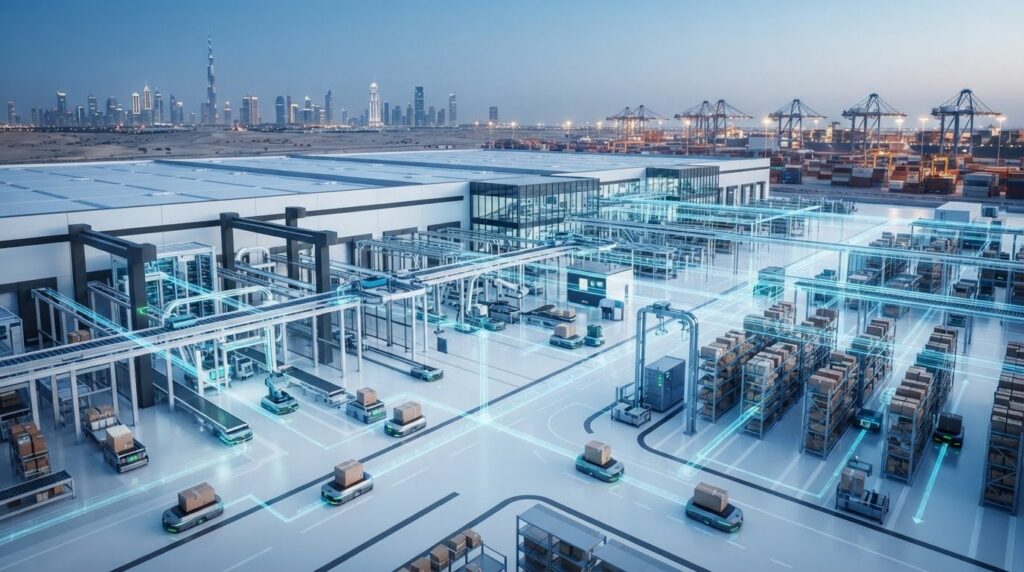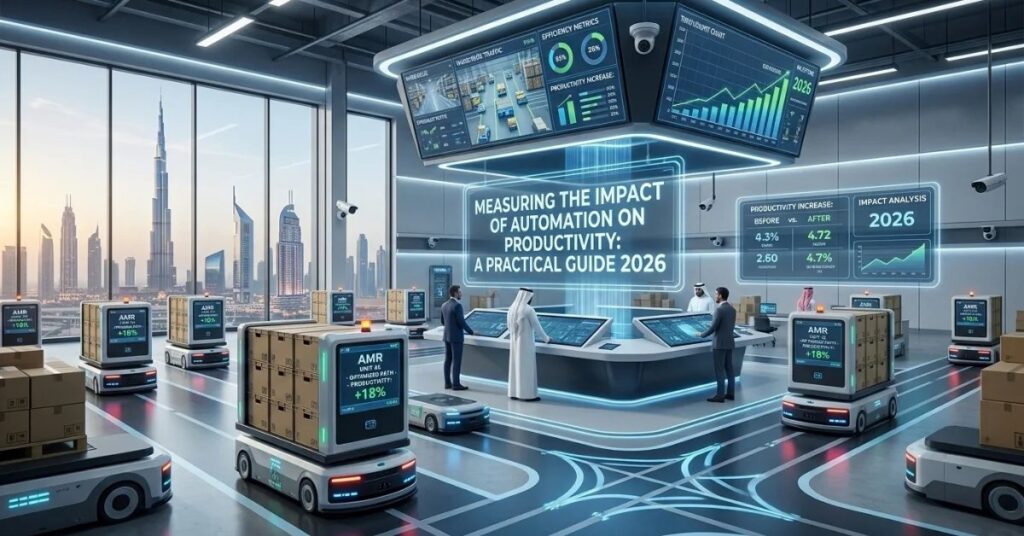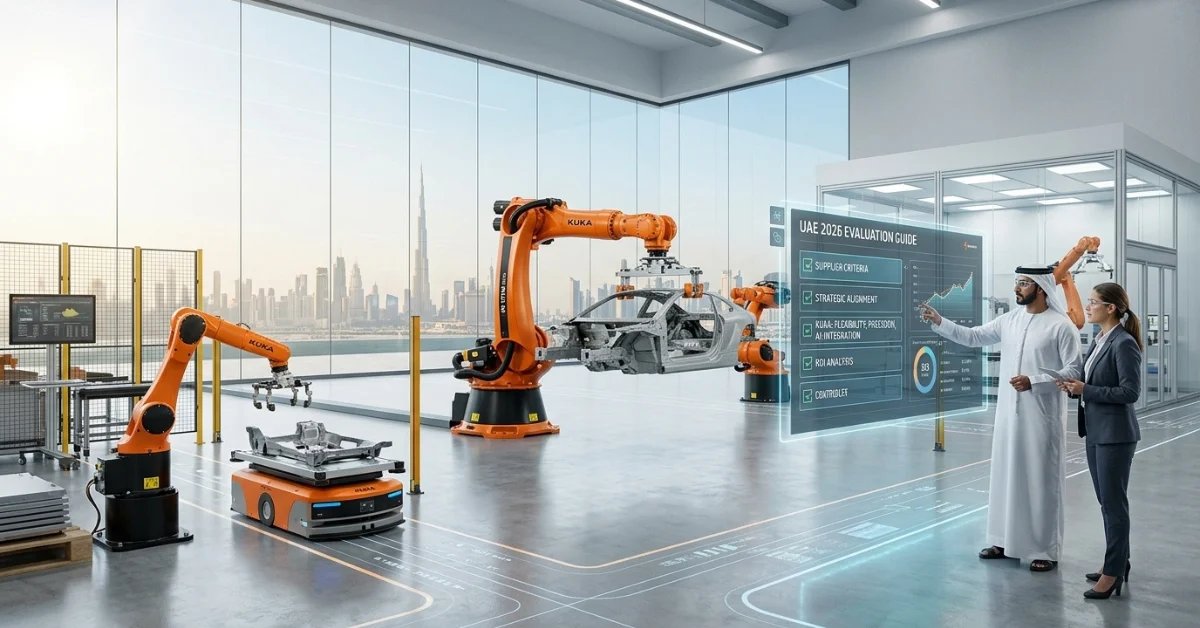
By the end of 2026, the industrial automation market in the UAE is projected to exceed AED 39.7 billion, a figure that underscores the rapid transition toward high-tech manufacturing environments. While the scale of investment is clear, many organizations find that the leap from manual processes to autonomous systems presents significant technical hurdles. You likely understand that selecting industrial robotics suppliers UAE isn’t just about purchasing hardware; it’s about securing a partner who can navigate the complexities of the UAE AI Act 2026 while ensuring seamless PLC and SCADA integration.
Leveraging our expertise in high-level industrial transformation, this guide provides a strategic framework for identifying partners who drive measurable ROI through intelligent automation. We’ll explore how deploying Collaborative Robots (Cobots), Autonomous Mobile Robots (AMRs), and Automated Storage and Retrieval Systems (ASRS) can reduce operational risk and solve high labor costs. By examining the latest customs tariff updates and 2026 R&D tax credits, you’ll gain the intellectual framework necessary to build a scalable, interconnected facility that remains competitive in an increasingly autonomous global economy.
Key Takeaways
- Establish a rigorous framework for evaluating industrial robotics suppliers UAE by focusing on technical integration depth and official global certifications.
- Discover how to transition from isolated robotic cells to fully interconnected ecosystems using advanced PLC and SCADA synchronization.
- Identify high-ROI applications for Autonomous Mobile Robots (AMRs) and ASRS to modernize logistics and material handling across the national industrial landscape.
- Navigate the 2026 regulatory environment, including the UAE AI Act and R&D tax credits, to ensure long-term compliance and financial viability.
- Learn to mitigate operational risks by selecting partners who offer end-to-end expertise from initial architectural design to localized technical support.
The Evolution of Industrial Robotics in the UAE Market
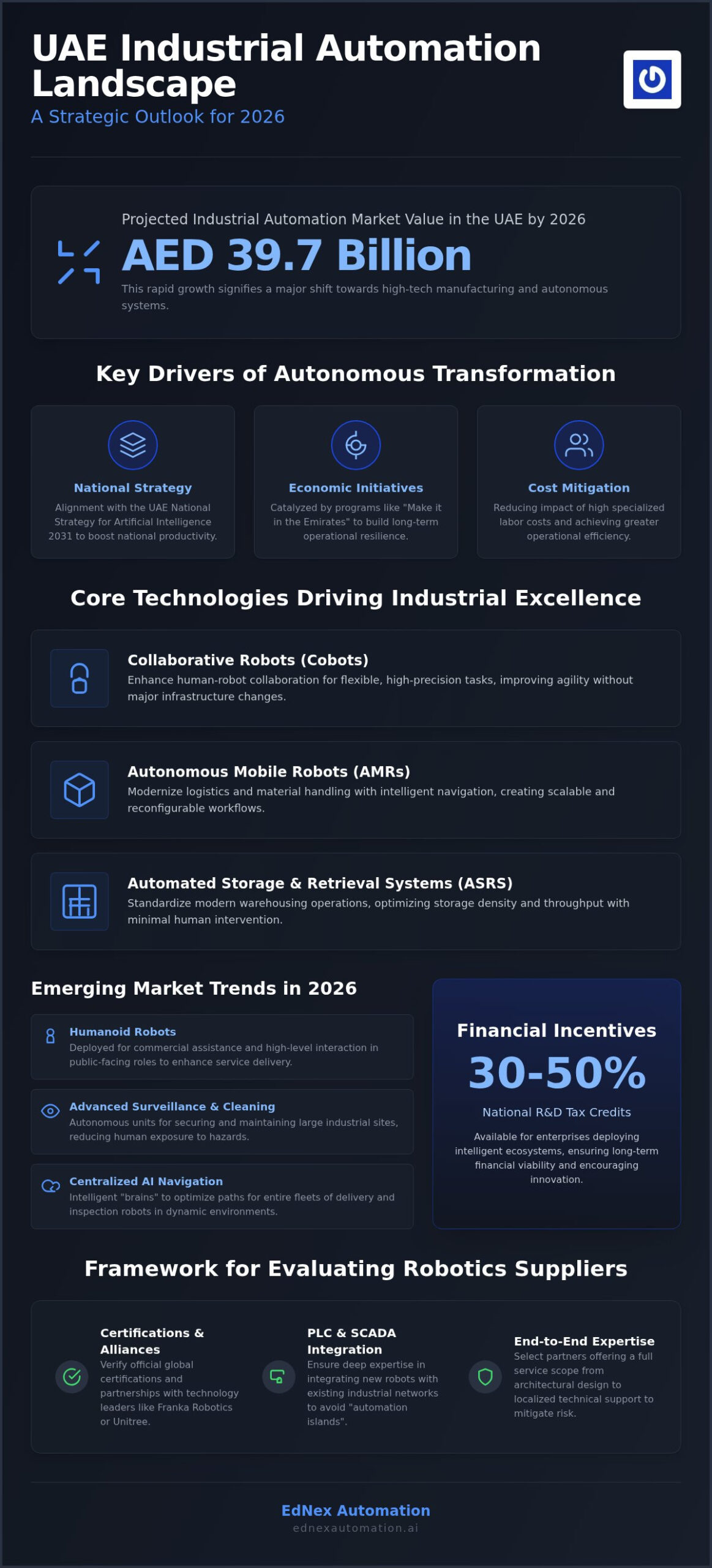
Transitioning toward a knowledge-based economy, the UAE has positioned itself as a global hub for advanced technological integration. The national industrial automation market is projected to exceed AED 39.7 billion by the end of 2026, reflecting a fundamental shift in how enterprises perceive the industrial robot. Modern systems are no longer confined to rigid, high-volume production lines; instead, they prioritize flexibility and intelligence. To remain competitive, industrial robotics suppliers UAE are providing solutions that align with the UAE National Strategy for Artificial Intelligence 2031, which mandates the adoption of AI-driven technologies to enhance national productivity across all sectors.
The Drive for Autonomous Transformation
Executing a shift from manual labor to robotic precision allows organizations to maintain high-output environments while mitigating the impact of rising specialized labor costs. Government initiatives like “Make it in the Emirates” act as a catalyst, encouraging the replacement of legacy fixed cells with autonomous systems that offer long-term operational resilience. By integrating technologies such as Collaborative Robots (Cobots) and Autonomous Mobile Robots (AMRs), businesses achieve a level of agility previously unattainable. This transition is essential for sectors like logistics and manufacturing, where scalability depends on the ability to reconfigure workflows without extensive downtime or massive reinvestment in infrastructure.
Key Market Trends for 2026
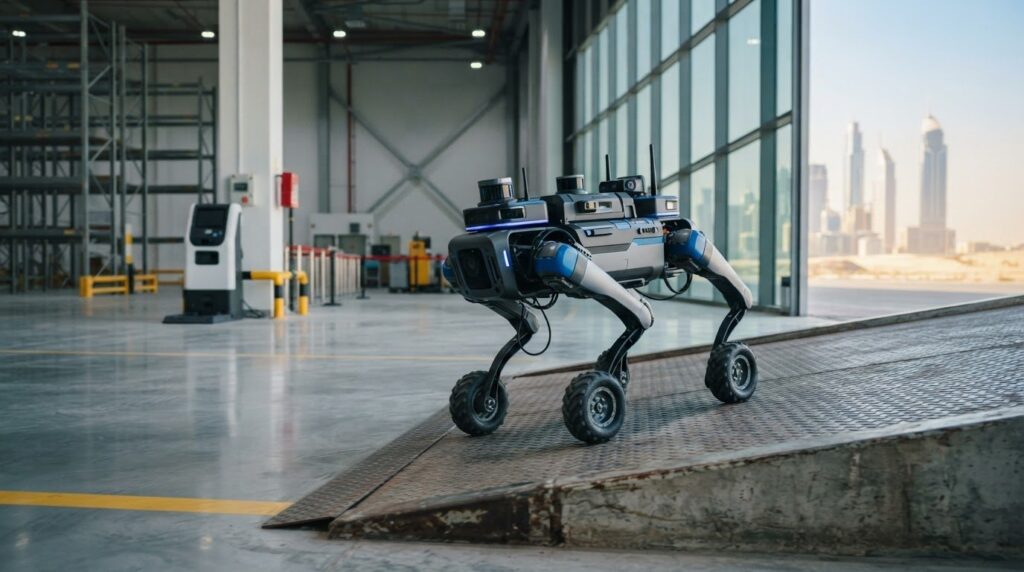
The emergence of humanoid robots and advanced surveillance automation marks a new chapter in the UAE’s technological journey. As of 2026, the market has moved beyond simple repetitive tasks to embrace complex, AI-driven navigation and specialized outdoor cleaning systems. These trends are particularly visible in facilities management and large-scale infrastructure projects where efficiency is paramount. Current market dynamics highlight three critical areas of growth:
- Humanoid units: Providing commercial assistance and high-level interaction in public-facing roles to enhance service delivery.
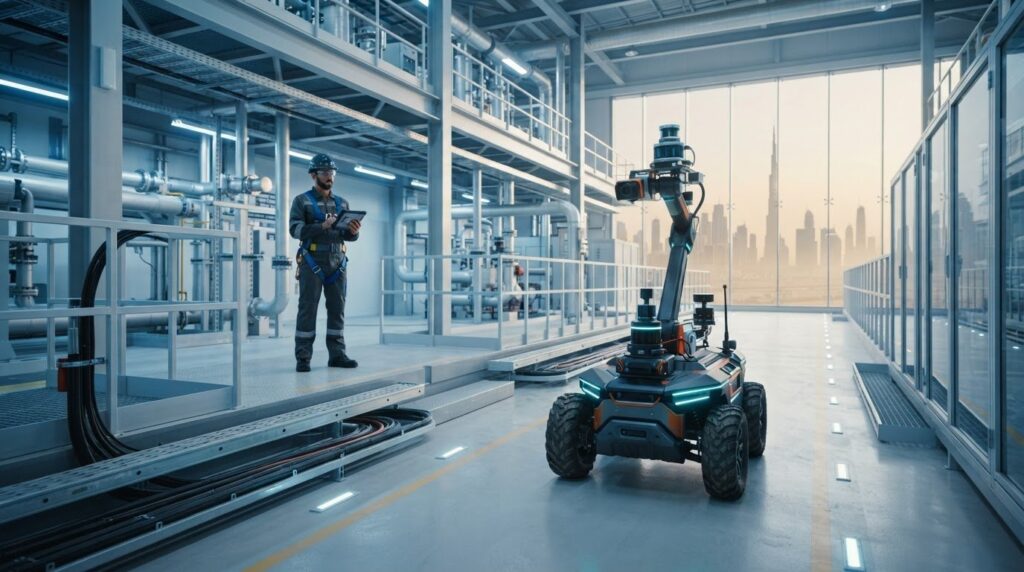
- Surveillance and Cleaning: Deploying autonomous units to secure and maintain expansive industrial sites, reducing human exposure to hazardous environments.
- Intelligent Navigation: Utilizing centralized AI “brains” to optimize paths for delivery and inspection robots, ensuring seamless operation in dynamic spaces.
Logistics remains a primary driver for automation, with ASRS and AMR deployment becoming the standard for modern warehousing. Manufacturing continues to evolve through bespoke integration and autonomous intelligence, while facilities management sees a surge in demand for inspection and outdoor cleaning robots. Leveraging national R&D tax credits of 30% to 50%, forward-thinking enterprises are now prioritizing the deployment of intelligent ecosystems over standalone hardware to ensure their long-term business viability.
Essential Criteria for Evaluating Industrial Robotics Suppliers
Selecting a strategic partner in the UAE’s rapidly advancing high-tech environment requires a focus on architectural synergy rather than mere hardware acquisition. Industrial robotics suppliers UAE must demonstrate more than just an inventory of machines; they need to provide a comprehensive roadmap for digital maturity. Evaluating a supplier’s official certification status and their alliances with global technology leaders, such as Franka Robotics or Unitree, serves as a primary marker of legitimacy and technical depth. These partnerships ensure that the solutions provided aren’t only cutting-edge but also backed by the intellectual framework of the world’s most innovative engineering firms.
Technical Integration and SCADA Compatibility
Achieving a fully automated, interconnected facility depends on the seamless flow of data between physical hardware and centralized control software. A supplier must demonstrate profound expertise in PLC and SCADA integration services to ensure that new robotic units communicate effectively with existing industrial networks. This level of orchestration prevents the creation of isolated “automation islands” and allows for real-time monitoring and data-driven optimization. Software flexibility is non-negotiable for future-proofing your investment. It allows for bespoke programming that meets the unique safety and logic requirements of specialized industrial applications, ensuring your facility can adapt as production needs evolve.
Support Infrastructure and Regional Expertise
Technical prowess is irrelevant without a robust national support network to back it up. When you evaluate industrial robotics suppliers UAE, prioritize those with a proven infrastructure for lifecycle maintenance and immediate on-site responsiveness. Successful robotic deployment relies on more than just initial installation; it requires comprehensive training programs that empower your local workforce to operate and troubleshoot advanced systems confidently. Organizations should verify a supplier’s commitment to preventative maintenance schedules and the immediate availability of spare parts within the region to minimize the risk of unforeseen downtime.
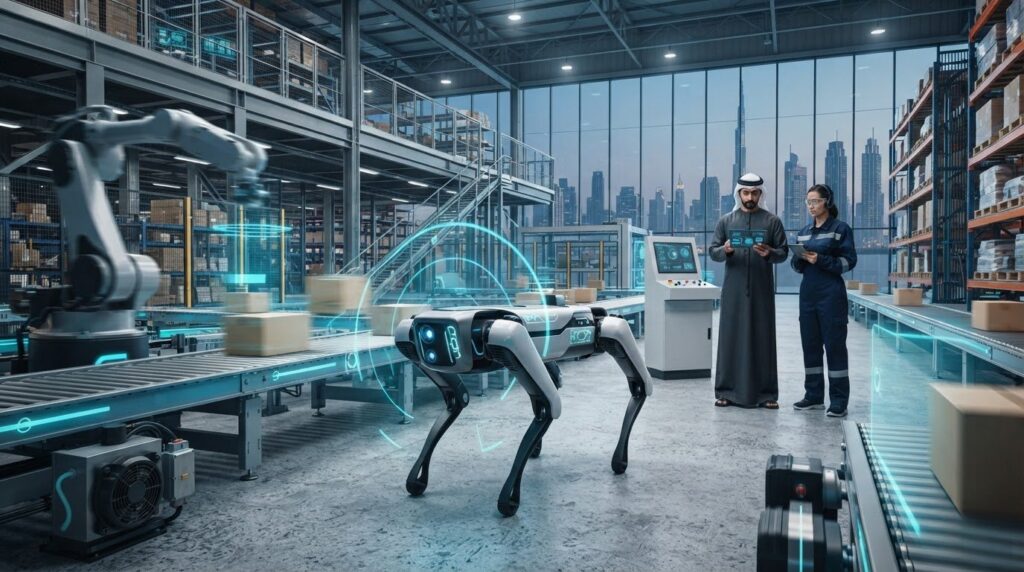
Evaluating a supplier’s track record in multi-system orchestration is equally vital for large-scale operations. A partner who understands how to synchronize Autonomous Mobile Robots (AMRs) with static assembly lines provides a level of efficiency that standalone vendors cannot match. Partnering with a consultant who offers comprehensive automation design ensures that your technological investment translates into measurable operational gains and long-term business viability. This systematic approach brings order and safety to complex environments, positioning your enterprise as a leader in the national shift toward Industry 4.0 standards.
Key Robotic Technologies Driving Industrial Excellence
Achieving operational excellence in the UAE’s competitive industrial sector requires a nuanced understanding of the specific robotic classes available. Leading industrial robotics suppliers UAE now provide a spectrum of intelligent hardware designed to solve distinct challenges, from high-precision assembly to large-scale autonomous logistics. Selecting the appropriate technology isn’t merely a matter of hardware procurement; it’s a strategic decision that defines the intelligence and scalability of your entire facility.
Collaborative vs. Autonomous Systems
Prioritizing human safety without sacrificing throughput, Collaborative Robots (Cobots) represent a fundamental shift in assembly line architecture. Unlike traditional industrial arms that require heavy safety fencing and isolated zones, cobots utilize advanced force-feedback sensors and proximity detection to work alongside human operators safely. This synergy allows for flexible manufacturing where robots handle repetitive, high-precision tasks while humans focus on complex problem-solving.
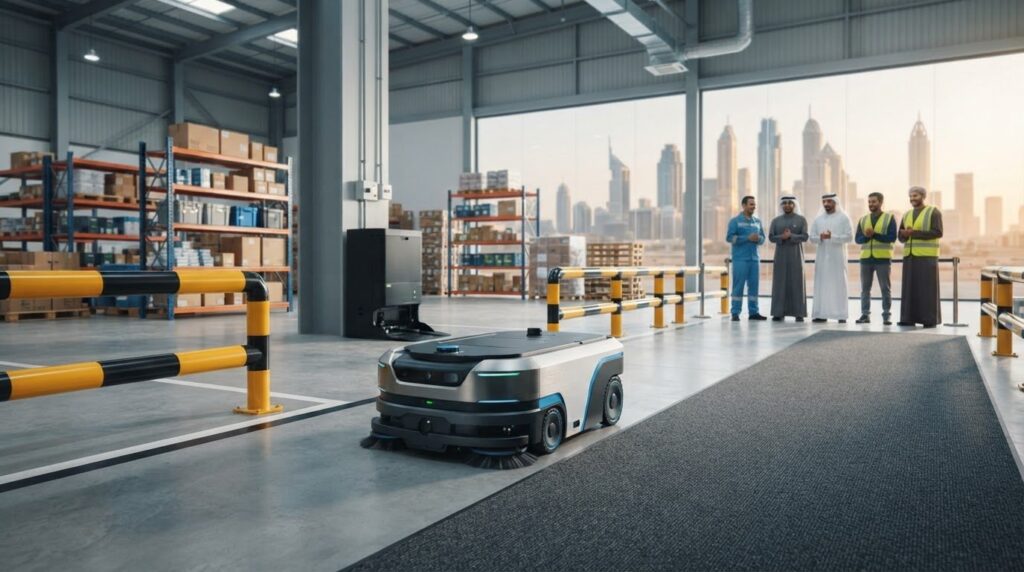
For tasks requiring mobility across dynamic environments, autonomous mobile robots provide the necessary intelligence to navigate complex warehouse floors without the need for fixed tracks or infrastructure. These units use AI-driven SLAM (Simultaneous Localization and Mapping) to adapt to changing surroundings in real-time. Determining the right mix of these assets involves analyzing the ratio of static precision tasks to mobile material handling requirements within your specific facility to ensure optimal resource allocation.
Logistics and Warehouse Automation
Maximizing inventory density while maintaining total accuracy is the hallmark of modern warehouse design. Implementing automated storage and retrieval systems allows organizations to leverage vertical space that was previously inaccessible, significantly reducing the physical footprint of fulfillment centers. These systems provide rapid, error-free access to inventory, which is essential for high-throughput sectors like e-commerce and pharmaceutical distribution.
The true power of these systems emerges when they work in synergy with mobile units; while ASRS handles high-density buffering and retrieval, AMRs manage the rapid transport of goods to picking or shipping stations. This orchestration eliminates manual travel time and dramatically lowers operational overhead. Beyond the warehouse floor, specialized service robots are transforming facilities management through autonomous surveillance and cleaning. Outdoor cleaning robots maintain expansive industrial sites with minimal human intervention, while inspection units provide real-time data from hazardous areas. Utilizing these specialized technologies ensures that every facet of an enterprise is optimized for safety and long-term business viability.
Strategic Integration: From Hardware Procurement to SCADA Connectivity
Procuring high-end robotic hardware represents only the initial phase of industrial modernization. To extract genuine value, enterprises must ensure that new assets communicate effectively with legacy infrastructure. Industrial robotics suppliers UAE often provide the machines, but few possess the architectural expertise to bridge the gap between physical motion and digital control. Overcoming the challenge of legacy system interoperability requires a sophisticated approach to protocol conversion and hardware synchronization, ensuring that your investment doesn’t sit idle due to software friction.
The Importance of Control System Integration
Programmable Logic Controllers (PLCs) serve as the localized intelligence for any automated environment, managing the complex safety logic and motion control required for high-speed operations. By implementing bespoke PLC programming, organizations minimize plant downtime during the transition from manual to robotic workflows. This localized control ensures that emergency response protocols are integrated directly into the machine’s DNA, mitigating risk to both human operators and expensive hardware.
Centralizing these operations through comprehensive SCADA (Supervisory Control and Data Acquisition) architectures allows for real-time data visualization and efficient fleet management. A well-designed SCADA system provides a single pane of glass for monitoring disparate robotic units, from stationary cobots to mobile AMRs. This connectivity must be shielded by robust cybersecurity measures, adhering to the UAE’s National Cyber Accreditation Programme (NCAP) to protect the industrial network from external threats. Organizations looking to secure their infrastructure should consult with an integration specialist to design a resilient automation backbone.
Data-Driven Decision Making
Modern robotic units act as high-fidelity data nodes, utilizing advanced sensors to capture performance metrics that were previously invisible. Integrating this robotic data into Enterprise Resource Planning (ERP) systems enables a level of operational transparency that drives predictive maintenance and performance analytics. Instead of reacting to equipment failure, maintenance teams can anticipate wear and tear based on real-time feedback, significantly improving the longevity of the system.
Measuring the impact of this integration on Overall Equipment Effectiveness (OEE) provides a clear picture of ROI. When hardware, PLCs, and SCADA work in harmony, manufacturers see a tangible reduction in cycle times and a sharp increase in inventory accuracy. This data-driven approach transforms the facility from a collection of machines into a self-optimizing ecosystem, ensuring long-term business viability in an increasingly competitive national market.
EdNex Automation: Advanced Robotic Systems for the Future-Ready Enterprise
Positioning ourselves at the vanguard of the national industrial shift, EdNex Automation provides the intellectual and technical framework necessary for large-scale digital transformation. We don’t merely act as equipment vendors; we function as high-level consultants who connect global technological breakthroughs with regional industrial needs. By maintaining official partnerships with global innovators such as Unitree, Franka Robotics, and Pudu, we ensure our clients have access to the most advanced autonomous systems available in 2026. This strategic alliance allows us to deliver bespoke solutions that are officially certified and ready for immediate integration into complex industrial environments, making us the premier choice among industrial robotics suppliers UAE.
A Multi-Disciplinary Automation Partner
Leveraging the legacy of the EdNex group founded in 2018, our automation division delivers Industry 4.0 excellence through a multi-disciplinary approach. We recognize that successful robotic implementation requires more than just hardware, so we provide a comprehensive portfolio that spans from humanoid service robots to heavy-duty ASRS. Our specialized units for autonomous cleaning, surveillance, and inspection are designed to mitigate operational risk while enhancing safety in hazardous or high-traffic areas. By providing the underlying logic and SCADA connectivity for these systems, we bring order and efficiency to the most demanding commercial sectors across the UAE.
Transitioning to an Autonomous Future
Transitioning to an autonomous future requires a partner who understands the specific economic context of the region and the nuances of the 2026 regulatory environment. Our tailored industry solutions address the core pains of high labor costs and system interoperability by offering a single-source approach for hardware, software, and localized technical support. This comprehensive model ensures that every component, from a delivery robot to a complex warehouse management system, remains synchronized and scalable. Establishing a national presence that spans the entire territory, we prioritize the delivery of high-impact industrial solutions that align with the latest R&D tax credits and safety codes.
Executing a start-to-finish expertise model, we ensure that your transition to automation is both methodical and reliable. We provide the necessary infrastructure to ensure your facility isn’t just automated, but truly intelligent and interconnected. By choosing a partner with deep regional expertise and global standing, you secure your organization’s long-term business viability through controlled, deliberate innovation. Partner with EdNex Automation to redefine your industrial capabilities and lead the next wave of national technological evolution.
Securing Your Competitive Edge in the National Automation Landscape
Navigating the shift toward Industry 4.0 requires more than just high-end hardware; it demands a comprehensive architectural vision that links physical motion with digital intelligence. By prioritizing seamless PLC and SCADA integration while adhering to the UAE AI Act 2026, organizations secure a significant advantage in operational resilience. Evaluating industrial robotics suppliers UAE through the lens of technical depth and official global certifications ensures that your investment drives measurable ROI and remains scalable for the long term.
Leveraging our status as an authorized partner of Pudu, Unitree, and Franka Robotics, EdNex Automation delivers the specialized consulting and national support network required for high-stakes deployments. We provide the intellectual framework to transform your facility into a fully interconnected, autonomous ecosystem. Consult with our Automation Architects to optimize your industrial facility and ensure your enterprise is prepared for the next era of industrial excellence. It’s time to embrace a systematic approach that brings order and efficiency to your complex environments.
Frequently Asked Questions
What are the main types of industrial robots available in the UAE?
The national market features a diverse range of autonomous systems designed for specific high-output applications. Primary categories include Collaborative Robots (Cobots) for assembly, Autonomous Mobile Robots (AMRs) for material handling, and Automated Storage and Retrieval Systems (ASRS) for high-density warehousing. Additionally, specialized service robots for cleaning, delivery, and surveillance are increasingly deployed. These high-tech solutions allow enterprises to transition from legacy manual processes to intelligent, interconnected ecosystems that drive measurable ROI.
How do I calculate the ROI for a collaborative robot implementation?
Calculating ROI for a collaborative robot implementation involves analyzing the total cost of ownership against measurable gains in throughput and labor optimization. You must factor in the reduction of specialized labor expenses, lower error rates, and the elimination of expensive safety fencing required for traditional robots. Enterprises often see a significant return by measuring the impact on cycle times and the redistribution of human capital toward higher-value tasks, ensuring long-term business viability.
Can autonomous mobile robots operate alongside human workers safely?
Yes, Autonomous Mobile Robots are engineered with advanced sensor suites, including LiDAR and 3D cameras, to navigate dynamic environments alongside human workers safely. These units utilize real-time SLAM algorithms to detect obstacles and adjust paths instantly, preventing collisions. By adhering to international safety standards and the UAE Fire and Life Safety codes, AMRs provide a secure method for automating internal logistics without requiring isolated work zones or physical barriers that disrupt facility flow.
What is the role of PLC and SCADA in industrial robotics?
Programmable Logic Controllers (PLCs) provide the localized intelligence required for robotic motion and safety logic, while SCADA systems offer a centralized platform for real-time data visualization. This integration is essential for multi-system orchestration, allowing operators to monitor a fleet of robots from a single interface. By leveraging these control systems, industrial robotics suppliers UAE ensure that hardware remains synchronized with the broader industrial network, facilitating predictive maintenance and performance analytics that prevent unforeseen downtime.
Do industrial robotics suppliers in the UAE provide local technical support?
Reputable industrial robotics suppliers UAE maintain a robust national service and support network to ensure maximum system uptime. Local technical support is critical for lifecycle maintenance, providing immediate on-site responsiveness for troubleshooting and spare parts replacement. EdNex Automation, for instance, offers specialized consulting and deployment services across the territory. This regional expertise ensures that your facility receives the necessary training and preventative maintenance to sustain high-output operations without the risk of long-term operational friction.
What industries benefit most from automated storage and retrieval systems?
Automated Storage and Retrieval Systems (ASRS) provide the greatest value to sectors requiring high-density inventory management and rapid fulfillment. E-commerce, pharmaceutical distribution, and large-scale manufacturing benefit significantly from the optimization of vertical space and the elimination of manual picking errors. These systems allow organizations to maximize their storage footprint while maintaining total inventory accuracy, which is vital for maintaining a competitive edge in the UAE’s fast-moving logistics and material handling landscape.
How long does it typically take to deploy an industrial robotic system?
The deployment timeline for an industrial robotic system typically ranges from several weeks to several months, depending on the complexity of the integration. A standard phase includes initial architectural design, bespoke PLC programming, and rigorous on-site testing to ensure SCADA connectivity. While simple cobot cells can be operational quickly, large-scale ASRS or AMR fleet deployments require a more methodical, multi-stage approach to ensure safety protocols and logic are fully synchronized with existing workflows.
Are there specific regulations for industrial robotics in the UAE?
Yes, all robotic deployments must comply with the UAE AI Act 2026, which establishes binding governance for AI-driven systems. Additionally, systems must adhere to the UAE Fire and Life Safety codes and international safety standards like CE marking. Cybersecurity is another critical area, with the National Cyber Accreditation Programme (NCAP) mandating secure integration for any hardware connected to an industrial network. All organizations deploying these systems must complete a mandatory self-assessment by September 2026.