By 2026, the transition to automated warehouse environments has shifted from a visionary ambition to a foundational requirement for any organization seeking to maintain its standing in the UAE’s AED 3 trillion non-oil economy. Operating within high-cost industrial zones often means grappling with inefficient space utilization and the escalating overhead of manual sorting processes. You likely recognize that the traditional reliance on manual labor is increasingly untenable as specialized technical talent becomes harder to secure. This strategic guide empowers you to master the complexities of intralogistics automation UAE by providing a rigorous framework for the deployment of robotics and ASRS systems.
Leveraging our expertise as a high-level technical integrator, we bridge the gap between global innovations and regional industrial requirements to ensure your infrastructure remains resilient. We’ll examine the specific pathways to reducing operational downtime and scaling warehouse throughput through controlled, deliberate innovation. By aligning advanced PLC and SCADA integration with modern robotic fleets, you can transform your logistics hub into a high-performance asset that thrives under the demands of a post-digital trade economy. This evolution isn’t just about current efficiency; it’s about securing the long-term viability of your industrial operations.
Key Takeaways
- Analyze the fundamental shift toward Industry 4.0 that is converting traditional UAE warehouses into intelligent, high-density autonomous hubs.
- Evaluate the specific roles of AMRs and ASRS in driving intralogistics automation UAE to ensure maximum scalability and reduced operational overhead.
- Identify why sophisticated PLC and SCADA integration serves as the critical neural network for synchronizing complex robotic deployments and real-time data visualization.
- Assess how specialized technologies, including autonomous cleaning and delivery robots, mitigate technical labor shortages while maintaining rigorous industrial hygiene standards.
- Gain a comprehensive framework for conducting feasibility studies and ROI modeling to de-risk your organization’s journey toward full-scale industrial automation.
The Evolution of Logistics Automation in the UAE
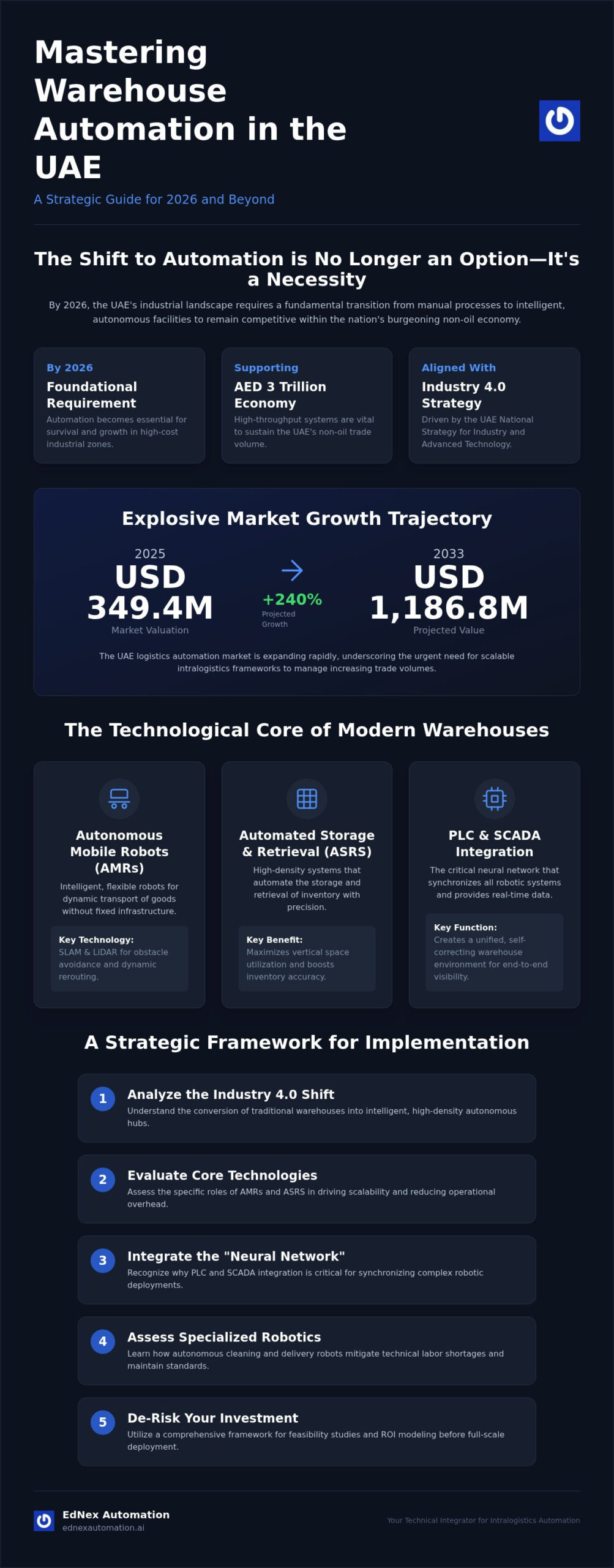
The UAE industrial landscape is undergoing a profound transformation as organizations transition from legacy manual processes toward sophisticated, high-density autonomous facilities. This shift is fundamentally driven by the UAE National Strategy for Industry and Advanced Technology, which prioritizes the adoption of 4IR technologies to enhance global competitiveness. Within this framework, Logistics Automation has evolved from a peripheral efficiency tool into the central nervous system of modern trade. By 2026, the maturity of intralogistics automation UAE standards will define which enterprises can sustain the throughput required to support the nation’s non-oil trade, which surpassed AED 3 trillion in 2025. This year marks a definitive turning point where regional supply chain resilience becomes inseparable from technological autonomy.
The Drivers of Automation in the Regional Market
Rapid growth in the e-commerce sector acts as a primary catalyst for this industrial evolution. With the UAE e-commerce market forecast to exceed AED 47.7 billion by 2029, the pressure on fulfillment speeds has reached a critical threshold. Traditional sorting methods can’t match the requirements of high-frequency, low-volume orders typical of modern digital retail. Systematic robotic deployment addresses these pressures while simultaneously mitigating the persistent shortage of specialized technical labor. High-precision sortation systems allow global trade hubs to maintain 24/7 operational cycles without the performance degradation inherent in manual labor. These systems ensure that facility throughput remains consistent even during peak demand periods, securing the UAE’s position as a reliable global trade partner.
Defining the Scope of Modern Logistics Systems
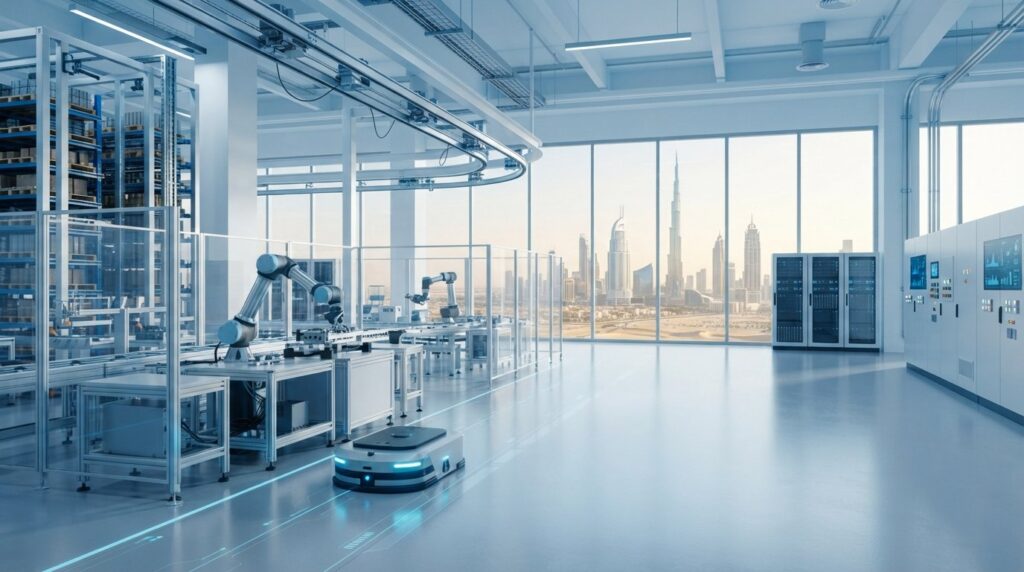
Understanding the distinction between software-based optimization and physical robotic hardware is essential for strategic planning. While Warehouse Management Systems (WMS) provide the digital logic for operations, physical systems like autonomous mobile robots handle the actual movement of inventory with mathematical precision. Industry 4.0 as it applies to UAE logistics is the seamless integration of cyber-physical systems with real-time data analytics to create self-correcting warehouse environments. Achieving end-to-end visibility requires more than just isolated machinery; it demands a unified stack where PLC and SCADA integration services synchronize every movement across the facility floor. This comprehensive approach ensures that intralogistics automation UAE solutions deliver measurable ROI by eliminating data silos and operational bottlenecks. Organizations that adopt this integrated model don’t just move goods faster. They build a scalable foundation for future growth in a highly competitive economic territory.
Core Technologies: AMRs and ASRS Systems
The UAE logistics automation market was valued at USD 349.4 million in 2025 and is projected to reach USD 1,186.8 million by 2033. This rapid expansion underscores the critical necessity for scalable intralogistics automation UAE frameworks that can handle increasing trade volumes. At the heart of this transformation lie two distinct but complementary technologies: autonomous mobile robots and high-density storage systems. These tools don’t just replace labor; they provide the intellectual framework for dynamic inventory management. By deploying these advanced systems, facilities can achieve the throughput required to support the nation’s ambitious non-oil trade targets while maintaining high operational safety standards.
Autonomous Mobile Robots (AMRs) for Dynamic Transport
AMRs represent a paradigm shift from traditional Automated Guided Vehicles (AGVs). Utilizing SLAM and LiDAR, these units navigate complex environments without fixed infrastructure like magnetic strips. This intelligence enables dynamic rerouting to avoid obstacles, while modular attachments support diverse payload capacities for various cargo types. This transition from rigid AGVs to intelligent AMRs allows for greater flexibility in fast-paced fulfillment centers.
Maximizing Vertical Space with ASRS
For facilities in high-cost industrial zones, automated storage and retrieval systems solve inefficient space utilization. Shuttle-based systems drive high-velocity throughput for small items, while crane-based ASRS excels in vertical pallet storage. These systems optimize temperature-controlled environments by reducing the overall footprint. Integration with a WMS provides real-time inventory visibility, ensuring high-velocity SKUs are managed with mathematical precision.
Beyond individual hardware units, the success of intralogistics automation UAE depends on how these technologies integrate with existing facility layouts. Most regional operators can’t afford the downtime associated with total structural overhauls. Modern AMRs are designed for non-invasive deployment, allowing them to map a facility and begin operations within days rather than months. Safety remains the paramount concern in these active logistics zones. Human-robot coexistence is managed through a combination of physical sensors and intelligent fleet management software that enforces exclusion zones and speed limits in high-traffic areas. By prioritizing these safety protocols, organizations protect their workforce while achieving the continuous operational cycles necessary for regional supply chain resilience. If you’re ready to modernize your facility, our experts can help you evaluate the right automation stack for your specific industrial needs.
Specialized Robotics for Comprehensive Facility Management
Providing the intellectual framework for total environmental control, specialized robotic units serve as the frontline of modern facility management. While the previous sections detailed the movement of inventory, intralogistics automation UAE standards also encompass the maintenance, security, and hygiene of the industrial ecosystem. High-performance facilities require more than just rapid throughput; they demand consistent sanitation and rigorous asset protection to ensure operational longevity. By deploying specialized robotics, operators can automate critical support tasks, effectively reallocating human capital to supervisory roles that require high-level decision-making. This holistic approach ensures that the facility remains a controlled and efficient environment, capable of meeting the stringent demands of global trade partners.
Industrial Hygiene and Maintenance Automation
Eliminating the inconsistencies of manual sanitation, autonomous cleaning robots maintain medical-grade hygiene standards across large-scale logistics hubs. These autonomous floor scrubbers utilize sophisticated mapping to navigate safely around active AMR fleets, ensuring that cleaning cycles don’t disrupt primary fulfillment workflows. Beyond the warehouse floor, outdoor cleaning robots manage loading docks and external perimeters, preventing debris from entering the facility. Implementing scheduled robotic maintenance reduces the overhead associated with traditional cleaning crews and minimizes safety risks in high-traffic zones. These systems provide a verifiable record of sanitation, which is increasingly vital for facilities handling sensitive goods or food-grade products within the regional market.
Surveillance and Inspection Robotics
Securing unmanned or high-density warehouses requires a continuous presence that static CCTV systems can’t provide. Surveillance robots offer autonomous patrolling capabilities, delivering 24/7 security with real-time alerts for unauthorized access or environmental anomalies like heat spikes. These units often feature specialized sensors for the inspection of hazardous materials or structural integrity in hard-to-reach racking systems. Integrating advanced vision systems with the broader SCADA stack enables predictive maintenance by identifying mechanical wear on facility assets before it leads to systemic failure. This proactive monitoring acts as a critical risk mitigation tool, protecting high-value infrastructure from preventable downtime.
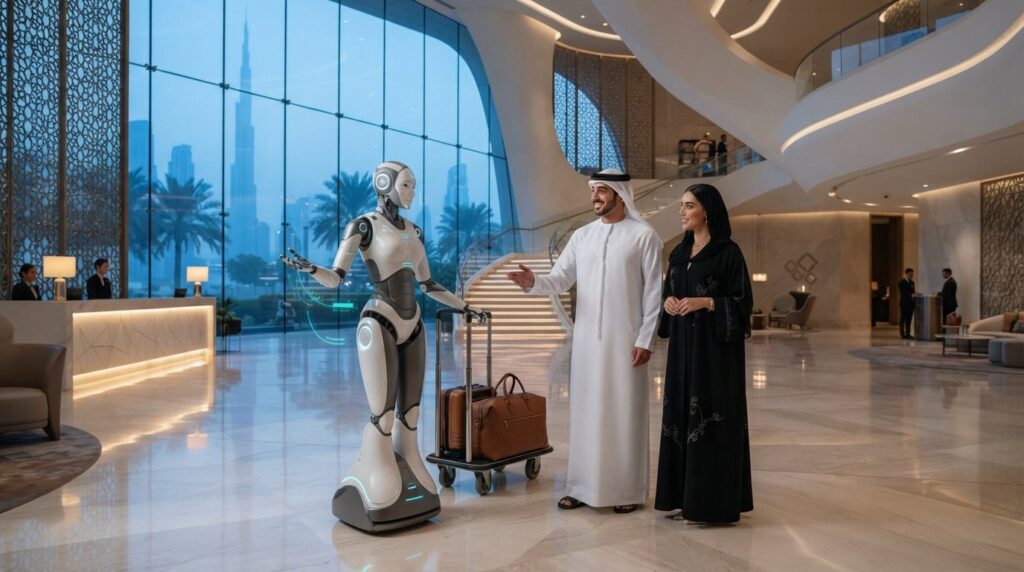
Optimizing internal facility logistics, delivery robots handle small-part transfers between workstations to eliminate unnecessary “walking time” for human operators. Looking toward the future, the emergence of humanoid robots for sale UAE represents the next evolution in logistics support. These versatile machines are designed to operate in environments originally built for humans, offering a functional bridge between manual labor and full-scale industrial autonomy. As part of a comprehensive intralogistics automation UAE strategy, these specialized systems ensure that every facet of the facility operates at peak efficiency, safeguarding assets and personnel in an increasingly complex industrial landscape.
The Brain of Automation: PLC and SCADA Integration
Synchronizing the disparate components of a modern facility, the control architecture serves as the intellectual framework that transforms individual machines into a cohesive system. While robotic hardware provides the physical muscle for movement, PLC and SCADA integration services provide the logic and oversight necessary for complex industrial operations. In the context of intralogistics automation UAE, this integration layer is critical for managing the high-velocity trade volumes characteristic of the region. Without a robust control stack, even the most advanced AMRs and ASRS units remain isolated silos, unable to communicate or adapt to real-time operational shifts. Establishing this centralized “brain” ensures that every conveyor, sorter, and robot operates in perfect alignment with the facility’s overarching strategic objectives.
Programmable Logic Controllers (PLC) in Logistics
Acting as the primary interface between software logic and physical action, Programmable Logic Controllers manage the high-speed execution of localized tasks. These units are essential for controlling conveyor systems, high-speed palletizers, and precision sorters that form the backbone of fulfillment centers. Utilizing custom PLC programming allows for the creation of bespoke logistics workflows tailored to specific regional industrial standards. This level of customization ensures that hardware responds with mathematical precision to varying load requirements and throughput demands. Furthermore, robust control logic includes advanced diagnostics that identify mechanical friction or electrical anomalies before they escalate into systemic failures. By minimizing unplanned downtime through these proactive diagnostics, organizations maintain the continuous operational cycles required for regional supply chain resilience.
SCADA Systems for Operational Intelligence
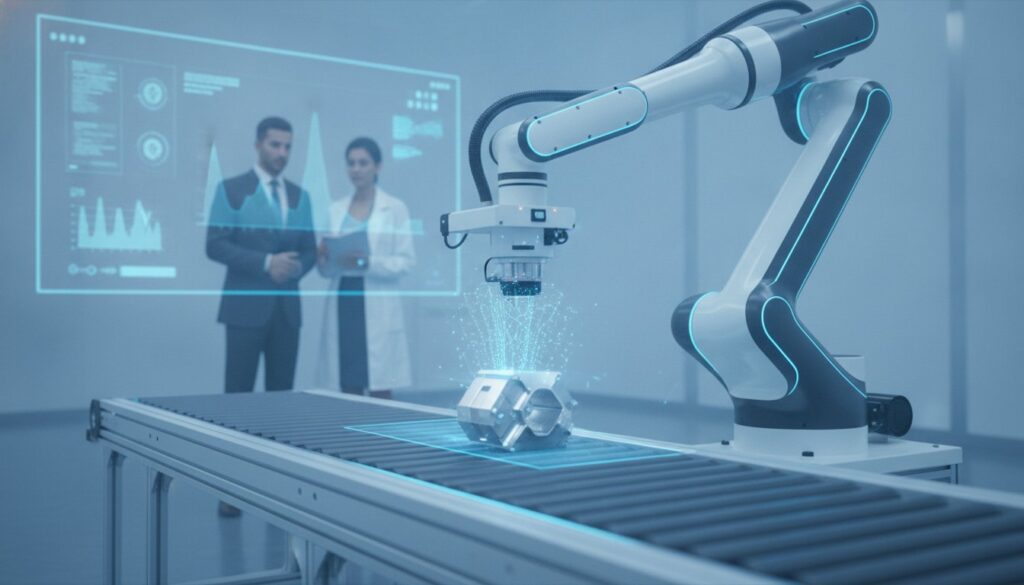
Providing the high-level supervisory control required for facility-wide monitoring, SCADA systems aggregate data from across the entire automation stack. This centralized visualization allows floor managers to monitor real-time performance metrics, from battery levels of robotic fleets to the status of high-density storage aisles. Leveraging this data for predictive analytics enables the identification of subtle bottlenecks that might otherwise go unnoticed in a manual environment. SCADA systems maximize ROI for UAE logistics firms by transforming raw operational data into actionable insights that optimize high-cost industrial square footage. This transparency is particularly vital in multi-vendor environments where interoperability between different robotic platforms is paramount. When hardware from different manufacturers can share data through a unified SCADA interface, the entire facility achieves a higher level of intelligence and adaptability.
Building a resilient automation strategy requires more than just purchasing hardware; it demands a sophisticated control architecture that can scale with your business. Our team provides the technical expertise necessary to bridge the gap between complex robotic hardware and centralized industrial control systems. If you’re looking to enhance your facility’s operational intelligence, consult with our integration specialists to design a bespoke PLC and SCADA framework for your logistics operations.
Implementing Logistics Automation: A Strategic Framework
Executing a successful transition to an automated environment requires a structured roadmap that aligns technological capability with specific business outcomes. Successful intralogistics automation UAE projects depend on rigorous planning rather than ad-hoc equipment acquisition. This strategic journey begins with a comprehensive technical feasibility study and a detailed ROI analysis to ensure that every robotic unit contributes to long-term viability. By adopting a phased implementation strategy, organizations can de-risk their investment, starting with pilot programs in high-impact zones before moving to full-scale industrial autonomy. This methodical approach allows for the refinement of workflows and the steady integration of new systems without disrupting existing supply chain commitments.
Assessing Automation Readiness
Evaluating infrastructure constraints is the first critical step in de-risking your investment. High-performance AMRs and ASRS units require specific environmental conditions, including high-precision floor flatness and robust 5G or Wi-Fi 6 connectivity for real-time data transmission. Defining clear key performance indicators (KPIs) for success, such as a 25% increase in warehouse throughput or a significant reduction in sorting errors, provides a metric for evaluating the performance of the automation stack. Identifying high-impact zones, such as palletizing areas or high-velocity picking lanes, allows for the immediate realization of efficiency gains. These initial successes build the internal confidence necessary for broader organizational transformation while ensuring that power and connectivity requirements are scaled proportionally with the robotic fleet.
The EdNex Automation Approach
Acting as a bridge between global technological breakthroughs and regional industrial needs, EdNex Automation provides the intellectual framework necessary for large-scale transformation. We specialize in the bespoke integration of AMRs, collaborative robots UAE, and high-density ASRS to create a unified and resilient infrastructure. Our role as a high-level consultant and integrator ensures that your systems aren’t just installed but are optimized for the specific demands of the regional market. We provide comprehensive support from initial design through to certified technical maintenance, ensuring your facility adheres to international safety and reliability standards.
Training the workforce for high-tech human-robot collaboration is equally vital for sustaining long-term operational improvement. As low-level manual tasks are automated, the workforce must evolve to handle supervisory roles and system maintenance. This evolution requires a commitment to specialized technical training that empowers employees to work alongside sophisticated machinery with confidence. Partnering with a certified system integrator provides the technical expertise needed to bridge this skills gap, ensuring that your team is prepared for the complexities of Industry 4.0. By prioritizing both technological and human readiness, you build a scalable foundation that thrives within the UAE’s ambitious industrial landscape.
Securing Industrial Resilience in the Post-Digital Economy
Transitioning to a fully autonomous warehouse environment has become a foundational requirement for industrial viability in the region. By integrating high-density ASRS and intelligent AMRs, your organization addresses the critical challenges of space utilization and labor shortages while scaling throughput to meet global trade demands. The success of these deployments hinges on a robust control architecture, where specialized PLC and SCADA integration provides the necessary logic for seamless synchronization across the facility floor. Mastering intralogistics automation UAE standards ensures that your infrastructure remains resilient against future market shifts and operational pressures.
Leveraging our certified technical expertise in PLC/SCADA and ASRS, we act as a reliable bridge between global breakthroughs and regional needs. Our visionary portfolio of collaborative and autonomous robotics is designed to drive your industrial digital transformation with precision and reliability. Consult with EdNex Automation to design your Industry 4.0 logistics roadmap and lead the evolution of your supply chain. Embracing these advanced systems today secures your competitive standing and ensures long-term business viability in an increasingly automated world.
Frequently Asked Questions
What is the primary difference between AGVs and AMRs in logistics?
The primary difference lies in the method of navigation and the level of environmental adaptability. While AGVs rely on fixed infrastructure like magnetic strips or wires to follow pre-defined paths, AMRs utilize sophisticated SLAM and LiDAR technologies to navigate dynamically. This intelligence allows AMRs to reroute around obstacles in real-time, making them far more effective for the flexible requirements of modern intralogistics automation UAE facilities where floor layouts change frequently.
How does ASRS technology improve warehouse space efficiency in the UAE?
ASRS technology maximizes vertical cube utilization by replacing wide aisles and manual reach trucks with high-density racking and automated retrieval units. In the UAE’s high-cost industrial zones, this allows facilities to maximize their storage capacity without expanding their physical footprint. By utilizing shuttle systems or cranes, organizations optimize their throughput for high-velocity SKUs while maintaining precise inventory control in temperature-controlled or ambient environments, significantly reducing the cost per pallet stored.
Can logistics robots be integrated with existing SCADA and PLC systems?
Most modern logistics robots are designed for seamless integration with existing industrial control architectures. Utilizing standardized communication protocols allows robotic hardware to share real-time data with centralized PLC and SCADA systems. This synchronization is vital for achieving facility-wide visibility and ensuring that automated mobile robots or conveyor systems operate in perfect alignment with broader fulfillment goals. Proper integration prevents data silos and enables a unified, data-driven approach to facility management and risk mitigation.
What are the safety requirements for operating collaborative robots in a warehouse?
Operating collaborative robots requires adherence to rigorous safety standards, including power and force limiting and speed and separation monitoring. Unlike traditional industrial robots that require physical fencing, cobots utilize integrated sensors to detect human presence and stop or slow down instantly upon contact. A comprehensive risk assessment is essential to define safe interaction zones, ensuring that human-robot collaboration remains productive without compromising worker safety in active, high-traffic logistics environments across the nation.
How much can a business expect to save by automating industrial cleaning?
Automating industrial hygiene significantly reduces operational overhead by eliminating the need for manual cleaning crews in large-scale hubs. Businesses realize savings through reduced water and chemical waste and the prevention of debris-related damage to sensitive AMR sensors or conveyor components. While specific AED figures depend on facility scale, scheduled robotic maintenance provides a verifiable record of sanitation that protects high-value inventory and ensures compliance with regional industrial hygiene regulations without manual intervention.
What role does Industry 4.0 play in the future of UAE logistics?
Industry 4.0 serves as the intellectual framework for the UAE’s transition toward a post-digital trade economy. By integrating cyber-physical systems and real-time data analytics, the nation aims to enhance supply chain resilience. AI-driven optimization has the potential to improve delivery efficiency by up to 30% in UAE operations, aligning with the UAE National Strategy for Industry and Advanced Technology. This converts traditional warehouses into intelligent hubs that autonomously adapt to shifting market demands.
Are humanoid robots currently viable for logistics operations in 2026?
Humanoid robots have become a viable support solution for specific logistics tasks that require human-like dexterity in environments built for manual labor. These units act as a functional bridge, performing repetitive picking or sorting tasks alongside existing workforces. In the context of intralogistics automation UAE, humanoids offer a scalable way to mitigate technical labor shortages without requiring total structural overhauls of legacy facilities, providing a versatile and intelligent tool for comprehensive industrial autonomy.
What are the first steps for a UAE company to begin logistics automation?
The initial phase involves conducting a rigorous technical feasibility study and a detailed ROI analysis to identify high-impact zones for deployment. Companies should evaluate their existing infrastructure, including floor flatness and connectivity, before launching a pilot program. Partnering with a certified system integrator like EdNex Automation ensures that the transition follows international standards. This methodical approach, from initial design to certified technical maintenance, ensures long-term business viability and operational success in the region.