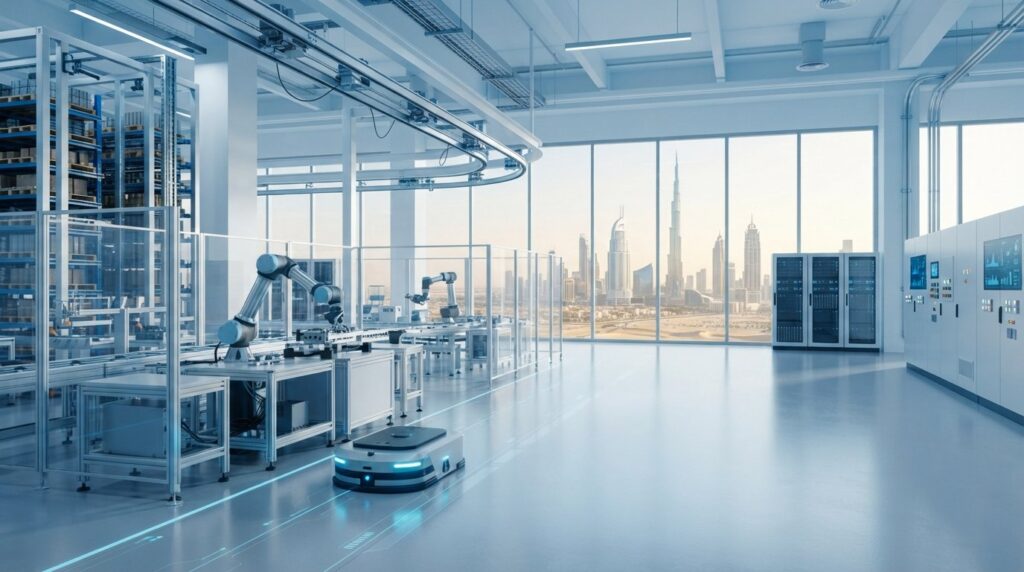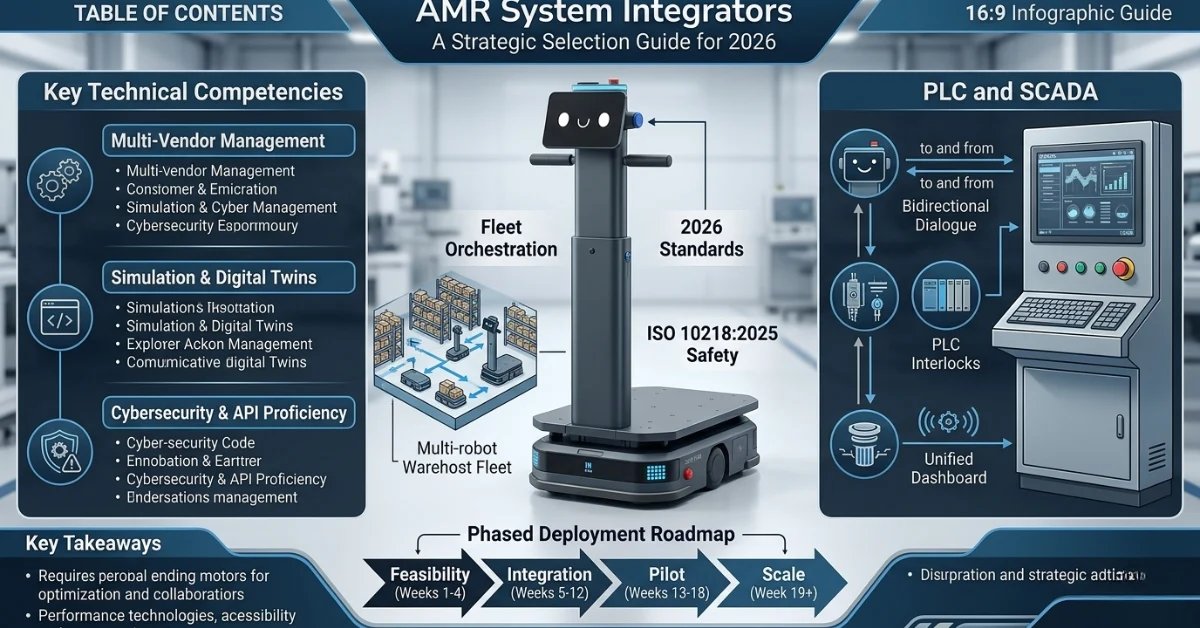
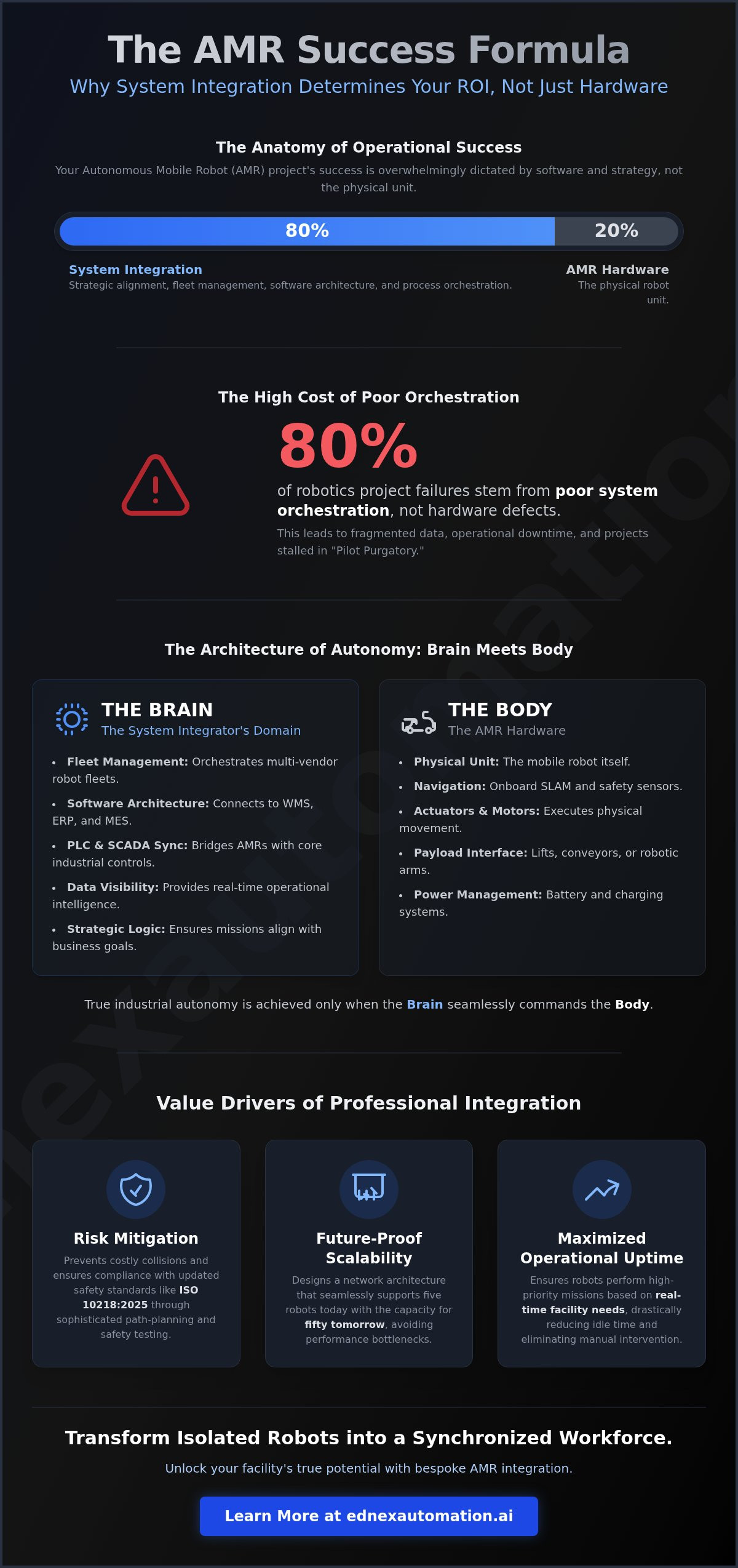
Achieving a sustainable return on investment in autonomous mobile robotics depends less on the hardware you purchase and more on the AMR system integrators who orchestrate the deployment. While the global mobile robot market is projected to reach approximately 51.4 billion AED by 2030, the physical unit accounts for only 20% of your operational success. You likely recognize that deploying a multi-vendor fleet without a unified strategy leads to fragmented data and costly operational downtime.
This guide provides the strategic framework needed to bridge the gap between sophisticated autonomous hardware and tangible industrial ROI. Prioritizing the integration of fleet intelligence with existing PLC and SCADA control logic, we provide a roadmap for leaders to ensure their transition to automation remains seamless and scalable. We will examine the updated ISO 10218:2025 safety standards, the complexities of enterprise-level synchronization, and the specific requirements for securing local technical support within the United Arab Emirates industrial sector.
Key Takeaways
- Understand why 80% of a project’s success depends on the strategic alignment provided by AMR system integrators rather than the autonomous hardware alone.
- Learn to evaluate technical competencies that go beyond simple deployment, focusing on the ability to manage multi-vendor fleets and sophisticated software architectures.
- Discover the critical importance of synchronizing autonomous missions with existing PLC and SCADA infrastructure to achieve true industrial autonomy and real-time data visibility.
- Identify the common pitfalls of “Pilot Purgatory” and implement a scalable framework for moving from initial testing to full-scale robotic fleet orchestration.
- Explore how bespoke integration strategies can transform autonomous mobile robots from isolated tools into long-term drivers of operational efficiency within the UAE industrial landscape.
Beyond the Hardware: Why AMR System Integrators are Critical to Industrial ROI
Achieving industrial-scale efficiency requires a fundamental shift in perspective regarding mobile robotics. While the physical robot is the visible component of automation, professional AMR system integrators act as the essential bridge between raw hardware and actionable facility intelligence. They don’t just deliver machinery; they build the sophisticated logic layer that transforms a collection of mobile units into a synchronized workforce. Without this intellectual framework, even the most advanced robots remain isolated assets incapable of driving meaningful return on investment.
Industry performance data indicates that approximately 80% of project failures in the robotics sector stem from poor system orchestration rather than hardware defects. This statistic underscores the gravity of the integrator’s role. They’re responsible for managing the “brain” of the operation, which includes the Fleet Management Systems and enterprise software connections, while the robot serves merely as the “body.” When these two elements aren’t perfectly aligned, operational friction increases, leading to the “Pilot Purgatory” trap where projects fail to scale beyond the initial testing phase.
An Autonomous Mobile Robot (AMR) requires a high degree of environmental awareness to function within a dynamic UAE warehouse. Expert integrators ensure that the robot’s onboard intelligence communicates seamlessly with high-level facility systems. This connectivity allows the fleet to respond to real-time changes in production demand, ensuring that your investment contributes to a future-proofed industrial architecture rather than becoming a legacy technical debt.
The Evolution of Mobile Robotics Integration
Modern industrial facilities are rapidly moving away from the traditional automated guided vehicle alternative in favor of dynamic autonomy. This transition is driven by 2026 standards in SLAM (Simultaneous Localization and Mapping) navigation, which have expanded the integrator’s toolkit. Today’s integration demands system-wide thinking. It’s no longer enough to deploy a single unit; the focus has shifted to how that unit interacts with existing infrastructure, human workers, and other automated systems to maintain a steady operational flow.
Value Drivers in Professional Integration
Partnering with experienced AMR system integrators provides several critical advantages that directly impact the bottom line. These value drivers include:
- Risk Mitigation: Sophisticated path-planning and safety testing prevent costly collisions and ensure compliance with updated ISO 10218:2025 standards.
- Scalability: Professional integrators design network architectures that support five robots today while maintaining the capacity for fifty tomorrow.
- Operational Uptime: High-level integration ensures that robots don’t just move; they perform missions that are prioritized by real-time facility needs, reducing idle time and manual intervention.
By focusing on the integration of intelligence rather than just the acquisition of hardware, UAE businesses can secure a more resilient and productive industrial future. The goal isn’t simply to replace manual labor but to optimize the entire logistical ecosystem through controlled and deliberate innovation.
Key Technical Competencies: Evaluating AMR Integrators for Complex Environments
Selecting a partner for industrial automation and robotics requires a rigorous assessment of their engineering depth. The most capable AMR system integrators distinguish themselves through a workforce that balances mechanical precision with advanced software architecture. It’s no longer sufficient to evaluate an integrator based on their sales portfolio; you must scrutinize their ability to manage multi-fleet environments where robots from disparate manufacturers must coexist within a single operational logic. This multi-vendor capability is essential for UAE enterprises that wish to avoid vendor lock-in while scaling their autonomous capabilities.
Before any physical hardware arrives at your facility, your integrator should provide comprehensive on-site simulations. Utilizing digital twin technology allows for the identification of bottlenecking and pathing conflicts in a virtual environment, effectively de-risking the deployment. This phase is critical for ensuring that high-speed turns or heavy payloads don’t compromise safety or throughput on your specific floor layout. Without this preliminary validation, the risk of operational downtime during the physical rollout increases significantly.
In a networked industrial environment, cybersecurity is a non-negotiable standard. Leading AMR system integrators must demonstrate a clear framework for securing robot-to-server communications and protecting sensitive operational data from external threats. As robots become increasingly connected to the cloud and internal ERP systems, maintaining robust encryption and access protocols is vital for long-term business viability.
Software and Connectivity Expertise
API proficiency is the backbone of a successful rollout. Connecting your fleet to a WMS or ERP requires an integrator who understands the nuances of autonomous mobile robots fleet software. They must also possess the infrastructure knowledge to design robust 5G or Wi-Fi 6 networks that guarantee 100% signal coverage across expansive industrial zones. This ensures that data analytics can be harvested in real-time, turning movement data into actionable warehouse throughput insights. For organizations seeking to modernize their floor operations, consulting with a specialized automation partner ensures that these technical complexities are managed with precision.
Mechanical and Payload Customisation
Professional integration often involves more than just the mobile base. Many UAE applications require custom top-modules, such as conveyor interfaces, integrated cobot arms, or specialized shelving. Understanding how do AMRs work in relation to physical navigation constraints is vital when engineering for uneven floors or high-capacity racking systems. The integrator’s role is to ensure that the payload remains stable and safe, even when the robot is navigating tight corners or interacting with other automated machinery.
The Architecture of Autonomy: Bridging AMRs with PLC and SCADA Infrastructure
True industrial autonomy remains elusive if your mobile fleet operates in a data vacuum, disconnected from the primary control systems that govern your production floor. While previous sections highlighted the necessity of selecting the right engineering partner, the technical core of success lies in the ability of AMR system integrators to establish a bi-directional dialogue between mobile assets and stationary automation. This synchronization ensures that a robot doesn’t just arrive at a destination; it arrives precisely when the production line is ready to receive or discharge material, eliminating idle time and maximizing throughput.
When integrating AMRs in industrial facilities, engineers often face the challenge of bridging 2026-era robotic software with legacy PLCs that may have been in service for two decades. Expert integrators utilize specialized gateway devices and custom code to translate modern protocols into the ladder logic understood by older controllers. This capability is vital for UAE manufacturers who wish to modernize their operations without undergoing a complete, cost-prohibitive overhaul of their existing machinery.
PLC Synchronisation Strategies
Establishing robust handshake protocols is the first step in ensuring stationary automation and mobile robots work in harmony. These protocols allow the PLC to trigger specific AMR missions based on real-time sensor data, such as a “pallet ready” signal from a palletizer or a “bin empty” alert from a picking station. Beyond simple task execution, integrators must manage complex safety interlocks. These digital handshakes ensure that a conveyor stops moving before a robot attempts a transfer, protecting both the equipment and any human workers in the shared workspace. This level of control is what separates a simple delivery robot from a truly integrated industrial asset.
SCADA Integration and Visibility
Centralizing fleet health monitoring within the primary PLC and SCADA integration services framework provides a single pane of glass for facility managers. This level of integration allows for sophisticated KPI tracking, specifically focusing on Overall Equipment Effectiveness (OEE) for the mobile fleet. When an AMR encounters an obstacle or requires maintenance, the alert is prioritized within the central SCADA dashboard alongside other critical machine alarms. This unified approach ensures that the control room has total visibility over the entire autonomous ecosystem, allowing for rapid response and data-driven optimization of the industrial architecture. By treating the AMR fleet as a standard node in the SCADA network, businesses can ensure long-term operational reliability.
Mitigating Deployment Risks: A Framework for Seamless Fleet Orchestration
Transitioning from a successful proof-of-concept to a full-scale operational deployment is the stage where many industrial automation projects falter. This phenomenon, often termed “Pilot Purgatory,” occurs when AMR system integrators fail to account for the exponential complexity of fleet orchestration beyond the first two units. Scaling requires a rigorous framework that addresses not just the digital logic of the robots, but the physical and psychological environment of the warehouse. A structured approach ensures that the transition from manual labor to autonomous systems is deliberate and data-driven.
Effective change management remains a cornerstone of successful integration. Training the human workforce to collaborate with autonomous systems prevents the operational friction that arises from fear or misunderstanding. When employees view robots as collaborative tools rather than replacements, they’re more likely to follow safety protocols and optimize their own workflows around the automated fleet. This human-centric focus is essential for ensuring that solutions for labor shortage in warehouse operations remain sustainable over the long term.
Implementing a phased rollout allows UAE businesses to stabilize their return on investment before expanding to more intricate tasks. By starting with high-impact, low-complexity routes, organizations can refine their processes in real-time. This methodical scaling prevents the systemic shocks that often accompany “big bang” deployments, where the sudden introduction of a large fleet can overwhelm existing infrastructure and personnel.
Traffic and Fleet Management
Solving the “Deadlock” problem is a primary technical challenge during fleet orchestration. Integrators must program sophisticated traffic rules for narrow aisles where multiple robots may converge simultaneously. Dynamic re-routing capabilities allow the fleet to navigate around unexpected obstacles, such as misplaced pallets or human traffic, without halting the entire mission. Furthermore, strategic placement of autonomous charging stations ensures that the fleet remains operational throughout 24-hour cycles, utilizing “opportunity charging” to maintain battery health without manual intervention.
Safety and Compliance Standards
Adhering to ANSI/RIA R15.08 standards for mobile robot safety is the baseline for any professional deployment. AMR system integrators must conduct rigorous risk assessments for all shared spaces, identifying potential pinch points or blind spots where human-robot interaction is frequent. In the UAE market, obtaining national industrial safety certifications requires a partner who understands local regulatory nuances and can provide the necessary documentation for official compliance. Selecting a lifecycle partner like EdNex Automation ensures that these safety standards are maintained as your operational needs evolve and your fleet grows.
Scaling National Industrial Capacity: Bespoke AMR Integration with EdNex Automation
Establishing a robust industrial foundation in the UAE requires more than just importing global technology; it necessitates a partner who can bridge the gap between international breakthroughs and regional operational realities. EdNex Automation stands as the leading national partner for Industry 4.0 transformation, providing the intellectual framework required to turn mobile robotics into a long-term competitive advantage. As specialized AMR system integrators, we provide a localized engineering presence that global vendors often lack, ensuring that technical assistance and system optimizations are available within the same time zone and economic context.
Our end-to-end approach begins long before the first robot is unboxed, starting with comprehensive feasibility studies that align automation with your specific business outcomes. We recognize that true ROI isn’t achieved through hardware alone but through the seamless orchestration of that hardware within your existing facility intelligence. By focusing on the “missing link” of local technical support, we mitigate the risk of prolonged downtime, providing the immediate expertise necessary to keep your fleet operational and efficient in a 24/7 industrial environment. This commitment to reliability ensures that your transition to autonomy is both controlled and deliberate.
The EdNex Integration Methodology
Delivering high-level solutions requires a structured and sophisticated methodology that prioritizes precision at every stage. Our process includes:
- Discovery and Digital Twin: Utilizing advanced simulation to visualize fleet dynamics and identify potential bottlenecks before physical deployment, ensuring the environment is optimized for autonomous flow.
- Seamless PLC/SCADA Bridging: Integrating mobile assets into your central control logic to eliminate data silos and ensure real-time visibility across the entire factory floor.
- Lifecycle Partnership: Moving beyond the initial installation to provide ongoing performance tuning and software updates that maximize the long-term value of your robotic assets.
Driving the UAE’s Automation Vision
Aligning enterprise-level goals with national industrial digital transformation mandates is critical for maintaining viability in the GCC region. Our experience spans diverse sectors, including high-output manufacturing, complex logistics, and specialized industrial environments, allowing us to deliver bespoke solutions that respect the unique constraints of each industry. By partnering with experienced AMR system integrators, your organization doesn’t just acquire a tool; it invests in a resilient, future-proofed architecture designed to scale alongside the UAE’s ambitious economic growth. We act as the systematic organizer that brings order, safety, and efficiency to complex environments through evidence-based innovation.
Partner with EdNex Automation to engineer your autonomous future today.
Engineering Your Autonomous Industrial Legacy
The transition to a fully autonomous industrial ecosystem requires a departure from traditional vendor-client relationships in favor of strategic engineering partnerships. As explored throughout this guide, the ultimate success of your robotic fleet depends on the capability of your AMR system integrators to synchronize mobile intelligence with the established logic of your PLC and SCADA infrastructure. By prioritizing technical depth and regional engineering support, UAE organizations can bypass the risks of “Pilot Purgatory” and secure a future-proofed architecture that drives measurable ROI.
EdNex Automation provides the intellectual framework necessary for this transformation, backed by official industrial automation certifications and a dedicated national engineering support team. Our comprehensive expertise in PLC/SCADA and ASRS integration ensures that your autonomous mobile robots function as high-performance nodes within a unified system rather than isolated tools. We invite you to Consult with our AMR Integration Experts to begin optimizing your facility for the next generation of industrial growth. The path to regional leadership in Industry 4.0 starts with deliberate, expert-led innovation.
Frequently Asked Questions
What is the primary difference between an AMR vendor and an AMR system integrator?
An AMR vendor focuses primarily on the sale of specific hardware units, whereas AMR system integrators provide the engineering expertise to connect those units to your facility’s operational logic. Integrators handle the software bridging, mechanical customization, and workflow orchestration required to turn a mobile base into a productive asset. They act as a technical partner who ensures the robots communicate with your WMS and ERP systems rather than operating in isolation.
How long does a typical AMR integration project take from design to deployment?
A typical integration project ranges from 12 to 24 weeks depending on the complexity of the facility and the size of the fleet. This timeline includes initial feasibility studies, digital twin simulation, network infrastructure optimization, and physical deployment. Phased rollouts are often utilized to stabilize the first few units before scaling to full-capacity orchestration across the entire warehouse floor.
Can an AMR system integrator work with my existing PLC and SCADA systems?
Professional integrators specialize in bridging modern robotics with existing PLC and SCADA infrastructure. By utilizing specialized gateway protocols and custom ladder logic, AMR system integrators ensure that mobile assets can trigger missions based on real-time sensor data from stationary machinery. This synchronization is vital for UAE manufacturers who want to modernize their operations without replacing their entire legacy automation stack.
What are the most common risks when integrating AMRs into a live warehouse?
The most frequent risks include operational deadlocks in narrow aisles and wireless signal interference within high-density racking environments. Without proper path planning and network design, robots may fail to navigate around unexpected obstacles or lose connectivity with the central server. Expert integrators mitigate these risks through rigorous site mapping and the deployment of robust Wi-Fi 6 or 5G industrial networks.
How do AMR system integrators handle safety in environments with human workers?
Safety is managed through adherence to updated ISO 10218:2025 and ANSI/RIA R15.08 standards, focusing on the entire collaborative application. Integrators conduct comprehensive risk assessments to identify potential pinch points and program the robots with sophisticated LIDAR and 3D camera logic. This ensures that the fleet can detect human presence and respond with controlled stops or dynamic re-routing to maintain a safe shared workspace.
Is it possible to integrate AMRs from different manufacturers into a single fleet?
Integrating AMRs from different manufacturers into a single fleet is possible through the use of vendor-agnostic fleet management platforms. These systems utilize standardized protocols like VDA 5050 to allow disparate robots to share traffic rules and mission priorities. This flexibility prevents vendor lock-in and allows UAE enterprises to select the best-in-class hardware for specific tasks within a unified operational framework.
What kind of maintenance support should I expect from an AMR integrator in the UAE?
You should expect comprehensive on-site engineering support and proactive software lifecycle management from a UAE-based partner. Local support is critical for maintaining high uptime, as it ensures that technical assistance is available within the same time zone and economic context. Maintenance typically includes regular sensor calibration, software patches, and hardware inspections to ensure the fleet continues to meet national industrial safety certifications.
How do I calculate the ROI of an integrated AMR system compared to manual labour?
Calculating ROI requires comparing the Total Cost of Ownership (TCO) against the long-term costs of manual labor over a 3 to 5-year period. You must factor in the initial purchase price, integration fees, and annual maintenance costs, which often account for 40% to 60% of the total project investment. In the UAE, this analysis should account for the reduction in recruitment and housing costs alongside the gains in throughput and error reduction.