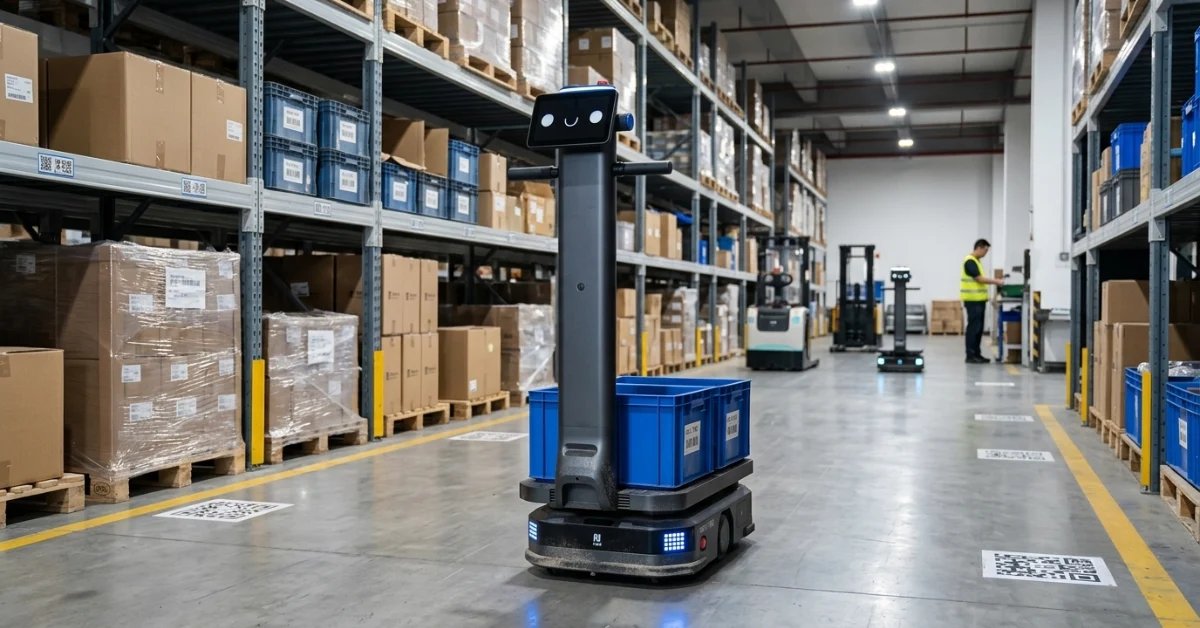
The static industrial floor is an obsolete relic of the past, replaced by dynamic ecosystems where machines no longer follow paths but create them. You likely recognize that traditional manual material handling is increasingly becoming a bottleneck for your operational throughput, especially as global markets demand unprecedented speed and precision. Understanding how do AMRs work is the first step in moving beyond the high costs of fixed magnetic tape and rigid infrastructure. By decoding the sophisticated sensory architecture and AI-driven logic powering these systems, you can transform your facility into a responsive, intelligent environment that operates without human intervention.
This article explores the internal “brain” of the Autonomous Mobile Robot, providing the technical clarity needed to evaluate safety features and operational reliability. Leveraging the latest industry standards, such as the TARS/AMRA-300:2026(en) guideline published in February 2026, we’ll examine how these robots maintain safety in human-shared spaces. You’ll gain a comprehensive perspective on whether AMRs are the viable alternative to AGVs required for your long-term business viability, aligning with visionary initiatives like the UAE National AI Strategy 2031. We’ll conclude by evaluating the specific logic that allows these robots to navigate complex industrial environments with absolute autonomy.
Key Takeaways
- Distinguish between rule-based automation and true robotic autonomy to understand how advanced systems perceive and navigate environments independently.
- Analyze the sophisticated sensor fusion architecture, including LiDAR technology, that provides AMRs with a comprehensive 360-degree view of dynamic industrial spaces.
- Decode the core logic of how do AMRs work by examining the SLAM algorithms and AI path-planning used to calculate efficient routes in real-time.
- Discover how Fleet Management Software and SCADA integration allow for the seamless coordination of multiple robots within established industrial frameworks.
- Align your modernization strategy with the UAE National AI Strategy 2031 to leverage advanced robotics for long-term industrial resilience and global competitiveness.
Defining Autonomous Mobile Robots: The Evolution of Industrial Intelligence
Industrial environments are undergoing a fundamental transformation as facilities move away from rigid, predictable workflows toward intelligent, self-optimizing ecosystems. At the center of this shift is the Autonomous Mobile Robot (AMR), a sophisticated platform designed to perceive, plan, and execute complex movements without external guidance or human intervention. These machines utilize a continuous loop of environmental scanning and cognitive processing to navigate safely. This intelligence allows them to serve diverse roles, ranging from heavy-duty logistics to specialized autonomous cleaning robots that maintain hygiene standards in sensitive pharmaceutical or food production zones. Within the framework of the UAE’s “Make it in the Emirates” 2026 initiative, integrating these autonomous systems is a critical step for organizations aiming to localize vital industries and accelerate AI adoption.
Autonomy vs. Automation: Why the Distinction Matters
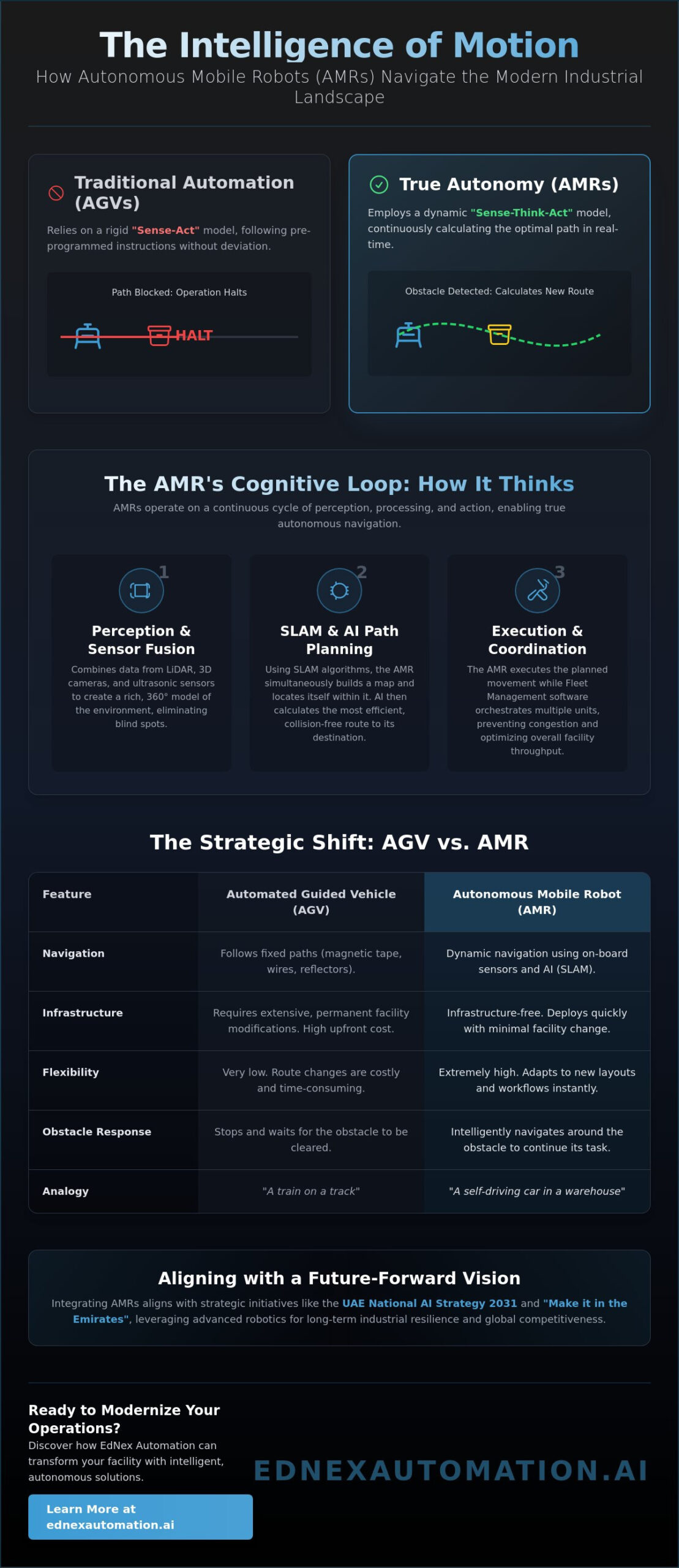
The core distinction between automation and autonomy defines the modern industrial landscape. Traditional automation relies on a “sense-act” model where machines follow pre-programmed instructions. If a forklift blocks a traditional automated machine, the entire production line may grind to a halt because the unit cannot deviate from its path. When analyzing how do AMRs work, it’s clear they employ a “sense-think-act” model. They don’t just detect a blockage; they understand its geometry and calculate a safe bypass. This level of decision-making capability removes the need for expensive, permanent facility modifications. You don’t have to sacrifice floor flexibility for productivity. Instead, the robot acts as a dynamic participant that adapts to your changing operational needs.
The Strategic Shift from AGVs to AMRs
Forward-thinking enterprises are rapidly adopting an automated guided vehicle alternative to escape the constraints of legacy hardware. Automated Guided Vehicles (AGVs) often function like trains, tethered to magnetic tape, wires, or reflectors installed in the building’s infrastructure. AMRs represent a break from this dependency, offering an infrastructure-free deployment that minimizes upfront capital expenditure. By eliminating the requirement for magnetic floor tape, facilities can maintain a clean, professional aesthetic while retaining the ability to reconfigure layouts overnight. Understanding how do AMRs work highlights their role as intelligent edge-computing nodes that provide real-time data on floor activity. This shift doesn’t just improve material handling; it provides the intellectual framework for a truly responsive, data-driven factory floor. For facilities also contending with workforce volatility, implementing AMRs represents one of the most effective solutions for labor shortage in warehouse environments, reducing dependency on a shrinking manual workforce while maintaining consistent throughput.
The Sensory Architecture: How AMRs Perceive Dynamic Environments
Modern industrial autonomy relies on a sophisticated nervous system of sensors that allows a machine to perceive its surroundings with greater precision than a human operator. To grasp how do AMRs work, one must first analyze the concept of sensor fusion. This process involves the simultaneous integration of data from multiple sources, including laser scanners, 3D cameras, and ultrasonic sensors, to create a unified 360-degree situational awareness. By merging these distinct data streams, the robot eliminates blind spots and compensates for the limitations of any single sensor type, ensuring reliable operation in high-traffic zones. Organizations seeking to modernize their facilities can explore high-performance Autonomous Mobile Robots designed for seamless operational integration into complex workflows.
LiDAR: The Eyes of the Autonomous System
Operating as the primary navigation tool, Light Detection and Ranging (LiDAR) utilizes rapid laser pulses to measure distances with extreme accuracy. These sensors emit thousands of pulses per second, measuring the time it takes for the light to bounce off objects and return to the receiver. This data is then translated into a high-resolution “point cloud,” a three-dimensional digital map of the immediate environment. Executing precise movements requires a robust implementation of Simultaneous Localization and Mapping (SLAM), which transforms these raw laser returns into a coherent spatial understanding. Most industrial units utilize a dual-LiDAR setup: a safety-rated scanner dedicated to emergency stops and a navigation scanner that provides sub-centimetre positioning accuracy for complex path execution.
Computer Vision and Depth Cameras
While LiDAR provides the geometric structure of a room, computer vision provides the necessary context. Advanced AI algorithms interpret visual data from 3D depth cameras to distinguish between static infrastructure and dynamic obstacles. This capability allows the system to identify a specific pallet for pickup or recognize a human worker walking through a transit aisle. Depth sensing is particularly critical for detecting low-hanging obstacles or floor-level hazards that a standard 2D laser might miss. During the final stages of a task, such as docking at a charging station or aligning with a conveyor, vision systems enable the “fine positioning” required for millimetre-perfect engagement. This visual intelligence ensures that the robot doesn’t just avoid collisions but understands the operational significance of the objects it encounters.
Complementing these primary systems, AMRs often employ ultrasonic and infrared sensors to manage close-range detection. These sensors act as a secondary safety layer, identifying transparent surfaces like glass or high-gloss materials that might occasionally deflect laser pulses. By combining these layers of sensory input, the robot maintains a persistent, high-fidelity model of its environment. This multi-layered architecture is what allows these machines to operate with absolute confidence in the unpredictable, fast-paced settings of a modern industrial facility.
SLAM and AI: The Brain Behind Autonomous Navigation
Harnessing the raw data from LiDAR and vision systems, the AMR’s central processing unit executes complex algorithms to make split-second decisions. To truly grasp how do AMRs work, you must look at the cognitive layer where mapping and movement converge. This intelligence ensures that the robot doesn’t just react to its environment but proactively manages its journey through a busy industrial floor. By continuously updating its internal representation of the workspace, the system maintains high levels of operational reliability even when warehouse layouts shift. This self-correcting logic is what transforms a simple machine into an intelligent edge-computing node capable of navigating without human oversight.
Simultaneous Localization and Mapping (SLAM) Explained
Simultaneous Localization and Mapping (SLAM) represents the pinnacle of robotic logic, solving the fundamental challenge of building a map of an unknown area while simultaneously keeping track of the robot’s location within that map. Utilizing wheel odometry data, which tracks the precise rotation of the drive motors, the system cross-references physical movement with sensory input to eliminate positioning drift. This approach enables Natural Feature Navigation, where the robot uses existing structural elements like walls and support pillars as permanent landmarks. By identifying these fixed points, the system maintains sub-centimetre accuracy without requiring the invasive infrastructure associated with legacy systems. This capability significantly reduces deployment timelines and allows for immediate operational scaling.
Path Planning and Re-Routing Logic
Analyzing the intricate details of how do AMRs work reveals that path planning is not a static calculation but a continuous, real-time optimization process. Path planning logic operates on two distinct levels to ensure mission success. Global path planning calculates the most efficient route from point A to point B based on the known static map, prioritizing factors like distance and energy consumption. Simultaneously, local path planning manages immediate, reactive movements to bypass dynamic obstacles such as pedestrians or moving forklifts. This dual-layer approach allows the robot to predict the trajectory of moving objects and recalculate its path without stopping.
If the robot encounters a narrow corridor blocked by a pallet, the AI evaluates the geometry of the space to resolve potential deadlocks or select an alternative route. This level of autonomy prevents the “traffic jams” common in less sophisticated systems. Furthermore, by selecting the most energy-efficient paths, the system optimizes battery life, directly improving the long-term business viability of the automation investment. These robots don’t just follow a line; they understand the most effective way to reach their destination while preserving resources and ensuring the highest safety standards in human-shared spaces.
Fleet Management and SCADA Integration: Orchestrating Robotic Workforces
Transitioning from individual machine intelligence to collective robotic orchestration is the hallmark of a truly modernized facility. While individual units possess the cognitive power to navigate, the broader question of how do AMRs work at scale is answered through Fleet Management Software (FMS). This centralized control layer acts as a high-level conductor, synchronizing the movements of dozens or hundreds of robots to prevent congestion and maximize throughput. Beyond simple movement, these systems facilitate a bidirectional data loop, feeding real-time operational insights back to the Manufacturing Execution System (MES). This integration ensures that every robotic movement is aligned with global production targets, transforming mobile assets into active participants in the enterprise’s digital strategy.
Traffic Control and Task Allocation
Ensuring smooth operations in high-density environments requires a sophisticated approach to spatial management. The fleet manager utilizes predictive logic to prevent collisions at high-traffic intersections, often assigning right-of-way based on task priority or battery status. When a new transport request enters the system, the software doesn’t just pick any unit; it analyzes the fleet to identify the closest available robot with sufficient charge and the appropriate top-module for the job. To maintain 24/7 uptime, the system manages automatic charging schedules, sending units to docks during natural lulls in production. This level of coordination eliminates the inefficiencies of manual tasking and ensures that the robotic workforce remains a reliable, constant presence on the floor.
Bridging the Gap: Robotics and Industrial Control Systems
Achieving true interoperability requires that mobile robots communicate fluently with fixed facility infrastructure. Leveraging advanced PLC and SCADA integration services, AMRs can autonomously trigger automatic doors, call elevators, and respond to fire alarm signals. This communication typically relies on robust industrial protocols such as OPC-UA and MQTT, which provide the low-latency connectivity needed for safe operation. Integrating these systems allows the SCADA platform to serve as a “single pane of glass,” giving operators a comprehensive view of both fixed machinery and mobile robotic assets in one interface.
Establishing this intellectual framework is essential for facilities aiming to remain competitive within the UAE’s evolving industrial landscape. As businesses adopt the latest TARS/AMRA-300:2026(en) guidelines for robot-friendly environments, bespoke system integration becomes the primary differentiator for operational success. If you’re ready to modernize your facility with a fully integrated robotic workforce, discover our comprehensive industrial automation solutions designed for the next generation of manufacturing. By connecting mobile intelligence with established control systems, you create a responsive environment where every asset is optimized for maximum efficiency and safety.
Implementing AMRs in the UAE: A Vision for 2026 Industrial Transformation
Adopting advanced robotics in the Emirates requires a strategic alignment with the UAE National AI Strategy 2031 and the “Make it in the Emirates” initiative. As the region transitions from a technology importer to a developer of automation, understanding how do AMRs work within local regulatory frameworks is essential. These systems represent the intellectual framework needed to modernize vital industries and improve operational resilience. By integrating autonomous nodes into your facility, you contribute to a broader national vision of a diversified, tech-driven economy that prioritizes safety and efficiency. This evolution ensures that your organization remains competitive as the Dh1 billion industrial resilience fund begins to accelerate local manufacturing growth.
Sector-Specific Applications: Beyond the Warehouse
While logistics often dominates the conversation, the versatility of autonomous systems allows for transformative applications across various high-value sectors. In the healthcare industry, robots handle sterile deliveries and waste management to minimize human exposure to pathogens. Large-scale commercial spaces utilize autonomous cleaning units to maintain hygiene standards without disrupting visitor flow. The energy sector also benefits from specialized inspection units that monitor oil and gas infrastructure in hazardous environments. This trend toward multi-functional robotics is further evidenced by the increasing interest in humanoid robots for sale UAE, signaling a shift toward more complex, human-centric automation that extends beyond simple material transport. Across all these sectors, autonomous systems also deliver proven solutions for labor shortage in warehouse and industrial operations, enabling facilities to sustain 24/7 throughput without reliance on an increasingly scarce manual workforce.
The EdNex Automation Advantage: Start-to-Finish Automation Expertise
Navigating the transition to an autonomous facility is a complex undertaking that requires a certified regional partner. EdNex Automation provides the comprehensive expertise needed to move from initial site audits to full SCADA integration. Working with a local integrator ensures that your deployment meets the latest TARS/AMRA-300:2026(en) guidelines for robot-friendly environments. We provide the bespoke PLC programming and technical support required to keep your fleet operational and synchronized with your business goals. To begin architecting a responsive, intelligent workspace, Consult with EdNex Automation today. Our team is ready to help you implement a scalable robotic workforce that secures your organization’s long-term business viability in an increasingly automated world.
Architecting the Autonomous Industrial Future
Transitioning to a fully autonomous facility requires a deep understanding of the synergy between sensory hardware and cognitive logic. Having decoded how do AMRs work, it’s evident that these systems represent more than just material handling tools; they’re the foundational nodes of a responsive, data-driven ecosystem. By moving from rigid automation to fluid autonomy, you ensure your organization remains resilient against the complexities of modern global supply chains. This transformation is not merely an upgrade; it’s a necessary evolution for any enterprise aiming to lead in the age of Industry 4.0.
Realizing this vision necessitates a partnership with an Industry 4.0 certified technical partner who provides the intellectual framework for large-scale transformation. Leveraging our expert PLC and SCADA integration and comprehensive national UAE coverage, EdNex Automation delivers the end-to-end expertise required to bridge global innovation with regional industrial needs. Scale your operations with EdNex Automation’s bespoke AMR solutions to secure your competitive advantage in a rapidly evolving market. The path to industrial excellence is no longer a fixed line but a dynamic, intelligent journey that starts with the right technological foundation.
Frequently Asked Questions
What is the main difference between an AMR and an AGV?
The primary distinction lies in navigation flexibility and infrastructure requirements. While Automated Guided Vehicles (AGVs) rely on fixed guides like magnetic tape or wires, AMRs utilize onboard sensors and SLAM algorithms to move independently. This allows the robot to recalculate its path in real-time when encountering obstacles, whereas an AGV would simply stop and wait for human intervention. This shift from “following” to “decision-making” is the core of modern robotic autonomy.
Are AMRs safe to operate around human workers in a busy facility?
AMRs are specifically engineered for safe collaboration within human-shared spaces. Utilizing safety-rated LiDAR and 3D depth cameras, these robots maintain a persistent 360-degree awareness of their surroundings. Compliance with the latest TARS/AMRA-300:2026(en) guidelines ensures that the building environment and the robot’s logic are synchronized for maximum safety. The system’s ability to predict human movement and execute emergency stops provides a reliable framework for risk mitigation in busy facilities.
How long does it take to map a facility for AMR deployment?
Initial mapping of a facility typically takes only a few hours to a few days, depending on the complexity of the site. A technician or the robot itself traverses the floor to identify fixed landmarks like walls and pillars. Once this digital blueprint is established, the robot is ready for task allocation. This rapid deployment timeline is a significant advantage over legacy systems that require weeks of physical infrastructure installation.
Can AMRs operate on uneven floors or in outdoor environments?
Standard industrial units are optimized for flat, indoor surfaces to maintain sub-centimetre positioning accuracy. However, specialized platforms like outdoor cleaning robots are designed with robust suspension systems and ruggedized sensors to handle uneven terrain and varying weather conditions. When evaluating how do AMRs work in non-traditional settings, it’s essential to select a platform with the specific mechanical architecture suited for your environment’s physical constraints.
Do I need to change my warehouse layout to accommodate AMRs?
No significant layout changes are required because AMRs adapt to your existing environment rather than forcing you to adapt to them. They navigate using natural features, meaning you don’t need to install mirrors, tape, or wires. This infrastructure-free approach allows you to maintain operational continuity during deployment. You can continue with your current workflow while the robots learn the floor plan and identify the most efficient transit aisles.
How do AMRs handle Wi-Fi dead zones in large industrial plants?
AMRs maintain full navigational autonomy even when they lose connection to the central network. Because the robot carries its own map and processing power, it continues to move and avoid obstacles in Wi-Fi dead zones. While it may not receive new task assignments until it re-enters a coverage area, its safety systems and local path-planning logic remain fully operational. This decentralized intelligence is a critical component of how do AMRs work in large-scale industrial plants.
What happens if an AMR encounters an unexpected obstacle?
When an AMR encounters an unexpected obstacle, it immediately initiates a re-routing sequence to find the most efficient bypass. The onboard AI analyzes the geometry of the blockage and calculates a new path without stopping, ensuring minimal impact on throughput. If the aisle is completely obstructed, the robot will halt safely and send a real-time alert to the fleet management system, allowing operators to resolve the physical bottleneck.
Can AMRs be integrated with existing WMS or ERP systems?
Seamless integration with existing Warehouse Management Systems (WMS) or Enterprise Resource Planning (ERP) platforms is a standard feature of modern robotic deployments. Utilizing Fleet Management Software as a bridge, the robots receive transport orders directly from your high-level business software. This connectivity ensures that robotic tasks are always synchronized with real-time inventory levels and production schedules, creating a unified data loop that enhances overall operational visibility.