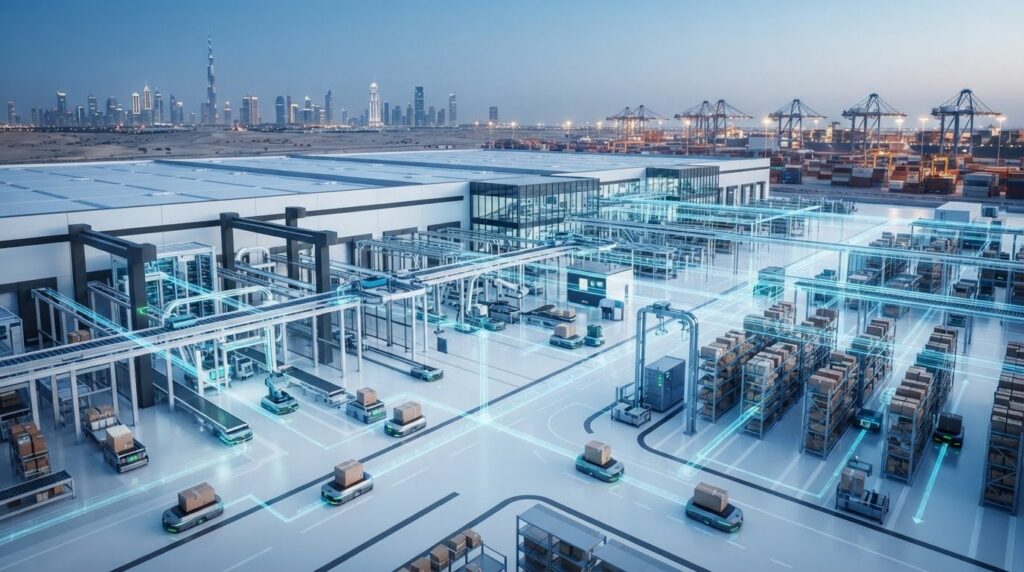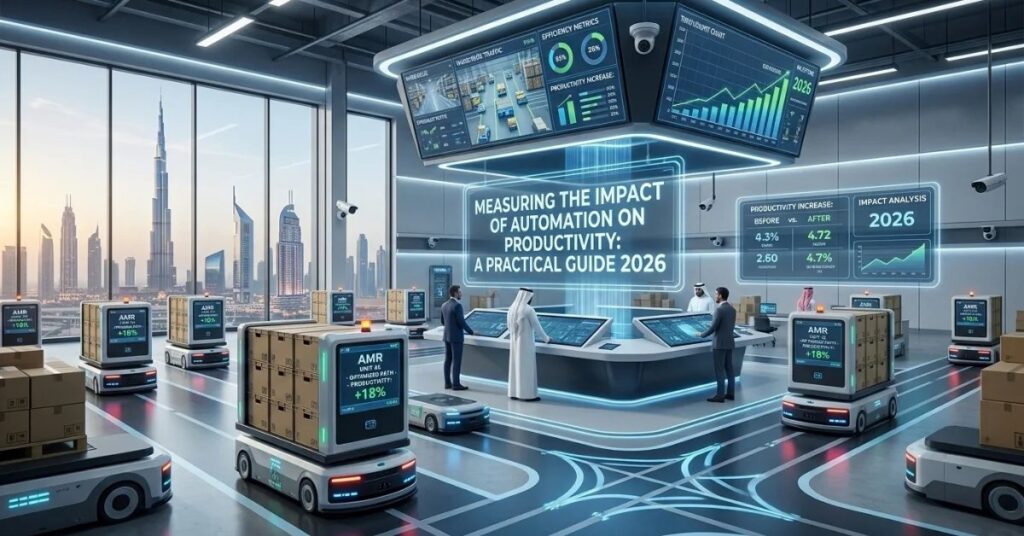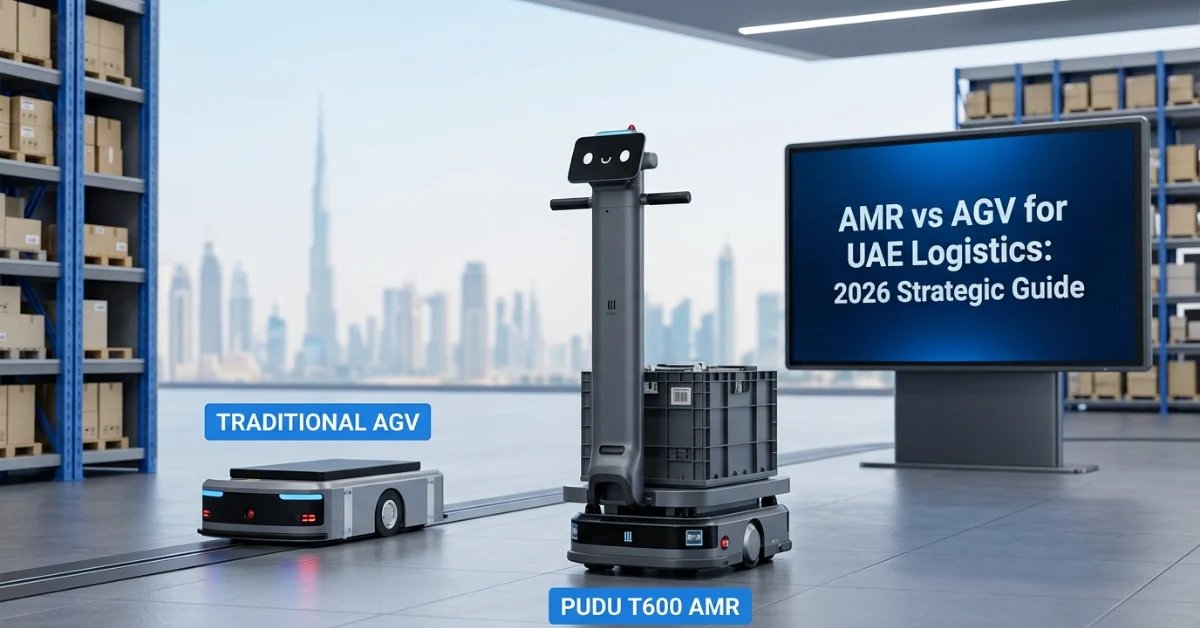
By the end of 2026, the distinction between a profitable distribution hub and a legacy cost center in the Emirates will be determined by the intelligence of its internal mobility. While the drive toward Industry 4.0 is clear, many facility managers struggle with the high operational costs of manual logistics and the technical friction of integrating new robotics with legacy PLC or SCADA systems. Selecting the right platform for AMR vs AGV for logistics UAE requires a precise understanding of how these technologies align with national initiatives like Operation 300bn and the Dubai Robotics and Automation Program.
You’ll gain a comprehensive decision-making framework that evaluates the total cost of ownership against the UAE’s new AED 2 million R&D tax incentives. We explore validated integration paths that bridge the gap between global technological breakthroughs and regional industrial needs; this ensures your infrastructure remains competitive as the government targets 50% AI-driven federal services. This analysis provides the intellectual framework necessary to move beyond simple equipment acquisition toward a systematic, high-autonomy transformation that secures long-term business viability.
Key Takeaways
- Evaluate how the UAE’s industrial expansion and national strategies like Operation 300bn are driving the transition from manual material handling to intelligent, software-defined logistics.
- Master the technical distinctions between LiDAR-based AMRs and fixed-path AGVs to identify the most resilient AMR vs AGV for logistics UAE solution for your specific infrastructure.
- Quantify the economic impact of your automation strategy by analyzing upfront installation costs against long-term operational efficiency and ROI within the Emirates’ market.
- Implement a structured selection framework that audits facility layout permanence and task variability to ensure your robotic fleet scales with future demand.
- Discover how specialized integration with PLC and SCADA systems creates a seamless bridge between autonomous hardware and existing industrial control layers.
Navigating the UAE’s Autonomous Logistics Landscape in 2026
The United Arab Emirates has transitioned from a traditional trade gateway into a sophisticated, tech-centric industrial powerhouse. Driven by the “Operation 300bn” strategy, the nation’s logistics sector now demands a level of precision that manual material handling simply cannot sustain. As 2026 unfolds, the pressure to optimize is no longer theoretical; it’s a regulatory and economic necessity. Navigating the technical nuances of AMR vs AGV for logistics UAE is now a prerequisite for any facility manager aiming to meet the 10% Emiratization target by the end of 2026 while maintaining high-velocity throughput.
Adopting advanced robotics represents the bridge between current infrastructure and the high-autonomy future envisioned by the Ministry of Industry and Advanced Technology. This shift toward software-defined mobility allows operators to replace rigid, labor-intensive processes with agile systems that respond to real-time data. With the Emirates Development Bank providing over AED 1.3 billion in financing to support automation across various industrial zones, the financial barriers to entry have significantly lowered, making this year the definitive tipping point for regional adoption.
The Rise of Smart Logistics Hubs
Expanding national logistics zones and major port facilities requires a fundamental rethink of internal transport. These high-throughput environments increasingly rely on autonomous systems to achieve national efficiency benchmarks and manage the complexity of modern 3PL operations. By deploying mobile robotics, facilities can mitigate the risks associated with manual labor shortages and rising operational overheads. These smart hubs don’t just move goods; they serve as data-gathering nodes that feed into larger SCADA and PLC networks, ensuring every pallet movement contributes to a leaner, more transparent supply chain.
Defining AGVs and AMRs: A High-Level Overview
Choosing the right technology begins with understanding the fundamental difference in operational philosophy. A traditional Automated Guided Vehicle (AGV) operates on fixed paths, utilizing magnetic tape, wires, or QR codes to navigate through a facility with predictable, repetitive precision. While highly effective for heavy-load transport in static environments, they lack the ability to deviate from their programmed tracks without infrastructure modification.
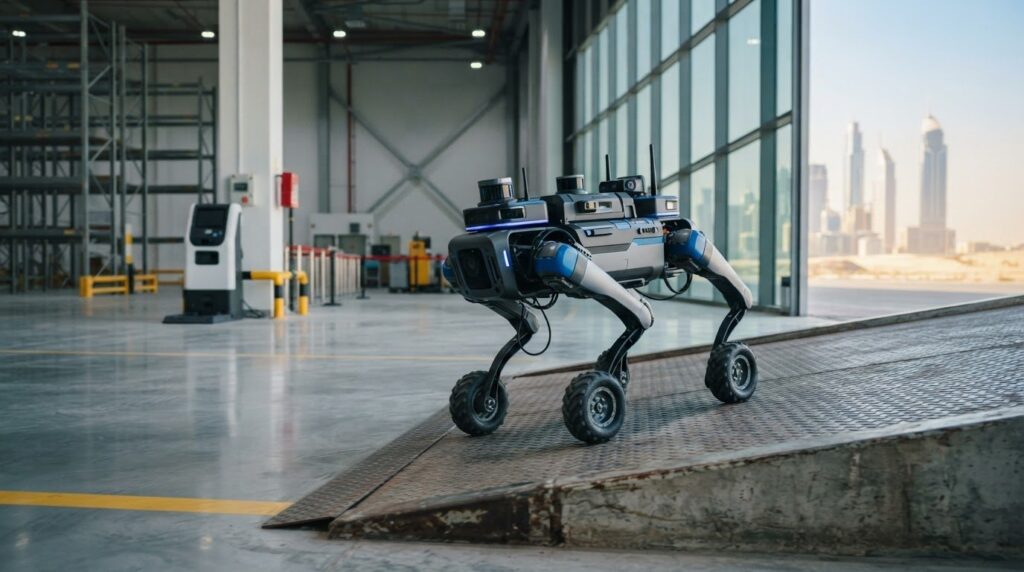
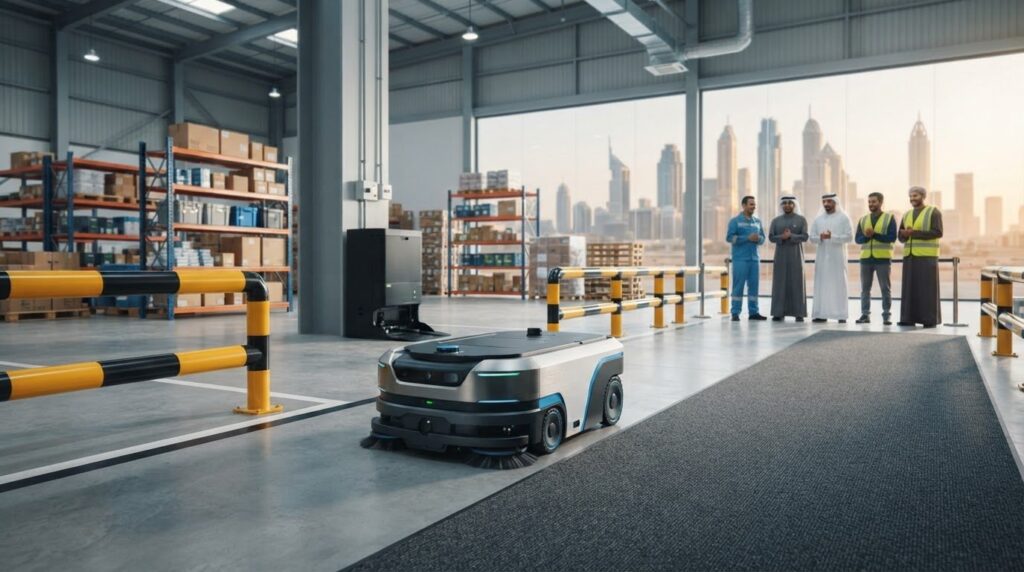
In contrast, Autonomous Mobile Robots (AMRs) leverage LiDAR and SLAM (Simultaneous Localization and Mapping) to navigate dynamically. They don’t require physical floor markers; instead, they interpret their surroundings in real-time to avoid obstacles and calculate the most efficient route to a destination. An Autonomous Mobile Robot acts as an intelligent, decentralized agent capable of real-time environmental processing rather than a simple motorized vehicle. This intelligence allows AMRs to work collaboratively alongside human teams, adapting to the fluid nature of a modern UAE warehouse where floor layouts frequently evolve to meet changing market demands.
Technical Architecture: Fixed-Path AGVs vs. Dynamic AMRs
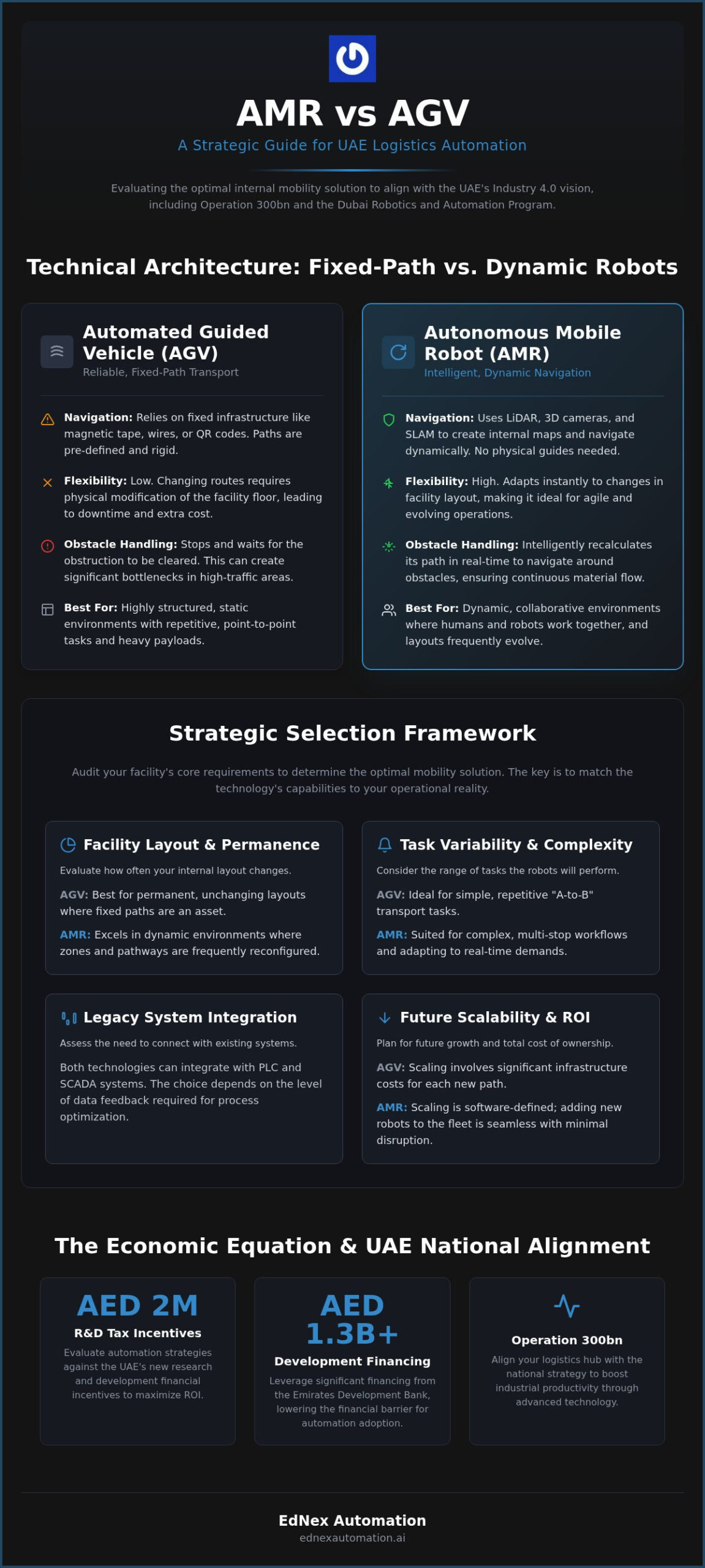
The technical divergence between these systems defines their long-term viability within the rapidly evolving UAE Logistics Automation Market. While traditional Automated Guided Vehicles (AGVs) rely on fixed infrastructure such as magnetic tape or QR codes, Autonomous Mobile Robots (AMRs) utilize on-board intelligence to navigate complex environments. This architectural difference determines how a facility responds to operational bottlenecks; an AGV typically employs a stop-and-wait protocol when encountering an obstacle, whereas an AMR recalculates its path in real-time to maintain throughput. For those evaluating AMR vs AGV for logistics UAE, the choice often hinges on whether the facility requires the rigid, high-capacity stability of a guided vehicle or the agile, sensor-driven autonomy of a mobile robot.
Navigation and Environmental Perception
Utilizing Simultaneous Localization and Mapping (SLAM), AMRs construct internal digital maps by processing data from LiDAR and 3D vision sensors. This zero-infrastructure approach eliminates the need for floor-mounted markers, which can cost between AED 7 and AED 37 per meter to install and maintain. In contrast, wire-guided systems remain susceptible to physical damage in high-traffic zones, leading to costly downtime during repairs. Modern deployments must also adhere to ISO 3691-4:2023 safety standards, ensuring that collaborative robots can operate safely alongside human personnel without the need for physical safety cages or restricted zones. Transitioning to SLAM-based navigation allows operators to modify facility layouts via software updates rather than physical reconstruction, providing the flexibility needed for seasonal demand shifts.
Synergy with ASRS and Fixed Automation
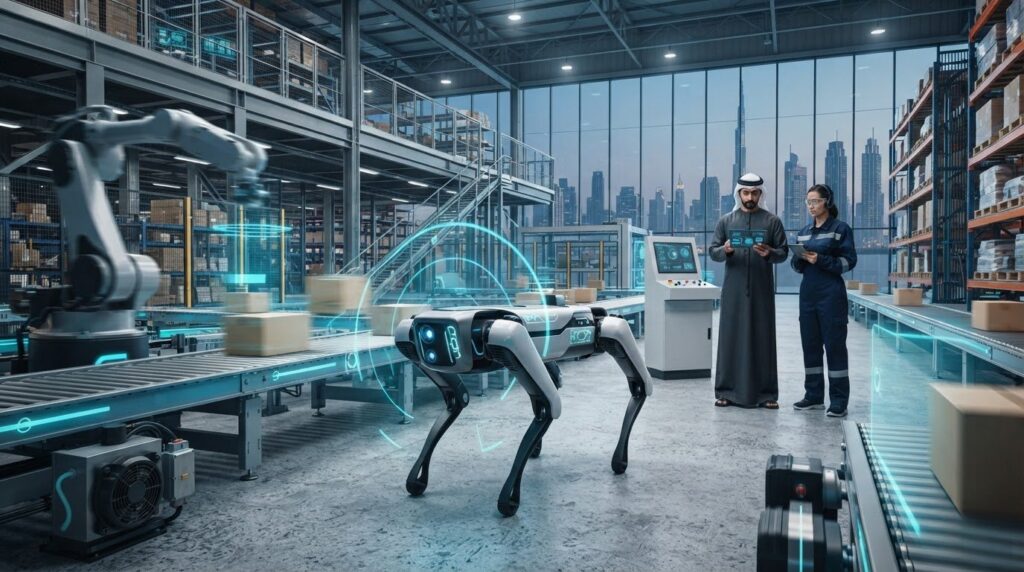
Integrating mobile robotics with automated storage and retrieval systems creates a cohesive, end-to-end automation strategy. AMRs act as the flexible connective tissue, transporting goods from high-density ASRS induction points to palletizing stations or outbound docks without human intervention. This interoperability is critical for 3PL providers who manage diverse SKUs with varying turnover rates. By interfacing these robots with existing conveyor systems through bespoke PLC and SCADA layers, facilities can achieve a unified operational environment that maximizes equipment utilization. If you’re looking to bridge the gap between fixed assets and mobile autonomy, reviewing your robotic orchestration options with a technical partner ensures your infrastructure remains resilient against future industrial shifts.
Payload stability remains a key consideration when selecting form factors. While AMRs excel in dynamic navigation for loads up to 1,500 kg, heavy-duty AGVs often remain the preferred choice for transporting massive components exceeding 5,000 kg along predictable, heavy-traffic corridors. The decision depends on balancing the necessity for high-load stability against the requirement for intelligent, decentralized pathfinding.
The Economic Equation: ROI and Scalability in the Emirates
Calculating the financial viability of AMR vs AGV for logistics UAE involves a transition from viewing automation as a fixed expense to treating it as a scalable, high-yield asset. While initial unit prices vary, the true economic differentiator lies in the Total Cost of Ownership (TCO). AGV systems typically demand significant upfront investment in physical infrastructure, such as floor modifications and magnetic track installation, which acts as a barrier for 52% of potential users according to industry research. In contrast, AMRs offer a leaner CAPEX profile by utilizing existing facility layouts, allowing for a deployment timeline of two to six weeks compared to the three to six months required for guided alternatives.
Adopting a software-defined mobility layer ensures that your investment remains resilient as the UAE’s AI market approaches its projected value of over AED 811 billion by 2034. This flexibility is a tangible financial asset during seasonal demand spikes, such as Ramadan or major e-commerce events, where robots can be reassigned to different zones via a central management system without physical reconstruction. By focusing on systems that offer low-friction integration with existing SCADA networks, operators can ensure their infrastructure scales in lockstep with regional industrial growth.
CAPEX vs. OPEX: A Strategic Breakdown
Identifying the optimal balance between capital expenditure and operational flexibility is essential for long-term business viability in the Emirates. AGVs often lock a facility into a specific workflow, making subsequent layout changes costly and disruptive to the bottom line. AMRs provide a dynamic alternative that scales without additional infrastructure costs, significantly improving the long-term ROI. Furthermore, the UAE’s non-refundable R&D tax incentive of up to AED 2 million for manufacturers provides a powerful mechanism to offset the initial investment for companies adopting intelligent, high-autonomy systems.
Operational Efficiency in High-Volume Facilities
Driving throughput in high-volume environments requires more than just speed; it demands the elimination of idle time and human error. Multi-robot fleet orchestration allows for optimized pathfinding, which reduces the cost-per-pick by ensuring that no robotic agent is ever redundant. By mitigating the risks of workplace accidents through ISO-compliant safety sensors, facilities realize substantial savings in insurance premiums and liability costs. Implementing 24/7 operation cycles through autonomous charging and continuous task allocation drastically shortens the ROI period, often delivering full payback in less than 12 months.
Strategic Selection: Determining the Optimal Mobility Solution
Selecting the optimal platform for AMR vs AGV for logistics UAE necessitates a multi-stage engineering audit that balances current physical constraints against long-term strategic objectives. As the industrial landscape in the Emirates matures toward full digitalization, the decision-making process must evolve beyond simple hardware procurement. Beginning with a rigorous assessment of facility permanence, operators must determine if their floor layout is static or subject to the fluid shifts common in high-growth 3PL environments. Evaluating task complexity reveals whether a simple A-to-B transport is sufficient or if the operation requires intelligent agents capable of navigating unstructured zones while avoiding dynamic obstacles. Finally, assessing internal technical expertise ensures the organization can manage the sophisticated software orchestration layers required for high-autonomy fleets. Aligning these choices with the Dubai Robotics and Automation Program positions your facility to benefit from the nation’s push toward a 9% GDP contribution from the robotics sector by 2032. To ensure your selection aligns with these rigorous standards, consult with our technical consultants for a site-specific automation audit.
When to Choose an AGV
Automated Guided Vehicles remain the superior choice for high-volume, repetitive movements in environments where the production architecture is permanent. These systems excel on long-term production lines where paths remain unchanged for years, providing unmatched reliability for heavy-duty transport. If your facility requires the movement of extremely heavy payloads, such as massive industrial components or bulk raw materials on fixed routes, the track-bound stability of an AGV offers a focused solution that maximizes safety and predictability within a controlled corridor.
Similarly, when selecting other types of essential material handling equipment, a thorough evaluation of brand capabilities is necessary; for example, unitedlift.com provides a detailed head-to-head comparison of major boom lift manufacturers to assist with these high-stakes procurement decisions.
When to Choose an AMR
Autonomous Mobile Robots are the definitive solution for dynamic 3PL warehouses and e-commerce fulfillment centers that experience frequent SKU turnover and layout reconfigurations. Facilities requiring rapid deployment without the disruption of floor modifications find AMRs particularly advantageous, as these robots can be mapped and operational within weeks. These intelligent agents are essential in operations where human-robot collaboration is frequent; their advanced sensor suites allow them to work safely alongside personnel in shared aisles, recalculating routes in real-time to maintain throughput during peak operational periods.
Determining the right path requires a systematic organizer who can bridge the gap between global technological breakthroughs and regional industrial needs. By following a structured selection framework, you move beyond the chaos of rapid change toward a controlled and deliberate innovation path that secures your organization’s competitive standing in the future.
Seamless Integration: Deploying Advanced Robotics with EdNex Automation
Successful implementation of AMR vs AGV for logistics UAE depends on more than just the mechanical assets; it requires a sophisticated control layer that unifies hardware with enterprise-level intelligence. Bridging the gap between physical robotic agents and the underlying factory floor requires a systematic approach to data orchestration. Without a robust integration strategy, even the most advanced autonomous systems remain isolated silos, unable to communicate with the broader industrial ecosystem. EdNex Automation acts as the intellectual framework for this transformation, ensuring that mobile robotics don’t just exist within a facility but actively enhance the entire value chain through controlled and deliberate innovation.
Future-proofing logistics operations involves adopting modular, AI-driven mobility solutions that can adapt to the UAE’s rapidly shifting economic requirements. Utilizing centralized fleet management software allows operators to maintain a unified industrial network where tasks are assigned based on real-time agent availability and proximity. This level of coordination is essential for maintaining the 27% productivity increase often reported after successful robotic implementation, providing the long-term business viability necessary to remain competitive in a global market.
The Integration Layer: PLC and SCADA Connectivity
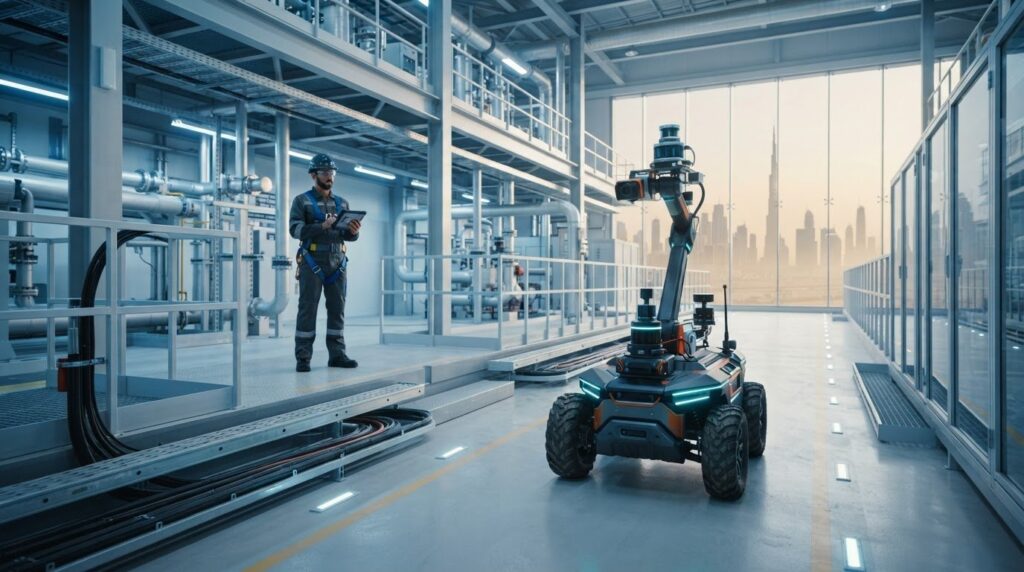
Linking mobile assets to PLC and SCADA integration services ensures that every movement is visible and actionable within the facility’s central nervous system. This connectivity allows for real-time data visibility, enabling the central control system to adjust robotic priorities based on upstream production changes or downstream shipping bottlenecks. EdNex specializes in synchronizing autonomous mobile robots with existing factory automation, such as conveyors and palletizers, creating a seamless flow of material. By utilizing SCADA for comprehensive fleet monitoring, facilities can implement predictive maintenance protocols that identify potential hardware failures before they result in operational downtime.
Partnering for Industrial Transformation
Navigating the transition from manual handling to high-autonomy logistics requires a partner who understands the gravity of large-scale industrial transformation. EdNex provides start-to-finish expertise, beginning with detailed feasibility studies that audit your specific infrastructure before moving into national-scale deployment and long-term support. Leveraging global partnerships, such as our status as an Authorized Gold Partner of Unitree, we provide access to cutting-edge robotic hardware tailored to the regional industrial landscape. This consultative approach ensures that your automation journey is methodical, reliable, and fully aligned with the UAE’s visionary industrial goals. To begin your transition toward a software-defined logistics environment, consult with EdNex Automation for your facility audit and discover the technical path to optimized autonomy.
Securing Your Competitive Edge in the 2026 Industrial Landscape
The transition toward a software-defined logistics environment is no longer a distant aspiration; it’s a current industrial imperative. Mastering the technical nuances of AMR vs AGV for logistics UAE allows your organization to move beyond manual inefficiencies toward a systematic, data-driven operation. By balancing the rigid stability of guided vehicles with the intelligent flexibility of mobile robots, you ensure your facility remains resilient against shifting market demands and national efficiency benchmarks.
Success in this transformation requires more than just hardware. It demands a partner capable of bridging the gap between global breakthroughs and regional needs. EdNex Automation provides the intellectual framework for this evolution, leveraging specialized PLC and SCADA integration alongside national-scale deployment expertise. As an authorized partner of leading global robotics brands, we provide the start-to-finish support necessary to achieve long-term business viability. Modernize your logistics with EdNex Automation solutions today to secure your position at the forefront of the Emirates’ industrial future. Your journey toward optimized autonomy begins with a single, deliberate step toward innovation.
Frequently Asked Questions
What is the primary difference between AGVs and AMRs for logistics?
The primary difference lies in their navigation methodology and environmental adaptability. While an AGV operates along fixed tracks defined by magnetic tape or wires, an AMR utilizes LiDAR and SLAM technologies to navigate dynamically. This intelligence allows AMRs to bypass obstacles in real-time, whereas AGVs typically stop until the path is cleared; this makes AMRs more suitable for fluid, high-traffic environments where flexibility is paramount.
Which system is more cost-effective for a large-scale UAE warehouse?
Determining the most cost-effective solution for AMR vs AGV for logistics UAE requires analyzing your facility’s layout permanence. AGVs generally offer lower unit costs but require significant capital for infrastructure installation, which can cost up to AED 37 per meter. For large-scale warehouses with evolving workflows, AMRs provide superior long-term value by eliminating these physical modification expenses and allowing for rapid, software-based reconfiguration.
Can AMRs safely operate alongside human workers in a busy facility?
AMRs are specifically engineered to operate safely alongside human personnel in high-density environments. Utilizing advanced sensor suites and adhering to ISO 3691-4:2023 standards, these robots detect human movement and recalculate routes to avoid collisions. This collaborative capability eliminates the need for safety cages, allowing for a more integrated and flexible workspace that maximizes floor utilization without compromising worker safety during peak operational periods.
Do AMRs require significant changes to my existing warehouse floor?
Autonomous Mobile Robots require zero physical changes to your existing warehouse floor or infrastructure. Unlike AGVs, which necessitate the installation of magnetic strips or QR codes, AMRs create a digital map of the facility during initial setup. This non-invasive deployment allows for a rapid implementation timeline of two to six weeks, ensuring that your operations continue without the downtime associated with physical construction or facility modification.
How do I integrate mobile robots with my current PLC or SCADA system?
Integration is achieved by connecting the robotic fleet management software to your facility’s central PLC or SCADA layers. Specialized systems integrators implement bespoke communication protocols that ensure real-time data visibility across the entire industrial network. This synchronization allows for automated task allocation and predictive maintenance, transforming individual robots into a cohesive part of your unified Industry 4.0 infrastructure while maintaining centralized control.
What is the typical ROI period for an AMR system in the logistics sector?
The typical payback period for an AMR investment in the logistics sector is under 12 months. This accelerated ROI is driven by minimal upfront infrastructure costs and the ability to operate 24/7 without human intervention. When combined with the UAE’s AED 2 million R&D tax incentive, the financial viability of high-autonomy systems becomes even more compelling for regional operators looking to modernize their supply chain.
Are AGVs still relevant in the era of Industry 4.0 and smart factories?
AGVs remain highly relevant for industrial applications requiring the transport of extremely heavy payloads exceeding 5,000 kg. In static environments where production paths remain unchanged for years, the predictable stability of an AGV offers a reliable, low-complexity solution. They serve as a focused alternative for heavy-duty material handling where the dynamic pathfinding of an AMR isn’t a functional requirement for the specific workflow.
How does heat and dust in the UAE affect the sensors of AMRs and AGVs?
Industrial-grade sensors used in modern robotics are specifically designed to withstand the high temperatures and particulate matter common in the UAE. Utilizing IP-rated enclosures and advanced filtration, these systems maintain high levels of precision even in challenging environments. Regular maintenance protocols and site-specific sensor calibration ensure that heat and dust don’t compromise the navigational integrity or safety of the fleet during summer months.