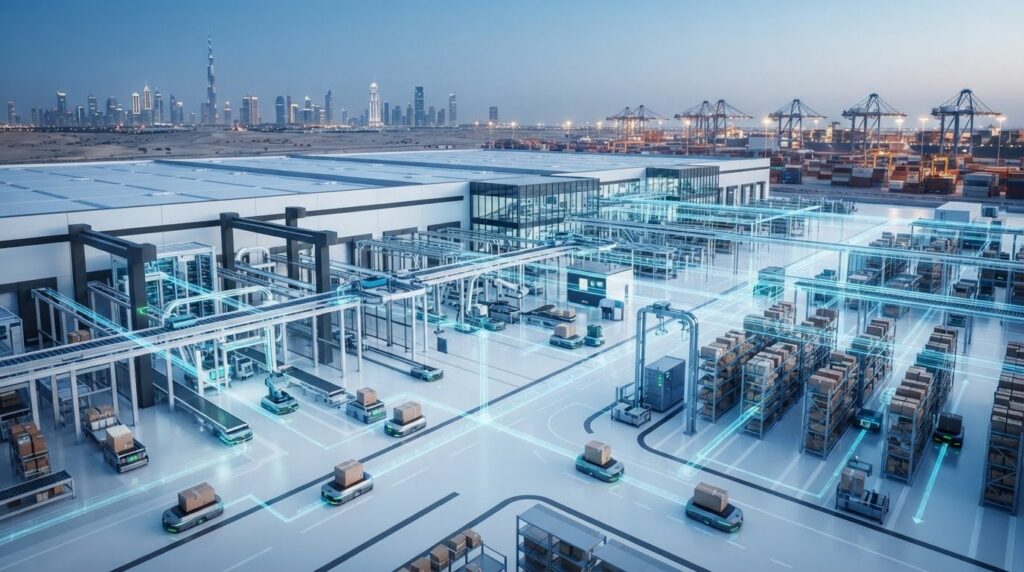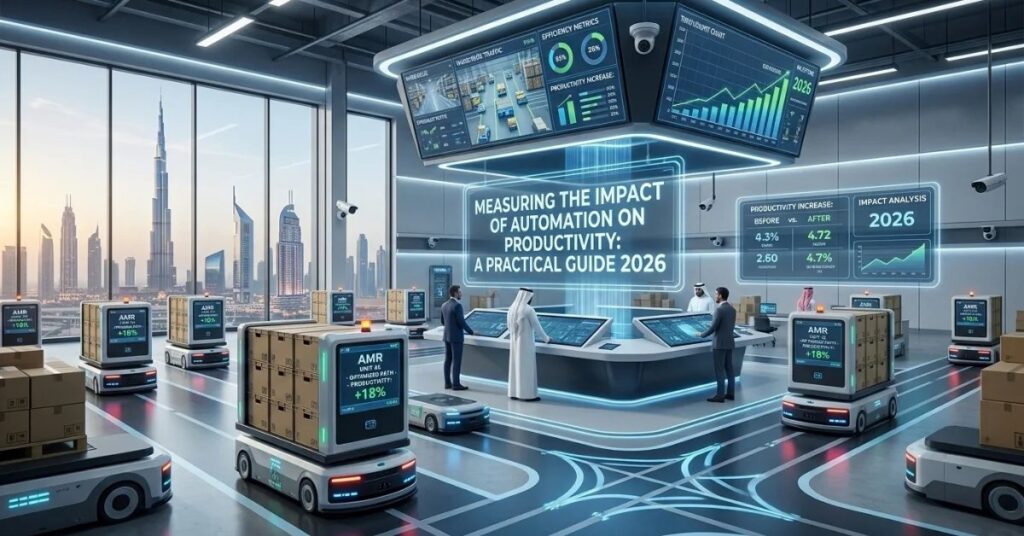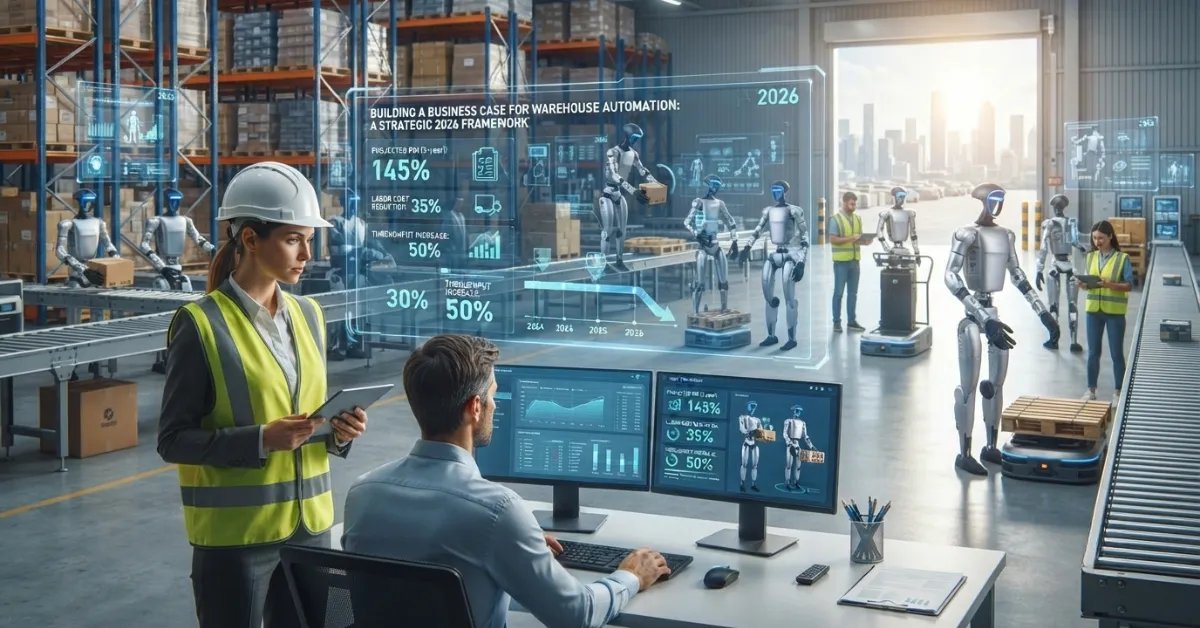
With labor accounting for 50% to 70% of total warehousing budgets in 2026, the cost of maintaining a manual workforce has reached a critical tipping point. Despite this financial pressure, 80% of warehouses continue to operate without advanced systems, leaving them vulnerable to rising recruitment challenges and the stringent new OSHA Heat Safety Regulations. Building a business case for warehouse automation is no longer a speculative venture. It’s a mandatory strategic evolution for any organization aiming to survive the current Industry 4.0 transition.
You likely feel the weight of inaccurate inventory and lost revenue, yet the hurdle remains securing board-level buy-in for significant capital expenditure. Leveraging data-driven insights, this guide provides the sophisticated financial and operational framework you need to demonstrate how transformative robotics and control systems secure long-term viability. We’ll examine the ROI roadmap for technologies like Autonomous Mobile Robots and ASRS, ensuring your strategy aligns with mandatory UAE AI Act compliance and global efficiency standards. By the end of this analysis, you’ll possess the technical logic required to transform your facility into a high-performance, scalable ecosystem.
Key Takeaways
- Understand the transition from manual logistics to autonomous Industry 4.0 ecosystems to maintain operational viability in the 2026 industrial landscape.
- Discover the precise methodology for building a business case for warehouse automation by calculating Total Cost of Ownership and identifying indirect ROI gains.
- Evaluate the strategic trade-offs between the flexibility of AMRs and the high-density storage of ASRS to determine the optimal architecture for your facility.
- Master a phased implementation framework that guides your organization through rigorous current state assessments and objective vendor vetting processes.
- Learn how a single-source integration architect unifies disparate hardware and control systems into a cohesive, high-performance warehouse environment.
The Strategic Imperative for Warehouse Automation in 2026
Transitioning from legacy manual workflows to autonomous Industry 4.0 ecosystems represents the most significant shift in supply chain management since the introduction of the shipping container. In 2026, the global warehouse automation market has reached a valuation of $29.98 billion, signaling that early adoption is no longer a luxury but a requirement for survival. Building a business case for warehouse automation involves more than just selecting hardware; it requires a strategic alignment of technological capability with long-term fiscal objectives. Organizations that fail to bridge this gap find themselves struggling against three primary triggers: labor volatility, escalating space constraints, and the relentless demand for higher throughput.
With labor accounting for 50% to 70% of total warehousing budgets, the financial fragility of manual operations has become undeniable. This vulnerability is exacerbated by the 2026 implementation of OSHA Heat Safety Regulations, which mandate specific environmental controls and rest cycles that further reduce the efficiency of human-centric picking. By shifting toward an intelligent infrastructure, businesses can stabilize their operational costs while dramatically increasing their density and speed. Recognizing the gravity of these shifts, industry leaders are moving away from reactive equipment purchases toward comprehensive digital twin simulations that predict performance before a single robot is deployed.
Beyond Labour Savings: The New Value Drivers
Focusing solely on payroll reduction ignores the massive secondary financial benefits of logistics automation. In high-velocity fulfillment environments, the cost of a single human picking error can cascade into lost customer lifetime value and expensive reverse logistics. Automation serves as a critical hedge against future supply chain disruptions, providing a 24/7 operational capability that manual shifts can’t match. This constant uptime allows firms to capture greater market share by offering later order cut-off times and guaranteed next-day delivery, transforming the warehouse from a cost center into a competitive engine.
Aligning with National Industrial Goals
Positioning your automation strategy within the broader context of national digitization initiatives is essential for securing high-level stakeholder approval. In the United Arab Emirates, for instance, the mandatory self-assessments under the UAE AI Act by September 2026 have turned digital transformation into a regulated requirement. Utilizing advanced PLC and SCADA integration services ensures that your robotics and control systems contribute to national sustainability and efficiency mandates. A warehouse automation business case is a comprehensive justification for capital expenditure that synthesizes operational efficiency, risk mitigation, and long-term financial viability into a single strategic document.
Quantifying the ROI: Financial Metrics and Performance Indicators
Analyzing the financial architecture of modern logistics reveals that surface-level capital expenditure is rarely the most accurate predictor of long-term success. For executives building a business case for warehouse automation, the focus must shift toward a rigorous Total Cost of Ownership (TCO) model that accounts for the entire lifecycle of the technology. While manual operations carry high variable costs that scale linearly with volume, automated systems offer a fixed-cost structure that yields greater dividends as throughput increases. Data indicates that most automation projects achieve a full return on investment within 12 to 36 months, with specific technologies like Autonomous Mobile Robots (AMRs) often delivering a payback in under 24 months.
Securing board approval requires presenting the “Cost of Inaction” (COI) alongside traditional ROI projections. Failing to modernize isn’t a neutral stance; it’s a decision to accept compounding losses from labor volatility and recruitment challenges. Developing an effective automation business case means quantifying these risks, including the potential 250% ROI seen in high-performing deployments. By highlighting how early adopters typically realize a 20% ROI within the first two years, stakeholders can visualize automation as a necessary shield against market instability. If you’re ready to define these metrics for your facility, consulting with industrial integration experts can provide the technical clarity needed for a definitive proposal.
CAPEX vs. OPEX: Financial Structuring for Automation
Moving from a labor-heavy OPEX model to a CAPEX-intensive strategy fundamentally alters a company’s financial resilience. Implementing automated storage and retrieval systems allows firms to capitalize their operational infrastructure, transforming what was once a recurring expense into a depreciable asset. This transition requires a sophisticated accounting approach that factors in specialized maintenance, software orchestration updates, and optimized energy consumption. By fixing these costs, organizations protect themselves from the unpredictable wage inflation that currently defines the global logistics sector.
Key Performance Indicators (KPIs) for Success
Measuring the impact of advanced systems necessitates a new set of high-tech KPIs that go beyond simple pick rates. Throughput per square meter becomes a vital metric as facility footprints reach their physical limits, allowing businesses to maximize existing real estate without costly expansions. Additionally, reducing workplace incidents through the deployment of autonomous cleaning robots significantly lowers insurance premiums and improves employee retention. These safety and efficiency gains, combined with a 300% improvement in order fulfillment speeds, create a compelling narrative of operational excellence that resonates with any results-oriented leadership team.
Evaluating Technology Architectures: AMRs, ASRS, and Control Systems
Selecting the correct architectural framework is the pivot point upon which the entire investment rests. While previous sections detailed the fiscal metrics, building a business case for warehouse automation requires a technical validation of how specific hardware addresses operational bottlenecks. Decision-makers must choose between the high-density throughput of Automated Storage and Retrieval Systems (ASRS) and the versatile, rapid-deployment capabilities of autonomous mobile robots. While ASRS maximizes vertical cube utilization, AMRs offer the agility needed to adapt to shifting SKU profiles and seasonal demand spikes without requiring permanent floor modifications.
Integrating collaborative robots into picking and packing lines further enhances this architecture by creating human-robot teams that are reported to be 85% more productive than either party working in isolation. These cobots handle the repetitive, ergonomically taxing tasks, allowing human workers to focus on complex problem-solving. This hybrid approach ensures that the robotic fleet remains scalable, providing a future-proof foundation that grows alongside the business. By aligning these technologies with specific throughput goals, organizations can present a technical roadmap that is both ambitious and grounded in operational reality.
Autonomous Mobile Robots (AMRs) vs. Traditional AGVs
Choosing AMRs over traditional Automated Guided Vehicles (AGVs) often results in a faster ROI, particularly in brownfield sites where existing infrastructure cannot be easily altered. Unlike AGVs that rely on fixed magnetic strips or wires, AMRs utilize intelligent SLAM (Simultaneous Localization and Mapping) technology to navigate complex environments dynamically. This intelligence reduces initial installation costs and allows operators to add units to the fleet as demand fluctuates, ensuring the capital investment remains proportional to actual throughput needs. With approximately 4.7 million commercial warehouse robots installed globally in 2026, the shift toward these intelligent, infrastructure-light systems has become the industry standard for modern logistics.
The Backbone of Automation: Integrated Control Systems
A business case frequently fails at the implementation stage if it lacks a robust framework for visibility and orchestration. Utilizing PLC and SCADA integration services is essential for unifying disparate hardware into a single, cohesive ecosystem. Without a centralized SCADA architecture, managers lack the real-time data acquisition necessary for continuous process improvement and predictive maintenance. Expert PLC programming ensures full interoperability between different robotic vendors, preventing the creation of “automation silos” that hinder long-term scalability. This control layer acts as the warehouse’s central nervous system, providing the analytical insights required to justify the initial expenditure to stakeholders through transparent, data-driven performance reports.
Constructing the Proposal: A Step-by-Step Implementation Framework
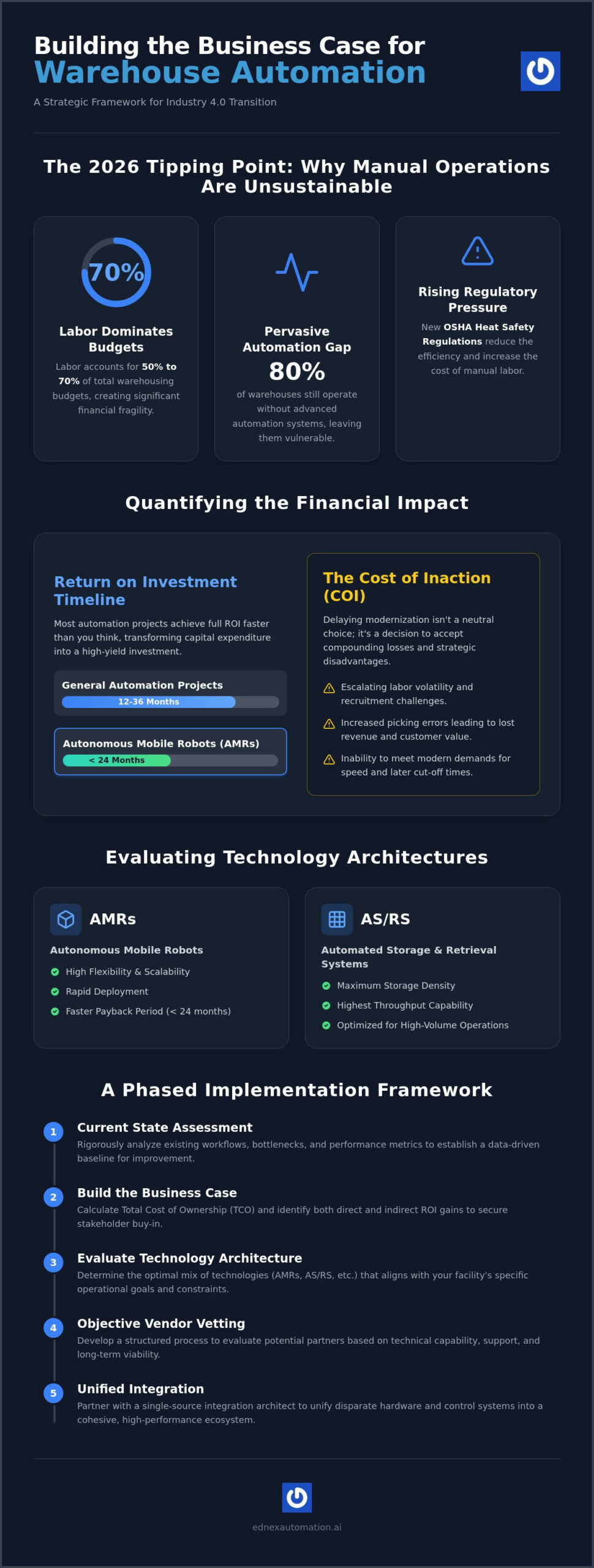
Transforming raw operational data into a compelling investment narrative requires a methodical, five-phase approach. Building a business case for warehouse automation is a process of translating technical capabilities into the language of corporate strategy. Phase 1 begins with a forensic assessment of the current state, specifically targeting areas where manual error rates or fulfillment bottlenecks create measurable fiscal leakage. Phase 2 moves into rigorous technology selection and vendor vetting, ensuring the hardware aligns with the facility’s unique physical constraints. In Phase 3, managers must conduct detailed financial modeling, incorporating the TCO and COI metrics established in previous sections. Phase 4 establishes the implementation roadmap and change management strategy, while Phase 5 focuses on post-implementation reviews to identify opportunities for scaling robotic fleets across the enterprise.
Execution excellence depends on the clarity of this roadmap. Each phase serves to de-risk the investment by providing a structured path from identification to integration. By following this framework, organizations ensure that their automation strategy is not just a hardware purchase but a sustainable evolution of their supply chain infrastructure. If you’re looking to bridge the gap between assessment and implementation, partner with EdNex Automation to build your custom implementation roadmap.
Identifying and Mitigating Implementation Risks
The Executive Summary: Selling the Vision to the Board
The executive summary serves as the bridge between technical capability and corporate strategy. Instead of focusing on granular technical specifications, this section must emphasize how building a business case for warehouse automation hedges against labor inflation and meets 2026 Industry 4.0 standards. Using visual ROI projections and throughput simulations provides the board with the clarity needed to approve high-value capital expenditures. Highlighting the competitive advantage of becoming an early adopter of 2026 technology frames the investment as a necessary evolution for long-term market dominance.
Partnering for Success: EdNex Automation as Your Integration Architect
Leveraging a comprehensive suite of robotic solutions, EdNex Automation acts as a strategic architect for organizations navigating the complexities of industrial transformation. When building a business case for warehouse automation, the most common point of failure is the lack of a unified integration strategy that connects hardware to the control layer. Selecting a single-source partner ensures that every component of your robotic ecosystem, from ASRS design to PLC programming, operates as a cohesive unit. We transcend the traditional vendor-client model by providing the intellectual framework necessary for large-scale industrial evolution. Our focus remains on long-term system optimization, ensuring that your initial investment remains viable as throughput demands and technological standards advance. By unifying disparate hardware under a robust SCADA architecture, we deliver the transparency and control required for modern Industry 4.0 environments.
Execution excellence depends on partnership. Transitioning from manual workflows to autonomous systems requires a partner who understands the gravity of industrial change. We don’t just provide tools; we provide a systematic organization of technology that brings order, safety, and efficiency to complex environments. This methodical approach reassures stakeholders that the transition will be controlled and deliberate, mitigating the risks associated with large-scale automation deployments.
End-to-End Automation Expertise
Next Steps: Your Journey to an Automated Future
Building a business case for warehouse automation requires empirical data and facility-specific insights that generic calculators cannot provide. EdNex specialists conduct rigorous facility audits to identify high-impact automation opportunities, providing the baseline metrics needed for a defensible proposal. We collaborate with your leadership team to develop a bespoke ROI model that accounts for labor savings, inventory accuracy, and long-term scalability. This data-driven approach ensures your board has the confidence to approve transformative investments. Contact our specialists today to begin drafting the technical roadmap that will define your organization’s future in the autonomous era.
Securing Your Competitive Advantage in the Autonomous Era
Transitioning to an Industry 4.0 framework requires a sophisticated synthesis of financial foresight and technical precision. By aligning specific operational pain points with scalable architectures such as AMRs and ASRS, organizations transform legacy facilities into high-performance, autonomous ecosystems. Successfully building a business case for warehouse automation depends on demonstrating long-term viability through rigorous ROI modeling and the seamless integration of control systems. These strategic investments don’t just mitigate current labor volatility; they provide the intellectual and physical infrastructure necessary for sustained market dominance.
EdNex Automation, acting as a specialized division focused on Industry 4.0, provides the end-to-end expertise required to execute this complex vision. Our deep technical proficiency in PLC/SCADA and ASRS integration, paired with a comprehensive range of AMRs and industrial robotics, ensures your transition remains both seamless and strategically sound. We invite you to Request a Strategic Consultation for Your Warehouse Automation Project to begin identifying the bespoke solutions that will define your facility’s future. The path toward a modernized, resilient supply chain is now clearly defined. It’s time to lead your organization toward its next necessary evolution with confidence.
Frequently Asked Questions
What is the average ROI period for warehouse automation in 2026?
Most warehouse automation projects achieve a full return on investment within 12 to 36 months. Specifically, Autonomous Mobile Robots (AMRs) frequently deliver a payback in under 24 months due to their low infrastructure requirements. High-performing deployments can even see an ROI exceeding 250% by significantly reducing labor costs and improving order fulfillment speeds by up to 300%.
How do I choose between AMRs and ASRS for my business case?
Selecting the optimal architecture depends on whether your priority is spatial density or operational flexibility. ASRS is the superior choice for maximizing vertical cube utilization in high-density environments where storage footprints are limited. Conversely, AMRs provide the agility required for dynamic workflows and rapid deployment in existing facilities without requiring permanent floor modifications or massive upfront capital.
Can I automate my warehouse in phases to manage costs?
Implementing automation in distinct phases is a highly effective strategy for managing initial capital expenditure and reducing operational risk. This approach allows businesses to validate performance benchmarks in a controlled environment before scaling to a full robotic fleet. By starting with high-impact areas like automated picking, companies can use early ROI to fund subsequent phases of their modernization roadmap.
What are the hidden costs in a warehouse automation business case?
Identifying hidden costs is a critical step in building a business case for warehouse automation to ensure long-term fiscal accuracy. Beyond the hardware, managers must account for software orchestration updates, data migration, and specialized employee training. Ongoing expenses like optimized energy consumption and predictive maintenance must be integrated into the Total Cost of Ownership (TCO) model to avoid budget overruns.
How does PLC and SCADA integration affect the success of automation?
Robust PLC and SCADA integration acts as the central nervous system of an automated facility, ensuring seamless interoperability between disparate robotic systems. Without this control layer, organizations risk creating “automation silos” that hinder data visibility and process optimization. Effective integration allows for real-time performance monitoring and provides the analytical insights necessary for continuous operational improvement and predictive maintenance.
Is warehouse automation suitable for small to medium-sized enterprises?
Modern automation is increasingly accessible to small and medium-sized enterprises through scalable technologies and flexible acquisition models like Robots-as-a-Service (RaaS). SMEs can deploy small fleets of AMRs or targeted cobot stations to address specific bottlenecks without the massive upfront investment required for full-scale ASRS. This modularity ensures that Industry 4.0 benefits are no longer reserved for large-scale industrial entities.
How do I address employee concerns about job security in my proposal?
Proposals should frame automation as a tool for enhancing safety and creating higher-value roles through collaborative robotics. Emphasizing the reduction of ergonomically taxing tasks and the opportunity for technical upskilling helps mitigate job security fears. By positioning robots as partners that handle repetitive work, leadership can foster a culture of innovation while meeting stringent safety regulations like the 2026 OSHA heat standards.
What role do humanoid robots play in future warehouse business cases?
Humanoid robots represent the next frontier in building a business case for warehouse automation by offering multipurpose utility in unstructured environments. These advanced systems are designed to perform tasks traditionally reserved for humans, such as maneuvering through narrow aisles and handling diverse SKU profiles. Their ability to integrate into existing manual workflows makes them a visionary addition to long-term strategic roadmaps for 2026 and beyond.