With the UAE industrial automation and control systems market projected to reach $10,814 million by 2033, the transition from legacy manual processes to autonomous intelligence is no longer optional for regional enterprises. You’re likely facing the persistent challenge of labor shortages in warehousing or the high cost of manual cleaning in massive facilities. While legacy systems often feel disconnected from the future, leading industrial automation companies in UAE are now providing the intellectual and technical framework to modernize these operations.
Leveraging the AED 18 billion in competitive financing recently secured by the Ministry of Industry and Advanced Technology, this guide explores how to achieve total operational throughput and full system visibility. We’ll examine the strategic deployment of collaborative robots and autonomous mobile robots that align with Operation 300bn milestones. By the end of this article, you’ll understand how to integrate SCADA and PLC systems to ensure compliance with UAE standards while drastically reducing your reliance on manual labor.
Key Takeaways
- Understand how national mandates like Operation 300bn are accelerating the transition toward fully autonomous industrial environments across the region.
- Learn to distinguish between simple hardware vendors and the leading industrial automation companies in UAE that provide bespoke integration for complex robotic systems.
- Discover the critical role of PLC and SCADA integration as the digital foundation for managing advanced machinery, including AMRs and collaborative robots.
- Identify the strategic steps for a phased automation rollout, starting with bottleneck audits to ensure measurable ROI and long-term operational scalability.
- Explore how high-level solutions like ASRS and humanoid robotics are being deployed to mitigate labor shortages and enhance total facility throughput.
Industrial Automation Companies in UAE in 2026
Drivers of Automation in the National Economy
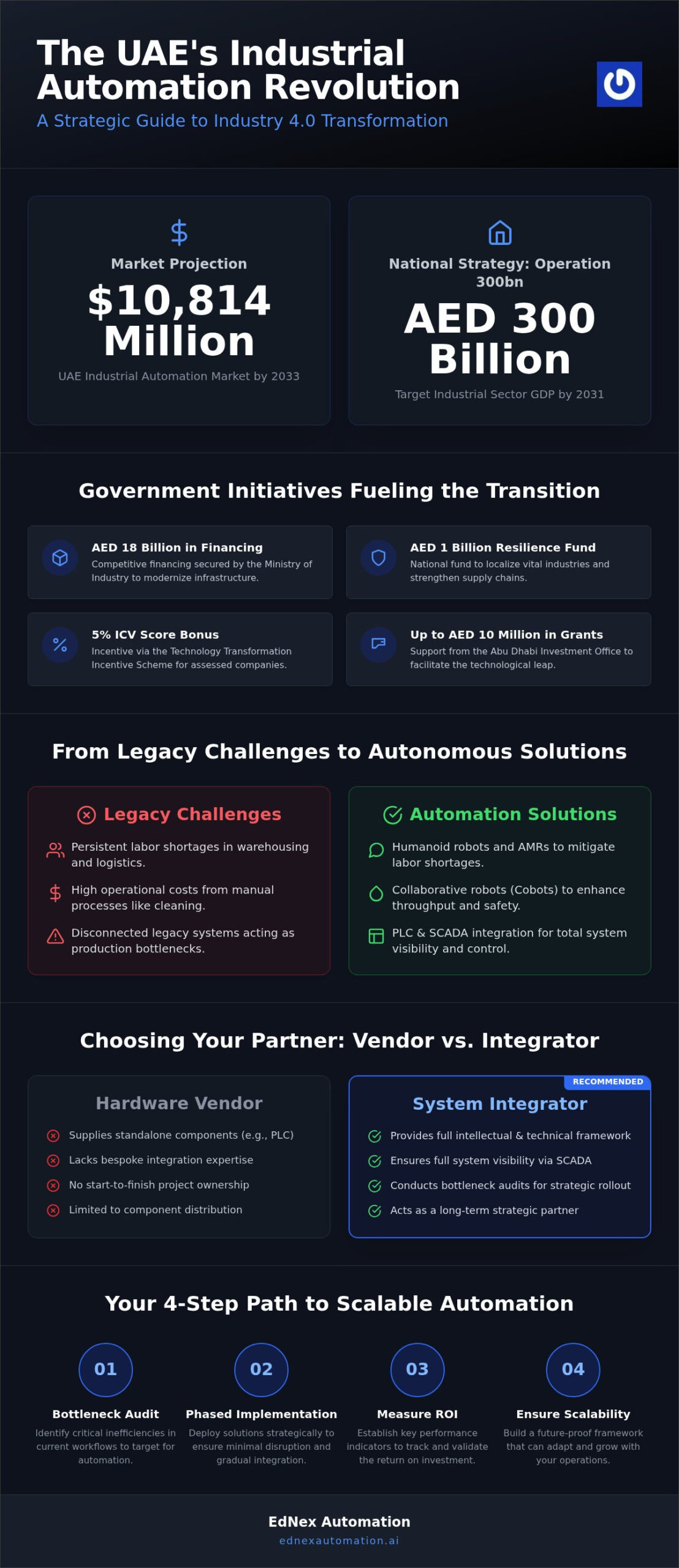
Driving this transformation is the National Industrial Resilience Fund, established in April 2026 with AED 1 billion to localize vital industries and strengthen supply chains. By utilizing the Technology Transformation Incentive Scheme, companies now receive a 5% bonus on their National In-Country Value (ICV) score upon completing an Industrial Technology Transformation Index (ITTI) assessment. These initiatives address critical labor market dynamics, specifically the shortage of specialized robotics expertise and the need to eliminate inefficient manual cleaning in large-scale facilities. Adopting Core Technologies: Robotics and Control System Integration allows enterprises to leverage the AED 18 billion in competitive financing secured by the Ministry of Industry and Advanced Technology to modernize their physical infrastructure. Government-led grants, such as those from the Abu Dhabi Investment Office, provide up to AED 10 million to support this technological leap, ensuring that the shift toward smart manufacturing is financially viable for forward-thinking enterprises.
Defining the Modern Automation Partner
Distinguishing between a hardware trader and a full-spectrum system integrator is vital for long-term operational success. While a trader might supply a standalone PLC, a true partner like EdNex Automation provides the intellectual framework necessary for full system visibility via SCADA. This shift toward software-driven intelligence ensures that legacy systems are no longer a bottleneck but are instead prepared for Industry 4.0 frameworks. It’s not just about the machinery; it’s about the bespoke integration of collaborative robots and autonomous mobile robots into existing workflows to mitigate risks and improve safety.
Reliable partners prioritize official certifications and alliances with global technology leaders to guarantee system viability. They don’t just sell tools; they act as systematic organizers who bring safety and efficiency to complex environments through controlled and deliberate innovation. In 2026, a partner’s value is measured by their ability to provide start-to-finish expertise, from initial bottleneck audits to the deployment of specialized humanoid robots. Choosing an integrator with deep regional expertise ensures that your facility remains compliant with evolving UAE industrial standards while maximizing operational throughput. This comprehensive approach transforms industrial automation companies in UAE from equipment vendors into essential strategic consultants.
Core Technologies: Robotics and Control System Integration
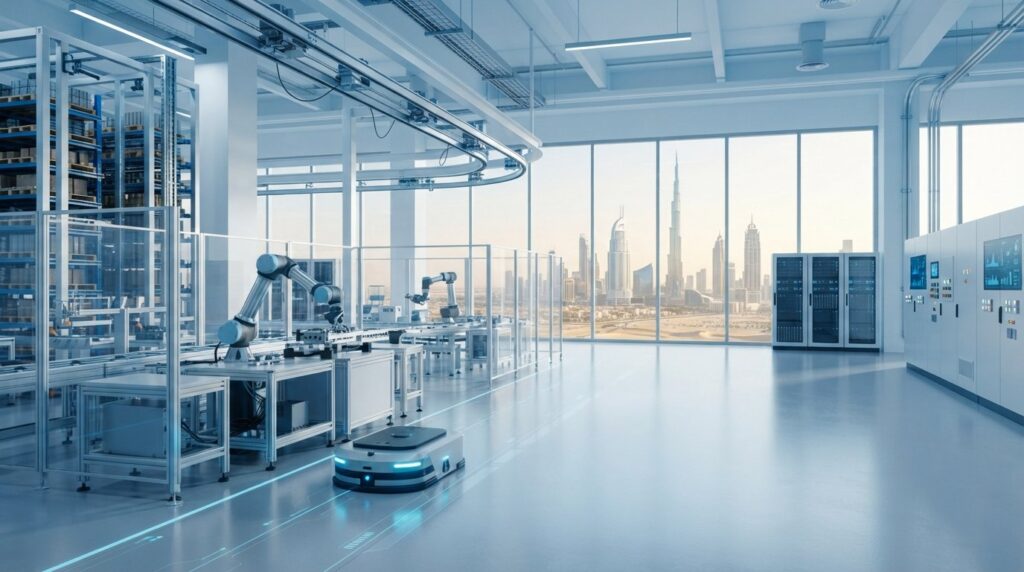
Bridging the gap between mechanical execution and digital intelligence requires a unified architectural approach that few industrial automation companies in UAE can fully deliver. A comprehensive strategy now necessitates the synchronization of autonomous hardware with sophisticated digital control layers to ensure maximum operational uptime. While Programmable Logic Controllers (PLCs) remain the primary logic engine of the factory floor, their functional scope has expanded to manage high-speed data exchange between diverse robotic assets and enterprise-level software. This integration ensures that every movement on the production line is tracked, analyzed, and optimized in real time.
Advanced Control via PLC and SCADA
Modernizing legacy infrastructure involves far more than simple hardware replacement; it requires a complete digital overhaul of the control environment. Utilizing PLC and SCADA integration services allows plants to establish a unified visualization layer for their entire operation. This digital framework facilitates real-time data acquisition, enabling predictive maintenance models that prevent costly unplanned downtime before it occurs. By integrating these systems, enterprises gain granular visibility into energy consumption and cycle times, allowing for precise adjustments that improve overall equipment effectiveness (OEE). Protecting these interconnected assets is paramount, necessitating the implementation of rigorous cybersecurity protocols within the industrial control network to safeguard sensitive operational data against evolving digital threats.
Collaborative and Humanoid Robotics
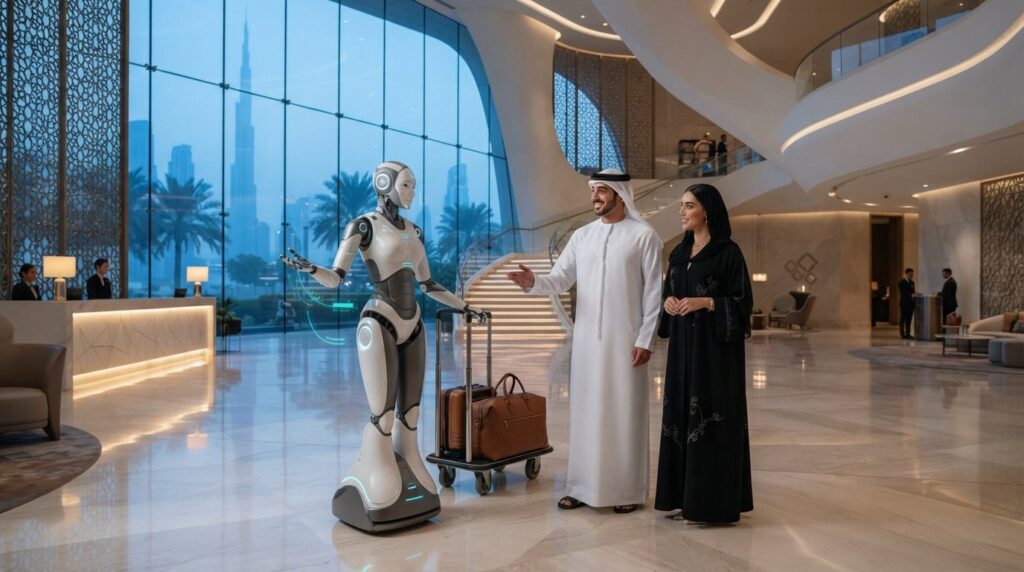
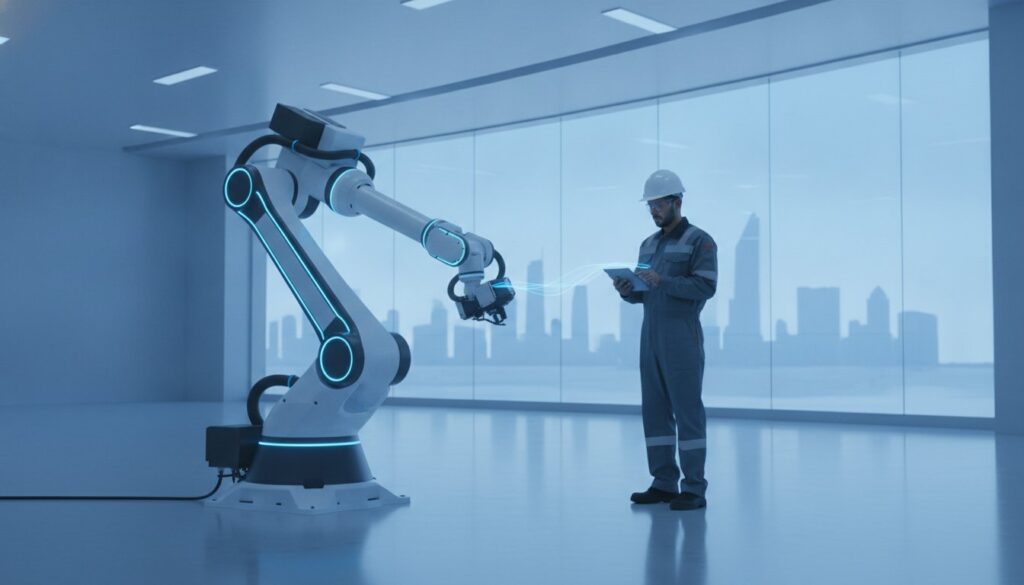
Transitioning toward a flexible and resilient workforce involves the strategic deployment of collaborative robots in the UAE. Unlike traditional industrial robots that require safety cages, these systems are designed with advanced force-sensing technology to work safely alongside human operators in high-precision assembly tasks. For more complex service requirements and intricate manipulation, the availability of humanoid robots for sale UAE represents the next frontier in facility management and multi-purpose automation.
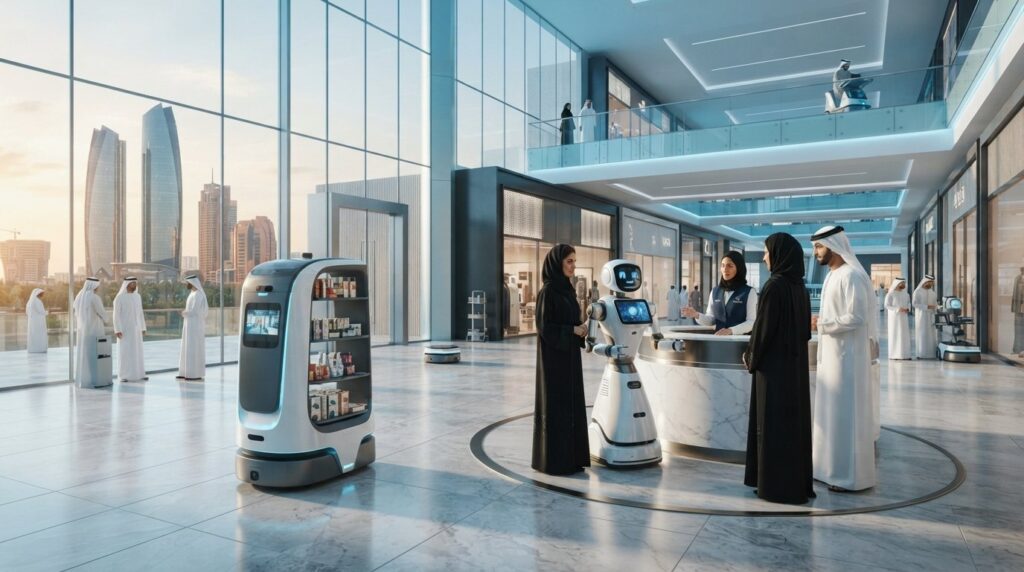
Streamlining internal logistics within large-scale facilities relies heavily on autonomous mobile robots (AMRs) that navigate dynamic environments without the need for fixed tracks or magnetic tape. These technologies ensure safety through sophisticated sensor fusion while meeting the high-throughput demands of the modern UAE industrial sector. Implementing these advanced systems requires a partner who understands the nuance of local industrial standards. For enterprises seeking to lead this evolution, exploring a bespoke automation framework is the essential first step toward long-term viability. By choosing a partner with deep expertise in both robotics and control logic, industrial automation companies in UAE can transform fragmented processes into a cohesive, intelligent ecosystem.
Evaluating Automation Partners: Integration vs. Supply
Distinguishing between simple equipment procurement and strategic system integration is the most critical decision for any facility manager seeking long-term viability. While many industrial automation companies in UAE operate as hardware traders, providing only the physical components, the true value resides in bespoke integration. A trader can sell you a motor; an integrator builds the logic that ensures that motor drives a high-efficiency production line. Operating with an engineering-minded approach, a true integrator identifies technical solutions that directly translate to risk mitigation and operational improvement. Successful automation requires a partner capable of architecting a comprehensive intellectual framework rather than just fulfilling a bill of materials.
The Integrator’s Checklist for UAE Enterprises
Selecting a partner requires a rigorous assessment of their technical depth and local deployment history. You should verify if the provider offers custom programming for PLC and HMI interfaces to ensure the system aligns with your specific operational logic. Inquire about their experience with high-impact solutions like autonomous cleaning robots, which solve the pain of manual hygiene maintenance in large facilities. Their proficiency in deploying automated storage and retrieval systems (ASRS) serves as a benchmark for their ability to handle complex, large-scale logistics challenges. A diverse portfolio that includes specialized sectors such as surveillance and outdoor cleaning automation indicates a versatile engineering team capable of handling multifaceted industrial requirements. These companies act as systematic organizers, bringing order to complex environments through controlled and deliberate innovation.
Post-Implementation Support and Scalability
Ensuring long-term viability depends on the presence of a local engineering team for on-site commissioning and training. Relying on remote support or international contractors often leads to extended downtime when mission-critical systems encounter issues. Reliable industrial automation companies in UAE provide 24/7 technical support and maintain a local inventory of spare parts for robotic units, guaranteeing rapid recovery from unforeseen interruptions. This local presence is essential for scaling operations. It’s much safer to expand from a single pilot robot to a full facility fleet when you have a grounded technical partner managing the transition. By establishing a framework for iterative growth, you protect your initial investment while steadily increasing total facility throughput and ensuring compliance with evolving UAE industrial standards.
Strategic Implementation: Future-Proofing UAE Operations
Implementing a transformative automation strategy requires a methodical transition from high-level vision to ground-level deployment. Leading industrial automation companies in UAE emphasize that successful projects don’t begin with hardware procurement; they start with a rigorous audit of existing operational bottlenecks. By identifying high-friction areas where manual labor is either inefficient or hazardous, enterprises can establish a clear baseline for ROI. This systematic approach ensures that every robotic asset added to the floor serves a specific, measurable purpose within the broader Industry 4.0 framework. Integrating IoT sensors to feed real-time data back into centralized SCADA dashboards allows for a granular level of control that was previously unattainable in legacy environments.
Phase 1: Audit and Architecture Design
Focusing on high-impact, low-complexity tasks allows organizations to prove the value of automation without overextending their internal resources. Identifying low-hanging fruit such as outdoor cleaning robots or automated palletizing via collaborative robots provides immediate wins in operational throughput. During this stage, engineers design a scalable control architecture that avoids the trap of isolated islands of automation, ensuring future robotic additions can be integrated into the existing digital environment. Industry 4.0 readiness for UAE manufacturers is defined by a facility’s alignment with the Industrial Technology Transformation Index (ITTI) to ensure full digital interoperability across all production and management layers.
Phase 2: Deployment and Systems Integration
Managing the physical installation of AMRs and ASRS infrastructure, our engineering teams ensure precise coordination to minimize disruption to ongoing production cycles. Executing these complex deployments involves more than just physical placement; it requires the deep software integration of robotic controllers with enterprise ERP and MES systems. This connectivity facilitates a closed-loop data environment where performance metrics are analyzed in real time to optimize cycle speeds. Rigorous testing of safety interlocks and autonomous navigation protocols remains a non-negotiable step to ensure human-robot collaboration meets the highest safety standards.
Transitioning the workforce from manual execution to robotic supervision is the final, critical component of a future-proof strategy. By training employees to manage and maintain advanced systems, companies reduce their reliance on manual labor while increasing the technical capability of their local teams. This evolution turns operators into system supervisors who leverage data to optimize throughput and mitigate operational risks. To begin your facility’s transition toward an intelligent, autonomous ecosystem, consult with our expert integration team to design your strategic roadmap for 2026.
EdNex Automation: Leading the National Industrial Evolution
Positioning EdNex at the apex of the regional shift, EdNex Automation serves as a high-level consultant for organizations navigating large-scale industrial transformation. Unlike many industrial automation companies in UAE that focus strictly on hardware procurement, we provide the systematic organization required to integrate global technological breakthroughs into the local economic context. Our approach prioritizes the delivery of high-level solutions that translate directly into risk mitigation and enhanced operational throughput. By acting as a strategic bridge-builder, we connect the most advanced robotic innovations with the specific economic demands of the UAE manufacturing landscape, ensuring that every deployment aligns with national resilience goals.
Our Comprehensive Automation Ecosystem
Developing bespoke PLC and SCADA environments tailored for regional industrial standards, we ensure that every control layer is optimized for mission-critical infrastructure. Our visionary portfolio extends beyond traditional controls to include advanced service robotics such as specialized cleaning, delivery, and surveillance robots. We also specialize in the deployment of complex ASRS and humanoid robots, providing a level of technical sophistication that addresses the most challenging industrial pain points. By maintaining strategic alliances with global technology leaders, we guarantee that the systems deployed are of world-class quality and fully capable of autonomous operation in dynamic environments. This comprehensive ecosystem allows enterprises to modernize their physical assets while ensuring complete digital interoperability across all production and management layers.
Focusing on the intersection of traditional control and cutting-edge robotics, our methodology is built upon four core pillars:
- Strategic Consultancy: Identifying the optimal path for digital transformation based on specific facility constraints and ROI targets.
- Bespoke Integration: Custom-coding PLC and HMI layers to ensure seamless communication between disparate robotic assets and ERP systems.
- Advanced Robotics Deployment: Implementing high-autonomy systems including AMRs, Cobots, and Humanoids to solve labor and efficiency gaps.
- Lifecycle Support: Providing the local engineering presence required for on-site commissioning, specialized training, and long-term maintenance.
Partnering for Long-Term Viability
Providing the intellectual framework necessary for successful Industry 4.0 adoption, EdNex acts as a grounded technical partner for national-scale projects. We understand that the gravity of industrial transformation requires more than just tools; it demands a systematic organizer who brings order, safety, and efficiency to complex environments through controlled and deliberate innovation. Unlike other industrial automation companies in UAE that lack deep local engineering roots, our commitment to long-term business viability is backed by reliable technical support and regional expertise. We ensure that your investment remains competitive as the UAE’s industrial sector evolves toward total autonomy. To secure your facility’s future and modernize your industrial operations, connect with our experts to begin your journey toward total autonomous intelligence.
Securing Industrial Leadership Through Autonomous Intelligence
Transitioning toward a fully autonomous facility requires a deliberate shift from fragmented machinery to a unified, intelligent ecosystem. As we’ve explored, the path to 2026 demands more than simple hardware acquisition; it necessitates the deep integration of PLC logic with advanced robotic assets like AMRs and collaborative robots. By aligning with national mandates such as Operation 300bn, enterprises can leverage strategic financing to mitigate labor shortages and eliminate operational bottlenecks. Leading industrial automation companies in UAE are no longer just equipment vendors; they’re the intellectual architects of a resilient, high-throughput manufacturing landscape.
Success in this new era depends on choosing a partner capable of bridging global innovation with regional industrial standards. EdNex Automation provides the specialized expertise and visionary portfolio required to navigate this complexity with confidence. Our national-scale integration experience ensures that your deployment of Humanoids, Cobots, or ASRS infrastructure delivers measurable ROI from day one. It’s time to evolve your facility into a beacon of efficiency and safety. Partner with EdNex Automation to lead your industrial digital transformation and secure your organization’s position at the forefront of the UAE’s industrial evolution.
Frequently Asked Questions
What are the top industrial automation companies in the UAE for robotics?
EdNex Automation stands as a premier leader by providing a visionary portfolio that includes humanoid robots, collaborative robots, and autonomous mobile robots. Unlike simple equipment vendors, the most advanced industrial automation companies in UAE offer the intellectual framework and national-scale integration expertise required for comprehensive digital transformation. These partners act as systematic organizers who bridge the gap between global technological breakthroughs and regional manufacturing needs.
How does PLC and SCADA integration improve manufacturing efficiency?
Integrating PLC and SCADA systems establishes a unified visualization layer that enables real-time data acquisition across the entire production floor. This digital foundation facilitates predictive maintenance models that prevent costly unplanned downtime while directly improving overall equipment effectiveness. By providing full system visibility, these integrated controls allow facility managers to optimize cycle times and energy consumption through precise, data-driven adjustments.
What is the difference between an automation supplier and a system integrator?
An automation supplier typically focuses on the commodity trade of hardware components such as motors, sensors, or standalone controllers. In contrast, a system integrator provides bespoke engineering and custom programming to ensure these disparate tools function as a cohesive, intelligent ecosystem. The true value driver in any project is this start-to-finish expertise, which ensures that hardware assets align with specific operational logic and ROI targets.
Can autonomous mobile robots (AMRs) work alongside human staff safely?
Autonomous mobile robots utilize advanced sensor fusion and LiDAR technology to navigate dynamic environments safely alongside human personnel without the need for safety cages. These systems are programmed with rigorous navigation protocols that allow them to detect obstacles and adjust their path in real time. This high-level autonomy ensures that internal logistics remain efficient while maintaining a secure environment for the workforce in high-throughput facilities.
What are the benefits of implementing ASRS in UAE warehouses?
Implementing automated storage and retrieval systems maximizes vertical warehouse space while significantly increasing picking accuracy and speed. These systems reduce the reliance on manual labor in high-density environments, ensuring that regional facilities can meet the logistical demands of an accelerating digital economy. By automating the movement of goods, enterprises achieve higher throughput and better inventory control within their existing physical footprint.
How much does it cost to automate a factory in the UAE?
The investment required for factory automation depends heavily on the functional scope of the project and the specific robotic assets being integrated. While hardware procurement is a factor, the primary cost drivers are the bespoke engineering and software integration required to modernize legacy systems. Enterprises should focus on conducting a rigorous bottleneck audit to identify high-impact areas where automation provides the fastest path to measurable ROI.
What specialized cleaning robots are available for large facilities?
Facilities can deploy specialized autonomous cleaning robots designed for both intricate indoor floors and expansive outdoor environments. These high-tech solutions eliminate the inefficiencies of manual cleaning in large-scale infrastructure by utilizing intelligent navigation and automated charging cycles. By adopting these specialized robotic units, facility managers ensure consistent hygiene standards while reallocating human resources to more complex supervisory tasks.
How does the UAE government support industrial automation initiatives?
Supporting the national shift toward Industry 4.0, the UAE government provides extensive incentives through the National Industrial Resilience Fund and the Technology Transformation Incentive Scheme. These programs offer competitive financing and bonuses on the National In-Country Value score for enterprises that adopt advanced technologies. Many industrial automation companies in UAE help clients navigate these programs to secure grants that accelerate their transition toward autonomous smart manufacturing.