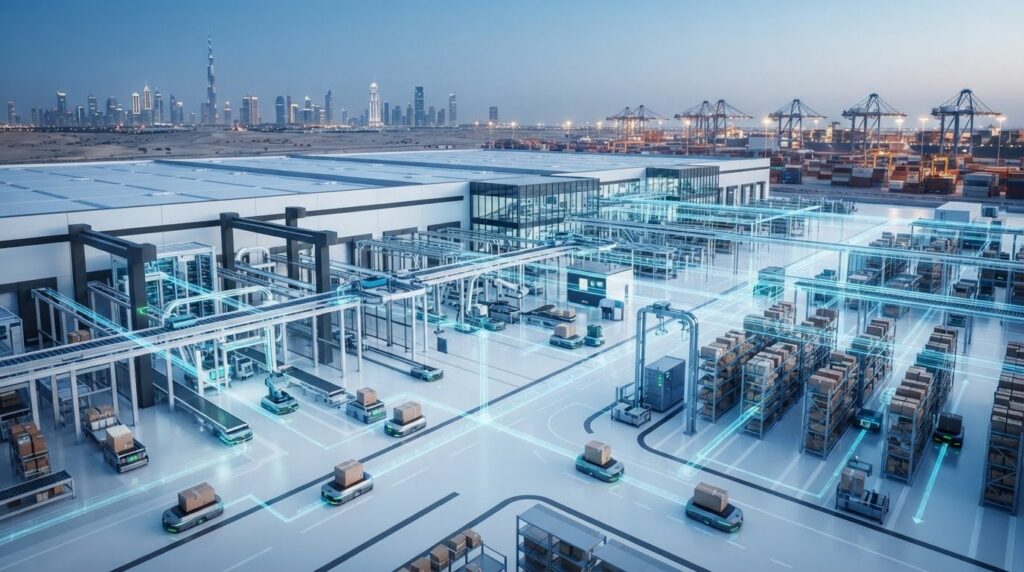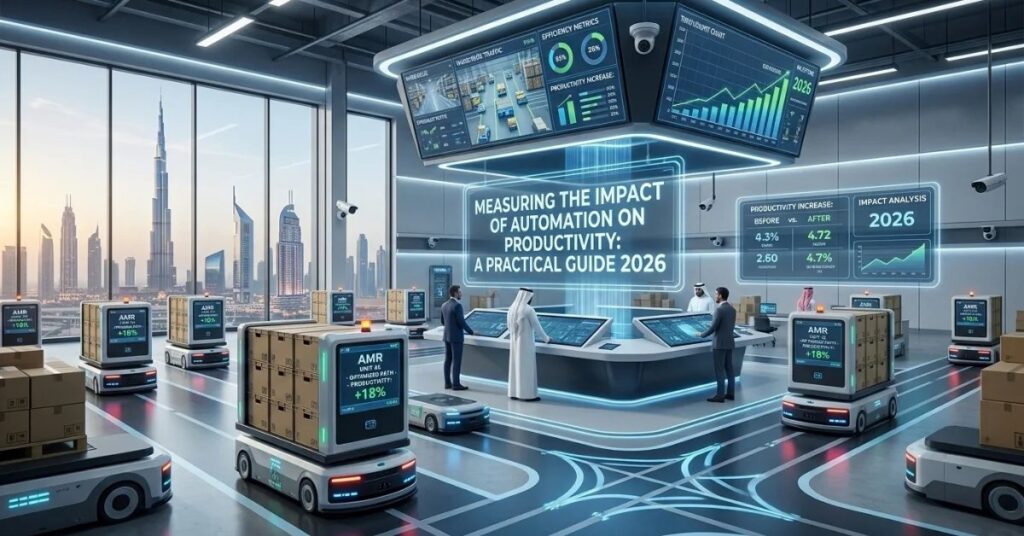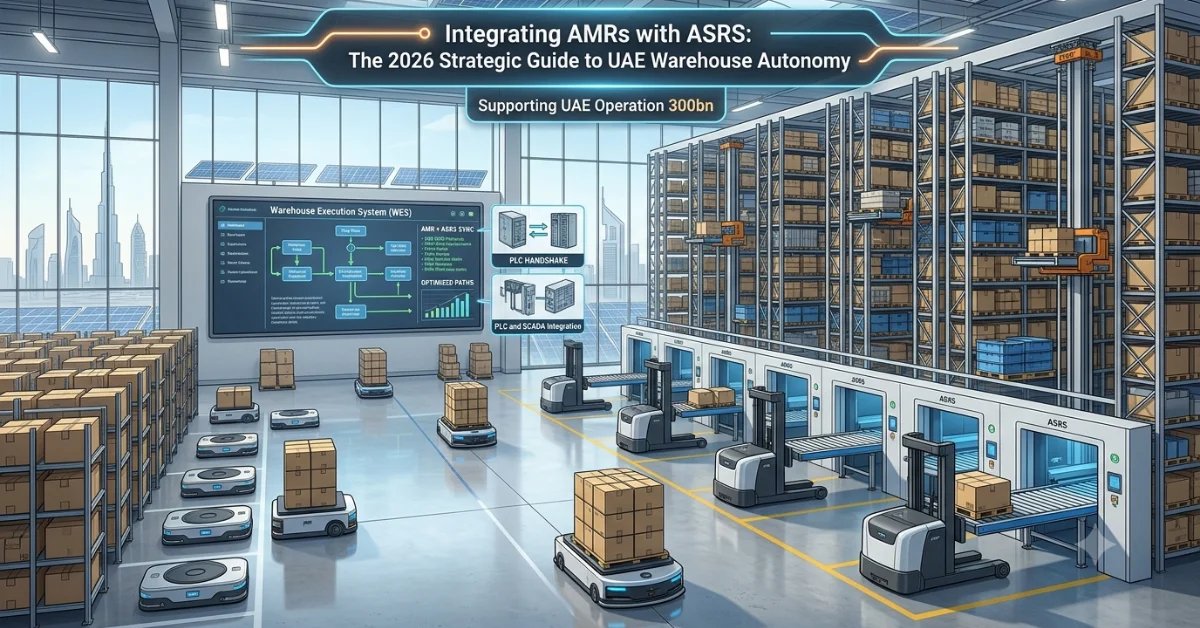
The era of the static warehouse is over, replaced by a reality where your storage density and your throughput speed are no longer at odds. You’ve likely seen how even the most sophisticated Automated Storage and Retrieval Systems (ASRS) encounter critical bottlenecks at induction and discharge points, where reliance on manual internal transport creates a costly disconnect. By successfully integrating AMRs with ASRS UAE industrial operators can bridge these gaps, transforming a rigid storage “black box” into a dynamic, flow-centric engine that responds to fluctuating market demands in real time.
Achieving this level of synchronization requires more than just deploying hardware; it demands a sophisticated intellectual framework that orchestrates different robotic brands into a single, high-throughput ecosystem. This strategic guide provides the technical roadmap to transition from fragmented automation to a fully autonomous end-to-end material flow. We’ll examine how unified control systems and AI-powered navigation future-proof your facility, ensuring your operations remain competitive within the UAE’s rapidly evolving Industry 4.0 landscape and align with the ambitious goals of Operation 300bn.
Key Takeaways
- Understand why the convergence of high-density storage and flexible robotic transport is essential for eliminating manual bottlenecks at ASRS induction and discharge points.
- Learn the technical requirements for integrating AMRs with ASRS UAE, including the critical role of Warehouse Execution Systems (WES) and standardized communication protocols.
- Evaluate the strategic shift from rigid, high-CAPEX conveyor systems to scalable AMR fleets that offer superior operational flexibility and long-term cost optimization.
- Discover the roadmap for implementing robotic handshakes through precise PLC logic and SCADA integration to ensure seamless material transitions between automated systems.
- Recognize how aligning robotic hardware with industrial infrastructure supports the UAE’s Operation 300bn goals and ensures long-term facility viability.
The Evolution of Integrated Logistics: Why AMRs and ASRS Must Converge
The industrial landscape in the UAE is undergoing a fundamental transformation as facilities transition from manual operations to high-density, autonomous environments. Central to this shift is the realization that standalone Automated Storage and Retrieval Systems (ASRS), while excellent for vertical density, often create isolated “islands of automation.” Without a dynamic transport layer, these systems rely on manual forklift intervention or rigid conveyor lines to move goods to their next destination. Integrating AMRs with ASRS UAE operators allows for the creation of a hybrid autonomous ecosystem. This architecture bridges the gap between high-density storage and flexible, perimeter-free transport, aligning perfectly with the UAE’s “Operation 300bn” industrial strategy to boost manufacturing and logistics contributions to the national GDP. By successfully integrating AMRs with ASRS UAE industrial leaders can ensure their facilities aren’t just dense, but truly agile.
The Limitations of Traditional ASRS Induction
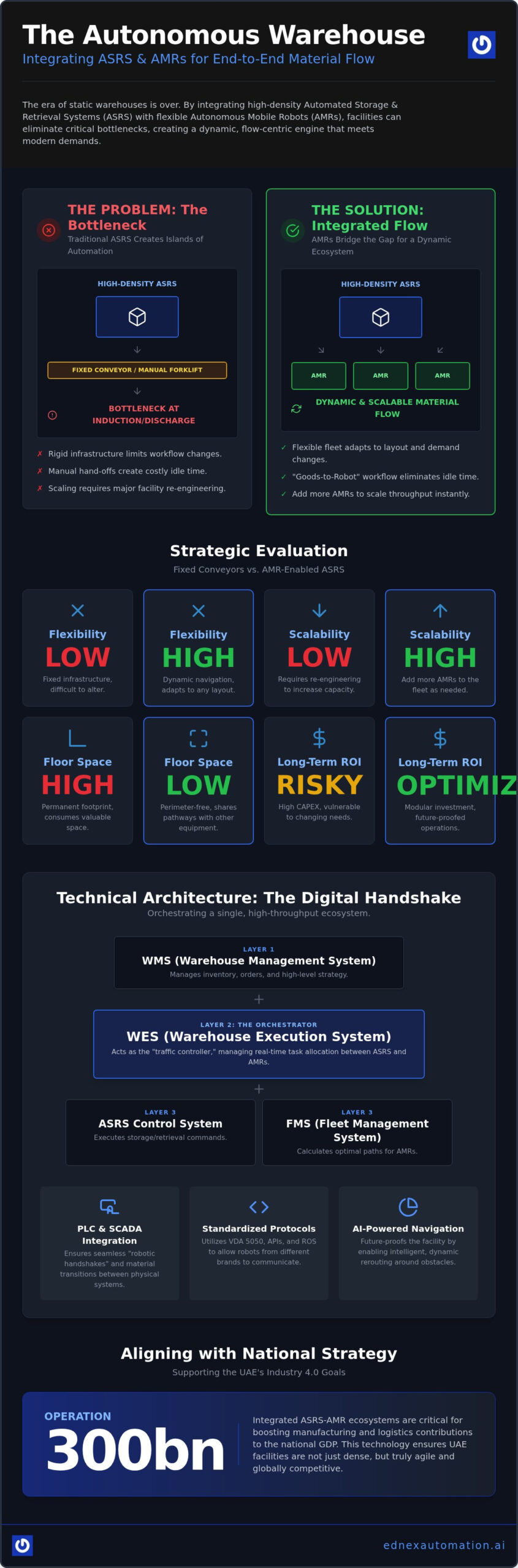
Traditional ASRS setups frequently suffer from the “conveyor bottleneck.” Fixed conveyors require significant floor space and offer zero flexibility once installed. If demand spikes or workflows change, the fixed infrastructure becomes a liability. Manual pallet handling at induction ports further degrades the system’s ROI, as human-operated equipment can’t match the 24/7 consistency of robotic systems. We’re seeing a decisive shift toward “Goods-to-Robot” workflows in the UAE. In these models, the ASRS retrieves the load, but instead of waiting for a human or a slow conveyor, an AMR is already positioned at the discharge port to receive it. This eliminates idle time and ensures the storage system operates at its theoretical maximum capacity.
AMRs as the Flexible Alternative to Fixed Infrastructure
Autonomous Mobile Robots (AMRs) serve as the connective tissue for the 2026 smart factory. Unlike floor-mounted sorters, AMRs navigate dynamically, rerouting around obstacles and adapting to layout changes without requiring a single bolt to be moved. This flexibility is essential for “Dark Warehouse” operations where multi-robot synchronization replaces human movement entirely. Scaling capacity no longer requires re-engineering the entire facility layout. You can simply add more AMRs to the fleet as throughput requirements grow. This modularity allows UAE businesses to scale their automation investment in direct proportion to their operational success, avoiding the massive upfront risks associated with over-engineered fixed infrastructure.
Technical Architecture: How AMRs and ASRS Communicate
Success in integrating AMRs with ASRS UAE depends on a robust digital handshake between heterogeneous systems. While traditional warehouses rely on a Warehouse Management System (WMS) for inventory tracking, an integrated facility requires a Warehouse Execution System (WES) to manage the real-time interplay between storage and mobility. This hierarchy ensures that as soon as the ASRS identifies a pallet for retrieval, a Fleet Management System (FMS) is already calculating the optimal path for an AMR to meet it at the discharge port. By synchronizing these layers, you eliminate the idle time that typically plagues manual hand-offs.
Bridging these digital layers requires standardized protocols like VDA 5050 or API-driven middleware, allowing robots from different manufacturers to communicate within a single environment. Utilizing the Robot Operating System (ROS) facilitates rapid interoperability, ensuring that hardware from one vendor can receive commands from a central control platform without custom coding for every unit. Recent advancements in ASRS and mobile robotics have shifted the focus from simple mechanical movement to high-fidelity data synchronization. If you’re planning a facility upgrade, consulting with a specialist in PLC and SCADA integration is vital to mapping these logic flows correctly before hardware arrives on-site.
The Role of Warehouse Execution Systems (WES)
A WES acts as the sophisticated traffic controller of the modern warehouse, managing the dynamic task allocation that a standard WMS isn’t equipped to handle. It prioritizes high-value orders in real-time, adjusting the retrieval queue of the ASRS and the dispatch frequency of the AMR fleet simultaneously. The Warehouse Execution System serves as the cognitive central nervous system of the integrated facility, translating high-level business goals into precise machine-level commands.
Precision Docking and Mechanical Hand-offs
Physical integration is just as critical as software logic, requiring high-precision docking stations for seamless material transfer. Operators must choose between active transfer stations, which utilize powered rollers for high-throughput zones, and passive stations that rely on the AMR’s own lifting mechanism. Achieving 100% pallet alignment during these transfers requires sensory feedback loops, often utilizing LiDAR or 3D cameras to verify positioning before the load is released. Safety remains paramount in these robotic interaction zones, where laser scanners and emergency stop circuits must be synchronized across both the ASRS perimeter and the mobile robot’s safety field. Ensuring this level of mechanical harmony is a core component of integrating AMRs with ASRS UAE facilities to maintain 24/7 operational continuity.
Fixed Conveyors vs. AMR-Enabled ASRS: A Strategic Evaluation
Selecting the right transport layer for your storage system is a decision that defines the operational lifespan of your facility. For decades, fixed conveyors were the default choice for high-volume throughput, yet they represent a rigid commitment to “concrete and steel” that modern markets no longer support. Integrating AMRs with ASRS UAE offers a decisive shift from heavy capital expenditure (CAPEX) toward a more agile operational model. While conveyors lock a facility into a single layout for a decade or more, an AMR fleet provides the intelligence to adapt to changing SKU profiles and new fulfillment strategies without requiring structural modifications. This transition allows industrial operators to recover valuable floor area previously occupied by permanent transit paths, repurposing that space for additional storage or value-added processing zones.
The risk profile of these two systems also differs fundamentally. Fixed systems are susceptible to single-point failures; a single motor or belt malfunction can halt the entire flow from the ASRS discharge port. In contrast, an AMR-enabled ecosystem is inherently resilient. If one robot requires maintenance, the fleet management software simply reroutes the remaining units to maintain throughput. This decentralization of risk is essential for UAE facilities operating 24/7, where even an hour of downtime can ripple through the entire supply chain. By integrating AMRs with ASRS UAE businesses replace rigid bottlenecks with a self-healing transport network that scales in direct proportion to demand.
Flexibility and Reconfigurability
UAE warehouse operators must navigate significant seasonal peaks and rapid SKU proliferation. Fixed infrastructure cannot expand to meet a 30% spike in Ramadan orders and then retract when demand stabilizes. AMRs function as “mobile conveyors” that emulate fixed flow with zero permanent hardware, allowing you to move robotic assets between different zones or even different facilities as needed. This reconfigurability ensures that your automation investment remains a productive asset rather than a stranded cost when your business model evolves.
Total Cost of Ownership (TCO) Comparison
Analyzing the long-term ROI requires looking beyond the initial purchase price. AMRs offer superior energy efficiency because they only consume power when active, unlike conveyors that often run continuously. Maintenance costs are also significantly lower; there are no miles of rollers, belts, and bearings to grease and replace. For a deeper dive into the financial metrics and performance data of these systems, consult The Definitive Guide to Autonomous Mobile Robots. Rapid deployment is the final piece of the TCO puzzle, as AMR fleets can be operational in weeks while conveyor construction often stretches into months of facility disruption.
Roadmap to Implementation: The Role of PLC and SCADA Integration
Transitioning from high-level strategy to field-level execution requires a methodical approach to industrial control. Integrating AMRs with ASRS UAE facilities depends on the underlying Programmable Logic Controller (PLC) architecture to bridge the gap between static storage logic and dynamic fleet movement. This roadmap ensures your facility moves through a controlled evolution from siloed machines to a unified, autonomous ecosystem. By following a structured implementation sequence, you mitigate the risks of operational downtime and ensure that every robotic asset delivers its maximum potential ROI.
The process begins with a comprehensive facility audit and material flow mapping, specifically accounting for the unique environmental variables of the UAE, such as extreme temperatures and humidity that can affect sensor performance. Once the flow is optimized, engineers design the PLC logic necessary for robotic handshakes, followed by the configuration of a SCADA dashboard for unified visualization. Pilot testing allows for the iterative optimization of robotic paths before moving to full-scale deployment and the implementation of predictive maintenance schedules. This systematic approach ensures that the transition to autonomy is both predictable and scalable.
PLC Programming for Robotic Handshakes
Facilitating a seamless hand-off between a retrieval crane and a mobile robot requires low-latency communication that a standard WMS cannot provide. You’re essentially creating a real-time conversation between the ASRS controller and the AMR fleet, where each unit confirms its position and readiness before a load is transferred. Developing these fail-safe logic loops is critical for preventing interrupted transfers or mechanical collisions. For organizations seeking specialized guidance on these protocols, our insights on PLC and SCADA Integration Services offer a deeper look at orchestrating complex robotic workflows.
SCADA: The Single Pane of Glass
Effective autonomy is impossible without total visibility, which is where the Supervisory Control and Data Acquisition (SCADA) system becomes indispensable. By visualizing robot health, battery status, and ASRS throughput on one screen, operators can identify potential bottlenecks before they impact the bottom line. Because the technical complexities of integrating AMRs with ASRS UAE require constant monitoring, the SCADA system also integrates IoT sensors for environmental monitoring, ensuring that high-precision electronics remain within safe operating parameters. This centralized data hub allows for continuous process improvement through the analysis of real-time performance metrics.
To begin your facility’s transformation into a high-throughput autonomous hub, consult with the integration experts at EdNex Automation today for a bespoke technical assessment.
EdNex Automation: Engineering Integrated Autonomy in the UAE
Positioning your facility at the forefront of the global industrial race requires a partner who provides the intellectual framework for transformation, not just the hardware. EdNex Automation operates as a specialized division of the EdNex group, dedicated to delivering the comprehensive Industry 4.0 solutions necessary for long-term business viability. Our start-to-finish approach ensures that every phase of integrating AMRs with ASRS UAE, from initial conceptual design to final SCADA deployment, is handled by a single, accountable entity. This holistic methodology eliminates the friction often found when managing multiple vendors, allowing for a seamless transition to a fully autonomous material flow.
Choosing the right integrator means selecting a team that understands the specific economic and regulatory nuances of the region. We act as a strategic bridge, connecting global technological breakthroughs with the unique requirements of the local market. By focusing on reliability and controlled innovation, we bring order and efficiency to complex industrial environments. Our expertise in both robotic hardware and industrial infrastructure ensures that your facility isn’t just automated, but intelligently synchronized to meet the high-throughput demands of the 2026 landscape.
Bespoke Integration Solutions
Customizing robotic workflows for specialized sectors is a core competency of our engineering team. Whether you operate in cold storage, high-volume e-commerce, or advanced manufacturing, we design bespoke systems that align with the UAE Ministry of Industry and Advanced Technology (MoIAT) standards. This commitment to official compliance serves as a marker of legitimacy, ensuring your facility meets all national safety and efficiency benchmarks. For those exploring specific hardware configurations, our Automated Storage and Retrieval Systems (ASRS) 2026 Guide provides a detailed overview of the options available to support your unique operational goals. Integrating AMRs with ASRS UAE becomes a catalyst for growth when the technology is precisely tuned to your sector’s specific throughput requirements.
Strategic Support and Maintenance
Maintaining a high-tech industrial ecosystem requires ongoing technical support and system optimization. EdNex Automation provides national coverage, ensuring that your autonomous warehouse remains operational 24/7 with minimal downtime. We don’t just deploy robots; we empower your organization by training your team to manage the underlying logic of the integrated facility. This focus on knowledge transfer ensures that your staff can confidently navigate the complexities of a modern smart factory. To begin your journey toward a future-proofed facility, schedule a technical consultation with EdNex Automation and discover how our expertise can accelerate your path to warehouse autonomy.
Leading the UAE’s Autonomous Industrial Transformation
Transitioning to a hybrid autonomous facility is no longer a futuristic ambition but a strategic necessity for maintaining long-term business viability. By replacing rigid, single-point-of-failure conveyors with agile robotic fleets, you unlock a level of throughput and storage density that manual operations simply can’t match. Successfully integrating AMRs with ASRS UAE facilities requires a sophisticated blend of high-level software logic and grounded engineering expertise to ensure that your storage and transport systems function as a single, synchronized engine. This evolution aligns your operations with the UAE’s Industry 4.0 goals, positioning your organization as a leader in the regional supply chain.
Leveraging our deep expertise in SCADA-driven robotic orchestration and national technical support, we provide the comprehensive framework needed to bridge the gap between global innovation and regional industrial needs. Our commitment to start-to-finish excellence ensures that your facility remains resilient, scalable, and ready for the demands of 2026 and beyond. It’s time to move beyond fragmented automation and embrace a unified industrial ecosystem. Partner with EdNex Automation for your Integrated Robotics Strategy and secure your competitive advantage today.
Frequently Asked Questions
Can AMRs be integrated with an existing ASRS from a different manufacturer?
Yes, integrating AMRs with ASRS UAE systems from different vendors is entirely feasible through the use of standardized communication protocols like VDA 5050. By leveraging API-driven middleware or the Robot Operating System (ROS), engineers can bridge the gap between proprietary software layers. This ensures that your storage infrastructure and mobile fleet operate as a unified ecosystem regardless of their original manufacturers.
What are the main safety requirements for AMRs operating near ASRS ports?
Safety is governed by international standards such as ISO 3691-4:2023 and ANSI/RIA R15.08, which are strictly followed by reputable integrators in the region. These protocols require that robots utilize LiDAR and 3D cameras to detect obstacles in real time. In high-speed interaction zones near ASRS ports, emergency stop circuits must be synchronized across both systems to ensure immediate cessation of movement during an anomaly.
How much space can I save by using AMRs instead of conveyors for ASRS induction?
Utilizing AMRs instead of fixed conveyors can recover a significant portion of the floor area previously dedicated to permanent transit paths. Because AMRs navigate dynamically, they don’t require the rigid physical footprint of floor-mounted rollers or belts. This recovered space allows facilities to increase storage density or introduce new processing zones without expanding the physical building envelope.
What role does 5G connectivity play in AMR and ASRS integration in the UAE?
5G connectivity provides the ultra-low latency and high bandwidth required for the real-time orchestration of massive robotic fleets. In the UAE’s advanced digital landscape, 5G allows a central Warehouse Execution System (WES) to communicate with hundreds of robots simultaneously without signal interference. This ensures that “handshake” signals between the ASRS and AMRs occur in milliseconds, maximizing total system throughput.
Is PLC/SCADA integration necessary for small-scale robotic deployments?
PLC and SCADA integration is essential even for smaller deployments to prevent the creation of “islands of automation.” Without a centralized control layer, your robots and storage systems won’t communicate effectively, leading to manual intervention at hand-off points. SCADA provides the single pane of glass necessary for visualizing system health and ensuring long-term operational reliability.
What is the typical ROI for a fully integrated AMR-ASRS system?
While ROI timelines vary based on operational scale, integrated systems typically see a significant boost in throughput, with some AI-powered navigation systems increasing output by as much as 25% according to 2026 industry reports. By reducing reliance on manual internal transport and maximizing vertical storage density, businesses often achieve a faster return on investment compared to traditional manual warehouses. The reduction in downtime and energy consumption also contributes to long-term financial viability.
How do these systems handle pallet variations and damaged packaging?
Modern integrated systems utilize advanced vision sensors and AI-driven image processing to identify pallet variations or packaging defects before they enter the ASRS. If a damaged pallet is detected, the AMR can automatically reroute the load to a manual inspection station. This proactive filtering prevents mechanical jams within the high-density storage racks, which are often difficult and costly to clear.
Are there specific UAE government incentives for implementing integrated automation?
The UAE’s “Operation 300bn” initiative provides a significant framework for industrial growth, encouraging the adoption of advanced automation through various strategic support programs. Additionally, the UAE Foreign Direct Investment (FDI) law permits up to 100% foreign ownership in the transport and storage sector. These initiatives make it more attractive for organizations integrating AMRs with ASRS UAE to invest in sophisticated warehouse autonomy within the region.