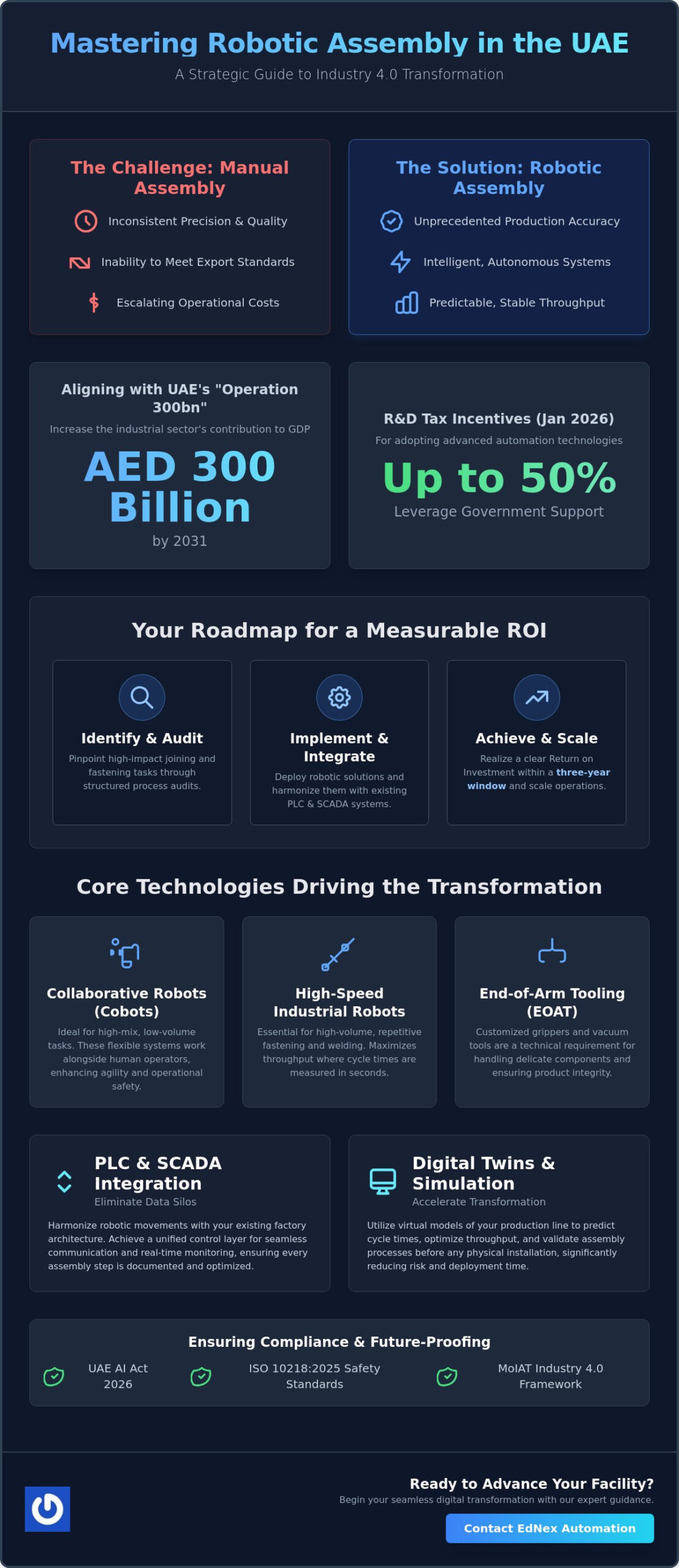
Did you know that as of January 2026, industrial leaders in the UAE can leverage R&D tax incentives of up to 50% for the adoption of advanced automation technologies? Maintaining manual assembly lines often leads to inconsistent precision and escalating operational costs that hinder your ability to meet rigorous international export standards. You’ve likely realized that staying competitive requires a shift toward intelligent, autonomous systems. This definitive guide empowers you to master the transition to automated manufacturing by effectively integrating robotic assembly solutions UAE into your existing factory architecture. By aligning with the Ministry of Industry and Advanced Technology’s Industry 4.0 framework, you’ll position your facility at the forefront of the region’s industrial evolution.
We’ll outline a roadmap to achieve a measurable ROI within a three-year window while ensuring full compliance with the UAE AI Act 2026 and the updated ISO 10218:2025 safety standards. You’ll discover how the convergence of collaborative robots and PLC integration drives unprecedented production accuracy. From leveraging MoIAT’s Industrial Technology Transformation Index to securing your place in the AED 300 billion industrial economy, this strategic overview provides the technical expertise needed for a seamless digital transformation.
Key Takeaways
- Align your manufacturing facility with the UAE’s national industrial strategy by deploying autonomous systems that support Operation 300bn and long-term self-sufficiency.
- Identify high-impact joining and fastening tasks through a structured process audit to ensure your investment in robotic assembly solutions UAE delivers a clear ROI within three years.
- Enhance operational agility by utilizing collaborative robots and customized end-of-arm tooling designed specifically for high-mix, low-volume production environments.
- Eliminate fragmented data silos by harmonizing robotic movements with existing factory architectures through advanced PLC and SCADA integration services.
- Accelerate your digital transformation by utilizing digital twins and simulations to predict cycle times and optimize throughput prior to physical installation.
The Landscape of Robotic Assembly Solutions in the UAE Industrial Sector
The industrial sector in the United Arab Emirates is undergoing a profound metamorphosis, shifting away from rigid manual stations toward flexible, high-throughput automated cells. Robotic assembly refers to the autonomous execution of mechanical joining, fastening, and component placement, representing a critical pillar of modern manufacturing. These industrial robots are no longer just tools; they’re the foundation of the UAE’s national strategy for industrial growth and self-sufficiency. Robotic assembly solutions are a fusion of high-precision robotics, machine vision, and integrated control logic. By adopting these systems, local manufacturers align themselves with the “Operation 300bn” initiative, which aims to increase the industrial sector’s contribution to the GDP to AED 300 billion by 2031. Implementing robotic assembly solutions UAE allows facilities to achieve the precision required for complex electronics and aerospace components while maintaining the agility needed for rapid product iterations.
The Drive Toward Industry 4.0 Standards
The 2026 industrial environment prioritizes digital twins and real-time production monitoring to ensure every assembly step is documented and optimized. Transitioning to these standards helps manufacturers reduce the “Cost of Quality” by utilizing automated error detection during the assembly phase. Instead of identifying defects at the end of the line, sensors integrated into the robotic arm detect misalignments or torque discrepancies in real time. This level of scrutiny is essential for meeting the stringent requirements of international supply chains. UAE-made goods must compete on a global stage; therefore, high-tech automation is a requirement for those seeking export-ready status and compliance with the latest MoIAT regulations.
To manage this complex data flow effectively, manufacturers often turn to Product Lifecycle Management (PLM) solutions; specialists like PLM-Sme FZC provide the consultancy needed to integrate Siemens Teamcenter, ensuring that every digital twin is perfectly synchronized with physical production.
Economic Drivers for Assembly Automation
Rising operational costs and the scarcity of specialized manual labor are pushing firms toward long-term capital investment in robotics. While the initial outlay is substantial, the ability to scale production capacity without a linear increase in physical floor space provides a significant competitive advantage. Automation also enhances facility safety by reallocating human workers from high-risk or repetitive assembly tasks to more strategic roles. This shift doesn’t just protect the workforce; it stabilizes throughput across multiple shifts. Since robots don’t suffer from fatigue or inconsistency, the output remains predictable, allowing for more accurate financial forecasting and resource allocation across the entire enterprise. Businesses that integrate these systems today are building the intellectual and physical infrastructure necessary for long-term viability in an increasingly automated global market.
Core Technologies: From Collaborative Robots to Precision Tooling
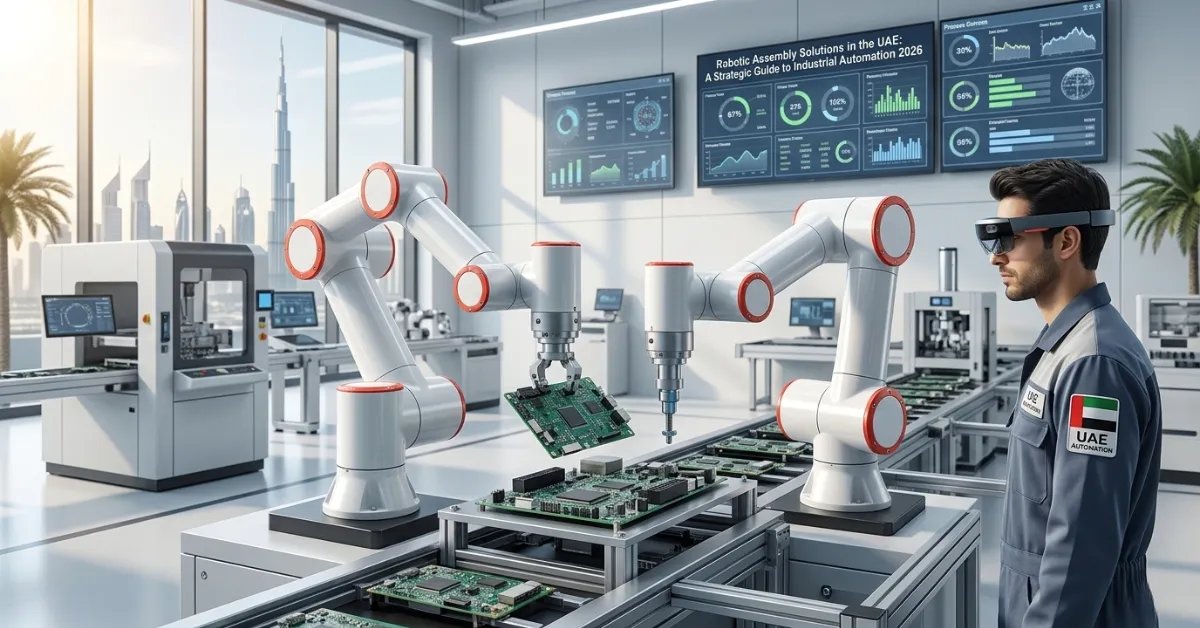
Integrating state-of-the-art hardware is the first step toward achieving autonomous excellence in modern manufacturing. Deploying collaborative robots UAE allows manufacturers to handle high-mix, low-volume assembly tasks with a level of flexibility that traditional fixed automation cannot match. These systems work alongside human operators, supporting the broader goals of the Operation 300Bn industrial strategy by localizing high-value production within the Emirates. While cobots provide versatility, high-speed industrial robots remain essential for high-volume, repetitive fastening and welding operations where cycle times are measured in seconds. The efficacy of these robotic assembly solutions UAE depends heavily on end-of-arm tooling (EOAT) customization. Tailored grippers and specialized vacuum tools ensure that even the most delicate components are handled without damage, maintaining the integrity of the finished product. Precision tooling is not a luxury; it’s a technical requirement for any facility aiming to achieve 2026 efficiency benchmarks.
The Synergy of Human-Robot Collaboration
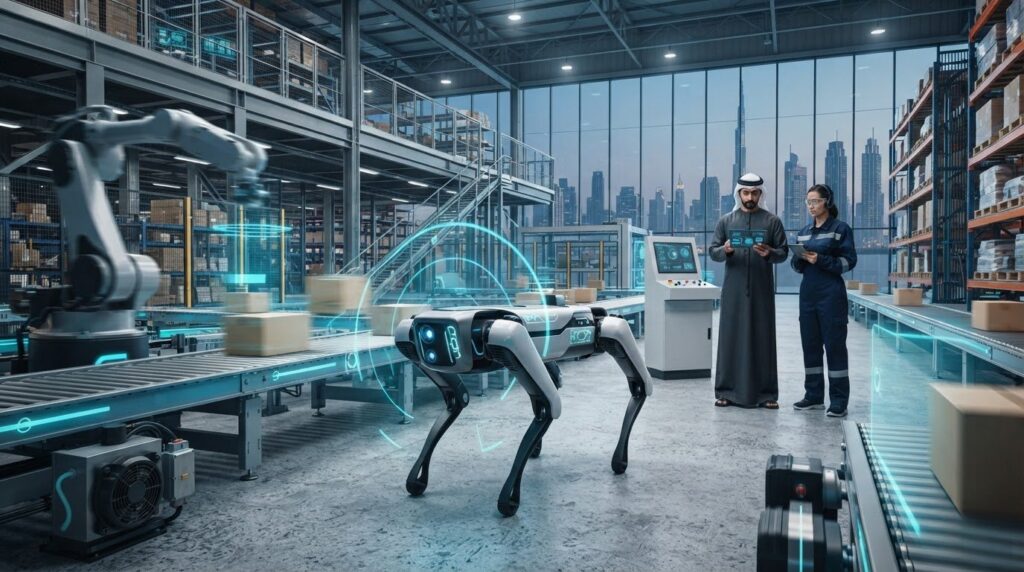
Hybrid workspaces represent a significant shift in factory design. By utilizing advanced safety sensors, engineers can eliminate traditional safety cages, allowing cobots to decelerate or stop when a human enters their proximity. This architecture enables a dynamic environment where robots handle repetitive, ergonomically taxing movements while humans focus on complex logic and troubleshooting. Rapid re-tooling between different product SKUs becomes a matter of software adjustment rather than physical reconfiguration, ensuring that your assembly line remains responsive to market demands. If you’re looking to optimize your floor plan, you might consider how bespoke collaborative systems can reduce your footprint while boosting output.
Advanced Vision and Sensing in Assembly
Machine vision integration provides robots with the visual intelligence required to align parts with sub-millimetre precision. Utilizing 3D vision systems facilitates “bin picking” and the handling of randomly oriented parts, which previously required expensive mechanical feeders. Force-torque sensors complement this visual data by enabling robots to “feel” resistance during delicate assembly insertions, effectively mimicking human touch. This sensory feedback loop allows for real-time quality verification at the point of assembly, preventing downstream defects and ensuring every unit meets international quality standards. Modern robotic assembly solutions UAE leverage these integrated sensors to transform a standard robotic arm into an intelligent, self-correcting assembly cell that operates with minimal human intervention.
The Control Layer: Synchronising Assembly with PLC and SCADA Systems
While physical robotic arms provide the necessary movement, the control layer provides the intelligence required for a truly autonomous environment. Standalone robotic cells often create isolated data silos that hinder overall equipment effectiveness (OEE) because they lack communication with the broader production line. Professional PLC and SCADA integration services play a critical role in harmonising robotic movements with conveyor speeds, ensuring that parts arrive and depart with perfect timing. PLC logic acts as the central nervous system for robotic assembly timing and safety interlocks. By centralizing these controls, manufacturers can implement sophisticated robotic assembly solutions UAE that respond dynamically to upstream changes. Data logging becomes a standard feature, capturing torque values, cycle times, and error codes for every unit produced to ensure total quality control across the facility.
Achieving Factory-Wide Traceability
Linking assembly data directly to SCADA dashboards provides real-time visibility into production health. This connectivity allows for comprehensive factory-wide traceability, where quality data is integrated with Enterprise Resource Planning (ERP) systems for automated, paperless reporting. Using granular assembly metrics helps drive predictive maintenance schedules for robotic assets, identifying potential failures before they result in costly downtime. This proactive approach ensures that high-tech infrastructure remains operational. It transforms raw data into actionable insights that define a facility’s competitiveness in the regional market.
Optimising Throughput via Logic Synchronisation
Reducing cycle times requires millisecond-level communication between robots and PLCs to eliminate “wait states” in the assembly sequence. Implementing automated reject lanes ensures that any unit failing to meet assembly specifications is removed without stopping the entire line, maintaining steady throughput. To ensure future-proof factory architectures, standardising communication protocols like OPC UA and MQTT is essential. These open standards allow for seamless integration of robotic assembly solutions UAE with evolving digital twin models and AI-driven optimization tools. This logical synchronization ensures that every component of the assembly line works in perfect unison, maximizing the return on your technological investment.
Strategic Deployment: A Roadmap for Automated Assembly Transition
Implementing robotic assembly solutions UAE requires a systematic, phased framework to mitigate technical risk and ensure a rapid return on investment. Successful deployment isn’t merely a hardware installation; it’s a strategic transition that begins with a comprehensive process audit to identify high-impact assembly tasks where automation provides the greatest throughput delta. By prioritizing tasks with high repeatability and precision requirements, manufacturers can focus their capital where it generates the most value. Following the audit, utilizing digital twins and simulation models allows engineers to predict cycle times and identify potential bottlenecks before any physical hardware is commissioned. This data-driven approach ensures that the bespoke system design, which includes selecting the optimal combination of robots, end-of-arm tooling, and control logic, is perfectly aligned with the facility’s operational goals. Once the design is finalized, synchronising new hardware with existing infrastructure during on-site commissioning requires deep technical expertise to maintain production continuity. The final phase focuses on technical training and continuous optimization, empowering the local workforce to manage these advanced systems effectively.
Calculating ROI and Business Viability
Moving beyond simple labour cost replacement is essential when calculating the true business viability of automation. A comprehensive ROI analysis must factor in significant scrap reduction, increased machine uptime, and the long-term value of expanded production capacity within a competitive national market. In the rapidly modernising industrial landscape of 2026, failing to automate carries a substantial “Cost of Inaction” that can lead to market share erosion. By achieving a clear ROI within a three-year window, facilities can justify the initial capital expenditure as a necessary evolution for long-term survival. If you’re ready to quantify the impact of automation on your facility, you can consult with our engineering team for a detailed feasibility study.
Managing Environmental and Technical Challenges
Designing robust assembly cells that withstand the specific heat and dust challenges of the UAE is a technical requirement that generic solutions often overlook. High-precision components and robotic joints require specialized ingress protection and thermal management to ensure reliable operation in regional climates. Furthermore, navigating the complex regulatory landscape, including the UAE AI Act 2026 and the updated ISO 10218:2025 safety standards, demands a partner who understands local compliance. Ensuring reliable technical support through a local integration partner is the only way to minimize downtime and maintain the high-tech infrastructure required for modern manufacturing. By addressing these environmental and regulatory factors early in the roadmap, businesses can ensure their assembly lines remain both productive and compliant with the latest national mandates.
Advancing UAE Industry with EdNex Automation Solutions
Positioning your facility at the absolute cutting edge of innovation, EdNex Automation Solutions delivers a visionary approach to bespoke robotic assembly integration for the national industrial sector. We don’t just provide equipment; we offer the intellectual framework required to navigate the gravity of large-scale industrial transformation. By merging global technological breakthroughs with deep regional engineering expertise, our team ensures that every deployment is optimized for the unique environmental and regulatory landscape of the Emirates. Integrating robotic assembly solutions UAE into your operations facilitates a transition from fragmented manual processes to a data-driven, autonomous manufacturing powerhouse. This evolution is essential for maintaining long-term business viability and securing a dominant position in the region’s increasingly competitive economy.
Establishing a full-spectrum automation ecosystem requires more than just isolated robotic cells. Our comprehensive support model encompasses everything from initial feasibility studies to dedicated technical assistance, ensuring that your high-tech infrastructure remains reliable and efficient. By leveraging official certifications and alliances with global technology leaders, we provide the legitimacy and security needed for complex system integration. This holistic approach empowers manufacturers to scale production without the constraints of traditional labor models, driving the UAE toward its goal of becoming a global leader in advanced manufacturing. Our commitment as a reliable technical partner ensures that your investment translates into measurable operational improvements and sustained growth.
A Full-Spectrum Automation Ecosystem
Maximizing the impact of your assembly line requires the integration of complementary technologies that ensure a frictionless production cycle. Complementing assembly with autonomous mobile robots facilitates a seamless material flow between workstations, eliminating the bottlenecks associated with manual transport. Optimizing inventory through integrated automated storage and retrieval systems allows for high-density parts management that synchronizes perfectly with robotic consumption rates. These interconnected systems form a unified infrastructure that responds dynamically to real-time production data, providing the agility needed to handle fluctuating market demands and complex assembly sequences.
Initiating Your Industrial Transformation
Commencing your journey toward Industry 4.0 requires a professional technical assessment to identify the specific automation bottlenecks within your current architecture. EdNex simplifies the inherent complexity of advanced technology adoption by providing a clear, structured roadmap tailored to regional manufacturers. Our specialist engineering team acts as a grounded partner, translating high-level technological potential into tangible operational improvements that define your facility’s future. Connect with our specialist engineering team today to discuss your assembly objectives and discover how our robotic assembly solutions UAE can redefine your facility’s throughput, precision, and global competitiveness.
Defining the Next Era of UAE Manufacturing Excellence
Transitioning to a fully autonomous production environment requires a sophisticated alignment of robotic precision and intelligent control logic. By harmonizing collaborative technologies with robust PLC and SCADA architectures, your facility can eliminate data silos and achieve the sub-millimetre accuracy required by modern international standards. Implementing robotic assembly solutions UAE has become a strategic necessity for any organization seeking to remain viable in an economy increasingly defined by the UAE AI Act 2026 and global Industry 4.0 benchmarks. This evolution represents the bridge between current manual limitations and a future of high-speed, error-free output.
Leveraging our status as an official integrator for global industrial robotics brands, EdNex Automation Solutions offers the deep expertise in PLC, SCADA, and ASRS integration required to secure your competitive advantage. Our proven track record in the UAE’s national industrial digital transformation ensures that your facility moves beyond simple tool acquisition toward comprehensive operational optimization. Consult with EdNex Automation to engineer your bespoke robotic assembly solution and take the first step toward a more efficient, data-driven future. Your facility’s transformation into a leader of the regional industrial landscape begins today.
Frequently Asked Questions
What are the primary benefits of robotic assembly over manual processes?
Robotic assembly provides a level of precision and throughput consistency that manual labor cannot sustain over multiple shifts. By eliminating human fatigue and variability, these autonomous systems ensure every component meets exact specifications, which significantly reduces scrap rates and overall operational overhead. Implementing these high-tech solutions allows your facility to scale production capacity without the linear increase in costs associated with manual assembly lines.
Can robotic assembly systems be integrated into existing legacy production lines?
Yes, legacy systems can be modernized through the strategic implementation of robotic assembly solutions UAE and advanced control logic. Our engineering team specializes in bridging the gap between older mechanical architectures and intelligent automation, ensuring a seamless data flow without requiring a total facility overhaul. This bespoke integration approach allows you to protect your existing capital investments while gaining the benefits of Industry 4.0 efficiency.
What is the typical ROI period for a robotic assembly solution in the UAE?
Facilities typically realize a full return on investment within a three-year window when accounting for increased production capacity and reduced material waste. This timeframe factors in the long-term capital benefits of high-tech infrastructure that aligns with the UAE’s national industrial goals. By achieving clear ROI early, manufacturers can justify the initial expenditure as a necessary step for maintaining global competitiveness in an automated landscape.
Are collaborative robots (cobots) safe for use without protective fencing?
Cobots are safe for use without traditional fencing provided they’re configured with force-limiting sensors and comply with the latest ISO 10218:2025 safety standards. These intelligent systems automatically decelerate or stop upon physical contact, ensuring a secure hybrid workspace where humans and robots interact. Utilizing these advanced safety features allows for a more compact and flexible factory floor plan compared to traditional industrial robot cells.
Which industries in the UAE are most suited for robotic assembly?
The aerospace, electronics, and automotive sectors in the UAE are the most suited for these technologies due to their high demand for repeatable precision. These industries benefit from the sub-millimetre accuracy required for mechanical joining and component placement, especially when meeting international export standards. This level of technical precision is also essential in high-end automotive customization; for example, you can visit Eikon Motorsports to see how expert engineering is applied to specialized door system installations. Any sector involving high-volume or high-mix assembly tasks can leverage automation to drive significant operational improvements and long-term viability.
How does PLC integration improve the performance of an assembly robot?
PLC integration improves performance by providing a unified logical framework that synchronizes robotic tasks with factory-wide production cycles. Acting as the central nervous system, the PLC manages timing and safety interlocks, ensuring that robots and peripheral equipment like conveyors work in perfect unison. This logical synchronization eliminates wait states and optimizes cycle times, transforming a standalone machine into a fully integrated assembly ecosystem.
What maintenance is required for high-precision robotic assembly cells?
Maintaining high-precision cells involves a combination of routine mechanical calibration and data-driven predictive maintenance to prevent unplanned downtime. Utilizing real-time data from SCADA systems allows engineers to identify wear in robotic joints or sensors before it impacts production quality. A structured maintenance schedule ensures that your high-tech assets remain operational and continue to deliver the precision required for complex industrial tasks.
How does EdNex Automation support staff training for new robotic systems?
EdNex supports industrial transformation through intensive technical training programs that cover everything from basic operation to advanced logic troubleshooting for robotic assembly solutions UAE. We provide comprehensive knowledge transfer during the on-site commissioning phase, empowering your local workforce to manage and optimize the new systems effectively. This continuous support ensures your team has the technical expertise needed to maintain peak performance as your production objectives evolve.