By the close of 2026, the distinction between a traditional warehouse and an autonomous, intelligent ecosystem has effectively vanished. You likely recognize that manual logistics inefficiencies and escalating facility maintenance costs are no longer just operational hurdles; they’re systemic liabilities that drain capital. Identifying service robotics companies in the UAE that possess the technical depth to bridge the gap between legacy PLC systems and advanced autonomous units remains the primary barrier to achieving a true digital transformation.
This strategic guide demonstrates how the convergence of intelligent control systems and high-tier robotics is fundamentally restructuring the UAE’s manufacturing and commercial sectors to eliminate overhead and secure long-term viability. We’ll examine the evolving landscape of automation providers, the implications of the UAE AI Act 2026, and the specific integration frameworks required to deploy a scalable Industry 4.0 infrastructure. Through a methodical analysis of autonomous logistics and bespoke cleaning solutions, you’ll discover the roadmap to a unified architecture where traditional industrial controls and mobile robotics function as a single, high-performance entity.
Key Takeaways
- Understand how national initiatives like Operation 300bn are accelerating the transition from traditional fixed automation to intelligent, autonomous ecosystems across the Emirates.
- Identify the specific criteria for selecting elite service robotics companies UAE that provide seamless integration between autonomous mobile robots and existing industrial frameworks.
- Learn to maximize operational efficiency by uniting PLC and SCADA systems with advanced automated storage and retrieval systems to optimize warehouse throughput.
- Discover how autonomous cleaning and surveillance robots can mitigate high maintenance overheads while ensuring compliance with the UAE AI Act 2026.
- Evaluate the necessity of end-to-end technical partnership over simple equipment procurement to ensure the long-term scalability of your Industry 4.0 infrastructure.
The Evolution of Automation Solutions Providers in the UAE
The industrial landscape across the Emirates is undergoing a radical transition from rigid, fixed-gate machinery to fluid, autonomous intelligence. This shift represents more than a technological upgrade; it’s a fundamental reimagining of how manufacturing and commercial sectors operate at scale. Leading service robotics companies UAE are no longer merely equipment vendors. They’ve evolved into high-level consultants and technical integrators capable of managing the gravity of large-scale industrial transformation. Integrated Automation is the synthesis of hardware, software, and AI into a unified, self-optimizing ecosystem.
Driving Industry 4.0 Across the UAE
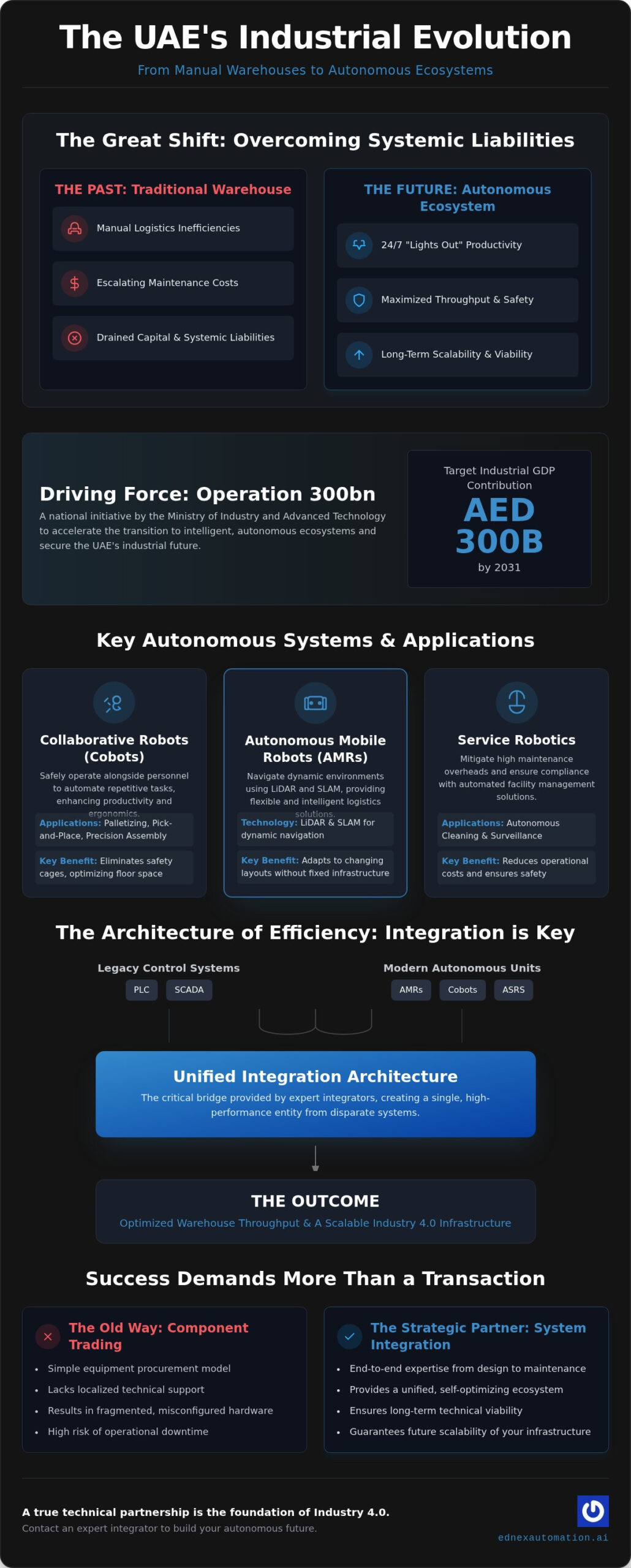
National industrial strategies, specifically the Ministry of Industry and Advanced Technology’s Operation 300bn, provide the intellectual and financial framework for this evolution. By targeting an industrial GDP contribution of AED 300 billion by 2031, the government has created a powerful incentive for smart factory transitions. Regional production hubs are increasingly adopting “Lights Out” manufacturing models. These autonomous environments operate with minimal human intervention, effectively mitigating regional labor shortages while maximizing throughput. Utilizing robotics and intelligent control systems allows organizations to maintain 24/7 productivity without the overhead of manual facility management. This approach brings order and safety to complex environments through controlled, deliberate innovation.
The Shift from Component Trading to System Integration
Purchasing a robotic unit is a simple transaction; implementing a functional automation solution is a sophisticated engineering endeavor. Traditional trading companies often fail because they lack the localized technical support and certified engineering expertise required for complex deployments. Modern industrial needs demand integrators who provide start-to-finish expertise from initial design to lifecycle maintenance. Transitioning from manual assembly to collaborative robots UAE requires a deep understanding of both PLC logic and advanced safety protocols. As the UAE AI Act 2026 mandates stricter safety standards for collaborative environments, the necessity for integrators who understand the nuances of human-machine interaction has become absolute. Businesses can’t afford the downtime associated with misconfigured hardware or fragmented software layers. Ultimately, identifying the right service robotics companies UAE requires looking beyond the price tag to evaluate long-term technical viability and the intellectual framework necessary for implementation.
Deploying Autonomous Systems: Cobots, AMRs, and Humanoids
Deploying autonomous systems requires a sophisticated understanding of how distinct robotic architectures serve specific operational goals. While traditional Automated Guided Vehicles (AGVs) rely on fixed infrastructure like magnetic strips or wires, modern autonomous mobile robots utilize LiDAR and Simultaneous Localization and Mapping (SLAM) to navigate dynamic environments without physical modifications. This inherent flexibility is why elite service robotics companies UAE are prioritizing adaptable fleets over rigid, legacy installations. These systems provide the intellectual framework necessary to transition from manual logistics to a fully automated, intelligent ecosystem.
Cobots in Manufacturing and Assembly
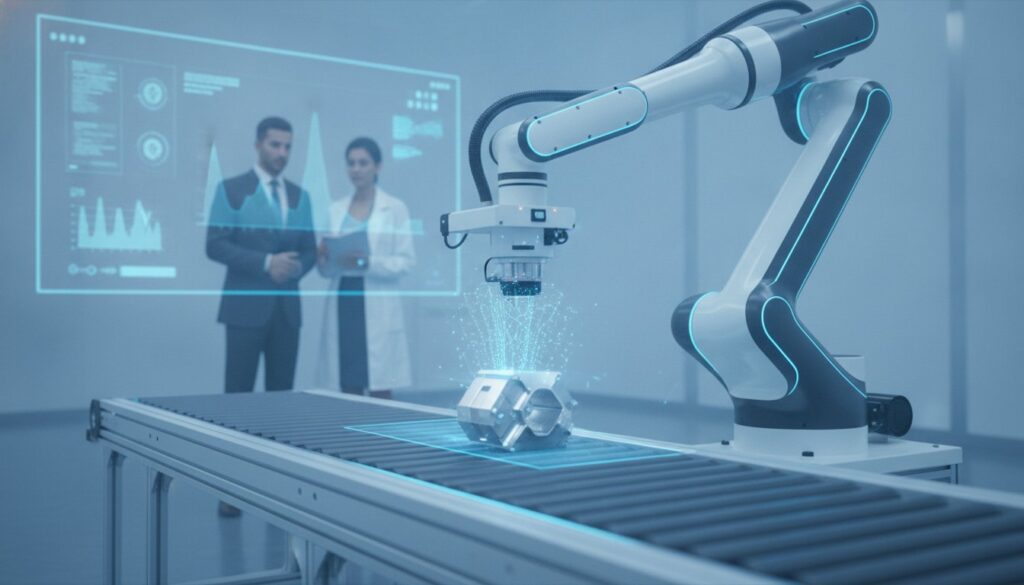
Collaborative robots, or cobots, redefine the human-machine interface by eliminating the necessity for bulky safety cages. Utilizing advanced force-torque sensors, these units operate safely alongside personnel in palletizing, pick-and-place, and precision assembly tasks. Removing physical barriers optimizes floor space and enhances human productivity by automating repetitive, low-value motions. For enterprises seeking to maintain high-output environments, the ROI of cobot implementation often manifests in drastically reduced cycle times and improved ergonomic safety. It’s a strategic shift that brings order and efficiency to complex manufacturing lines through controlled, deliberate innovation.
AMRs for Dynamic Warehouse Environments
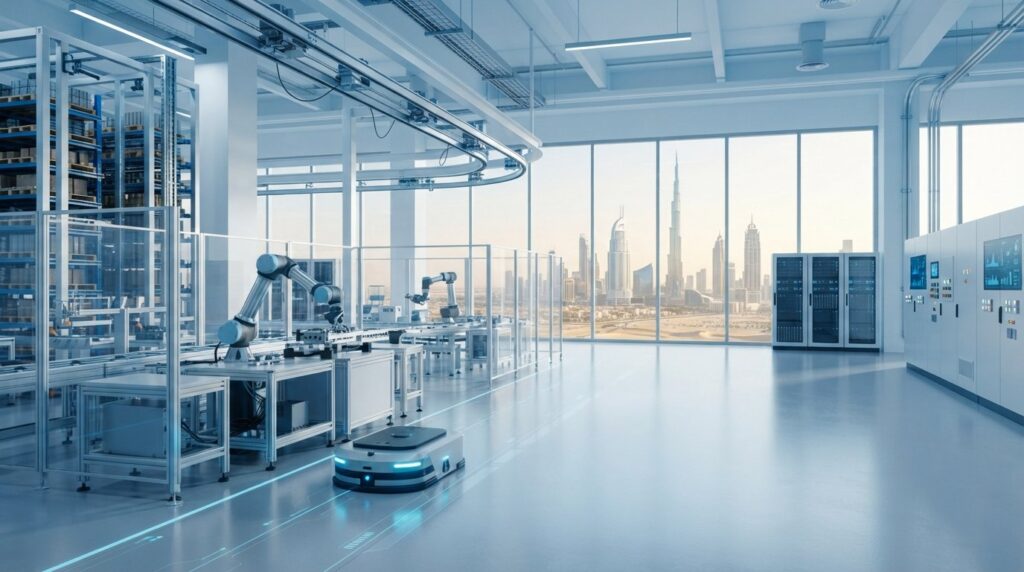
Integrating AMRs into existing Warehouse Management Systems (WMS) allows for real-time fleet coordination and granular inventory tracking. These units excel in logistics by autonomously recalculating paths to avoid obstacles, a technical capability impossible for legacy AGVs. Scalability remains a core advantage; operators can add units to a fleet as demand fluctuates without the need to redesign facility layouts or pause production. This modular approach ensures that your Industry 4.0 infrastructure remains adaptable to future market shifts. Organizations that prioritize this level of autonomy typically see a significant reduction in overhead and a streamlined supply chain.
The Emerging Role of Humanoid Robots
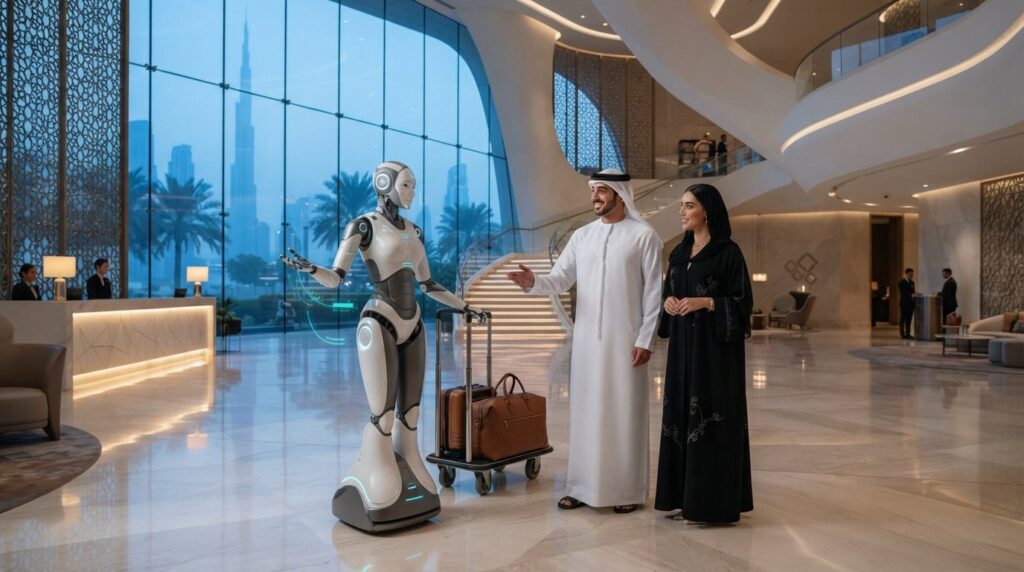
Representing the next frontier for enterprise service, Humanoid Robots for Sale UAE offer versatile, general-purpose platforms for both front-of-house interaction and complex manual labor. Their human-centric design allows them to navigate spaces built for people, providing psychological and functional benefits in retail, hospitality, or healthcare settings. Adopting these systems early ensures compliance with the safety standards mandated by the UAE AI Act 2026, positioning a brand as a visionary leader. When evaluating service robotics companies UAE, the focus must remain on the integrator’s ability to harmonize these diverse technologies into a single operational flow. To determine which platform aligns with your strategic objectives, you should consult with a specialized technical partner capable of delivering start-to-finish expertise.
The Architecture of Efficiency: PLC, SCADA, and ASRS Integration
Industrial efficiency in the modern era is predicated on the seamless communication between physical hardware and supervisory logic. Leading service robotics companies UAE recognize that without a robust control architecture, even the most advanced machinery remains an isolated tool rather than a strategic asset. A truly integrated facility relies on a hierarchical structure that links the factory floor directly to the executive suite through real-time data streams.
Optimising Control with PLC and SCADA
Reliable automation depends on the precision of PLC and SCADA integration services to manage complex industrial sequences. Programmable Logic Controllers (PLCs) handle the immediate, high-speed logic required for machinery, while Supervisory Control and Data Acquisition (SCADA) systems provide the high-level oversight needed for operational intelligence. SCADA acts as the nervous system of a smart facility by collecting real-time data from across the production floor and translating it into actionable insights. This synchronization enables predictive maintenance, allowing operators to identify potential failures before they disrupt the supply chain. In 2026, these networked industrial control systems also require sophisticated cybersecurity protocols to protect critical infrastructure from digital threats.
ASRS: Revolutionising UAE Logistics and Storage
Maximising vertical space is a strategic necessity in the Emirates, where industrial footprints must be optimized for maximum throughput. Implementing automated storage and retrieval systems (ASRS) allows facilities to utilize the full height of their structures, effectively tripling storage capacity without expanding the building’s physical perimeter. Specialized service robotics companies UAE offer various configurations, including high-speed shuttle systems for rapid picking, mini-loads for smaller bins, and unit-load systems for heavy pallets. These solutions dramatically improve inventory accuracy and order fulfillment speed, which are essential for the region’s booming e-commerce sector. ASRS technology is particularly transformative for cold storage applications, where it solves the logistical pains of operating in extreme environments by reducing human exposure to sub-zero temperatures. By integrating ASRS with real-time data analytics, businesses achieve a level of operational transparency that traditional manual warehousing simply cannot match.
Service Robotics: Autonomous Cleaning and Surveillance Solutions
Maintaining the operational integrity of expansive commercial facilities requires a fundamental shift from labor-intensive manual maintenance to high-tier robotic autonomy. Leading service robotics companies UAE are currently deploying systems that ensure consistent hygiene and security without the variance associated with human intervention. These advanced platforms provide a systematic way to bring order and efficiency to complex environments, transforming facility management into a data-driven engineering discipline. By integrating these units, organizations don’t just reduce overhead; they secure a necessary evolution for long-term business viability.
Commercial and Industrial Cleaning Robots
Utilizing autonomous cleaning robots allows facility managers to achieve full-scale hygiene automation across high-traffic zones such as airports, malls, and manufacturing plants. These robotic floor scrubbers optimize water and chemical consumption, aligning with the UAE’s sustainability mandates while delivering a measurable ROI through reduced operational costs. Specialized outdoor cleaning robots address the unique challenges of the regional climate, managing dust and debris accumulation on expansive urban sites with precision. Because these units operate on a structured, repeatable logic, they provide a level of cleanliness that manual teams simply can’t replicate consistently. With the UAE intelligent robotics market projected to reach approximately AED 1.05 billion by 2030, the adoption of these specialized systems has become a strategic imperative for competitive enterprises.
Robotic Surveillance and Inspection
Transitioning from static CCTV systems to mobile, autonomous surveillance units represents a critical advancement in perimeter security and risk mitigation. These inspection robots provide 24/7 autonomous patrolling for large-scale industrial perimeters, utilizing thermal imaging and AI-driven threat detection to identify anomalies in real time. In hazardous sectors like Oil & Gas and chemical processing, autonomous units perform critical inspections in environments where human presence poses a significant safety liability. These systems act as a systematic organizer, providing the intellectual framework necessary to monitor complex infrastructure without interruption. Integrating these units into a unified security architecture ensures that threat detection is proactive rather than reactive. To determine how these platforms can be integrated into your existing infrastructure, you should consult with an automation expert who understands the nuances of the UAE’s regulatory landscape.
Strategic Partnership: Evaluating Automation Integrators in the UAE
Selecting from the available service robotics companies UAE requires a fundamental shift in perspective from transactional purchasing to long-term strategic alliance. In 2026, technical depth far outweighs a broad trading portfolio. A partner must demonstrate the intellectual framework necessary to synchronize multi-vendor robotic ecosystems with legacy industrial infrastructure. This ensures that your investment remains a scalable asset rather than a depreciating tool. Organizations that fail to vet their integrators on these technical merits often face fragmented deployments that eventually stall their digital transformation.
Essential Criteria for a Future-Proof Automation Partner
Identifying a reliable partner involves looking beyond basic equipment sales to evaluate their engineering core. A visionary integrator should provide a comprehensive, start-to-finish service model that covers design, deployment, and lifecycle support. When vetting potential partners, prioritize these technical benchmarks:
- Certified Technical Expertise: Verify the integrator holds official certifications in both hardware robotics and specialized software layers like SCADA and PLC logic.
- National-Scale Track Record: Assess the provider’s history in executing large-scale industrial deployments that align with MoIAT initiatives and Operation 300bn.
- Lifecycle Reliability: Inquire about guaranteed local parts availability and the depth of their technical support teams to minimize operational downtime.
Compliance with the UAE AI Act 2026 is another critical factor. This legislation mandates stricter safety and data protocols for collaborative and autonomous systems. An integrator must possess the intellectual framework to ensure your facility remains compliant while maximizing the throughput of your Industry 4.0 infrastructure.
The EdNex Advantage: A Visionary Approach to Digital Transformation
EdNex Automation positions itself as a systematic organizer for regional industrial evolution. By adopting a consultative design phase, we align advanced technology with specific business outcomes before a single unit is deployed. Our approach ensures that diverse platforms-from AMRs and cobots to ASRS-work as a single, high-performance entity. We don’t just supply tools; we provide the intellectual framework necessary for implementation and long-term business viability. This start-to-finish expertise is essential for organizations wishing to remain competitive in a landscape where manual logistics are no longer viable.
As a specialized division of the EdNex group, our focus remains squarely on industrial digital transformation across the Emirates. We provide the national coverage and expert integration services required to bridge the gap between global technological breakthroughs and regional industrial needs. By partnering with a visionary leader, you ensure that your facility benefits from seamless integration and ongoing modernization support. This methodical approach brings order, safety, and efficiency to even the most complex commercial and manufacturing environments.
Securing Industrial Leadership in an Autonomous Era
Securing dominance in the UAE’s industrial sector requires a deliberate shift toward a unified, autonomous architecture. The synthesis of collaborative robotics, ASRS, and intelligent control systems is no longer optional for organizations aiming to mitigate high operational costs and labor shortages. Leading service robotics companies UAE provide the essential intellectual framework to bridge the gap between global innovations and regional industrial needs. Success in this landscape depends on identifying a partner that moves beyond simple equipment trading to offer bespoke, system-wide integration.
EdNex Automation operates as a specialized Industry 4.0 division, leveraging official certifications and global technology alliances to deliver comprehensive national integration services across the Emirates. Our start-to-finish expertise ensures that your facility transitions seamlessly from manual processes to a high-performance, intelligent ecosystem. We invite you to partner with EdNex Automation for your industrial transformation and secure your organization’s long-term viability. Embracing these advanced systems today ensures your business remains a leader in the regional economy of tomorrow.
Frequently Asked Questions
What are the primary benefits of hiring an automation solutions provider in the UAE?
Engaging with specialized service robotics companies UAE ensures that your facility benefits from start-to-finish technical expertise rather than simple equipment procurement. These providers offer the intellectual framework necessary to align advanced robotics with national industrial goals like Operation 300bn. Benefits include significant reductions in operational overhead, enhanced ergonomic safety, and guaranteed compliance with the UAE AI Act 2026. This systematic approach transforms fragmented manual processes into a unified, high-performance ecosystem designed for long-term business viability.
How do autonomous mobile robots (AMRs) differ from automated guided vehicles (AGVs)?
Autonomous Mobile Robots (AMRs) represent a significant technological leap over Automated Guided Vehicles (AGVs) due to their infrastructure-free navigation. While AGVs require fixed paths such as magnetic strips or wires, AMRs utilize LiDAR and SLAM technology to navigate dynamically. This allows them to autonomously recalculate routes to avoid obstacles in real time. This flexibility makes AMRs the preferred choice for modern warehouse environments where scalability and minimal facility redesign are prioritized for operational efficiency.
Can collaborative robots (cobots) work safely alongside human employees?
Collaborative robots are specifically engineered to function alongside human employees without the necessity for physical safety cages. They utilize sophisticated force-torque sensors and power-limiting technology to detect human contact and stop immediately. This inherent safety allows for the elimination of physical barriers, optimizing floor space and enhancing human productivity in precision assembly and palletizing tasks. These systems provide a controlled and deliberate method for integrating high-tech intervention into existing manual production lines.
What industries in the UAE benefit most from ASRS implementation?
Automated Storage and Retrieval Systems (ASRS) are transformative for sectors requiring high-density storage and rapid order fulfillment. Logistics providers, e-commerce giants, and pharmaceutical manufacturers benefit most from the vertical space optimization these systems provide. ASRS is also critical for cold storage applications, where it solves the logistical pains of operating in sub-zero environments by reducing human exposure. This technology ensures inventory accuracy remains high while significantly accelerating the throughput of national distribution centers.
How does SCADA integration improve industrial energy efficiency?
SCADA integration acts as the nervous system of a facility, providing the real-time data acquisition necessary to identify energy waste. By synchronizing industrial control systems with machine-level sensors, operators can optimize run-times and reduce idle energy consumption. This level of operational transparency allows for predictive maintenance, ensuring machinery operates at peak efficiency. These data-driven insights lead to a measurable reduction in utility overhead and align with the UAE’s national sustainability mandates for industrial modernization.
What is the typical ROI timeframe for industrial cleaning robots?
The return on investment for industrial cleaning robots typically manifests through a combination of labor reallocation and resource optimization. By automating repetitive floor maintenance, facilities can reduce their reliance on manual labor while improving hygiene consistency. These units utilize advanced logic to minimize water and chemical consumption, which further lowers operational expenses. Most commercial operators achieve a full ROI by significantly reducing maintenance overhead within a strategic operational cycle, ensuring the long-term viability of the cleaning program.
Are humanoid robots ready for commercial deployment in the UAE?
Humanoid robots have reached a level of technical maturity that allows for deployment in both front-of-house service and complex manual tasks. These general-purpose platforms navigate environments designed for people, providing psychological and functional benefits in retail and hospitality sectors. Leading service robotics companies UAE are already integrating these units to future-proof operations against labor shortages. Their versatility makes them a visionary investment for organizations seeking to maintain a high-tech edge in a competitive regional market.
How do I ensure my industrial automation systems are secure from cyber threats?
Securing industrial automation requires a multi-layered approach that begins with choosing integrators who possess certified expertise in networked control systems. Implementing encrypted communications and robust firewalls for PLC and SCADA layers is essential to prevent unauthorized access. Regular security audits and software updates ensure that your Industry 4.0 infrastructure remains resilient against evolving digital threats. A systematic organizer will prioritize these cybersecurity protocols during the design phase to protect your critical infrastructure and ensure long-term system viability.