By September 2026, every organization deploying autonomous systems in the UAE must finalize a mandatory AI self-assessment or face fines as high as AED 10 million under the UAE AI Act. You likely recognize that integrating collaborative robots for logistics UAE is no longer a luxury but a baseline requirement for remaining competitive in a market projected to grow significantly through 2033. It’s frustrating when high initial CAPEX doesn’t come with a clear ROI roadmap, especially when legacy systems don’t communicate effectively with new robotics or lack reliable local technical support.
This strategic guide identifies the leading warehouse automation integrators who provide the intellectual framework needed to transform your logistics into a high-efficiency Industry 4.0 operation. We’ll examine how a partner-led approach solves the problem of integration silos while ensuring compliance with mandatory ISO safety standards. You’ll discover how to achieve a seamless transition through bespoke PLC and SCADA integration that delivers documented efficiency gains. We’ll provide the roadmap to move from simple equipment procurement to a comprehensive modernization strategy that secures your long-term position in the regional industrial sector.
Key Takeaways
- Align your logistics strategy with the UAE national Industry 4.0 vision to ensure long-term business viability in a rapidly modernizing industrial landscape.
- Evaluate the strategic advantages of collaborative robots for logistics UAE, focusing on their ability to work safely alongside human teams while meeting strict MoIAT 2026 safety requirements.
- Distinguish between standalone equipment vendors and full-service integrators to avoid the common pitfalls of technical silos and incompatible control layers.
- Follow a disciplined, two-phase implementation roadmap that prioritizes operational audits and precise architectural design for systems like ASRS and AMRs.
- Secure reliable, local technical support to ensure your automation investment delivers documented ROI through continuous optimization and expert PLC/SCADA integration.
Defining the Landscape of Warehouse Automation in the UAE
The industrial sector in the UAE is undergoing a fundamental metamorphosis, transitioning from traditional manual operations to sophisticated, intelligent logistics frameworks. This evolution serves as the cornerstone of the national “Operation 300bn” strategy, which aims to elevate the industrial sector’s contribution to the GDP significantly. Integrating collaborative robots for logistics UAE has become a primary lever for organizations seeking to optimize floor space while maintaining high safety standards. By implementing comprehensive Logistics automation, facilities can mitigate regional supply chain volatility, ensuring that local distribution remains resilient against global disruptions.
Contemporary automation solutions have moved far beyond simple conveyor belts. They now manifest as autonomous ecosystems where machinery, software, and human operators function in a unified loop. This shift allows for unprecedented flexibility, enabling warehouses to scale operations rapidly in response to e-commerce surges or shifting trade routes. As the market projected value for logistics automation in the UAE climbs toward AED 4.35 billion by 2033, the urgency for adoption has never been higher. Failure to modernize results in technical debt and operational stagnation, whereas early adopters gain a decisive advantage in speed and accuracy.
The Business Case for National Industrial Modernization
Operational leaders are facing the dual pressure of labor shortages and escalating costs. Transitioning to automated workflows allows for a dramatic increase in throughput capacity, essential for meeting the UAE’s expanding export demands. Modern systems don’t just replace labor; they augment human capability, allowing for higher precision in high-velocity environments. Warehouse automation is a sophisticated fusion of physical robotics and digital control layers.
Key Drivers of Automation Adoption in 2026
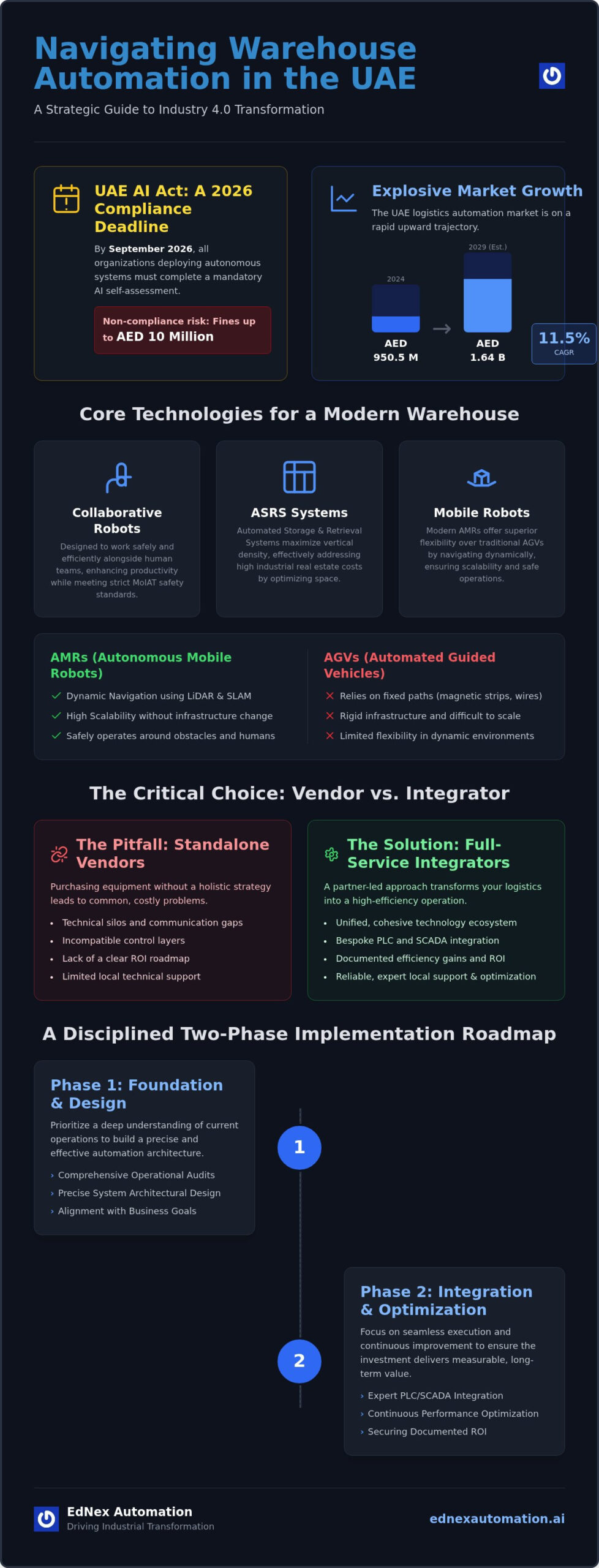
The UAE AI Act of 2026 mandates a risk-based approach to all AI-driven deployments. Beyond compliance, the push for sustainable, energy-efficient operations is driving the adoption of intelligent machinery that reduces power consumption. Facilities require real-time data for global supply chain transparency, necessitating systems that provide granular visibility. The deployment of collaborative robots for logistics UAE aligns with national digital transformation goals, ensuring that businesses remain viable in an increasingly competitive regional economy.
Essential Technologies Powering UAE Leading Automated Warehouses
Establishing a high-performance warehouse requires a sophisticated hierarchy of technology, transitioning from floor-level mobility to high-density storage. According to the UAE Logistics Automation Market report, the regional sector is valued at approximately AED 950.5 million in 2024 and is expected to reach AED 1.64 billion by 2029. This growth is underpinned by an 11.5% CAGR, reflecting a nationwide commitment to industrial autonomy. Success in this landscape isn’t about buying individual machines; it’s about creating a unified ecosystem where collaborative robots for logistics UAE interact with mobile and fixed storage units through a centralized control layer.
Autonomous Mobile Robots (AMRs) vs. Traditional AGVs
Leveraging autonomous mobile robots allows facilities to bypass the rigid constraints of traditional Automated Guided Vehicles (AGVs). While AGVs rely on fixed magnetic strips or wires, AMRs utilize advanced LiDAR and SLAM technologies to navigate dynamically around obstacles. This intelligence ensures safe operation in high-traffic zones where human personnel and machinery intersect. Scalability is a primary benefit; you can expand your fleet by simply introducing new units to the existing software map without altering physical infrastructure.
Advanced ASRS: The Solution for High-Density Storage
Addressing the high cost of industrial real estate requires maximizing vertical density through automated storage and retrieval systems (ASRS). These architectures, ranging from shuttle systems to mini-loads, eliminate the need for wide forklift aisles and manual picking paths. Integrating these systems with PLC and SCADA control layers ensures 100% stock accuracy and real-time inventory visibility. By concentrating inventory in a smaller footprint, businesses reduce cooling costs and operational overhead while accelerating order fulfillment cycles.
Deploying collaborative robots for logistics UAE bridges the gap between full automation and human dexterity. These cobots excel at repetitive, low-value tasks like kitting, sorting, and palletizing, freeing human workers for complex decision-making. Their power and force-limiting sensors comply with mandatory ISO 10218 and ISO/TS 15066 standards, permitting safe interaction without safety cages. Partnering with an expert to design this multi-layered architecture ensures that each component communicates seamlessly. You can explore these integrated automation solutions to begin your facility’s transformation.
Industrial Cleaning and Service Robotics
Ensuring facility hygiene is now a task for autonomous cleaning robots, which operate independently during off-peak hours to maintain pristine environments. Specialized delivery and inspection robots further support facility security by providing continuous surveillance and environmental monitoring. These service units maintain strict hygiene standards, which is particularly critical in temperature-controlled logistics sectors where contamination risks must be zero.
Evaluating Warehouse Automation Companies: Vendor vs. Integrator Model
Selecting a technology partner is a decision as critical as the hardware itself. Many organizations fall into the trap of the vendor-only model, acquiring standalone machinery that fails to communicate with legacy infrastructure. While an equipment vendor focuses on the sale of a specific unit, a professional integrator provides the intellectual framework required for a cohesive system. This distinction is vital when deploying collaborative robots for logistics UAE, as these units must safely synchronize with existing conveyor belts, ASRS, and warehouse management systems. Without this synergy, you risk creating automated silos rather than an integrated Industry 4.0 ecosystem.
Leveraging PLC and SCADA integration services allows a facility to function as a single, intelligent entity. These systems act as the central nervous system, translating raw data from diverse robotic platforms into actionable insights via real-time dashboards. Beyond mere connectivity, SCADA layers enable predictive maintenance, identifying potential mechanical failures before they cause costly downtime. This level of control is essential for managing the complexity of modern logistics, where even a minor synchronization error between a cobot and a conveyor can halt production.
Assessing Regional Expertise and Reliability
Selecting a partner requires a rigorous evaluation of their track record within the UAE industrial landscape. Look for organizations that offer start-to-finish project management, from initial feasibility studies to final site acceptance testing. A reliable partner understands the nuances of local regulations, including the latest MoIAT standards for 2026 and the UAE AI Act compliance requirements. Given the 24/7 nature of regional industrial operations, having access to national after-sales support is non-negotiable for maintaining continuous throughput. A partner who acts as a bridge between global technological breakthroughs and regional economic needs will ensure your facility remains competitive in the long term.
Strategic Roadmap for Implementing Automation in UAE Facilities
Executing a successful transition to Industry 4.0 requires a disciplined, multi-phase approach that aligns technical capabilities with commercial objectives. Phase 1 begins with a comprehensive operational audit and data-driven feasibility study to establish a baseline for current performance. During Phase 2, we design the automation architecture, integrating ASRS and AMR layers with sophisticated control systems that bridge physical and digital operations. Phase 3 involves pilot implementation, where collaborative robots for logistics UAE are tested within specific workflows to verify safety and efficiency before full-scale rollout. This stage is critical for meeting the September 2026 mandatory AI self-assessment deadline under the UAE AI Act. Phase 4 focuses on full-scale deployment and critical workforce upskilling, ensuring your team can manage advanced robotic systems effectively. Finally, Phase 5 utilizes advanced analytics for continuous optimization, turning raw sensor data into strategic business intelligence.
Calculating ROI and Long-Term Business Viability
Understanding the financial impact of automation requires moving beyond initial CAPEX to evaluate the Total Cost of Ownership (TCO). This calculation must include factors like reduced energy consumption, minimized error rates, and the elimination of unscheduled downtime. Identifying quick wins, such as automating high-frequency picking or palletizing tasks, allows organizations to justify larger infrastructure investments through immediate, documented efficiency gains. Adopting advanced automation is the definitive requirement for maintaining operational relevance in the 2026 UAE industrial landscape.
Future-Proofing through Modular System Design
Selecting interoperable systems ensures that your facility can adapt as global technology evolves without requiring a total overhaul of existing assets. The emergence of humanoid robots represents the next wave of warehouse evolution, offering unprecedented dexterity for complex logistics tasks. By preparing your infrastructure for future AI and machine learning enhancements today, you secure a modular foundation that grows with your business needs. Integrating collaborative robots for logistics UAE now provides the necessary data bridge for these future technologies, allowing for a seamless transition as new capabilities become available. To begin your journey toward a fully optimized facility, you can consult with our automation experts to develop a bespoke implementation strategy.
Driving Industrial Transformation with EdNex Automation
EdNex Automation serves as the intellectual framework for facilities seeking to navigate the complexities of modern industrialization. Since our founding in 2018, we’ve functioned as a specialized division dedicated to end-to-end integration across the UAE. Our comprehensive portfolio includes everything from advanced ASRS and AMRs to collaborative robots for logistics UAE, ensuring that every layer of your facility operates with maximum precision. By bridging global technological innovation with national industrial excellence, we provide the technical depth necessary to transition from legacy silos to intelligent ecosystems. Our team focuses on the transformative power of advanced systems, identifying technical solutions that immediately translate into tangible business outcomes such as risk mitigation and throughput optimization.
The EdNex Advantage: Systematic Innovation and Safety
Establishing trust through technical expertise and official global alliances, we deliver order to complex industrial environments that demand high-level safety and efficiency. Our engineering-minded approach prioritizes the delivery of high-level solutions that are fully compliant with mandatory MoIAT standards and the UAE AI Act of 2026. We don’t just provide machinery; we act as a systematic organizer who brings controlled and deliberate innovation to your warehouse floor. This commitment to long-term business viability ensures that your automation investment remains a relevant asset as the regional economy continues to diversify. Utilizing specialized machinery like inspection and surveillance robots, we enhance facility security while maintaining the steady flow of goods across the supply chain.
Partnering for a Digitally Transformed Future
Supporting the UAE’s transition into a high-tech industrial hub, EdNex provides tailored solutions for the manufacturing, logistics, and commercial sectors. Whether you’re looking to optimize hygiene through autonomous cleaning robots or maximize storage density with unit-load ASRS, our consultative approach ensures a bespoke fit for your unique operational requirements. We manage the entire lifecycle of the project, from initial design to final PLC and SCADA integration, providing the reliable local support necessary for 24/7 industrial performance. Every clause in our integration strategy serves a specific informative purpose, reflecting a deep understanding of the gravity of large-scale industrial transformation. If you’re ready to modernize your facility and secure your competitive edge, consult with our automation experts today to begin your transformation.
Securing Your Position in the UAE Industrial Future
Navigating the transition to a high-efficiency Industry 4.0 facility requires more than hardware; it demands a strategic alignment between global innovation and regional industrial goals. You’ve seen how the integrator-first model prevents technical silos by bridging PLC and SCADA layers with advanced machinery like ASRS and AMRs. Adopting collaborative robots for logistics UAE ensures your workforce remains safe while throughput capacity scales to meet national export demands. As a specialized Industry 4.0 division, EdNex Automation provides the start-to-finish integration expertise and global technology alliances necessary to meet mandatory MoIAT 2026 standards and UAE AI Act regulations.
Maintaining a competitive edge in the regional market necessitates a shift from manual workflows to intelligent, autonomous ecosystems. By following a disciplined roadmap from operational audits to continuous optimization, you’ll ensure that every investment delivers a documented ROI. We provide the intellectual framework to transform complex logistics challenges into streamlined, secure operations that grow with your business. The future of regional logistics is automated, and your path to excellence starts with a partner who understands the gravity of industrial transformation.
Request a Strategic Automation Consultation to define your roadmap toward long-term business viability.
Frequently Asked Questions
What are the primary benefits of warehouse automation for UAE companies?
Primary benefits include enhanced throughput, 24/7 operational capability, and strict adherence to mandatory safety standards like ISO 10218. Automation mitigates risks associated with labor shortages and rising operational costs while providing granular visibility into supply chain logistics. By deploying collaborative robots for logistics UAE, facilities can maintain high safety thresholds while optimizing floor space. These systems are essential for organizations aiming to align with the national “Operation 300bn” industrial strategy.
How do I choose between an equipment vendor and an automation integrator?
An equipment vendor typically provides standalone hardware without considering the broader facility infrastructure, which often leads to technical silos. Conversely, an automation integrator like EdNex Automation designs a unified ecosystem by bridging physical robotics with digital control layers. Choosing an integrator ensures that your ASRS, AMRs, and cobots communicate through a centralized PLC and SCADA system. This holistic approach minimizes compatibility risks and provides a clear roadmap for long-term business viability.
Can warehouse automation systems be integrated with my existing ERP or WMS?
Yes, seamless integration with existing Enterprise Resource Planning (ERP) or Warehouse Management Systems (WMS) is a core requirement for Industry 4.0. This connectivity is achieved through sophisticated PLC and SCADA layers that act as a bridge between the physical floor and corporate data centers. Real-time data synchronization ensures that inventory levels, order statuses, and equipment health are always accurate. This provides the transparency needed for high-velocity distribution environments across the UAE.
What is the typical ROI period for an ASRS or AMR implementation in the UAE?
The typical ROI period varies based on operational volume and the specific technologies deployed, such as ASRS or AMRs. While initial CAPEX is a factor, focus should remain on the Total Cost of Ownership (TCO) and the reduction in error-related losses. Many facilities identify quick wins in high-frequency tasks that justify the investment within a few years. Documented efficiency gains and reduced energy consumption contribute to a sustainable financial model for long-term industrial modernization.
How does automation impact the existing warehouse workforce?
Automation transforms the workforce by shifting human operators from repetitive, low-value tasks to complex decision-making and system management roles. The deployment of collaborative robots for logistics UAE creates a human-centric environment where safety sensors allow for close interaction without traditional cages. This evolution requires workforce upskilling, preparing employees to operate and maintain advanced robotic platforms. It’s a strategic move that enhances job quality while boosting overall facility productivity and safety.
What maintenance is required for autonomous mobile robots and ASRS?
Maintenance for autonomous mobile robots and ASRS involves both routine physical inspections and advanced predictive monitoring. SCADA dashboards track component wear and motor performance in real-time, allowing teams to address potential issues before they cause unscheduled downtime. AMRs require periodic sensor calibration and battery health checks to ensure optimal navigation. ASRS maintenance focuses on the precision of shuttle movements and rail alignment, ensuring the system maintains its high-density storage efficiency for decades.
Is warehouse automation suitable for small to medium-sized enterprises in the UAE?
Warehouse automation is highly suitable for small to medium-sized enterprises (SMEs) due to the modular nature of modern robotic systems. You don’t need a total facility overhaul to begin; you can start with a small fleet of AMRs or a single cobot station. This scalability allows SMEs to expand their automation footprint as their business grows. Modular designs ensure that early investments remain compatible with future enhancements like humanoid robots or AI-driven analytics layers.
How do PLC and SCADA systems improve warehouse efficiency?
PLC and SCADA systems act as the central brain of the warehouse, coordinating the movements of diverse robotic platforms. These systems improve efficiency by providing real-time monitoring and automated decision-making based on live operational data. By integrating PLC layers, facilities can synchronize conveyors with sorting robots and storage systems flawlessly. SCADA dashboards offer the visibility required to identify bottlenecks, allowing managers to optimize throughput and maintain continuous industrial performance without manual intervention.