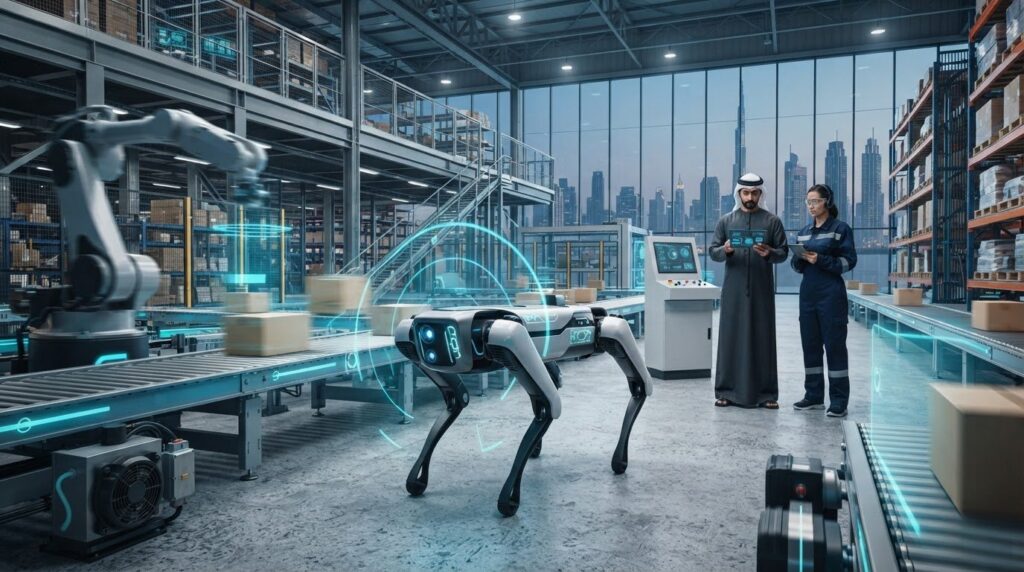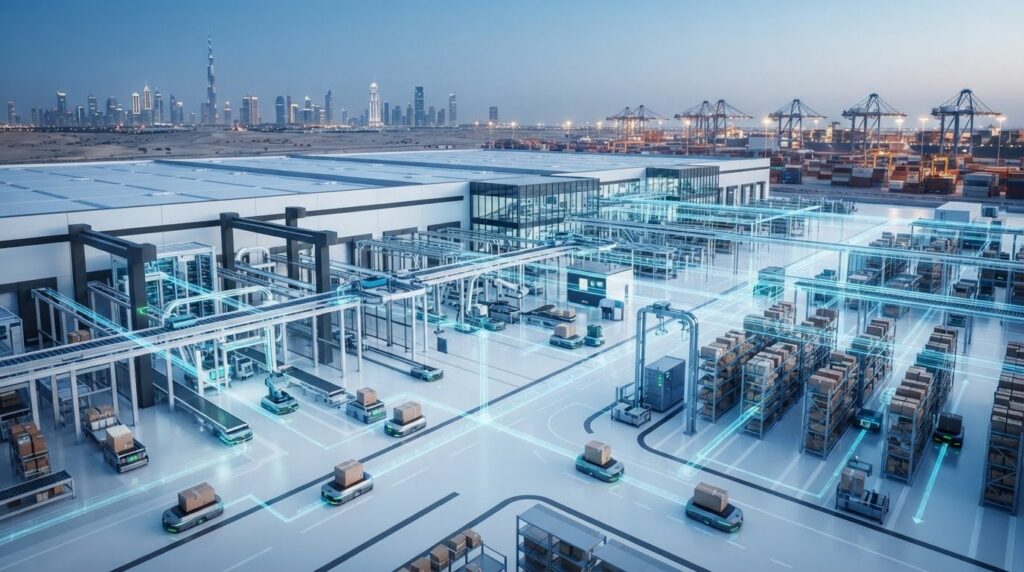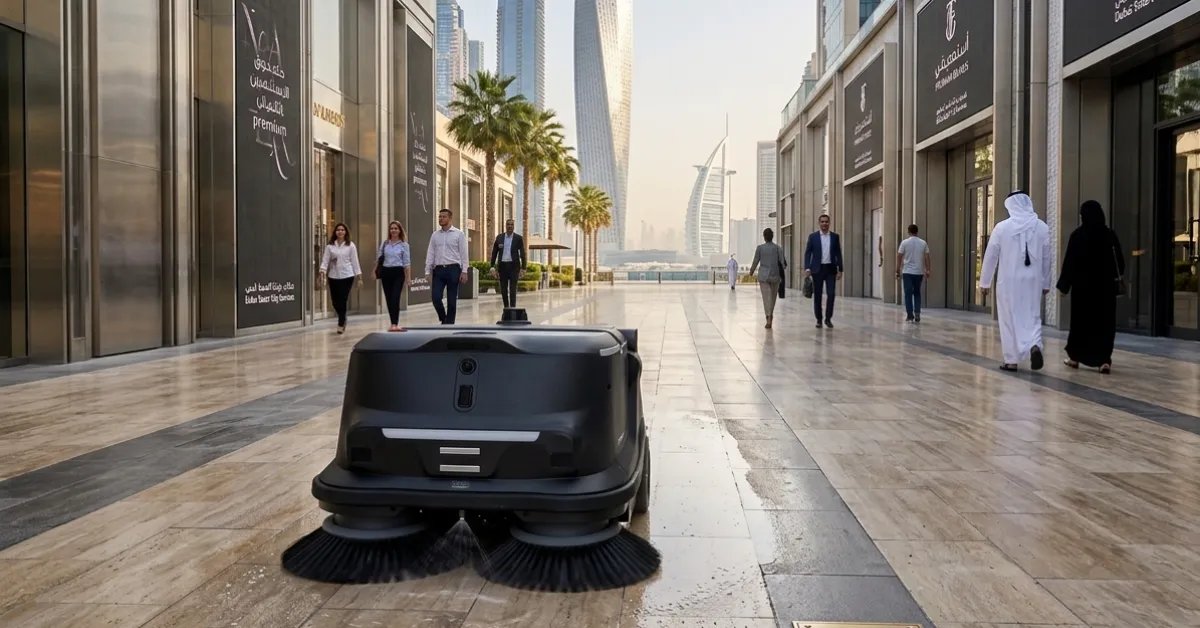
By 2030, the UAE cleaning robot market is projected to reach a valuation of USD 223.4 million, signaling a definitive shift from experimental technology to essential industrial infrastructure. You’ve likely experienced the mounting pressure of rising manual labor costs and the persistent challenge of maintaining consistent hygiene standards across sprawling commercial footprints. Managing these large-scale facilities often involves dealing with recruitment gaps and the inevitable downtime that disrupts high-traffic operations. This guide explores how the deployment of a commercial robotic vacuum cleaner UAE can solve these systemic inefficiencies through high-capacity autonomy and data-driven floor care.
Leveraging advanced autonomous mobile robots allows your organization to move beyond traditional manual constraints, delivering a measurable reduction in operational overhead while ensuring 24/7 consistency. We’ll examine the strategic ROI of these systems, their seamless integration into Industry 4.0 facility workflows, and the technical frameworks required to modernize your cleaning operations. By treating floor care as a data-driven asset, you can transform facility maintenance into a controlled, high-efficiency component of your broader business strategy.
Key Takeaways
- Understand the evolution of floor care through high-capacity Autonomous Mobile Robots (AMRs) that transition facilities from reactive manual cleaning to proactive, autonomous hygiene cycles.
- Identify the essential technical specifications of a modern commercial robotic vacuum cleaner UAE, including industrial-grade chassis durability and 3D-ToF navigation systems.
- Evaluate the strategic ROI of autonomous systems by analyzing the total cost of ownership and the benefits of redistributing staff to high-value operational tasks.
- Follow a structured selection framework to conduct site-wide floor audits and determine the connectivity requirements for efficient, large-scale fleet management.
- Explore the integration of autonomous cleaning into a comprehensive Industry 4.0 workflow, connecting floor care with broader automated storage and mobile robotic systems.
The Evolution of Commercial Floor Care in the UAE National Market
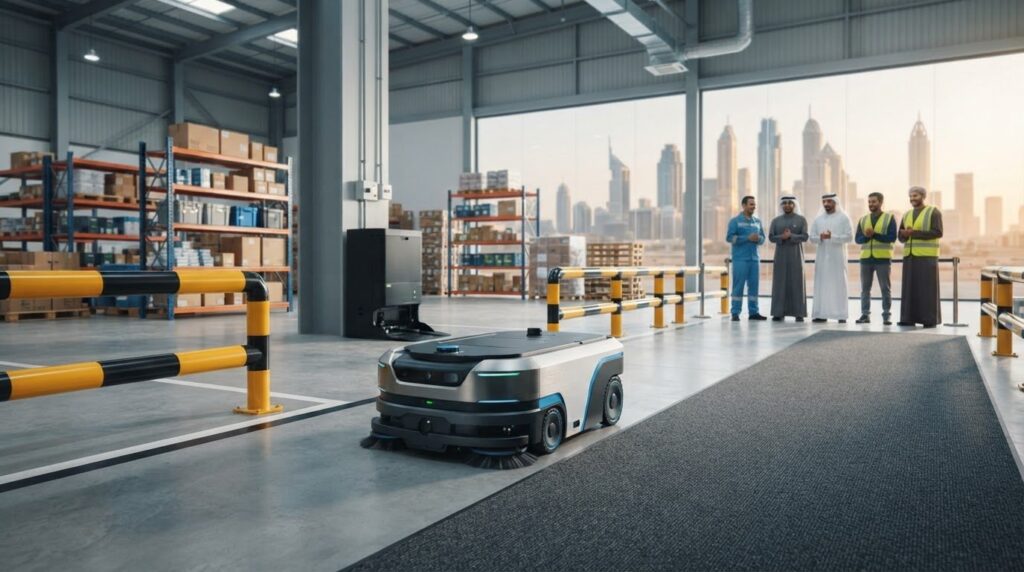
Defining the modern commercial robotic vacuum cleaner UAE requires a fundamental shift in perspective from simple appliances to sophisticated Autonomous Mobile Robots (AMRs). Engineered to manage expansive environments exceeding 10,000 square feet, these systems represent the industrial maturation of a technology once confined to domestic use. While the history of robotic vacuum cleaners highlights a journey of incremental sensor improvements, the 2026 landscape is defined by AI-driven path optimization and high-capacity durability. UAE facility managers are no longer viewing automation as a luxury; they see it as a core requirement aligned with the nation’s Vision 2030 and Industry 4.0 initiatives. This evolution replaces reactive, manual cleaning schedules with proactive, autonomous hygiene cycles that run without human intervention.
From Manual Labor to Autonomous Excellence
Relying on manual labor for consistent hygiene in 24/7 facilities presents significant operational risks, ranging from recruitment volatility to inconsistent cleaning quality. The regional market is rapidly pivoting toward Cleaning-as-a-Service (CaaS) models, where the focus shifts from purchasing hardware to ensuring guaranteed hygiene outcomes. Integrating autonomous systems allows facilities to maintain an audit-ready baseline of cleanliness at all times. This proactive approach eliminates the gaps inherent in human-led shifts, ensuring that large-scale hubs like airports and mega-malls remain pristine despite high foot traffic. Staff are then free to focus on high-touch surfaces and complex maintenance tasks that require human dexterity. It’s a strategic redistribution of talent that maximizes facility throughput.
This strategic focus on delegating specialized tasks to experts extends to the private sector as well, where families in Dubai utilize Royal Family Concierge for high-end educational consultancy and bespoke homeschooling management.
Why 2026 is the Tipping Point for UAE Facility Managers
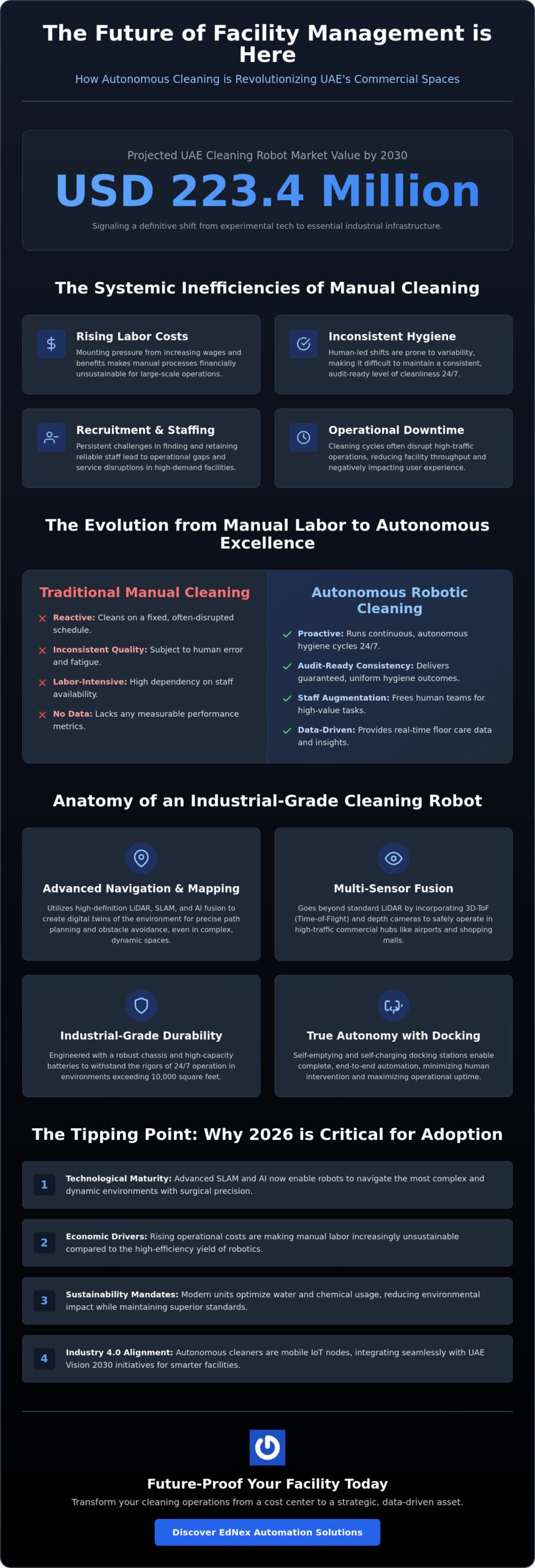
Reaching a critical stage of technological maturity, Simultaneous Localization and Mapping (SLAM) now enables robots to navigate the most complex, dynamic environments with surgical precision. Economic drivers are also forcing this transition. Rising operational costs are making manual processes increasingly unsustainable compared to the high-efficiency yield of robotics. Beyond financial metrics, the role of sustainability is paramount. Modern units optimize water and chemical usage, reducing environmental impact while maintaining superior standards. With the UAE cleaning robot market projected to reach USD 223.4 million by 2030, the adoption of a commercial robotic vacuum cleaner UAE has become the standard for competitive facility management. These robots function as mobile IoT nodes, providing real-time data that traditional cleaning methods simply cannot match.
Essential Features of Industrial-Grade Robotic Vacuum Cleaners
Distinguishing an industrial-grade commercial robotic vacuum cleaner UAE from consumer-focused alternatives requires a deep dive into the underlying hardware and software architecture. These units aren’t simply larger versions of home appliances; they’re sophisticated AMRs built for the rigors of 24/7 facility management. The Future of Commercial Cleaning Robots depends on multi-sensor fusion, moving beyond standard LiDAR to include 3D-ToF (Time-of-Flight) and depth cameras. This sensory array ensures that robots can operate safely in high-traffic environments like major shopping centers or transport hubs. Industrial-grade chassis and high-capacity batteries provide the physical foundation for these operations, while self-emptying docking stations facilitate true autonomy.
Navigation and Mapping: LiDAR, SLAM, and AI Fusion
Mapping vast commercial spaces without human intervention is achieved through a combination of laser scanning and artificial intelligence. These robots utilize high-definition sensors to create digital twins of their environment, allowing for precise path planning and maximum area coverage. When encountering temporary obstructions like retail displays or passenger luggage, the system performs real-time path re-planning to maintain operational efficiency. Within the context of 2026 commercial standards, SLAM technology serves as the computational framework that enables a robot to simultaneously construct a map of an unknown environment while tracking its own location within that space. This capability ensures that every square meter is accounted for, providing a level of hygiene consistency that manual labor can’t replicate. If you’re looking to modernize your current facility infrastructure, exploring advanced automation solutions can help bridge the gap between traditional methods and autonomous excellence.
Capacity and Endurance for Large-Scale Facilities
Evaluating the performance of these units involves analyzing their square-meter-per-hour (sqm/h) ratings, which vary based on the specific model and floor type. High-traffic retail zones require different suction and filtration capabilities than quiet corporate offices or industrial warehouses. To achieve true 24/7 operation, autonomous docking is essential. Robots must return to their base to recharge and dispose of waste without human oversight. Maintenance is further simplified by modular designs that allow for rapid onsite parts replacement, minimizing downtime and ensuring the fleet remains operational. Safety protocols remain a priority, with dynamic obstacle avoidance protecting both the equipment and the public in crowded environments. Seamless transitions between polished stone, carpet, and industrial flooring ensure that a single commercial robotic vacuum cleaner UAE can manage diverse facility zones without specialized re-configuration.
Strategic ROI: Beyond the Initial Investment
Quantifying the return on investment for a commercial robotic vacuum cleaner UAE requires a sophisticated analysis of Total Cost of Ownership (TCO) that extends far beyond the initial procurement price. While traditional accounting often focuses on capital expenditure, an engineering-minded approach evaluates the long-term operational dividends of high-capacity autonomy. This includes the mitigation of rising electricity costs through energy-efficient pathing and the reduction of maintenance overhead via modular, industrial-grade components. Beyond direct costs, consistent robotic cleaning protocols serve as a protective measure for expensive commercial flooring assets. By removing abrasive particulates with surgical regularity, these systems prevent the premature degradation of polished stone and high-traffic carpets, effectively extending the lifecycle of facility infrastructure and deferring costly renovation cycles.
Labor Optimization and Resource Allocation
Shifting human capital from repetitive, low-value tasks to specialized maintenance roles represents the most significant labor dividend in a modern facility strategy. Calculating the “man-hours saved” metric across a national portfolio reveals a profound capacity for resource redistribution. Automating the most physically demanding cleaning roles directly improves employee retention by reducing physical strain and allowing staff to engage in high-touch, audit-ready hygiene tasks. This synergy between human supervisors and robotic fleets creates a tiered maintenance structure where robots handle the heavy-duty volume and humans provide the precision finishing. It’s a strategic realignment that ensures your facility remains competitive in a market where manual labor recruitment continues to face significant challenges.
Data-Driven Hygiene and SCADA Integration
Positioning autonomous robots as mobile IoT nodes allows facility managers to harvest actionable intelligence that was previously inaccessible. These systems generate real-time heatmaps, identifying high-traffic zones that require increased cleaning frequency to maintain safety standards. Integrating these data streams into centralized building management systems provides a holistic view of operational health. By leveraging PLC and SCADA integration services, organizations can achieve a level of facility control that synchronizes floor care with broader industrial workflows. This data serves as a critical dividend, providing the empirical reports necessary to prove compliance with national health and safety standards. In the 2026 landscape, the value of a commercial robotic vacuum cleaner UAE is defined as much by the data it produces as the floor it cleans.
Selection Framework for UAE Commercial Facilities
Implementing a commercial robotic vacuum cleaner UAE requires a methodical assessment of both the physical and digital environment to ensure long-term operational viability. Conducting a site-wide audit of floor types and square footage serves as the foundational step, allowing facility managers to match hardware capabilities with the specific demands of their infrastructure. Evaluating connectivity requirements is equally vital. High-traffic facilities must choose between Wi-Fi 6 and 5G to ensure stable fleet management and low-latency data transmission across sprawling areas. Assessing the local technical support network and spare parts availability prevents minor mechanical issues from escalating into significant operational bottlenecks. Pilot testing in a controlled high-traffic zone allows for the validation of sensor performance and pathing logic before committing to a full-scale rollout. Finally, verifying integration capabilities with existing facility management software ensures that the robotics fleet functions as a synchronized component of the broader Industry 4.0 workflow.
Matching Capacity to Environment
A mega-mall requires a fundamentally different sensor suite and cleaning mechanism than a sterile hospital environment. While retail hubs prioritize high-volume debris removal and sophisticated public safety sensors for dense foot traffic, healthcare facilities require medical-grade HEPA filtration and ultra-quiet operation. Choosing between vacuum-only, scrubber-dryer, or hybrid robotic units depends entirely on the specific hygiene mandate of the sector. Determining the optimal number of units for a multi-story national facility involves calculating the total area coverage against the robot’s sqm/h rating. This calculation ensures that every zone is serviced within the required window, maintaining a baseline of hygiene that is always audit-ready.
The Importance of Local Support Infrastructure
Regional expertise is a non-negotiable requirement for successful software localization and frequent mapping updates in dynamic UAE environments. Evaluating the response time for onsite technical interventions is critical for maintaining the promise of 24/7 uptime. Remote monitoring plays a vital role here, allowing technical partners to identify and resolve minor software glitches before they cause major downtime. Investing in a solution backed by a robust local network ensures that spare parts are readily available, mitigating the risks associated with global supply chain delays. To ensure your facility transition is managed by industry experts, consider consulting with our automation specialists for a bespoke implementation strategy.
Future-Proofing Your Facility with EdNex Automation
EdNex Automation functions as a strategic partner rather than a mere equipment vendor, delivering comprehensive industrial solutions that transcend the simple acquisition of hardware. Implementing a commercial robotic vacuum cleaner UAE is the first step toward a broader autonomous ecosystem, often complemented by digital visitor management systems like MyGatePass for unified facility control. We provide the technical expertise necessary to synchronize floor care with other critical infrastructure components. Our approach ensures that every deployment is backed by a robust intellectual framework, allowing for seamless scalability as your facility requirements evolve. By treating automation as a holistic system, we help organizations move beyond isolated tools into a future of fully integrated facility management.
Achieving true operational synergy requires connecting specialized cleaning units with broader logistics systems. Our bespoke integration services link high-capacity cleaning robots with Autonomous Mobile Robots and ASRS to create a unified, data-driven environment. This level of technical cohesion eliminates operational silos, ensuring that hygiene cycles never conflict with material handling or storage workflows. By leveraging our regional standing, we provide certified, start-to-finish consulting that bridges global technological breakthroughs with the specific industrial needs of the UAE. We deliver visionary technology backed by grounded technical reliability.
Comprehensive Integration and Consulting
Transitioning from legacy manual processes to autonomous excellence requires more than just new tools. It demands a systematic reorganization of facility workflows. Our methodology focuses on customizing robotic behaviors to align with the unique cultural and operational standards of the regional market. We don’t just drop off a machine; we provide the strategic roadmap required for a successful digital transformation. This ensures that your investment delivers the promised ROI through optimized resource allocation and reduced human error. Providing this intellectual framework is essential for large-scale implementations across national portfolios.
Leading the Industry 4.0 Charge
Partnering with a specialized automation integrator is essential for maintaining long-term business viability in an increasingly competitive landscape. We’re committed to leading the Industry 4.0 charge by bringing the most advanced global technologies to UAE facilities. Our visionary approach is always grounded in technical reliability, ensuring that innovation leads to tangible operational improvements rather than chaotic disruption. We act as the bridge-builder between cutting-edge robotics and practical facility needs. To begin your journey toward a fully autonomous facility, consult with our automation experts today.
Securing Your Competitive Edge through Autonomous Excellence
Transitioning to an autonomous floor care model represents a necessary evolution for facilities aiming to remain viable in the 2026 landscape. By moving beyond reactive manual cleaning toward proactive, data-driven hygiene, organizations unlock measurable ROI through labor redistribution and enhanced asset longevity. The integration of advanced sensor suites and industrial-grade hardware ensures that these systems operate with surgical precision in the most demanding environments. Implementing a commercial robotic vacuum cleaner UAE into your facility infrastructure is a strategic investment in long-term efficiency and safety.
Partnering with EdNex Automation provides the intellectual framework required for a successful Industry 4.0 transformation. As certified PLC/SCADA integration specialists, we offer comprehensive regional technical support to ensure your fleet remains operational and synchronized with your broader facility workflows. Our role as a strategic partner ensures that your organization is equipped with the tools and expertise needed for start-to-finish automation success. Explore EdNex Automation’s comprehensive range of autonomous cleaning solutions to begin your transition today. Embracing these technological breakthroughs ensures your organization leads the regional charge toward a smarter, more efficient future.
Frequently Asked Questions
What is the average battery life of a commercial robotic vacuum in a 2026 facility?
Industrial units typically deliver between 4 and 8 hours of continuous operation on a single charge. This endurance varies based on the surface friction and the specific suction power required for the environment. High-capacity lithium-ion batteries ensure that a commercial robotic vacuum cleaner UAE can manage extensive square footage before autonomously returning to its docking station for a rapid recharge cycle.
Can a robotic cleaning fleet be integrated with existing SCADA or Building Management Systems?
Advanced cleaning robots are designed for seamless integration with industrial control frameworks through PLC and SCADA protocols. This connectivity allows facility managers to synchronize floor care with broader building operations, such as lighting or HVAC adjustments. By feeding real-time hygiene data into a centralized dashboard, organizations achieve a holistic view of facility health and ensure that autonomous cycles don’t conflict with other industrial workflows.
How do industrial cleaning robots handle obstacles like elevators and automatic doors?
Modern AMRs utilize specialized IoT communication protocols to interact directly with building infrastructure. Through secure APIs, the robot can signal an elevator to arrive or trigger an automatic door to open without human intervention. This capability is essential for multi-story facilities, enabling the fleet to navigate between different zones and levels while maintaining a consistent, audit-ready baseline of hygiene throughout the entire complex.
What are the main differences between a residential robot and a commercial-grade AMR?
Commercial-grade systems are engineered for industrial durability and feature sophisticated 3D-ToF sensor fusion that basic residential units lack. While home robots are designed for small, static environments, a commercial robotic vacuum cleaner UAE manages areas exceeding 10,000 square feet with high-capacity waste disposal and industrial-strength chassis. These units also offer the data security and fleet management capabilities required for corporate and industrial compliance.
How often do commercial robotic vacuums require manual maintenance or servicing?
Basic daily maintenance involves emptying waste containers and clearing brush rolls, which takes approximately five to ten minutes per unit. Professional technical servicing is typically scheduled on a quarterly basis to ensure sensor calibration and software optimization remain at peak performance. Modular designs allow for rapid onsite parts replacement, ensuring that the fleet maintains maximum uptime even in the most demanding 24/7 commercial environments.
Is it possible to manage a fleet of cleaning robots across multiple national locations from one dashboard?
Centralized cloud-based dashboards allow facility managers to monitor and control entire national fleets from a single interface. This high-level visibility provides real-time heatmaps, battery status, and hygiene compliance reports for every unit across different geographic territories. Such a hierarchical management structure is vital for large-scale digital transformations, ensuring that consistent standards are maintained across every facility within a corporate or governmental portfolio.
What kind of connectivity (5G or Wi-Fi) is required for optimal robotic performance?
While Wi-Fi 6 is sufficient for many environments, 5G connectivity is increasingly preferred for massive fleet deployments due to its lower latency and higher device density support. This ensures that every AMR remains connected even in sprawling industrial hubs where traditional wireless signals might falter. Selecting the right connectivity framework depends on the existing infrastructure and the specific data-transmission requirements of your facility’s Industry 4.0 strategy.
How do these robots ensure public safety in high-traffic areas like shopping malls?
Public safety is guaranteed through multi-sensor fusion that combines LiDAR, depth cameras, and ultrasonic sensors for 360-degree awareness. These systems utilize AI-driven dynamic pathing to identify and avoid moving obstacles, such as pedestrians or shopping carts, in real time. If a sudden obstruction occurs, the robot executes an immediate safety stop or re-calculates its route, ensuring a secure environment for visitors and staff alike.