While many executive boards still categorize advanced robotics as a discretionary expense, the reality of the 2026 industrial landscape suggests that failing to modernize is the ultimate operational risk. You likely recognize that manual workflows are reaching their ceiling, yet you face the persistent challenge of presenting automation investment to management when leadership remains focused on immediate capital expenditure and the fear of integration downtime. It is difficult to justify complex systems like Autonomous Mobile Robots or ASRS when the conversation stays trapped in technical specifications rather than tangible business outcomes.
This strategic guide will empower you to bridge that gap by converting engineering requirements into a high-level business case that secures executive buy-in through data-backed ROI frameworks. We will examine how to leverage current tax incentives such as Section 179 and navigate the transparency requirements of the EU AI Act to position automation as a driver of long-term viability. By the end of this article, you will possess a clear pitch deck structure and the intellectual framework necessary to transform your facility into a highly intelligent, interconnected ecosystem that thrives on controlled innovation. You will learn to frame these advanced systems not as a cost center, but as a necessary evolution for maintaining a competitive global standing.
Key Takeaways
- Frame robotics as a strategic necessity by aligning technical upgrades with enterprise-level goals and national manufacturing excellence frameworks.
- Optimize your financial justification by presenting automation investment to management through the lens of Total Cost of Ownership (TCO) rather than mere upfront capital expenditure.
- Neutralize fears of operational downtime by presenting a phased implementation roadmap that prioritizes steady-state production throughout the transition.
- Deploy a structured 5-step pitch deck that effectively communicates the strategic “why” while quantifying the long-term costs of maintaining manual, inefficient workflows.
- Identify the essential criteria for selecting a high-level integration partner who provides the regional expertise and maintenance infrastructure required for multi-year success.
Aligning Automation with Enterprise Strategy and National Goals
Establishing a competitive edge in 2026 necessitates a departure from viewing robotics as a mere technical upgrade. Successfully presenting automation investment to management requires a narrative that elevates these systems from isolated tools to the very bedrock of long-term business viability. By framing high-tech integration as a strategic pillar, you demonstrate that modernization isn’t just about speed; it’s about building a resilient infrastructure capable of withstanding global supply chain volatility and regional labor shifts. This visionary approach ensures that leadership views the proposal as a roadmap for survival rather than a discretionary expense.
Consulting a comprehensive overview of automation reveals that the most successful organizations treat autonomous systems as intellectual assets. They recognize that while the initial capital expenditure is a factor, the cost of maintaining manual, stagnant processes is far higher in an era where the global industrial automation market is estimated to be valued at $261.23 billion. You aren’t just buying machinery. You’re securing the ability to scale operations without the proportional increase in risk that typically accompanies human-centered growth.
The Shift from Cost Center to Growth Engine
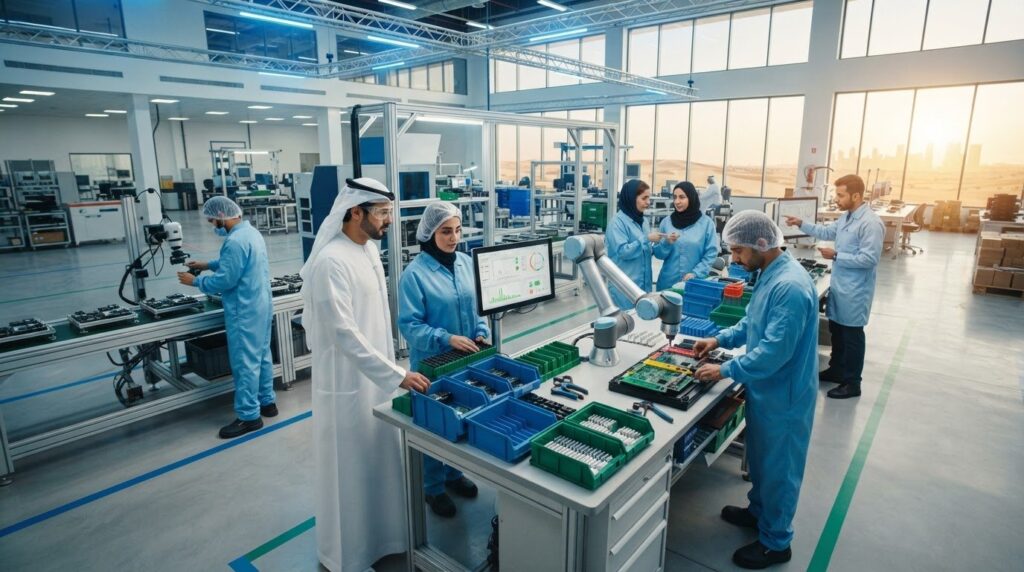
Transitioning from reactive maintenance to proactive automated optimization defines the modern industrial leader. In the Factory of the Future, systems don’t just perform tasks; they coordinate work across the entire organization to eliminate inefficiencies. Implementing collaborative robots UAE allows for a hybrid workforce where human intelligence and robotic precision coexist, creating a tangible competitive advantage. This shift transforms the facility from a cost center into a growth engine that scales without proportional increases in overhead. It replaces the unpredictable nature of manual labor with the reliability of intelligent, interconnected ecosystems.
Leveraging National Industrial Directives
Aligning your proposal with national industrial directives provides an additional layer of executive legitimacy. Presenting automation investment to management is far more effective when you connect the project to sovereign economic diversification goals, such as regional manufacturing excellence targets. These initiatives often offer frameworks for digital transformation, making the investment a strategic necessity for any organization wishing to remain competitive. By adopting advanced PLC and SCADA integration or Automated Storage and Retrieval Systems (ASRS), you enhance the regional brand, ensuring your output meets the highest global standards of precision and quality. This positioning frames the investment as a patriotic and economic evolution that future-proofs the company against global technological shifts.
Consider the following strategic benefits of alignment:
- Risk Mitigation: Diversifying away from labor-heavy processes protects against regional workforce shortages.
- Operational Sovereignty: Localized automation reduces reliance on external, volatile supply chains.
- Quality Assurance: Automated systems provide the repeatable precision required for high-value exports.
Building the Financial Case: Beyond Simple ROI
Constructing a robust financial narrative requires moving beyond the narrow confines of immediate capital expenditure. When presenting automation investment to management, you must shift the focus toward Total Cost of Ownership (TCO), a comprehensive metric that accounts for the complete lifecycle of the asset. While traditional ROI calculations often overlook the compounding costs of manual inefficiencies, a TCO-driven approach highlights the divergence between escalating labor inflation and the stabilizing effect of fixed-cost robotics. Utilizing advanced analytics, organizations can now quantify “invisible savings” such as reduced energy waste, the elimination of human-error-related scrap, and the optimization of existing floor space.
A New Survey from Harvard Business Review Analytic Services indicates that while adoption remains high, the realization of value often lags without deep workflow integration. This underscores the necessity of framing your proposal as a multi-year financial strategy. By leveraging U.S. tax incentives like Section 179, which allows for deductions up to $2.5 million on qualifying equipment, the net cost of implementation significantly decreases in the first year. This immediate tax benefit, combined with 100% bonus depreciation, provides a powerful incentive for executive boards to approve large-scale modernization projects before these benefits phase out.
Calculating Total Cost of Ownership (TCO)
A comprehensive TCO analysis must incorporate maintenance schedules, software updates, and projected energy consumption. Contrasting the TCO of autonomous mobile robots with traditional, fixed conveyor systems reveals the superior long-term value of flexible autonomy. Unlike rigid infrastructure, modern robotic systems offer modularity and redeployability, allowing them to adapt to changing production needs without requiring additional capital outlays. This adaptability mitigates the risk of asset obsolescence, ensuring the investment remains productive across multiple product lifecycles.
Quantifying Qualitative Benefits
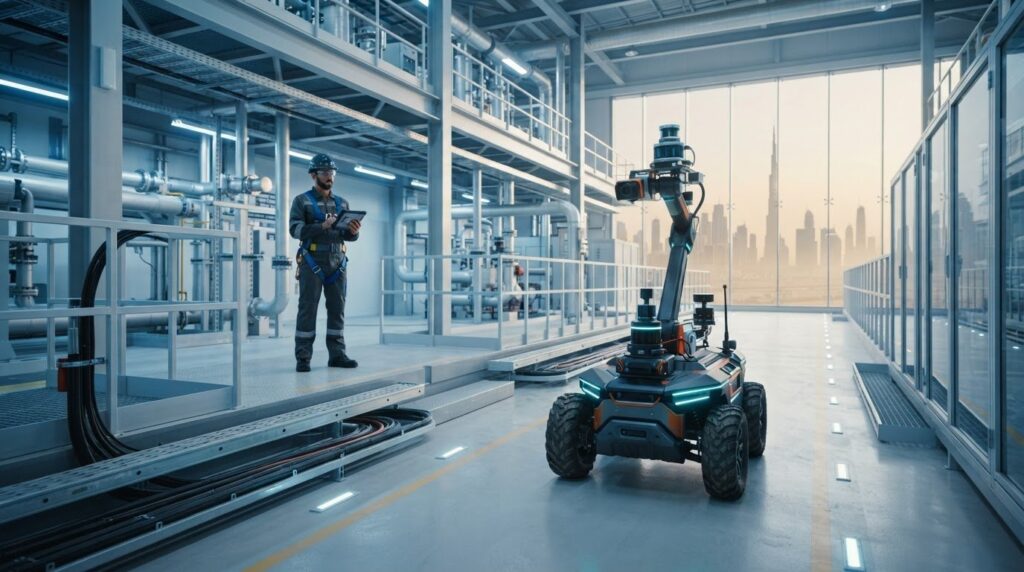
Assigning a monetary value to qualitative improvements is essential for a holistic business case. Improved worker safety directly translates to reduced insurance premiums and lower turnover costs, which are often significant but hidden expenses. Furthermore, the data insights gained through PLC and SCADA integration services enable real-time inefficiency detection, providing a level of operational transparency that manual processes cannot match. Estimating the market value of 24/7 operational capability allows management to visualize the potential for increased throughput and market share expansion.
| Financial Metric (36-Month Horizon) | Manual Operations | Automated Infrastructure |
|---|---|---|
| Labor & Recruitment Costs | High (Projected 5-7% Annual Growth) | Fixed (Maintenance Only) |
| Operational Waste & Errors | Variable (2-4% Average) | Optimized (Under 0.5%) |
| Energy Efficiency | Lower (Standard Lighting/HVAC) | Higher (Optimized “Lights-Out” Ops) |
| Tax Advantage (Section 179) | None | Significant (Up to $2.5M Deduction) |
To ensure your facility remains competitive, it’s vital to partner with experts who understand the nuances of bespoke industrial solutions and long-term financial viability.
Mitigating Executive Risk and Addressing Objections
Addressing the inherent hesitations of an executive board requires a transparent acknowledgment of the “fear factor” associated with large-scale industrial transformation. When presenting automation investment to management, the primary obstacle is often the perceived risk of operational downtime during the transition phase. Leadership frequently views modernization as a disruptive force that might jeopardize current production targets. By articulating a rigorous risk-mitigation framework that prioritizes continuity, you transform a perceived gamble into a calculated, low-risk evolution that safeguards the organization’s steady-state output.
Utilizing a systematic approach to integration ensures that every technological deployment is backed by a contingency plan. This involves moving away from “big bang” implementations in favor of controlled, deliberate innovation. Highlighting the reliability of modern systems is essential; for instance, 84% of organizations already report a positive ROI from their AI and automation investments, according to studies by IDC. This data serves as a powerful counter-argument to the myth that automation is an unproven or volatile cost center. You are not proposing an experiment; you are advocating for a verified path to industrial excellence.
The Phased Integration Strategy
Establishing a “Pilot Program” allows for value verification within a highly controlled environment before committing to a full-scale facility rollout. For example, automated storage and retrieval systems can be integrated in modular stages, allowing existing manual picking processes to run in parallel until the automated infrastructure achieves peak reliability. This staggered methodology includes predefined fallback protocols and dedicated on-site technical support to ensure that production targets remain unaffected during the go-live phase. By proving success in a single department, you build the intellectual framework necessary for a multi-year roadmap.
Safety, Compliance, and Technical Reliability
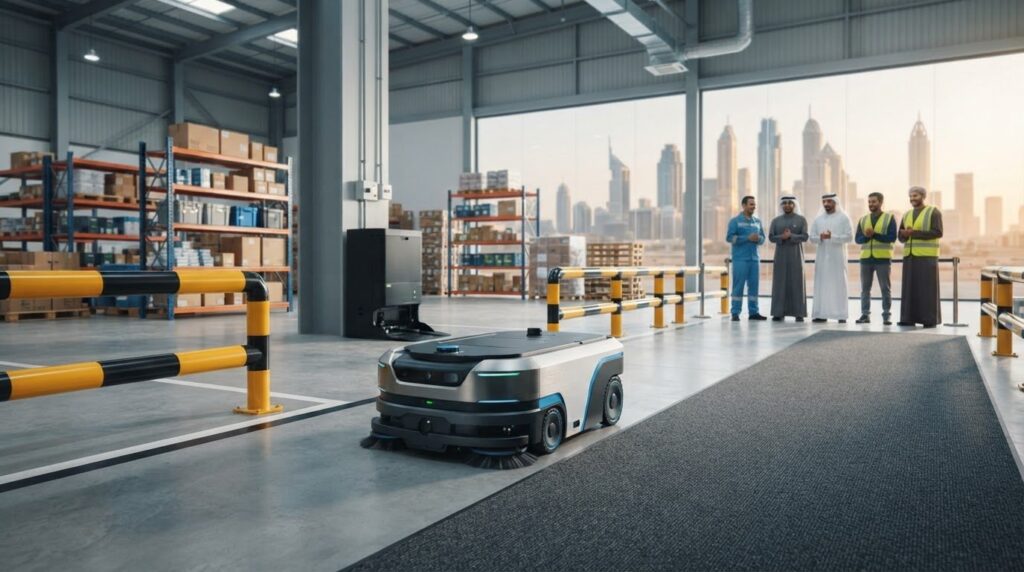
Ensuring compliance with international and national safety certifications is a non-negotiable component of any modern industrial strategy. Modern collaborative robots utilize advanced sensor arrays to work safely alongside human staff without the need for restrictive safety cages, significantly reducing the required floor space while enhancing worker protection. The reliability of these systems is further bolstered by SCADA-monitored environments that detect potential failures before they lead to catastrophic downtime. Additionally, the deployment of autonomous cleaning robots maintains a safe, compliant facility by performing high-frequency sanitation tasks without diverting human labor from high-value production roles.
Proposing a workforce upskilling plan as part of the initial investment effectively addresses the “Skills Gap” while neutralizing employee resistance. Transitioning current operators into high-level system supervisors ensures that your human capital evolves alongside your physical machinery. This approach creates a partnership between human intelligence and robotic precision, resulting in a more safety-conscious and efficient operational environment that is prepared for the complexities of 2026 and beyond.
The 5-Step Pitch Deck Structure for Management
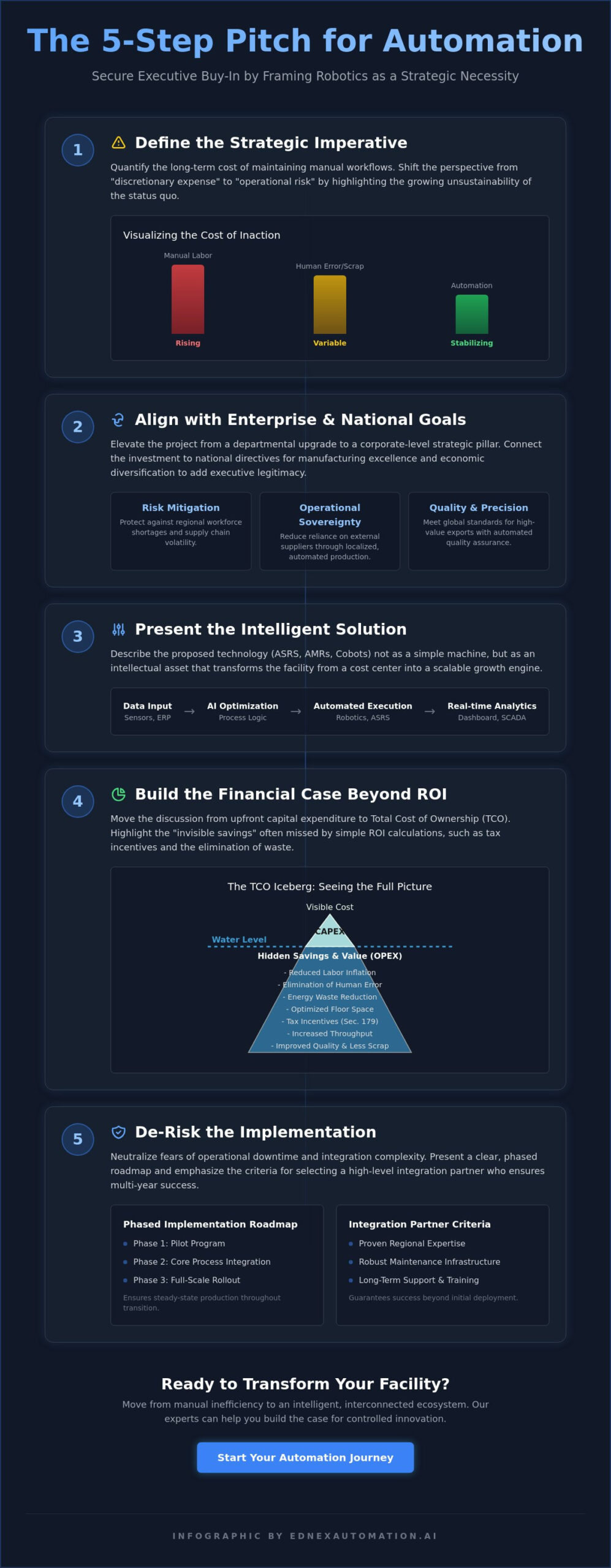
Presenting automation investment to management requires a structured communication framework that translates complex engineering data into a compelling executive narrative. While previous sections established the strategic “why” and the financial “how,” this section provides the tactical blueprint for your board presentation. A successful pitch doesn’t just list technical specifications; it organizes them into a logical, hierarchical flow that mirrors a professional consulting proposal. By following this 5-step architecture, you ensure that every slide addresses a specific executive concern, from long-term business viability to immediate risk mitigation.
- Step 1: The Executive Summary: Lead with a visionary statement that aligns the project with national Industry 4.0 goals. This slide should define the strategic “Why” by highlighting the transformative power of advanced systems to solve current industrial challenges.
- Step 2: The Problem Statement: Visualize the cost of inaction (COI). Use data to illustrate current bottlenecks, manual labor ceilings, and the escalating risks of maintaining stagnant infrastructure in a $261.23 billion global market.
- Step 3: The Proposed Solution: Detail the hardware and software architecture. Explicitly identify the roles of Autonomous Mobile Robots (AMRs) for logistics, Cobots for precision assembly, and PLC/SCADA integration for centralized intelligence.
- Step 4: The Financial Framework: Present the TCO and ROI analysis established in section 2. Focus on the 36-month payback period and the immediate tax advantages provided by Section 179 and bonus depreciation.
- Step 5: The Execution Plan: Outline a phased implementation roadmap. Clearly define the milestones for the pilot program and the specific role of the strategic integration partner in ensuring a seamless go-live phase.
Visualizing Data for the C-Suite
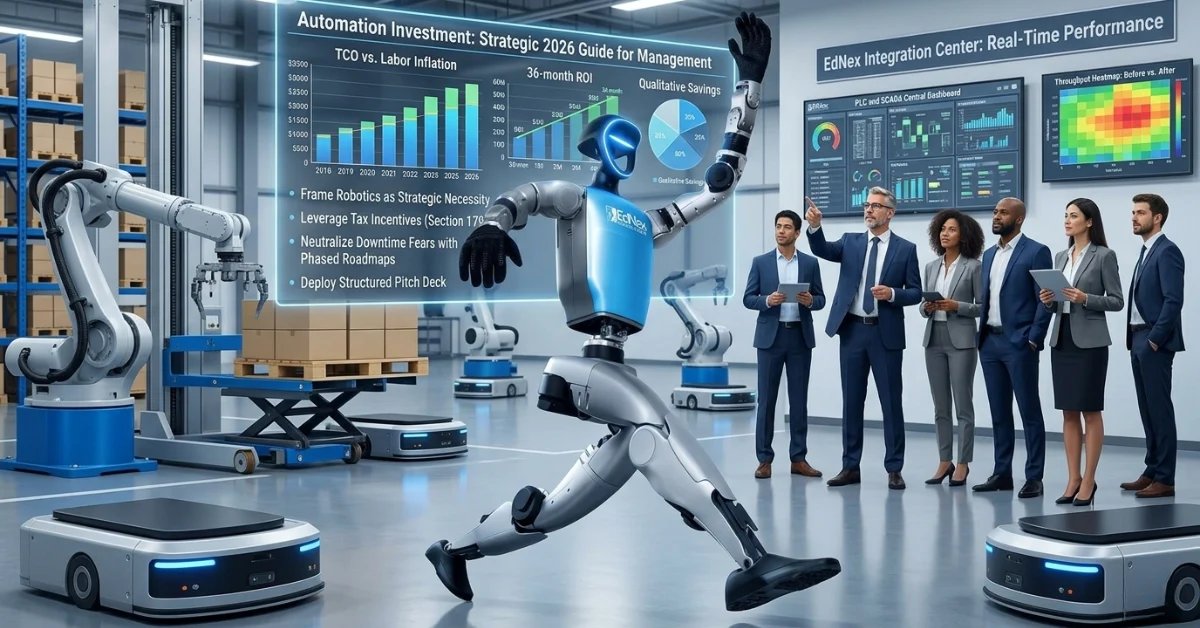
Utilizing heatmaps and flowcharts allows leadership to visualize current warehouse inefficiencies and compare them against a projected “After” state of optimized throughput. These visual aids transform abstract concepts into tangible business outcomes, making the benefits of modernization undeniable. Utilizing SCADA data enables the creation of real-time performance dashboards that provide management with immediate visibility into operational health.
Answering the Hard Questions
Preparing a “Frequently Asked Questions” slide demonstrates a level of thoroughness that reassures the board of your methodical approach. Focus on scalability by explaining how the proposed architecture grows with the business over a 10-year horizon. Emphasize the flexibility of modern systems, such as the emerging role of humanoid robots for sale UAE, which provide multi-purpose service capabilities across various sectors. This forward-looking perspective positions the investment as a necessary evolution for any organization wishing to remain competitive.
To begin architecting your facility’s future, consult with our strategic integration experts to build a customized, ROI-driven pitch.
Selecting the Right Integration Partner for Success
Successfully presenting automation investment to management culminates in the selection of a partner capable of executing the vision with technical precision. A technology vendor merely provides hardware, whereas a strategic integration partner provides the intellectual framework necessary for long-term operational success. This distinction is critical because the complexity of 2026 industrial environments demands a unified control plan rather than a collection of isolated machines. Relying on a partner with a strong regional presence ensures that maintenance, spare parts, and on-site support are immediately available, mitigating the risk of extended downtime that executive boards fear most.
Evaluating a partner’s experience in PLC, SCADA, and robotics synchronization is paramount for achieving a seamless Industry 4.0 ecosystem. Without this technical depth, organizations risk fragmented automation that fails to deliver the projected ROI. Considering that 30% to 50% of initial automation projects fail due to poor planning or lack of ongoing support, the choice of partner becomes a primary risk-mitigation factor. A truly competent integrator acts as a systematic organizer, bringing order and efficiency to complex environments through deliberate innovation. They provide the bridge between global technological breakthroughs and specific regional needs, ensuring that every deployment is tailored to the unique economic context of the facility.
The Value of End-to-End Expertise
Buying hardware without a master control plan often leads to expensive, underutilized assets that cannot communicate across departments. Utilizing a partner who understands the complete Industry 4.0 landscape allows for the delivery of high-level solutions that integrate disparate systems into a cohesive, intelligent whole. This end-to-end expertise includes the management of ongoing firmware updates and remote monitoring, which are essential for maintaining system health and security. Proactive optimization through these digital layers ensures that the infrastructure remains at the cutting edge throughout its lifecycle, preventing the technical debt associated with unmanaged systems.
Securing the Future with EdNex Automation
Positioning itself as a visionary leader in industrial transformation, EdNex Automation serves as the definitive bridge for organizations seeking to modernize their footprint. By offering comprehensive expertise across a spectrum of technologies, from Automated Storage and Retrieval Systems (ASRS) to specialized delivery robots, EdNex provides the start-to-finish support required for large-scale transformation. Our commitment to national industrial growth and technical excellence ensures that your organization doesn’t just acquire tools, but undergoes a necessary evolution to remain competitive in a global market.
Identifying the intersection of technical precision and business strategy, we provide the reliable framework your board requires for approval. Partner with EdNex Automation to build your strategic investment roadmap today.
Architecting Your Industrial Future in 2026
Modernizing your facility isn’t just a technical upgrade; it’s a fundamental requirement for remaining competitive in an increasingly autonomous global market. Successfully presenting automation investment to management hinges on your ability to frame robotics as a strategic growth asset rather than a simple cost center. By aligning your proposal with national Industry 4.0 targets and utilizing a rigorous, TCO-driven financial framework, you provide the clarity executive boards need to approve large-scale transformation. You’ve learned how to mitigate risk through phased implementation and how to select a partner who offers the regional expertise required for multi-year success.
As an Industry 4.0 Certified Integrator with a comprehensive robotics and PLC portfolio, EdNex Automation provides the intellectual framework and national support network necessary to turn your vision into operational reality. We act as the systematic organizer that brings order and efficiency to complex environments through controlled and deliberate innovation. Our global standing ensures your facility meets the highest standards of precision and quality.
Download our Executive Guide to Automation ROI and Pitching to the Board and take the first step toward securing your organization’s long-term viability today. The path to industrial excellence is open to those who lead with strategy and foresight.
Strategic Insights for Executive Approval
What is the average payback period for an industrial automation investment?
Determining the payback period requires a comprehensive analysis of both direct and indirect savings, typically resulting in a 12 to 36 month window for most enterprise-scale robotics. Leveraging U.S. tax incentives like Section 179 and 100% bonus depreciation can significantly accelerate this timeline by providing immediate capital relief in the first year. While simple projects may see faster returns, the focus should remain on the multi-year stabilization of operational costs against labor inflation.
How do I calculate the ROI of a collaborative robot (cobot)?
Calculating ROI for autonomous systems involves dividing the total realized savings by the Total Cost of Ownership (TCO), including maintenance and software integration. Studies by IDC indicate that for every $1.00 invested in AI and advanced automation, organizations realize an average return of $3.50. This metric is further bolstered by the fact that 84% of organizations report a positive ROI from their automation initiatives, making the business case for cobots highly compelling when presenting automation investment to management.
Should I focus on labor cost reduction or throughput increase in my pitch?
Targeting throughput increase and operational resilience often provides a more visionary narrative than focusing solely on headcount reduction. While labor savings are a tangible component, the ability to scale production without increasing risk or overhead positions the investment as a growth engine. Highlighting the 24/7 capability of systems like AMRs or ASRS demonstrates a commitment to capturing greater market share through enhanced capacity and precision.
As you scale these operations, it is equally important to modernize your communication channels; you can discover Nexdial to learn how AI-powered contact centers can help your team manage the increased business volume efficiently.
What are the biggest risks when presenting an automation proposal to a CFO?
Underestimating the Total Cost of Ownership and failing to account for integration downtime are the most significant risks in a financial pitch. Considering that 30% to 50% of initial RPA projects fail due to poor planning, you must address technical reliability and scalability from the outset. Providing a phased implementation roadmap with clear fallback protocols reassures the CFO that the project is a controlled evolution rather than a disruptive gamble.
How does SCADA integration improve the business case for automation?
Utilizing SCADA integration provides the data transparency necessary for real-time performance monitoring and long-term inefficiency detection. This centralized intelligence layer allows management to visualize operational health through dashboards, converting abstract technical data into actionable business insights. By proving that every automated asset is monitored for peak efficiency, you demonstrate a methodical approach to risk mitigation and resource optimization.
Can I implement automation in phases to reduce initial CAPEX?
Deploying a modular, phased integration strategy is an effective way to manage capital expenditure while proving value through pilot programs. Modern systems like autonomous mobile robots and ASRS are designed for scalability, allowing you to modernize a single workflow before a full-scale rollout. This approach minimizes operational disruption and allows the organization to fund subsequent phases using the savings realized from initial successes.
How do I address management concerns about workforce displacement?
Reframing the workforce conversation around upskilling and safety transforms a potential objection into a strategic advantage. Transitioning staff from manual, high-risk tasks to high-level system supervision creates a more safety-conscious and intellectually engaged environment. Emphasizing the role of cobots in supporting human precision ensures that leadership views automation as a tool for empowerment rather than a replacement for human intelligence.
What role does the UAE’s national strategy play in automation approval?
Aligning your proposal with national industrial directives provides an authoritative marker of legitimacy when presenting automation investment to management. Connecting the project to sovereign economic diversification goals and “Made in UAE” quality standards positions the organization as a leader in regional manufacturing excellence. This strategic alignment ensures that the investment is viewed as a necessary evolution for maintaining a competitive global standing within a national Industry 4.0 framework.