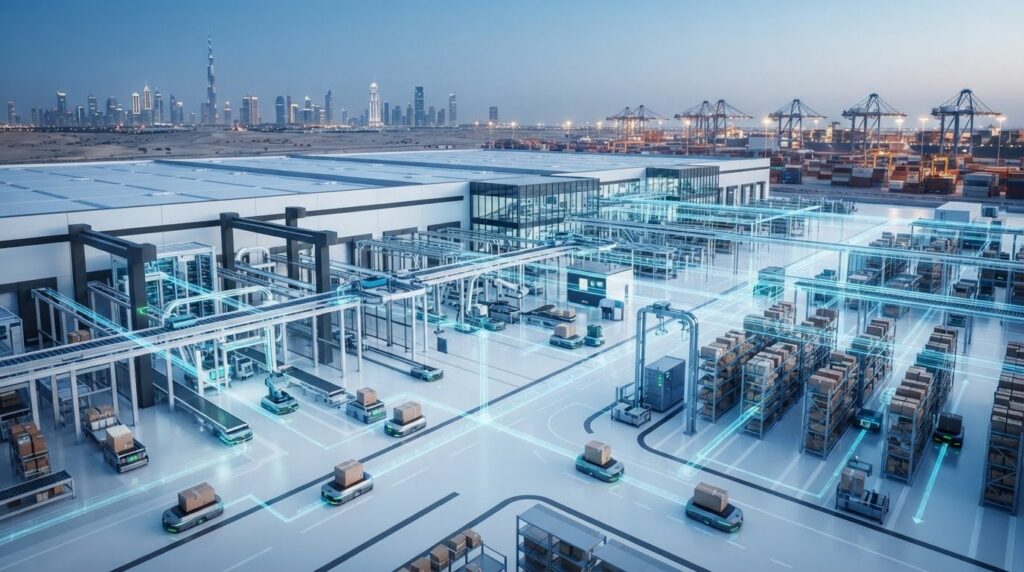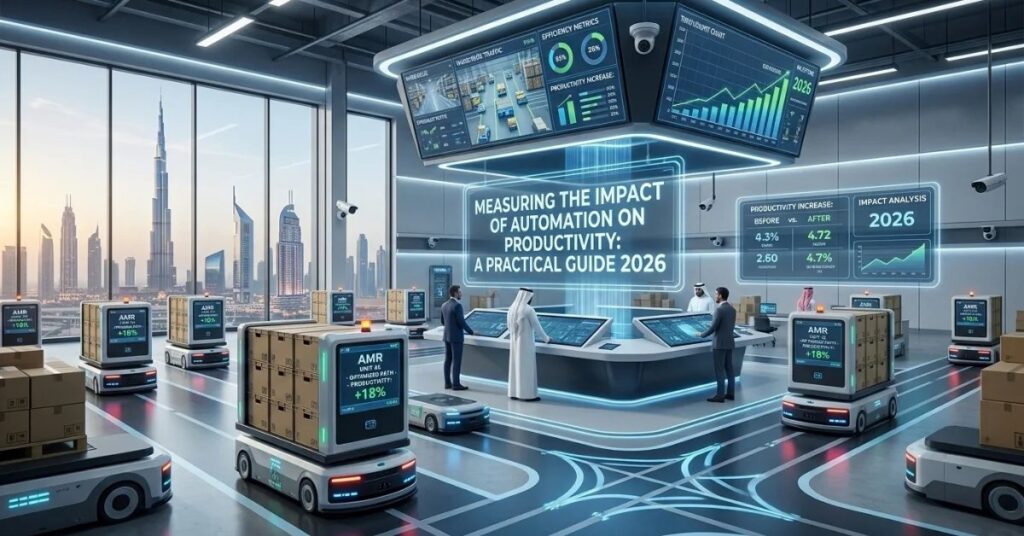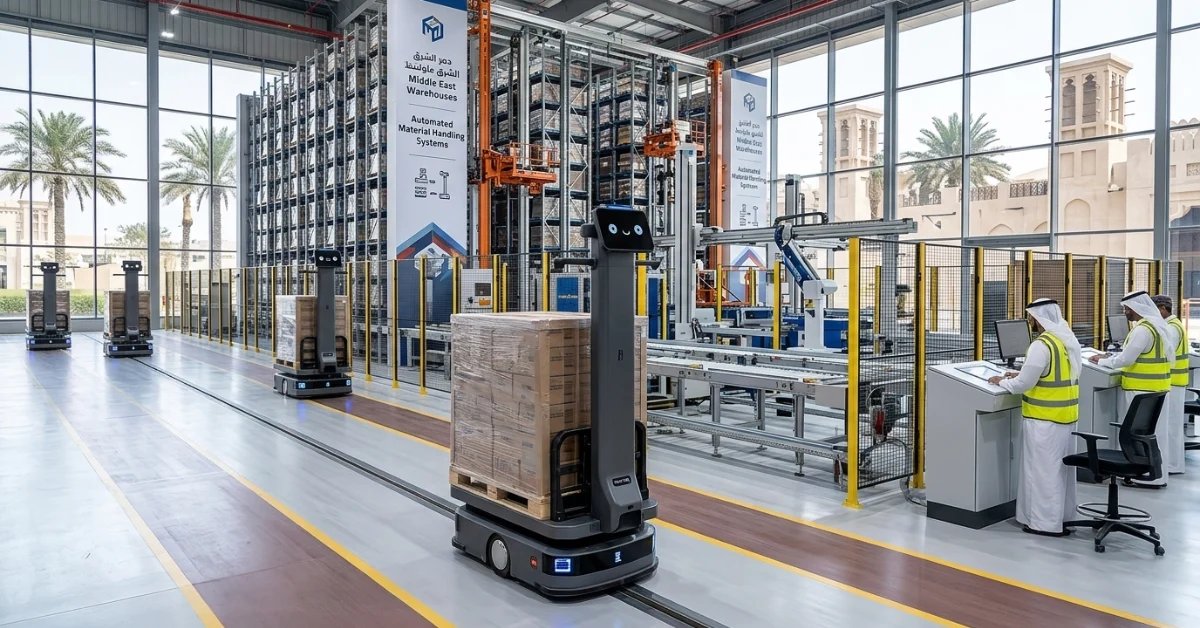
With Saudi Arabia capturing a dominant 44.01% revenue share of the regional market, the transition toward fully autonomous industrial ecosystems is a present-day mandate for survival. Leaders across the peninsula understand that traditional logistics frameworks struggle to withstand the pressures of rising labor costs and the physical limitations of warehouse space. Implementing automated material handling systems Middle East has become the critical differentiator for organizations aiming to maintain high throughput within the region’s extreme climates.
You’ve likely realized that sustaining a competitive edge requires more than just incremental improvements, as it’s a requirement to shift how goods move and are stored. This guide demonstrates how advanced robotics, including Autonomous Mobile Robots (AMRs) and Automated Storage and Retrieval Systems (ASRS), are transforming regional industrial efficiency. We’ll examine the strategic integration of PLC and SCADA systems that bridge the gap between intelligent hardware and operational control. This overview provides a roadmap for achieving reduced operational costs and increased storage density through a seamless, tech-driven infrastructure.
Key Takeaways
- Analyzing the transition to Industry 4.0, this guide details how data-driven logistics are replacing manual sorting to enhance regional supply chain resilience.
- Evaluating critical facility constraints like ceiling height and floor load allows for the precise selection of automated material handling systems Middle East that maximize storage density.
- Integrating collaborative robots and autonomous mobile robots into manufacturing workflows mitigates labor shortages while significantly accelerating assembly line throughput.
- Establishing a unified intelligence layer through PLC and SCADA integration eliminates operational silos, ensuring seamless communication between robotic hardware and control software.
- Conducting comprehensive site audits and calculating Total Cost of Ownership ensures your investment delivers the ROI that’s necessary for long-term viability.
The Evolution of Automated Material Handling Systems in the Middle East
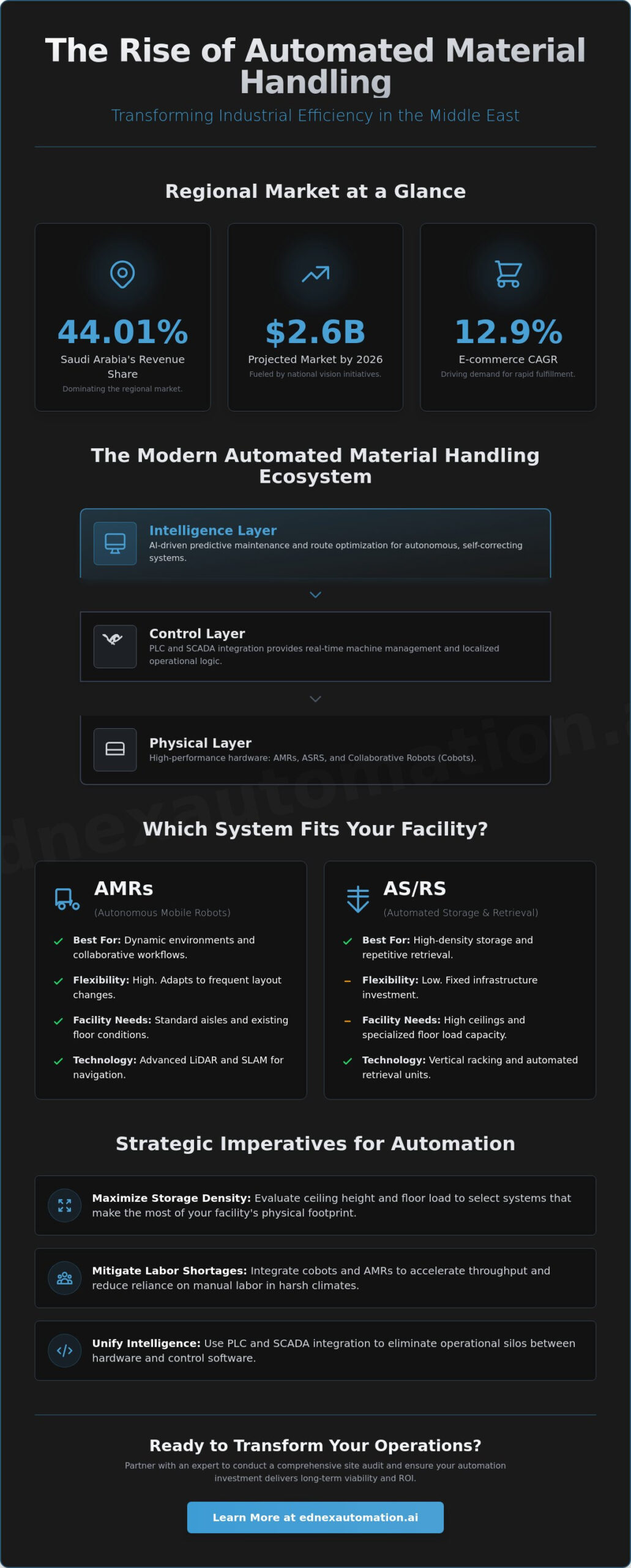
The regional industrial landscape is undergoing a profound metamorphosis. Defining automated material handling within the Industry 4.0 framework requires viewing it as an interconnected ecosystem rather than isolated machinery. By 2026, the market for automated material handling systems Middle East is projected to reach USD 2.6 billion, driven by a paradigm shift from manual sorting to intelligent, data-driven logistics. This evolution isn’t merely about speed. It represents a fundamental restructuring of industrial reliability, where autonomous systems manage complex workflows with a level of precision that human-centric models cannot match.
National vision initiatives, such as Saudi Arabia’s Vision 2030 and the U.A.E.’s Vision 2031, act as powerful catalysts for this transformation. These government programs prioritize the development of advanced manufacturing hubs and world-class logistics corridors, incentivizing the adoption of high-tech infrastructure. As Saudi Arabia currently commands a 44.01% share of the regional market, the push for 24/7 operations and absolute throughput accuracy has moved from a strategic advantage to an industry standard. Modern facilities are no longer debating the utility of automation; they’re optimizing the integration of intelligence into every square meter of floor space.
Why Middle Eastern Enterprises are Automating Now
The urgency to automate stems from a convergence of economic and environmental pressures. Rapid fulfillment demands in the e-commerce sector, which is growing at a CAGR of 12.9%, necessitate systems that operate without fatigue. Additionally, mitigating the impact of extreme heat on human labor productivity is a primary concern for regional facility managers. Adopting advanced automated material handling systems Middle East allows for consistent output in harsh climates. This transition also aligns with regional sustainability goals through energy-efficient, optimized power consumption across the supply chain.
Core Components of a Modern AMH Ecosystem
Building a resilient automation framework involves a three-tiered architecture. The physical layer consists of high-performance hardware, including Autonomous Mobile Robots (AMRs), collaborative robots (cobots), and Automated Storage and Retrieval Systems (AS/RS). Orchestrating these assets is the control layer, where PLC and SCADA integration provides real-time machine management and localized logic. Finally, the intelligence layer utilizes AI-driven predictive maintenance and route optimization to ensure the system remains autonomous and self-correcting. This hierarchical approach ensures that hardware and software function as a single, cohesive unit.
Comparing AMR and ASRS: Which System Fits Your Facility?
Selecting the correct infrastructure for automated material handling systems Middle East depends on a precise alignment between operational throughput and physical facility parameters. While many operators view automation as a binary choice, the reality involves balancing the agility of mobile robotics against the structural intensity of fixed storage solutions. According to a Middle East and Africa Automated Material Handling Market Analysis, the region’s rapid industrialization is forcing a critical evaluation of these technologies to solve specific urban constraints and labor challenges.
Evaluating facility constraints is the first step in this technical audit. High-density ASRS installations require significant ceiling height and specialized floor load capacities to support vertical racking structures. Conversely, AMRs thrive in facilities with standard aisle widths and existing floor conditions. Calculating your required picks-per-hour provides the baseline for this decision. If your operation demands high-volume, repetitive retrieval from deep storage, density wins. If your workflow involves frequent layout changes or collaborative picking, flexibility becomes the priority.
Autonomous Mobile Robots (AMRs) for Dynamic Environments
Utilizing advanced LiDAR and SLAM (Simultaneous Localization and Mapping) technologies, autonomous mobile robots navigate complex warehouse floors without the need for fixed tracks or magnetic tape. This infrastructure-free approach makes them ideal for sorting, cross-docking, and supporting human workers in collaborative order picking environments. Because they don’t require permanent modifications to the facility, they offer a modular path to automation that can scale as demand fluctuates.
Automated Storage and Retrieval Systems (ASRS) for Maximum Density
When warehouse space is at a premium, automated storage and retrieval systems provide the most efficient use of vertical volume. These systems, ranging from shuttle-based architectures to unit-load cranes, optimize storage density by eliminating wide aisles and utilizing the full height of the building. For companies managing thousands of SKUs in high-rent zones like Dubai or Riyadh, implementing these automated material handling systems Middle East ensures that every cubic meter contributes to the bottom line.
Designing a bespoke solution requires a deep understanding of these technical trade-offs. You might find that consulting with an automation specialist is the most effective way to determine which system configuration matches your specific industrial footprint.
Sector-Specific Applications for Material Handling Automation
Adopting automated material handling systems Middle East isn’t a one-size-fits-all endeavor. Different industrial sectors face unique operational bottlenecks that require specialized robotic interventions. In the FMCG and retail sectors, where the distribution segment now accounts for 38.59% of the market, high-volume sorting and “last mile” logistics are the primary focus. These industries utilize high-speed automated sorters and robotic picking arms to manage the 12.9% growth in e-commerce fulfillment demands, ensuring that orders move from shelf to shipping with zero manual intervention.
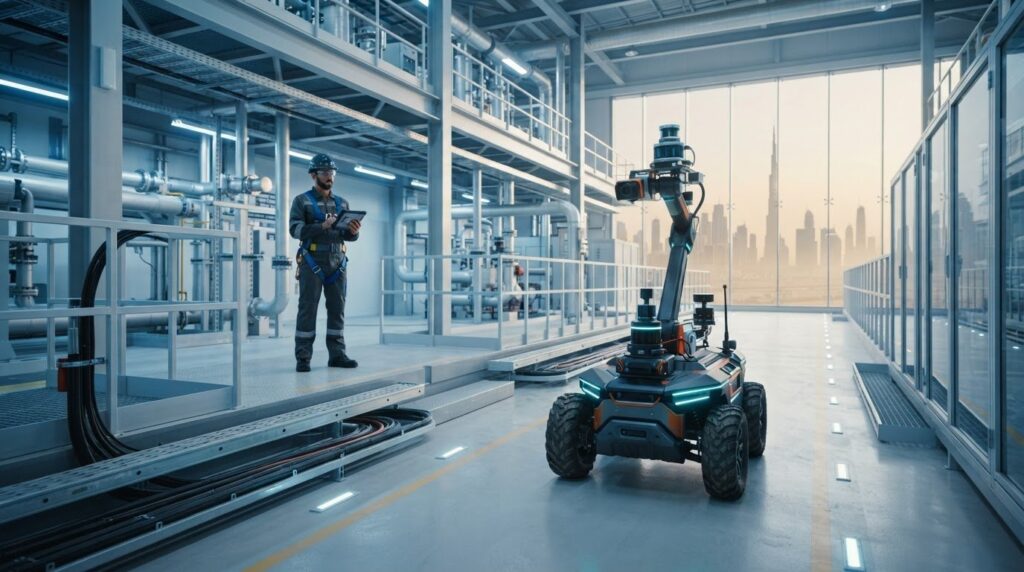
In the Oil & Gas sector, the deployment of specialized inspection and surveillance robots provides a critical safety layer in hazardous zones. These autonomous units perform routine checks and material delivery in environments where human presence poses significant risks. Similarly, the cold storage industry relies on automation to maintain throughput in temperature-controlled environments. Utilizing ASRS and AMRs designed for sub-zero operation, facilities can reduce energy loss caused by frequent door openings and eliminate the productivity drops associated with human labor in extreme cold.
Robotics in Manufacturing and Assembly
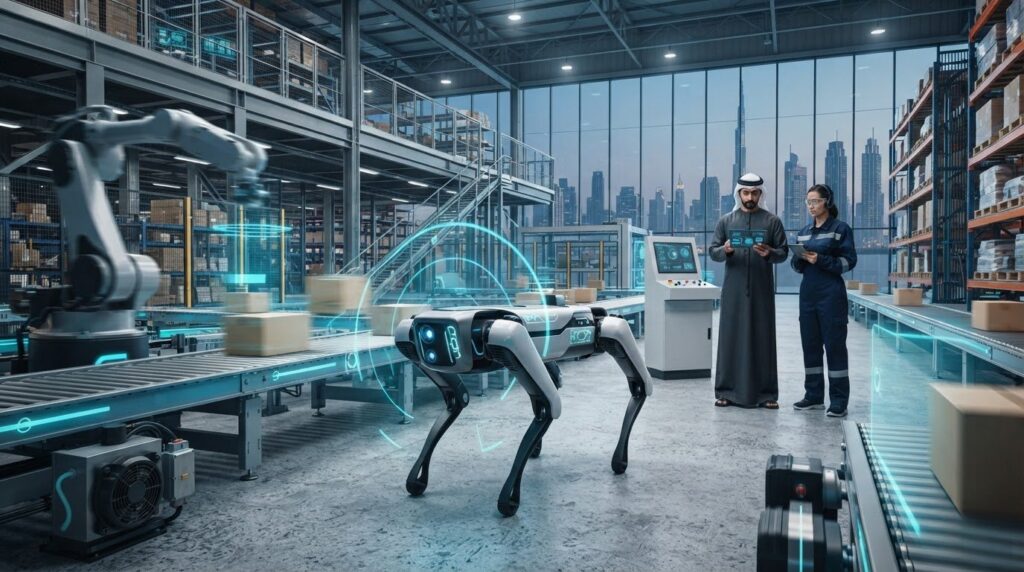
Integrating collaborative robots UAE into assembly lines has redefined the relationship between human skill and machine precision. Manufacturers deploy cobots for palletizing and machine tending, which effectively reduces physical strain on the workforce while maintaining consistent cycle times. These systems ensure safety through advanced sensor arrays and force-limiting technology, allowing robots to work alongside humans without the need for bulky safety cages. This hybrid approach optimizes material movement within the manufacturing plant, facilitating a leaner, more responsive production model.
Specialized Service Robotics for Large Facilities
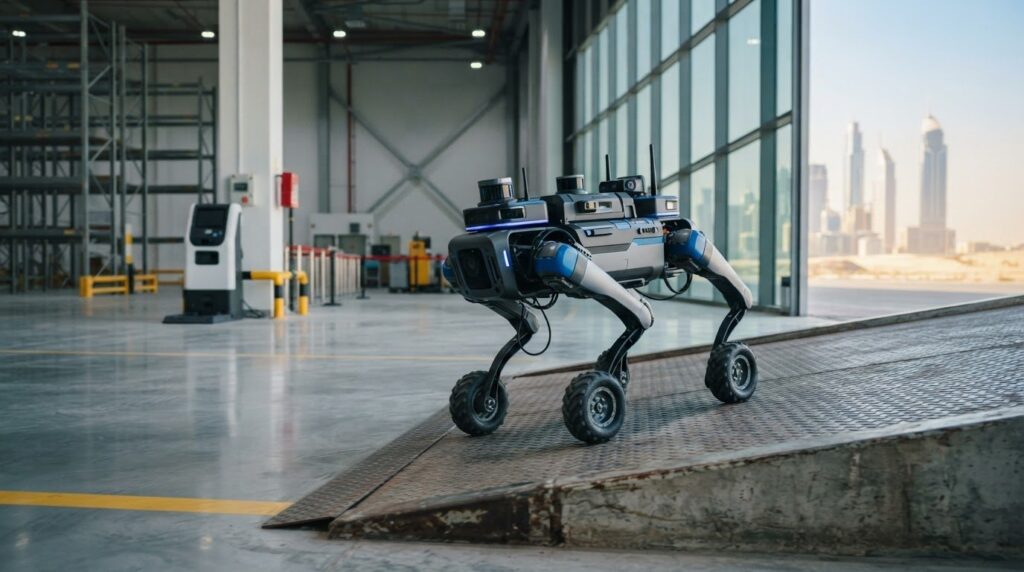
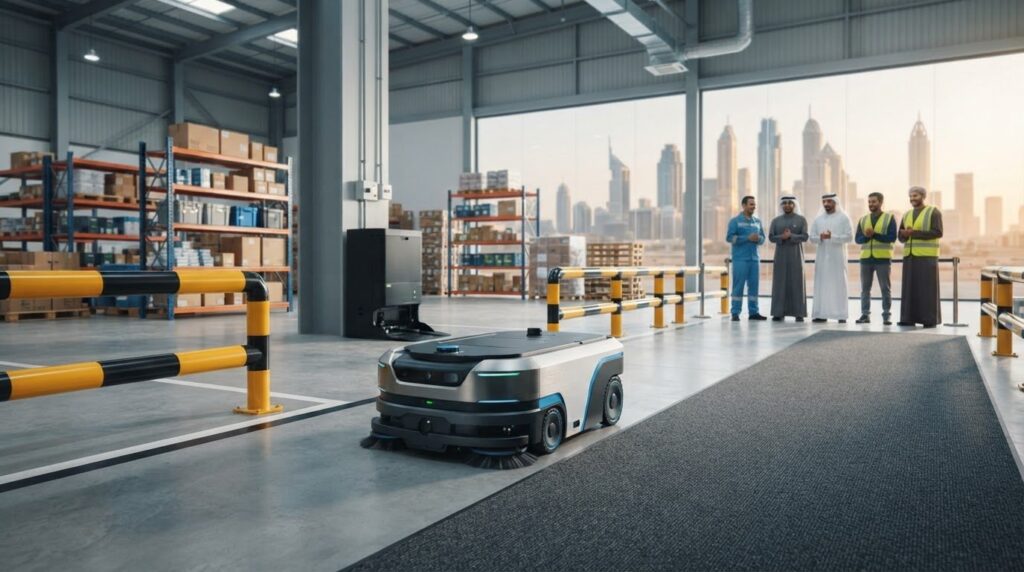
Large-scale facilities in hospitality and healthcare are increasingly adopting delivery robots to manage internal logistics. These units transport medical supplies or linens autonomously, freeing up staff for high-value tasks. Integrating autonomous cleaning robots into broader material handling workflows ensures that industrial floors remain debris-free, which is essential for the reliable operation of AMRs. Looking toward the future, the introduction of humanoid robots for complex, multi-tasking roles suggests a new era of facility management where automated material handling systems Middle East extend beyond simple transport into sophisticated service orchestration.
The Intelligence Layer: PLC and SCADA Integration
Deploying high-performance hardware without a unified control architecture creates fragmented operational silos that hinder the very efficiency automation aims to provide. Effective automated material handling systems Middle East rely on the seamless orchestration of Programmable Logic Controllers (PLCs) and Supervisory Control and Data Acquisition (SCADA) systems to transform raw mechanical movement into a synchronized industrial process. While the physical layer handles the weight, the PLC manages the localized machine logic, ensuring that every sensor trigger and motor response occurs with millisecond precision. Complementing this, SCADA provides the centralized visualization necessary for operators to monitor entire facility health from a single interface. Utilizing professional PLC and SCADA integration services ensures that your hardware investments are backed by a robust, fail-safe digital nervous system.
Bridging the Gap Between IT and OT
Achieving a true Industry 4.0 environment requires bridging the gap between Information Technology (IT) and Operational Technology (OT). This integration ensures that your Warehouse Management System (WMS) communicates fluently with floor-level robotics, providing a single source of truth for inventory and movement data. By utilizing SCADA-generated reports, facility managers can identify specific throughput bottlenecks and adjust operational parameters in real-time. Future-proofing your facility involves adopting scalable control architectures and modular PLC programming, allowing your automated material handling systems Middle East to evolve as your business expands.
Maintenance and Reliability in Automated Systems
Reliability is the cornerstone of any autonomous operation. Integrated SCADA systems enable predictive maintenance alerts, identifying potential component failures before they result in costly downtime. Through remote diagnostics and real-time error logging, technical teams can troubleshoot complex issues with unprecedented speed. This data-driven approach reduces the total cost of ownership by extending the lifespan of critical machinery. While remote monitoring is powerful, the importance of local technical expertise remains paramount for rapid system troubleshooting and physical maintenance. You can optimize your control architecture today by exploring how bespoke control integration unifies your industrial assets into a high-performance ecosystem.
Strategic Implementation: Partnering for Industrial Transformation
Conducting a comprehensive site audit remains the foundational step in determining an organization’s automation readiness. This meticulous evaluation assesses existing material flow patterns, structural constraints, and digital infrastructure to ensure that the transition to automated material handling systems Middle East is grounded in operational reality. Calculating the Total Cost of Ownership (TCO) extends far beyond the initial capital expenditure, as it encompasses long-term maintenance, energy consumption, and the projected ROI derived from increased throughput. Industrial leaders must prioritize a diagnostic approach that identifies specific inefficiencies before committing to a technological overhaul, ensuring that every robotic asset serves a clear strategic purpose.
EdNex Automation delivers bespoke integration for the Middle East’s industrial leaders, acting as a bridge-builder between global technological breakthroughs and regional operational needs. Selecting a partner with deep regional expertise is vital for navigating the unique economic and environmental challenges of the peninsula. By combining global tech access with localized technical support, organizations can implement automated material handling systems Middle East that are both innovative and resilient. This partnership model ensures that the intelligence layer and physical hardware are perfectly synchronized to meet the high-density storage and rapid fulfillment demands of 2026.
The Roadmap to Successful Automation
Executing a successful transition requires a structured, three-phase roadmap. Phase 1 involves the rigorous analysis and simulation of material flow patterns to visualize how autonomous systems will interact with existing workflows. Moving into Phase 2, the focus shifts to bespoke system design and the planning of PLC and SCADA architectures, which provides the digital nervous system for the facility. Finally, Phase 3 encompasses the physical deployment, rigorous testing, and comprehensive staff training necessary for autonomous operations. This hierarchical progression mitigates implementation risks and ensures a seamless integration of new technologies into the daily industrial cycle.
Why Choose a Specialized Integration Partner?
Partnering with a specialized integrator provides access to a diverse technological portfolio that ranges from high-capacity AMRs to advanced humanoid robots for sale UAE. Leveraging official certifications and strategic alliances with global automation leaders, EdNex Automation ensures that every system adheres to the highest international standards of safety and efficiency. This authoritative standing provides the intellectual framework necessary for continuous system optimization, framing automation not as a one-time acquisition but as a necessary evolution for long-term business viability. Through professional consultancy and technical precision, we empower enterprises to transform their logistics hubs into self-optimizing ecosystems.
Architecting the Future of Regional Industrial Excellence
Transitioning to an autonomous industrial model requires a sophisticated synthesis of intelligent hardware and robust control architectures. The strategic selection between modular robotics and high-density vertical storage must be driven by a technical audit of your facility’s specific constraints and throughput demands. Integrating automated material handling systems Middle East into your infrastructure is no longer a luxury for the few; it’s a fundamental requirement for any organization aiming to remain competitive in an increasingly high-speed, data-driven market. Success in this transformation depends on the intellectual framework provided by experts who understand the gravity of large-scale industrial evolution.
You can consult with EdNex Automation experts to design your bespoke material handling system and secure a framework built on comprehensive PLC and SCADA expertise. Leveraging our status as Industry 4.0 certified integrators and our global technology alliances ensures that your facility remains at the absolute cutting edge of progress. Your journey toward a self-optimizing, resilient supply chain is a necessary evolution that begins with a commitment to controlled and deliberate innovation. Let’s build a future where your operations aren’t just efficient, but visionary.
Frequently Asked Questions
What is the typical ROI for automated material handling systems in the Middle East?
ROI for automated material handling systems Middle East typically ranges between two and five years depending on the scale of the deployment and the labor costs being offset. By reducing manual errors and increasing storage density, enterprises achieve long-term savings in operational expenditures. The specific timeline is often accelerated in high-growth sectors where 24/7 throughput is essential for maintaining market share.
Can AMRs and ASRS be integrated into existing legacy warehouses?
Integrating modern robotics into legacy warehouses is entirely feasible, particularly through the deployment of infrastructure-free AMRs. While fixed ASRS installations might require structural modifications to floor loads or ceiling heights, mobile units can navigate existing aisles without permanent changes. This modular approach allows facility managers to modernize their operations incrementally without the need for a complete facility teardown.
How do extreme temperatures in the UAE affect robotic battery life and performance?
Extreme heat in the UAE can degrade robotic battery life and performance if it’s not managed through specialized thermal management systems. Advanced industrial robots utilize internal cooling and high-temperature-tolerant lithium-ion cells to maintain operational integrity during peak summer months. Charging stations are often placed in climate-controlled zones to prevent overheating during rapid energy replenishment cycles.
What is the difference between an AGV and an AMR for warehouse use?
The primary difference lies in the level of autonomy and navigational intelligence. Automated Guided Vehicles (AGVs) follow fixed paths via magnetic tape or wires, making them less adaptable to changing floor layouts. Autonomous Mobile Robots (AMRs) utilize LiDAR and SLAM to navigate around obstacles independently, providing the flexibility required for dynamic warehouse environments.
How does SCADA integration improve material handling efficiency?
SCADA integration improves efficiency by providing a unified visualization of the entire material handling ecosystem. It allows operators to identify throughput bottlenecks in real-time and adjust machine parameters to optimize flow. By centralizing data from various PLCs, SCADA ensures that hardware assets function as a cohesive, intelligent unit rather than isolated machines.
What industries benefit most from ASRS implementation?
Industries with high SKU counts and limited floor space, such as pharmaceuticals and e-commerce, benefit most from ASRS implementation. Cold storage facilities also see a high return on investment because ASRS reduces the volume of air that needs to be cooled and minimizes human exposure to sub-zero temperatures. Any sector requiring high-density storage and rapid retrieval is an ideal candidate for automated material handling systems Middle East.
Are humanoid robots ready for practical material handling roles in 2026?
Humanoid robots are entering practical material handling roles in 2026, specifically for complex tasks that require human-like dexterity and multi-functional movement. While AMRs handle bulk transport, humanoids are being deployed for intricate sorting and collaborative assembly roles where traditional robotic arms are too limited. They represent the next tier of autonomy for enterprises aiming for a fully lights-out facility.
What kind of maintenance is required for automated storage systems?
Maintenance for automated storage systems involves a combination of scheduled mechanical inspections and data-driven predictive monitoring. SCADA systems log machine performance to alert technical teams of potential component wear before a failure occurs. Regular lubrication of cranes and shuttle tracks, along with software updates for the control layer, ensures the system maintains peak operational reliability.