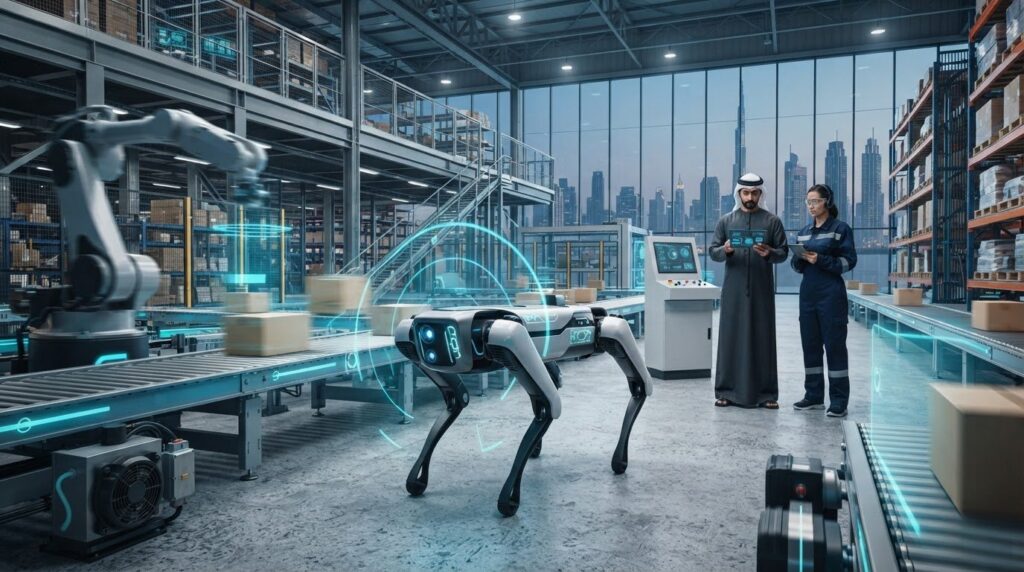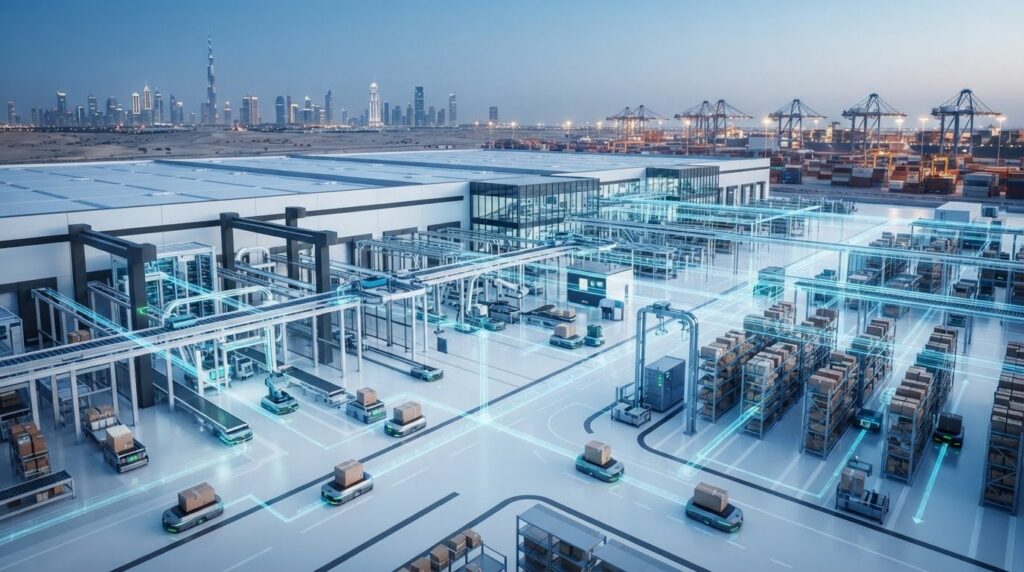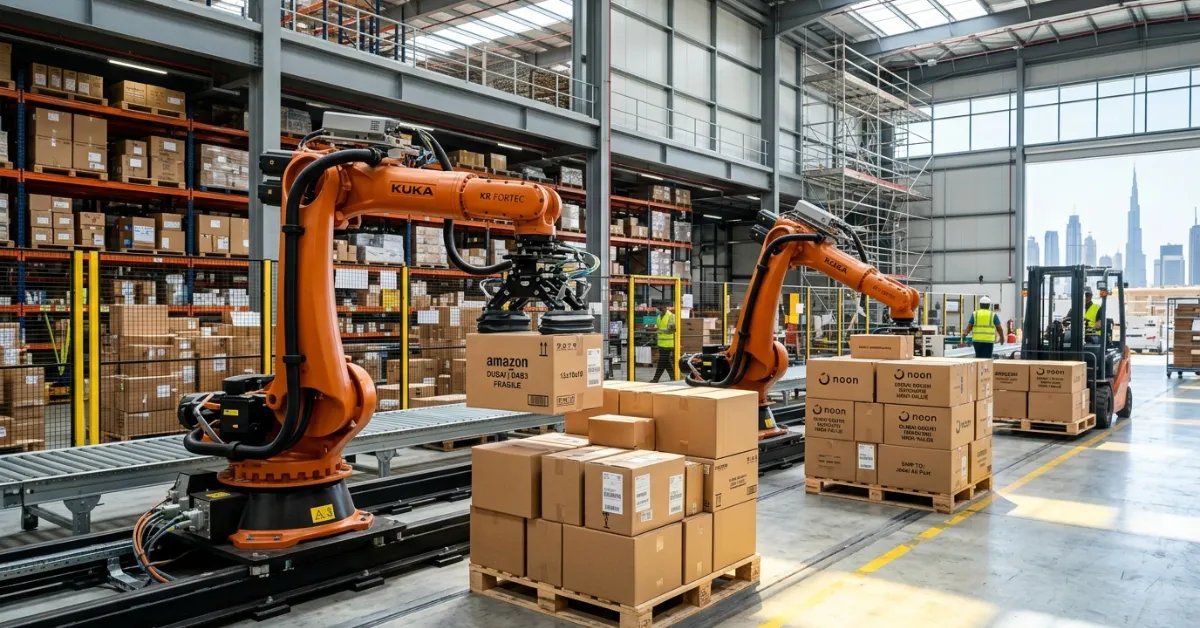
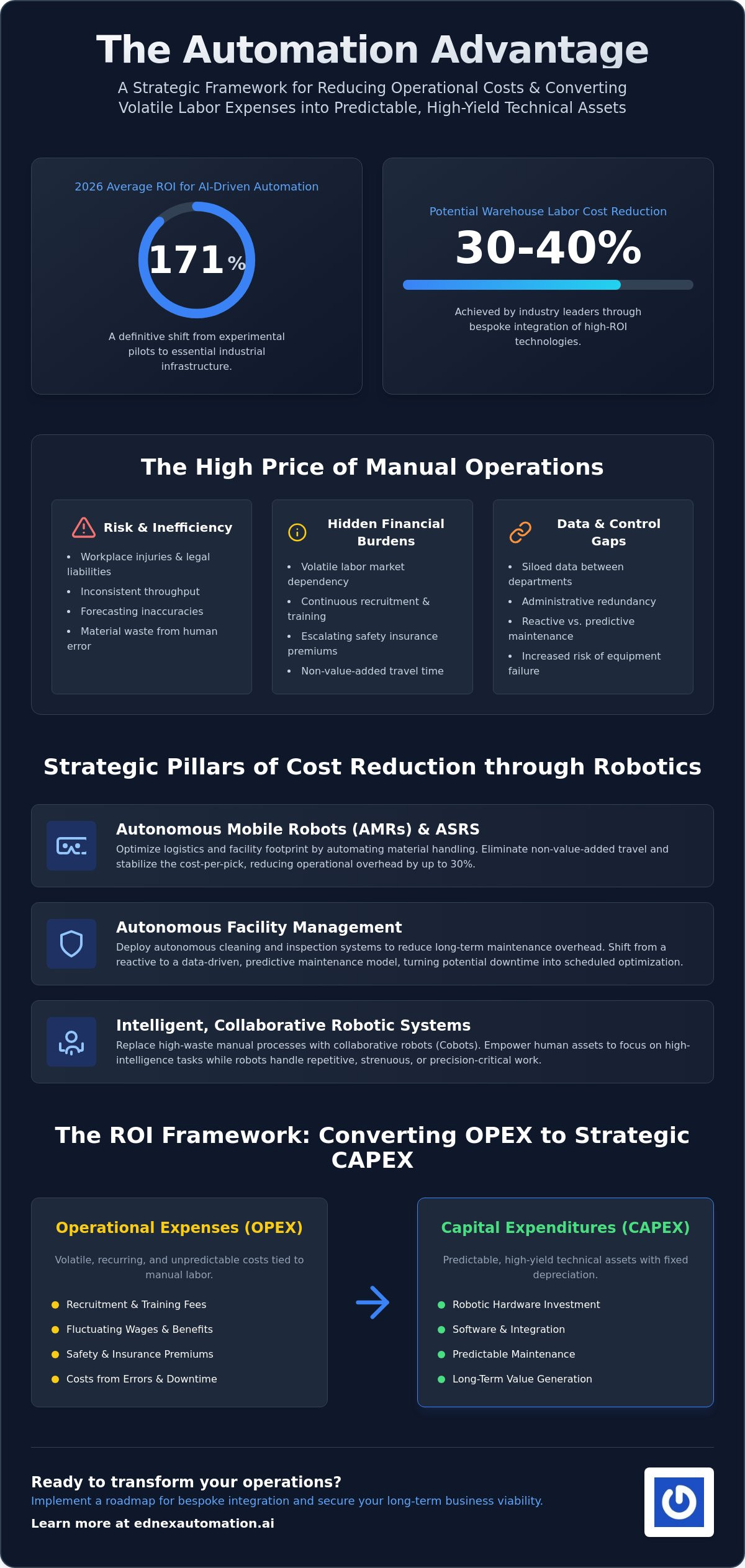
In 2026, the average return on investment for AI-driven automation has reached 171 percent, signaling a definitive shift from experimental pilots to essential industrial infrastructure. Leveraging advanced robotics allows visionary organizations to convert volatile manual labor expenses into predictable, high-yield technical assets. You’ve likely recognized that relying on fluctuating labor markets and manual material handling is no longer a viable strategy for maintaining competitive margins. This strategic framework demonstrates exactly how to reduce operational costs with automation by integrating sophisticated control systems that eliminate human error and optimize facility maintenance.
Transitioning from manual workflows to autonomous systems requires more than just hardware; it demands a systematic approach to modernization. We’ll provide a clear roadmap for implementing high-ROI technologies such as Collaborative Robots and Automated Storage and Retrieval Systems (ASRS). By focusing on bespoke integration and global-standard certifications, your organization can achieve the 30 to 40 percent reduction in warehouse labor costs that now defines industry leaders. This article identifies the specific categories of robotics that will secure your long-term business viability in an increasingly automated economy.
Key Takeaways
- Analyze the hidden financial burdens of manual labor and the strategic shift toward converting variable expenses into predictable technical assets.
- Master the deployment of Autonomous Mobile Robots (AMRs) and ASRS technology to optimize facility footprints while learning how to reduce operational costs with automation.
- Evaluate the transformative impact of autonomous cleaning and inspection systems on reducing long-term facility maintenance overhead.
- Build a robust ROI model that transitions your organization from volatile labor markets to a fixed-asset depreciation strategy within the regional industrial sector.
- Implement a roadmap for bespoke integration that identifies high-waste manual processes and replaces them with intelligent, collaborative robotic systems.
Understanding the Shift: Why Manual Operational Costs are Rising
Identifying the specific drivers behind escalating industrial overhead is the first step toward achieving long-term business viability. In the context of Industry 4.0, operational cost reduction isn’t merely about trimming budgets; it’s about replacing unpredictable human variables with the precision of autonomous systems. Understanding how to reduce operational costs with automation begins with a critical assessment of manual dependencies that drain capital through inefficiency. While digital workflows often rely on Robotic Process Automation to streamline software tasks, physical industrial environments require a more robust integration of hardware and intelligence to stabilize margins.
Analyzing the hidden costs of manual labor reveals a complex web of recruitment fees, continuous training requirements, and escalating safety insurance premiums. These expenses are often treated as fixed costs, yet they’re highly volatile and subject to regional labor market shifts. Beyond direct wages, human error introduces a layer of risk that manifests as material waste and inconsistent industrial throughput. Transitioning from a reactive maintenance model to an automated, data-driven approach allows facilities to anticipate failures before they occur, effectively turning potential downtime into scheduled, high-efficiency windows of optimization.
The High Price of Manual Material Handling
Manual material handling remains a primary source of industrial friction. Traditional picking and transport methods create significant bottlenecks that limit the speed of the entire production line. Consider the following impacts of manual variability:
- Workplace Injuries: Physical strain and repetitive motion lead to injuries that result in costly downtime and legal liabilities.
- Forecasting Inaccuracy: Human-led processes lack the rhythmic consistency needed for precise production forecasting, making it difficult to commit to aggressive delivery timelines.
- Non-Value-Added Travel: A substantial portion of manual labor hours is spent simply moving goods from point A to point B, a task that adds zero value to the end product.
Administrative Redundancy in Industrial Control
Non-integrated manufacturing plants often suffer from siloed data, where information from one department doesn’t communicate with another. This lack of transparency leads to administrative redundancy as staff must manually bridge the gap between disparate systems. When monitoring is left to manual observation, the risk of catastrophic equipment failure increases exponentially because subtle indicators of wear are easily missed. Establishing a unified operational view requires PLC and SCADA integration services to centralize oversight. By automating these control layers, organizations ensure that real-time data informs every decision, eliminating the guesswork that characterizes manual oversight and providing a clear path for how to reduce operational costs with automation across the entire facility.
Strategic Pillars of Cost Reduction through Robotics
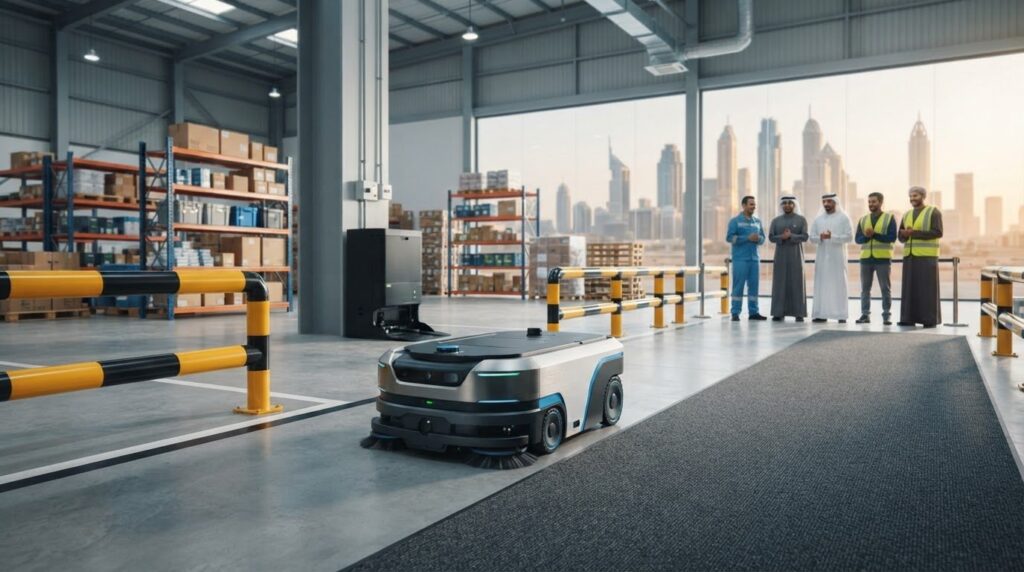
While many organizations focus on software-based efficiency, the physical movement of goods remains the largest cost center in industrial operations. Deploying autonomous mobile robots eliminates non-value-added travel time, ensuring that human assets focus on high-intelligence tasks rather than manual transit. Recent engineer-driven innovations demonstrate that these physical systems can reduce operational overhead by up to 30 percent in complex environments. By integrating delivery robots and automated storage, businesses can streamline internal parts distribution and optimize their entire logistics chain. This transformation isn’t just about speed; it’s about stabilizing the cost of every unit moved through the facility.
Optimising Logistics with AMRs and ASRS
The cost-per-pick in a manual facility is inherently tied to volatile labor rates and human fatigue, whereas automated storage and retrieval systems provide a consistent, high-density solution. These systems maximize vertical space, often reducing the required facility footprint by 40 percent or more. AMRs offer a flexible alternative to expensive fixed infrastructure like conveyors, allowing for modular plant layouts that adapt to changing demand without requiring massive capital reinvestment. Implementing “lights-out” warehouse operations further reduces energy consumption, as robotic systems don’t require the same lighting or climate control levels as human workers. This approach is a fundamental component of how to reduce operational costs with automation while simultaneously increasing throughput in an increasingly competitive market.
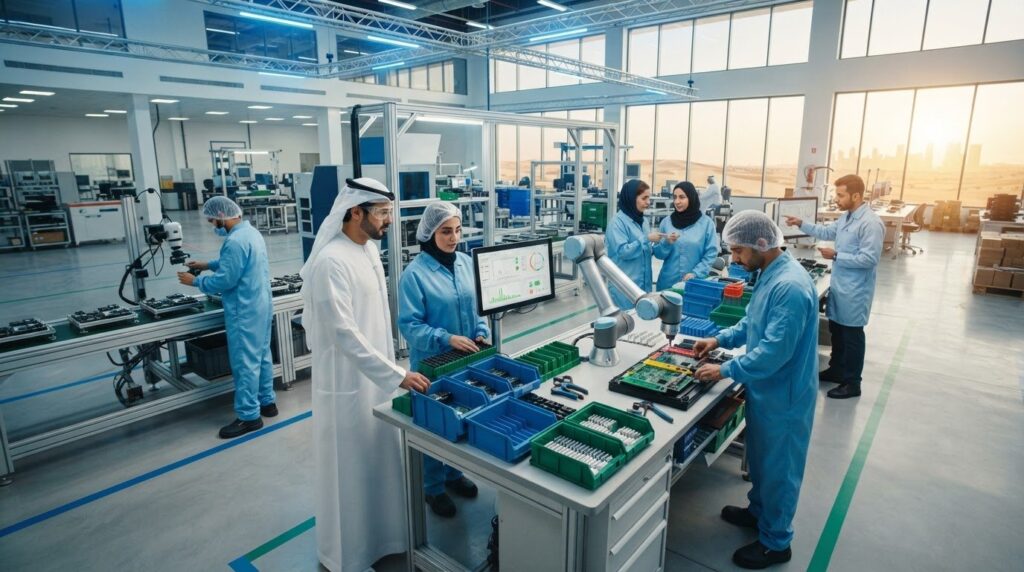
Precision Assembly with Collaborative Robots
High-precision, repetitive assembly tasks are prone to human error, which directly impacts scrap rates and material waste. Utilizing collaborative robots UAE allows for seamless human-robot cooperation, ensuring that intricate tasks are completed with sub-millimeter accuracy. These cobots lower the cost of retooling for short-run manufacturing cycles, providing a versatile platform that can be redeployed as production needs evolve. Beyond technical efficiency, automating dull, dirty, or dangerous tasks improves employee retention by elevating the workforce to supervisory roles. Understanding these pillars is essential for any leader exploring bespoke robotic solutions tailored to regional industrial requirements. By 2026, the global AI automation market is valued at 169.46 billion dollars, reflecting a massive shift toward these high-precision assets. Organizations that adopt these technologies now are positioning themselves to capture the 171 percent average ROI reported by successful early adopters.
Autonomous Facility Management: Reducing Maintenance Overhead
Shifting the strategic focus from the production floor to the facility’s perimeter reveals maintenance as a significant, often unoptimized cost center. By leveraging autonomous systems, organizations can transition from reactive cleaning and security models to a proactive, predictive framework that stabilizes long-term expenses. Discovering how to reduce operational costs with automation in facility management requires a move toward technical assets that provide 24/7 reliability without the overhead of shift-based manual labor. These systems don’t just replace manual tasks; they provide a level of consistency and data-driven oversight that human teams can’t replicate across sprawling industrial sites.
Industrial Hygiene and Cleaning Automation
Integrating autonomous cleaning robots into the daily operational schedule directly impacts facility OPEX by standardizing hygiene protocols and preventing costly industrial contamination. Calculating the labor-hour savings of robotic floor scrubbers in large-scale facilities demonstrates a clear reduction in recurring service fees and recruitment volatility. In regional contexts where sand and dust accumulation is a constant threat, autonomous outdoor cleaning robots preserve high-value industrial assets from environmental damage. This consistent, automated approach ensures long-term asset preservation, effectively reducing the frequency of deep-cleaning cycles and the necessity for premature equipment replacements.
Inspection and Surveillance Robotics
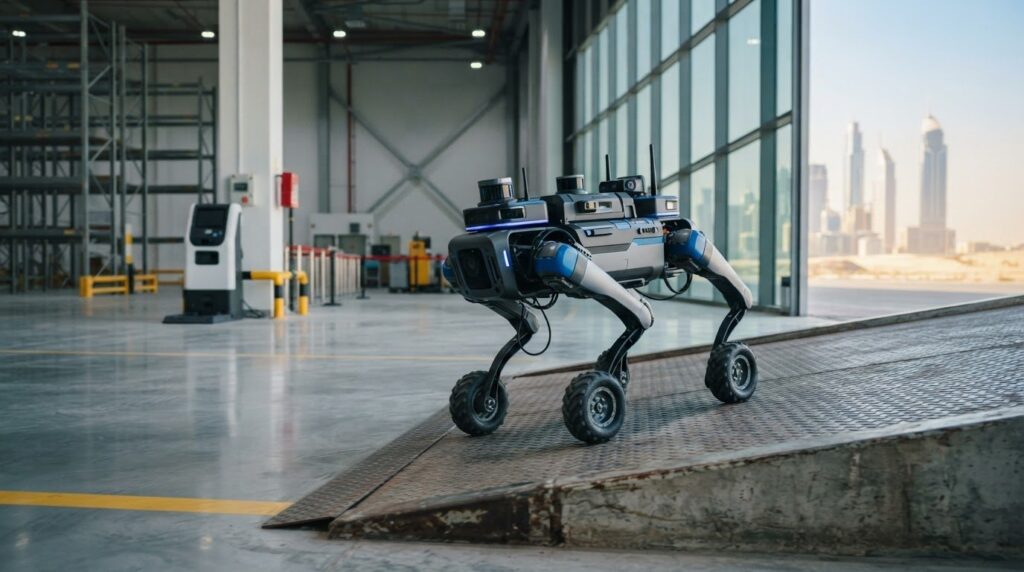
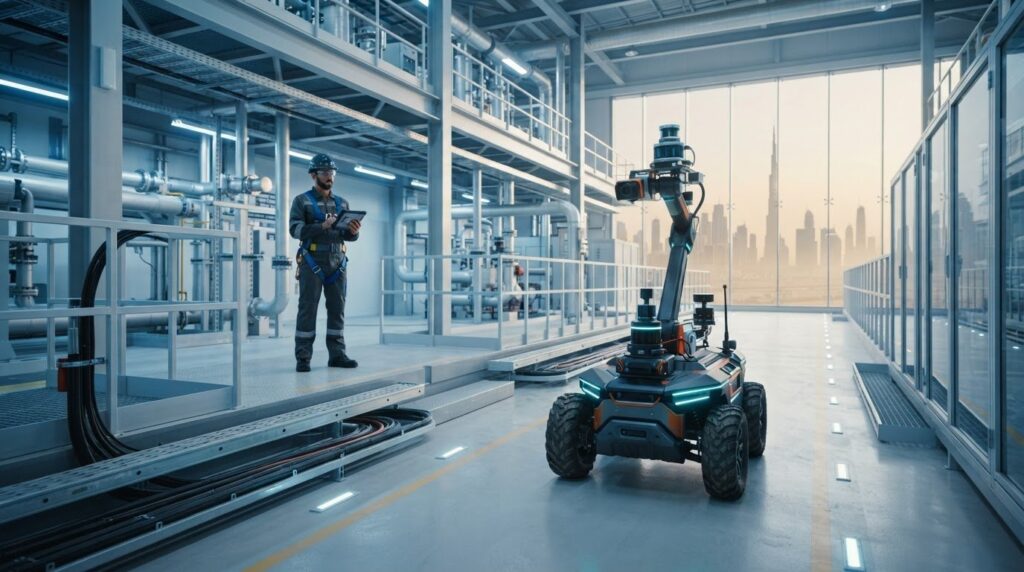
Replacing manual patrol shifts with 24/7 robotic surveillance systems minimizes security costs while significantly enhancing coverage and response times. Utilizing specialized inspection robots allows for the real-time detection of thermal anomalies or leaks before a catastrophic failure occurs, which mitigates the risk of expensive emergency repairs and unscheduled downtime. As the technology matures, the availability of humanoid robots for sale UAE is beginning to provide organizations with high-level facility ambassadors that bridge the gap between technical monitoring and human interaction. These advanced systems provide the intellectual framework necessary for total facility oversight, ensuring that maintenance remains a controlled, data-driven process. By standardizing these protocols, organizations effectively learn how to reduce operational costs with automation while maintaining the highest global standards of safety and industrial hygiene.
The ROI Framework: Converting OPEX to Strategic CAPEX
Shifting from variable monthly labor expenses to fixed asset depreciation represents a fundamental evolution in industrial finance. Unlike manual labor, which remains a recurring and volatile operational expense, robotics and integrated systems are capitalized assets that offer long-term value through depreciation and consistent performance. This transition is central to understanding how to reduce operational costs with automation, as it allows organizations to stabilize their balance sheets while scaling production. Calculating the Total Cost of Ownership (TCO) involves looking beyond the initial purchase price to account for energy efficiency, reduced waste, and the multi-year lifespan of robotic hardware. By treating automation as a strategic capital investment, businesses can project margins with a level of certainty that manual workflows simply cannot provide.
In a rapidly modernizing industrial landscape, the cost of inaction often exceeds the initial investment required for high-tech systems. Organizations that delay adoption find themselves burdened by rising regional labor costs and the inefficiencies of manual material handling. A financial analysis from May 2026 indicates that successful AI automation delivers an average return of 3.70 dollars for every 1 dollar invested, providing a clear mandate for immediate action. Failing to modernize doesn’t just result in higher costs; it creates a competitive gap that becomes increasingly expensive to bridge as competitors achieve the 171 percent average ROI reported by early adopters.
Direct vs. Indirect Cost Savings
Building a robust ROI model requires a dual focus on both immediate financial relief and long-term strategic advantages. Direct savings are often the most visible, including:
- Labor Reduction: Cutting warehouse labor costs by 30 to 40 percent over a five-year horizon.
- Energy Efficiency: Reducing facility overhead through “lights-out” operations and optimized power management.
- Risk Mitigation: Lowering insurance premiums by eliminating high-risk manual tasks and improving workplace safety.
Indirect savings, while harder to quantify, are equally transformative for brand reputation and scalability. These include enhanced data-driven decision-making and the ability to scale operations without a proportional increase in headcount. For a standard AMR installation in a 5,000 sqm facility, the typical payback period is achieved within 18 months through the systematic elimination of manual transit times.
Scaling Automation for Long-Term Viability
Modular automation strategies allow businesses to reduce initial CAPEX by launching high-impact pilot programs before full-scale deployment. Utilizing PLC and SCADA integration ensures that these early-stage solutions remain future-proof and compatible with subsequent expansions. Leveraging UAE industrial incentives for technology adoption in 2026 further accelerates this transition, making it the ideal window for conversion. To begin your journey toward a more predictable financial model, consult with our automation specialists to develop a bespoke implementation roadmap tailored to your specific facility requirements.
Partnering for Success: The EdNex Automation Integration Approach
Identifying high-waste manual processes is the foundation of a successful transition. EdNex Automation provides the intellectual framework necessary to convert these inefficiencies into high-yield assets. By analyzing every touchpoint within your current architecture, we pinpoint exactly where robotic intervention will yield the highest impact. This methodical approach ensures that your journey in learning how to reduce operational costs with automation results in a measurable, scalable improvement in industrial throughput. We focus on reducing your dependency on variable labor markets by replacing volatile human expenses with stable, depreciable technical assets.
Integrating advanced AMRs, Cobots, and ASRS requires more than just hardware placement; it demands a sophisticated understanding of bespoke plant architectures. Our engineering teams specialize in PLC and SCADA programming, ensuring that data flows seamlessly between new robotic units and existing legacy systems. This centralized oversight eliminates the siloed data issues mentioned previously, providing a unified control layer that supports total facility autonomy. We don’t just sell equipment; we act as a technical partner that bridges the gap between global technological breakthroughs and regional industrial needs through controlled and deliberate innovation.
End-to-End Automation Integration
Delivering a comprehensive, start-to-finish expertise, EdNex manages every phase of the automation lifecycle. Our process begins with a rigorous site audit to ensure that every deployment adheres to international safety and industrial standards. Once the systems are active, we provide ongoing firmware updates and system optimization to maintain maximum uptime. This proactive maintenance model prevents the catastrophic equipment failures associated with manual monitoring, securing your investment for the long term and ensuring consistent, high-yield performance.
Start Your Transformation with EdNex
Future-proofing your operations involves more than just current-gen robotics; it requires a vision for the next decade of industrial evolution. By incorporating advanced humanoid and inspection robotics, we prepare your facility for the full spectrum of Industry 4.0 capabilities. We also prioritize the human element of this transformation, offering customized training that allows your staff to transition into higher-value robot-supervisory roles. Contact EdNex today for a tailored operational cost-reduction audit and discover how to reduce operational costs with automation through a partnership built on technical excellence and regional expertise.
Securing Long-Term Industrial Viability through Autonomous Integration
Transitioning from volatile manual labor to stable, high-yield robotic assets is no longer a luxury for the forward-thinking enterprise; it’s a fundamental requirement for remaining competitive in the 2026 industrial landscape. This strategic framework has detailed how to reduce operational costs with automation by integrating autonomous mobile robots and specialized storage systems that optimize facility footprints. By automating facility management and hygiene protocols, organizations effectively eliminate human error and stabilize maintenance overhead across their entire infrastructure.
Success in this new era requires a partner who understands the gravity of large-scale industrial transformation. As an official integrator for leading global robotic brands with specialized Industry 4.0 expertise for the UAE industrial sector, EdNex provides the intellectual framework necessary for seamless modernization. Our comprehensive PLC and SCADA certification ensures that every deployment delivers maximum data transparency and operational control. Consult with EdNex Automation to audit your operational efficiency and take the first step toward a more predictable, high-yield future. Your path to industrial autonomy begins with a single, deliberate action.
Frequently Asked Questions
How quickly can I expect to see a return on investment (ROI) from industrial automation?
Payback periods for industrial automation typically range between 12 and 24 months, depending on the complexity of the installation. Organizations investing in these systems report an average ROI of 171 percent as of 2026, driven by the immediate stabilization of labor expenses and increased throughput. This rapid return ensures that capital is quickly freed up for further facility modernization.
Does implementing robotics require a complete overhaul of my existing facility?
Implementing robotics doesn’t require a complete facility overhaul because modern systems are designed for modular, non-invasive integration. Technologies like AMRs utilize natural feature navigation rather than fixed tracks, allowing them to adapt to your current floor plan. This flexibility minimizes installation downtime and ensures that you can modernize your plant incrementally without disrupting ongoing operations; for those applying similar principles of structural modernization to residential projects, nexeragc.com provides expert general contracting services.
What are the primary maintenance costs associated with autonomous mobile robots (AMRs)?
Maintenance for AMRs is primarily focused on sensor calibration, battery health monitoring, and regular firmware optimization. Unlike manual forklifts that require frequent mechanical repairs, autonomous robots utilize solid-state electronics and brushless motors that significantly reduce wear and tear. These predictable maintenance schedules help stabilize facility OPEX compared to the volatile costs of manual equipment upkeep.
Can collaborative robots (cobots) work safely alongside my existing manual workforce?
Collaborative robots are specifically engineered to work safely alongside manual workforces without the need for safety cages. Utilizing advanced force-feedback sensors and integrated vision systems, cobots automatically adjust their speed or stop completely upon detecting human presence. This allows for a hybrid assembly environment where robots handle repetitive precision tasks while humans focus on complex decision-making.
How does PLC and SCADA integration contribute to reducing operational costs?
PLC and SCADA integration reduces costs by centralizing operational oversight and eliminating the administrative redundancy of siloed data. By providing a unified view of every automated asset, these systems allow for real-time adjustments that mitigate the risk of catastrophic equipment failure. This data-driven approach ensures that your facility operates at peak efficiency with minimal human intervention.
Are autonomous cleaning robots suitable for outdoor industrial environments in the UAE?
Autonomous cleaning robots are highly suitable for outdoor industrial environments in the UAE, specifically those designed to mitigate sand and dust accumulation. These systems utilize specialized filtration and ruggedized chassis to preserve high-value assets from environmental damage. Standardizing these hygiene protocols prevents the costly industrial contamination often seen in regional manufacturing sites.
What is the typical lifespan of an industrial robotic system in 2026?
Industrial robotic systems in 2026 typically feature a lifespan of 10 to 15 years, provided they receive consistent technical support and updates. This longevity allows organizations to transition from variable monthly labor costs to a stable, long-term fixed asset depreciation model. Regular firmware updates ensure that the hardware remains compatible with evolving Industry 4.0 standards throughout its operational life.
Is it possible to automate operations in small to medium-sized manufacturing plants?
Automating operations in small to medium-sized manufacturing plants is entirely possible through modular implementation strategies. Smaller facilities can start with high-impact pilot programs, such as a single AMR for material transport, to discover exactly how to reduce operational costs with automation. This scalable approach allows SMEs to achieve high-ROI outcomes without the necessity for a massive initial capital expenditure.