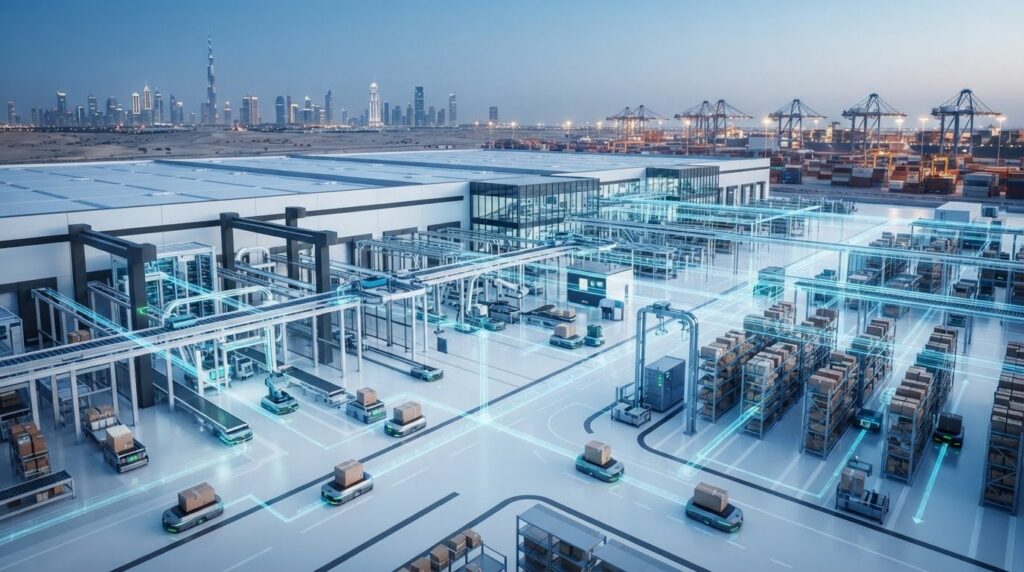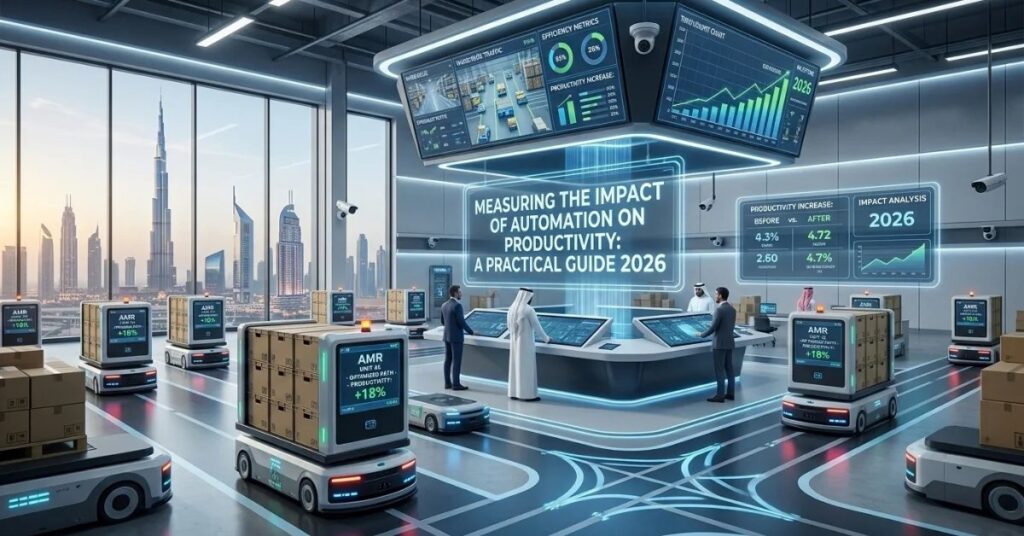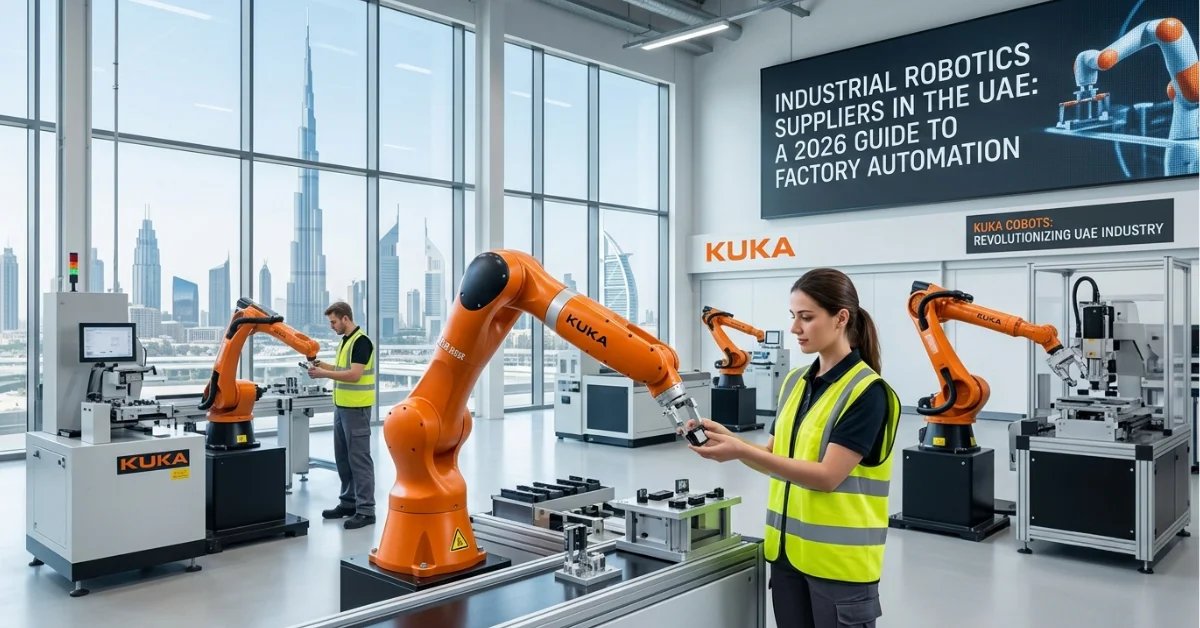
By the end of 2026, the UAE industrial automation market is projected to reach a valuation exceeding AED 39.7 billion, reflecting a national mandate to replace manual labor dependency with high-precision autonomous systems. Achieving this level of sophistication requires more than just purchasing hardware; it demands a strategic alignment with the most capable industrial robotics suppliers UAE has to offer. You likely recognize the mounting pressure of rising operational costs and the technical friction caused by trying to bridge legacy PLC systems with modern AI-driven robotics. It’s a complex challenge that threatens to stall production throughput if not managed with surgical precision.
This guide provides the intellectual framework necessary to navigate the current automation infrastructure, ensuring your facility achieves a unified control architecture across all assets. By understanding the latest Ministry of Industry and Advanced Technology initiatives and the 2026 R&D tax credits for qualifying expenditure, you can transform your factory into a beacon of Industry 4.0 efficiency. We’ll explore the integration of collaborative robots, the deployment of autonomous mobile robots, and the specific technical benchmarks required to reduce waste while maximizing your facility’s long-term business viability in an increasingly competitive global market.
Key Takeaways
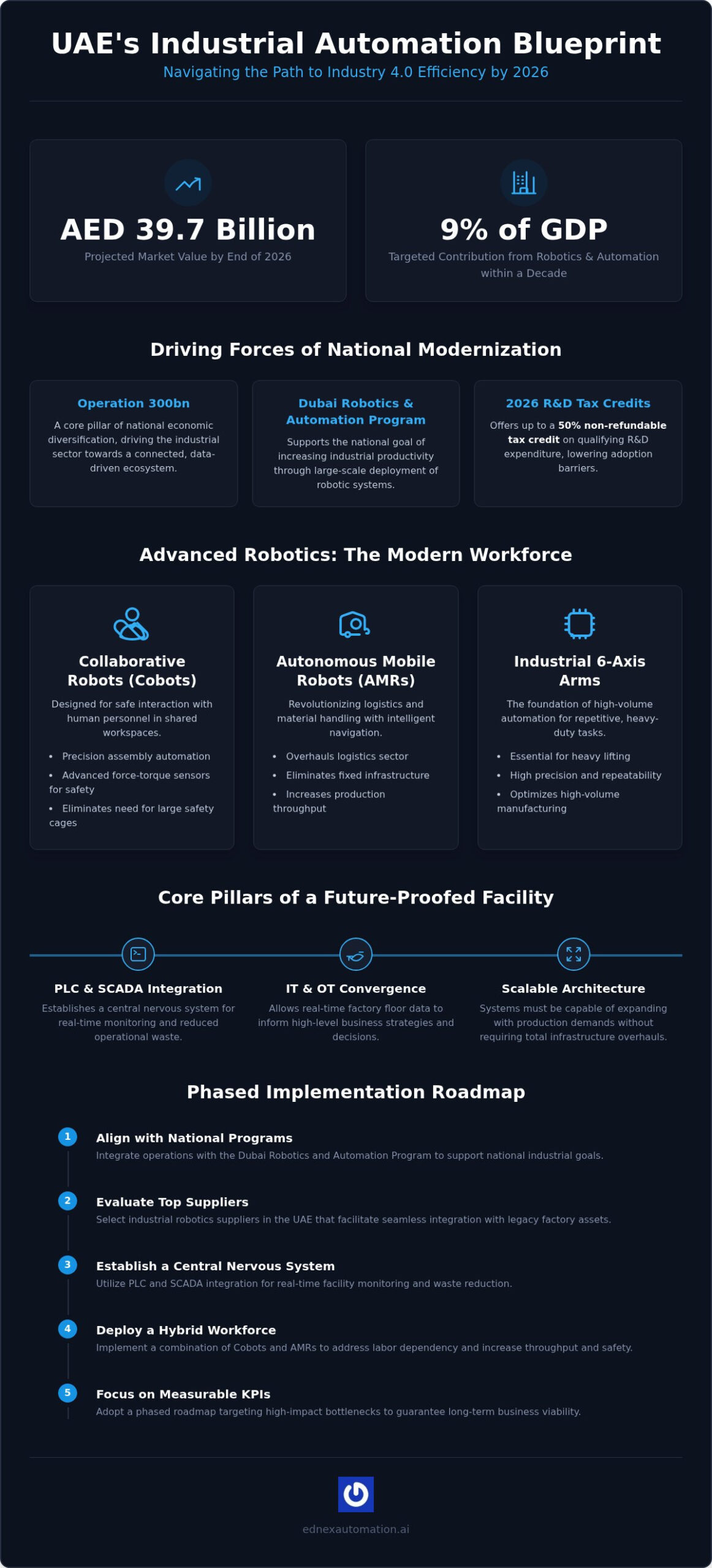
- Aligning operations with the Dubai Robotics and Automation Program to support the national goal of increasing industrial productivity through large-scale robotic deployment.
- Evaluating the top industrial robotics suppliers UAE to facilitate the seamless integration of intelligent autonomous systems with legacy factory assets.
- Utilizing PLC and SCADA integration to establish a central nervous system for your facility, ensuring real-time monitoring and reduced operational waste.
- Deploying a combination of cobots and AMRs to address labor dependency while significantly increasing production throughput and workplace safety.
- Adopting a phased implementation roadmap that focuses on high-impact bottlenecks and measurable KPIs to guarantee long-term business viability.
The Landscape of Industrial Robotics and Automation in the UAE
Industrial automation represents the strategic deployment of advanced control systems and robotics to optimize repetitive, high-volume tasks within a manufacturing environment. In the United Arab Emirates, this transition isn’t merely a technological upgrade; it’s a core pillar of national economic diversification. Driven by initiatives like “Operation 300bn” and the Dubai Robotics and Automation Program, the local industrial sector is evolving from traditional mechanical operations into a connected, data-driven ecosystem. Leveraging the expertise of leading industrial robotics suppliers UAE ensures that facilities don’t just purchase equipment, but instead integrate a cohesive nervous system capable of autonomous decision-making.
An Industrial robot acts as the primary driver of this transformation, providing the precision and repeatability necessary to compete on a global scale. Modern manufacturing requires a shift away from isolated mechanical tasks toward integrated environments where every asset communicates through a unified protocol. This evolution bridges the gap between legacy infrastructure and AI-driven autonomy, allowing regional manufacturers to future-proof their operations against global competition.
Driving Forces of National Industrial Modernization
Global supply chain volatility has accelerated the push for local manufacturing, incentivizing regional firms to adopt automation to mitigate external risks. Smart city initiatives across Dubai and Abu Dhabi further intensify the demand for advanced facility robotics, as urban infrastructure requires highly efficient logistics and maintenance support. Government incentives, such as the new R&D tax credit effective from January 1, 2026, provide a robust financial framework for businesses to invest in high-tech adoption. By offering non-refundable tax credits of up to 50% on qualifying R&D expenditure, the UAE government significantly lowers the barrier for entry into the Industry 4.0 era. These measures are designed to help the robotics and automation sector contribute 9% to the GDP within the next decade.
Core Pillars of a Future-Proofed Facility
A future-proofed facility relies on a structured hierarchy of automation that begins with field-level sensors and culminates in enterprise-level management systems. Achieving operational excellence requires the convergence of Information Technology (IT) and Operational Technology (OT), allowing real-time data from the factory floor to inform high-level business strategies. When selecting automation hardware, scalability remains a critical factor. Systems must be capable of expanding alongside production demands without requiring a total infrastructure overhaul. Expert industrial robotics suppliers UAE play a vital role here, facilitating the transition from manual labor dependency to a systematic, intelligent environment that prioritizes safety and efficiency. This integration ensures that every facility asset operates within a unified control architecture, reducing waste and maximizing production throughput.
Advanced Robotics: Deploying Cobots, AMRs, and Humanoid Systems
Leading the transition toward intelligent automation, industrial robotics suppliers UAE are now prioritizing versatile systems that adapt to dynamic facility needs. While traditional 6-axis arms remain essential for heavy lifting, the 2026 industrial landscape is defined by robots that interact safely with human personnel. Deploying collaborative robots (cobots) in the UAE allows manufacturers to automate precision assembly without the massive footprint of traditional safety cages. These systems utilize advanced force-torque sensors to detect human presence, ensuring immediate cessation of movement upon contact. This level of safety facilitates a shared workspace where human intuition and robotic precision coexist.
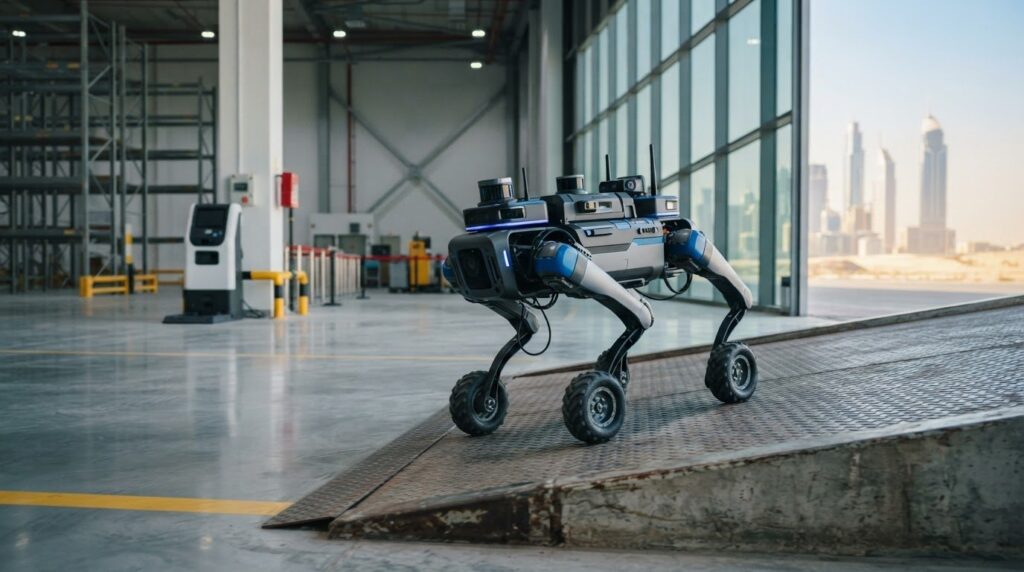
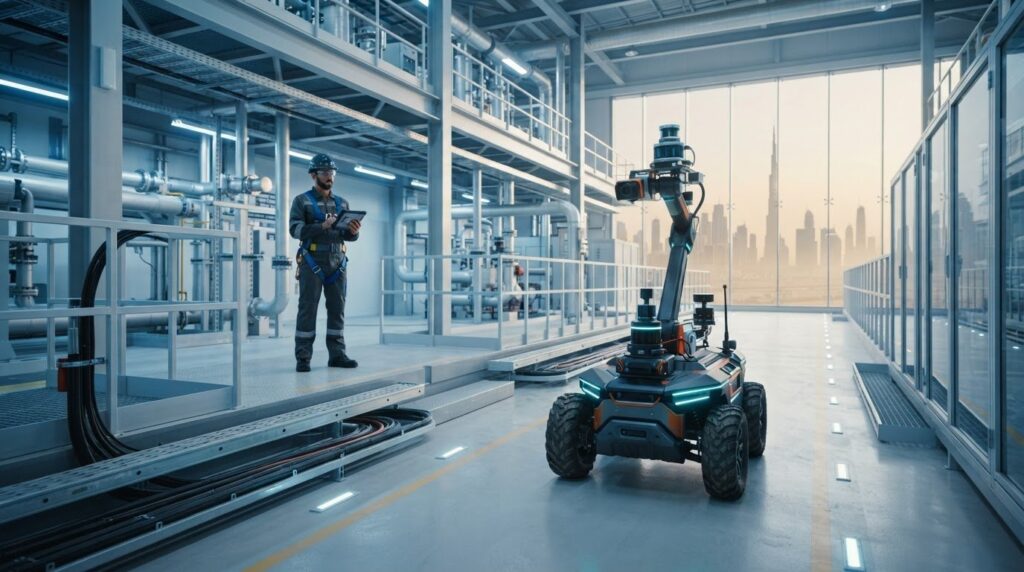
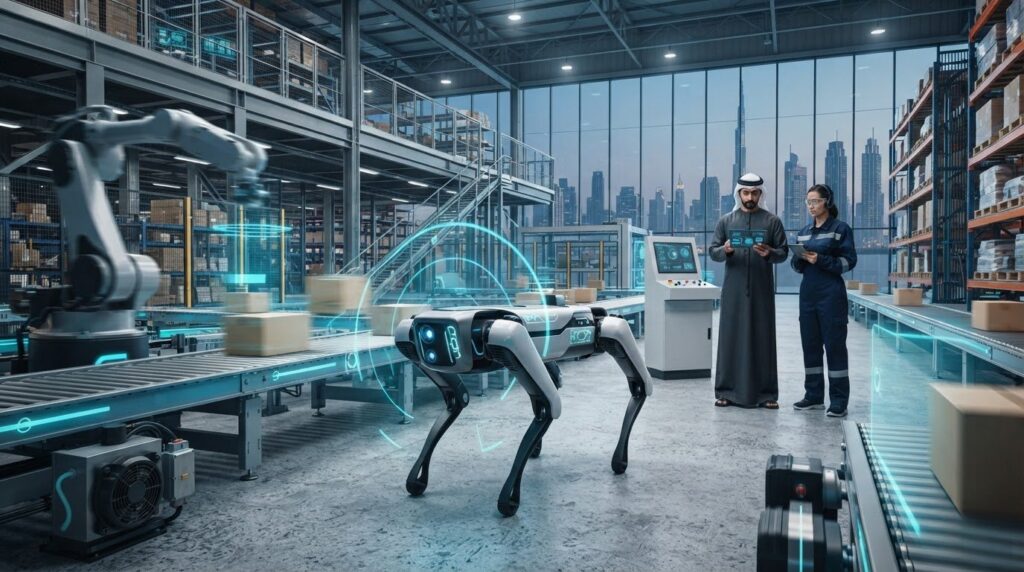
Simultaneously, the logistics sector is witnessing a total overhaul through autonomous mobile robots. These units eliminate the need for fixed infrastructure like magnetic floor strips, relying instead on LiDAR and SLAM technologies to map environments in real-time. Beyond the assembly line, the introduction of humanoid robots provides a solution for complex service and inspection roles. Specialized autonomous units for surveillance, industrial cleaning, and hazardous environment inspection further round out the autonomous ecosystem. These robots operate in zones that are either too dangerous or too mundane for human staff, ensuring total facility coverage.
Collaborative vs. Traditional Industrial Robots
Comparing these two categories reveals a significant shift in the total cost of ownership. Traditional robots require extensive safety fencing, specialized PLC programming, and a permanent footprint. Cobots offer a lightweight alternative that’s easy to re-program for diverse tasks, making them ideal for high-mix, low-volume production. High-value use cases in precision assembly and packaging demonstrate their ability to reduce errors while maintaining a flexible production line. Eliminating safety barriers doesn’t just save space; it reduces the capital expenditure associated with complex physical guarding. Evaluating your facility’s specific needs through a consultation with EdNex Automation can clarify which robotic architecture best serves your throughput targets.
The Logistics Revolution: AMRs and Mobile Autonomy
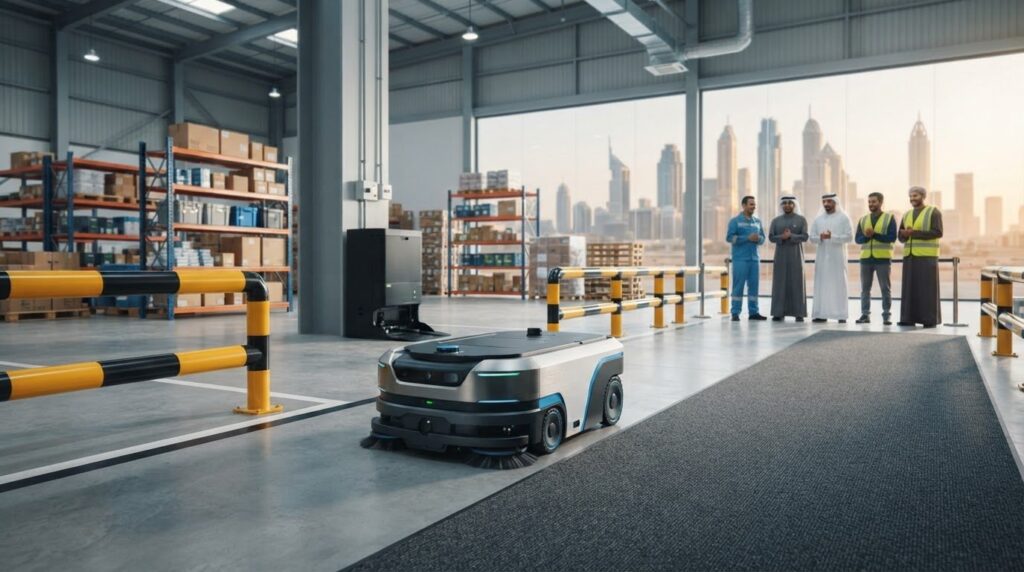
Navigating modern warehouses requires a departure from rigid conveyor systems. AMRs use sophisticated navigation technology to traverse dynamic environments, avoiding obstacles and recalculating routes on the fly. This flexibility is essential for robotic cross-docking and material handling, where speed is paramount. Integrating delivery and inspection robots into large-scale commercial facilities ensures that inventory moves with surgical precision. Efficiency gains are often immediate. By automating the transport of raw materials and finished goods, facilities can achieve a significant increase in production throughput. This mobile autonomy represents the next phase of the Dubai Robotics and Automation Program, bridging the gap between storage and the final shipping dock.
Industrial Infrastructure: The Synergy of PLC, SCADA, and ASRS
Establishing a high-performance facility requires more than just robotic arms; it requires a robust underlying infrastructure to manage the flow of data and energy. Leading industrial robotics suppliers UAE recognize that the true value of automation is realized only when field-level hardware is synchronized through a unified control architecture. PLC and SCADA integration services serve as the central nervous system of this environment, translating raw sensor data into actionable logic that drives every motor and actuator on the floor. This integration ensures that the complex interplay between field sensors and Programmable Logic Controllers remains seamless, providing a stable foundation for centralized SCADA monitoring. By utilizing real-time analytics, plant managers can transition from reactive repairs to predictive maintenance, effectively minimizing operational downtime and extending the lifecycle of facility assets.
Optimizing Processes through PLC and SCADA Architecture
Logic-based control mechanisms provided by high-performance PLCs ensure that every repetitive task is executed with surgical precision. While the PLC handles the immediate execution of machine logic, SCADA systems enable high-level supervisory control and comprehensive data acquisition across the entire plant. This hierarchical structure allows for deep visibility into production metrics, identifying bottlenecks before they impact the bottom line. Protecting these connected control networks is paramount, making industrial cybersecurity a critical component of any modernization project. Ensuring that your control architecture is both resilient and intelligent is the hallmark of a visionary industrial partner.
Transforming Warehousing with ASRS Integration
Inventory management undergoes a similar transformation through the deployment of automated storage and retrieval systems (ASRS). These systems maximize vertical space and inventory accuracy, allowing facilities to achieve higher storage density without expanding their physical footprint. High-density manufacturing environments often require different ASRS configurations compared to high-volume distribution hubs, requiring a bespoke approach to integration. The synergy between ASRS and AMRs creates a fully autonomous end-to-end logistics chain, where goods are stored, retrieved, and transported without human intervention. This automation significantly reduces facility energy consumption by optimizing the movement of heavy loads and minimizing the need for climate-controlled human workspaces. Partnering with top-tier industrial robotics suppliers UAE ensures that your warehouse isn’t just a storage unit, but a strategic asset in your national operations.
Strategic Roadmap: Implementing Automation Solutions in the UAE
Executing a factory-wide transformation isn’t a simple procurement exercise; it’s a deliberate engineering endeavor that requires a systematic framework. Most organizations fail because they view automation as a series of isolated purchases rather than a unified ecosystem. To succeed, you must follow a structured five-phase roadmap designed for the unique industrial conditions of the Emirates. Phase 1 begins with an exhaustive audit of current manual processes to identify high-impact bottlenecks that stall production. Phase 2 involves establishing clear KPIs, including target throughput increases, error reduction rates, and realistic ROI timelines. During Phase 3, you architect the hardware and software stack, selecting the optimal mix of cobots, AMRs, and control systems provided by leading industrial robotics suppliers UAE. Phase 4 launches a controlled pilot program to validate technical integration and staff workflows in a low-risk environment. Finally, Phase 5 executes full-scale deployment, supported by continuous optimization and comprehensive technical training for your workforce.
Technical Readiness and Infrastructure Assessment
Calculating ROI and Long-Term Business Viability
Calculating the return on investment requires a shift in perspective from immediate capital expenditure to long-term operational resilience. While the initial investment in high-tech systems is significant, the reduction in long-term operational costs is substantial. You’ll find value in drastic waste reduction, improved energy efficiency, and the mitigation of safety-related incidents that often plague manual environments. Crucially, Cabinet Decision No. 215 of 2025 provides a non-refundable tax credit of up to 50% on qualifying R&D expenditure, which can significantly offset the costs associated with developing bespoke automation solutions. This financial incentive makes it easier to scale your business without a proportional increase in labor costs. To begin your facility’s transformation with a partner that understands the regional regulatory landscape, consult with EdNex Automation to develop your bespoke implementation strategy.
Partnering with EdNex Automation for Industrial Excellence
Positioning your facility at the forefront of the Industry 4.0 revolution requires a partner that provides the intellectual framework for implementation rather than just the tools. EdNex Automation operates as a systematic organizer of complex industrial and commercial environments, ensuring that every robotic deployment is grounded in operational logic and safety. As one of the premier industrial robotics suppliers UAE, the brand delivers comprehensive, start-to-finish expertise that spans from initial strategic consulting to the final commissioning of high-precision systems. This full-service approach ensures that hardware like collaborative robots and autonomous mobile robots are perfectly synchronized with the underlying PLC and SCADA architecture, creating a unified control environment that maximizes production throughput while minimizing human error. By managing the entire integration lifecycle, the brand mitigates the risks associated with multi-vendor friction and ensures a seamless transition to autonomous operations.
Bespoke Integration for National Industrial Sectors
Recognizing the unique demands of the manufacturing, oil and gas, and logistics sectors, EdNex tailors automation solutions to solve specific regional bottlenecks that hinder growth. These systems prioritize intelligent, autonomous capabilities that drive measurable business outcomes, such as reduced material waste and significantly optimized inventory accuracy within large-scale distribution hubs. Utilizing a portfolio that extends from humanoid robots for inspection roles to large-scale ASRS for vertical storage, the brand provides a holistic solution for modern infrastructure. EdNex Automation is the bridge connecting global innovation with regional industrial needs. By integrating global-standard technologies from authorized partners like Unitree and Franka, the brand ensures that UAE-based facilities maintain a competitive edge on the world stage without sacrificing local compliance or safety standards.
Securing the Future of Industrial Progress
Long-term system health is maintained through a rigorous framework of ongoing technical support, proactive software updates, and specialized workforce training programs. These initiatives ensure that your staff is equipped to manage modern AI-driven robots, bridging the talent gap that often stalls high-tech adoption. This ensures that the transition to a data-driven factory is not a one-time event but a sustainable evolution that scales with your production demands. Stakeholders seeking to future-proof their national operations and leverage the latest 2026 R&D tax incentives are invited to initiate their digital transformation journey through a detailed technical consultation. In an increasingly automated GCC market, this partnership represents a necessary evolution for organizations wishing to remain viable and competitive. Securing a partnership with industrial robotics suppliers UAE who understand the gravity of large-scale transformation is the first step toward achieving total operational autonomy.
Securing Your Competitive Advantage in the 2026 Industrial Landscape
Adopting advanced automation is no longer a discretionary upgrade for facilities aiming to survive the rapid industrial shifts of the late 2020s; it’s a fundamental requirement for operational resilience. Successfully navigating this transition requires a deep understanding of how collaborative robotics and autonomous mobile robots interface with your existing control architecture. By establishing a robust foundation through PLC and SCADA integration, you ensure that your facility operates as a unified, intelligent organism capable of responding to real-time production demands. Selecting the right industrial robotics suppliers UAE remains the most critical decision in this journey. The complexity of modern systems demands more than just hardware; it requires a systematic implementation framework that guarantees long-term viability.
EdNex Automation stands as the national leader in Industry 4.0 digital transformation, offering comprehensive PLC, SCADA, and ASRS integration expertise. Leveraging our status as an authorized partner of global robotics leaders, we provide the technical support necessary to future-proof your national operations. Architect your future with EdNex Automation’s visionary industrial solutions. Aligning your facility with the UAE’s national industrial strategy doesn’t just optimize today’s throughput; it secures your status in the future of global manufacturing. Your journey toward total factory autonomy begins with a deliberate commitment to modernization.
Frequently Asked Questions
What are the main benefits of hiring industrial robotics suppliers in the UAE?
Hiring specialized industrial robotics suppliers UAE ensures your facility aligns with national mandates such as Operation 300bn while providing localized technical support. These experts act as systematic organizers who bridge the gap between global technological breakthroughs and regional industrial needs. Partnering with a local entity guarantees that your deployment adheres to MoIAT regulations and international safety standards. It also provides the intellectual framework necessary for start-to-finish system commissioning and long-term maintenance.
How do I choose between a collaborative robot and a traditional industrial robot?
Choosing between these systems depends on your specific safety requirements and the necessity of a shared human-robot workspace. Collaborative robots offer a smaller footprint and force-sensing capabilities that eliminate the need for safety fencing. Traditional industrial robots are better suited for high-speed, heavy-load applications where physical separation is mandatory. Evaluating task complexity and throughput targets will determine which architecture provides the best long-term business viability for your plant.
What is the typical ROI period for implementing an ASRS in a UAE facility?
The ROI period for an ASRS is typically accelerated by the 50% R&D tax credit offered under Cabinet Decision No. 215 of 2025. By maximizing vertical storage space and reducing material waste, these systems significantly lower operational costs from the first day of deployment. While initial capital expenditure is high, the reduction in facility energy consumption and footprint provides a stable financial return. This automation facilitates rapid business scaling without a proportional increase in labor expenses.
Can modern robotics be integrated with existing legacy PLC and SCADA systems?
Integrating modern robotics with legacy PLC and SCADA systems is a core competency of leading industrial robotics suppliers UAE. This process involves utilizing advanced communication protocols to ensure interoperability between modern AI-driven robots and older field sensors. Establishing a unified control architecture prevents data silos and allows for real-time analytics across all facility assets. This systematic approach ensures that your existing infrastructure remains a strategic asset during your digital transformation journey.
What role does SCADA play in optimizing national manufacturing throughput?
SCADA systems optimize manufacturing throughput by providing high-level supervisory control and comprehensive data acquisition across the factory floor. This centralized monitoring allows plant managers to identify high-impact bottlenecks and adjust production logic in real time. By translating raw sensor data into actionable insights, SCADA enables predictive maintenance that minimizes costly operational downtime. It serves as the nervous system that ensures every asset contributes to the facility’s overall efficiency and national industrial goals.
How do autonomous mobile robots (AMRs) differ from traditional AGVs?
Autonomous mobile robots differ from traditional AGVs by utilizing LiDAR and SLAM technologies to navigate dynamic environments without fixed magnets or wires. This flexibility allows AMRs to recalculate routes on the fly, avoiding obstacles that would stop a traditional AGV. These units are essential for robotic cross-docking and material handling where speed is paramount. Their ability to map environments in real time ensures a fully autonomous end-to-end logistics chain that adapts to changing warehouse layouts.
What safety standards must industrial robotics meet for operation in the UAE?
Industrial robotics in the UAE must adhere to international safety standards such as ISO 10218-1 and ISO 10218-2 while carrying the CE marking. The Ministry of Industry and Advanced Technology oversees these regulations to ensure that all autonomous deployments maintain high safety benchmarks for human personnel. Compliance involves rigorous risk assessments and the implementation of advanced force-sensing or physical guarding. Adhering to these standards is a non-negotiable requirement for any organization wishing to remain competitive and legally compliant.
How does factory automation address the current labor shortages in specialized sectors?
Factory automation addresses labor shortages by delegating repetitive, mundane tasks to autonomous systems, allowing your specialized human talent to focus on high-value roles. This shift increases production throughput without requiring an expansion of the workforce in a tight labor market. Deploying cobots and AMRs ensures that critical operations continue uninterrupted by human labor dependency. It’s a necessary evolution for maintaining long-term business viability and meeting the ambitious goals of the Dubai Robotics and Automation Program.