Maintaining pristine industrial yards and expansive parking facilities has transitioned from a janitorial task to a high-stakes operational challenge that manual labor can no longer reliably meet. As we move through 2026, the deployment of outdoor cleaning robots for commercial properties has evolved into a critical infrastructure requirement for any organization prioritizing long-term asset value. You likely recognize the mounting pressure of chronic labor shortages and the prohibitive costs of manual sweeping, which often leave large-scale perimeters with inconsistent hygiene standards. This strategic guide demonstrates how autonomous systems transform these operational burdens into streamlined, data-driven processes that significantly reduce overhead while ensuring 24/7 coverage. We will examine the latest technical advancements, including compliance with the new GB/T 46495—2025 standards and IEC 60335-2-72 safety protocols. By exploring the integration of these high-tech assets into existing PLC and SCADA frameworks, you’ll discover how to secure a measurable return on investment while setting a new benchmark for industrial excellence.
Key Takeaways
- Identify the technological shift from manual machinery to autonomous mobile platforms that define the modern standard for industrial hygiene across large-scale exterior assets.
- Evaluate the critical role of sensor fusion, utilizing LiDAR and AI vision, to ensure safe navigation and dynamic path planning in high-traffic commercial environments.
- Quantify the economic impact of outdoor cleaning robots for commercial properties by analyzing the total cost of ownership and the substantial “Efficiency Dividend” gained from 24/7 operation.
- Master the strategic implementation process, from initial site audits to the seamless integration of robotic fleets with established Building Management Systems (BMS) and PLC frameworks.
- Recognize the importance of selecting a visionary technical partner to bridge the gap between global automation breakthroughs and regional industrial requirements for long-term viability.
The Evolution of Outdoor Sanitation: Beyond Manual Labor in 2026
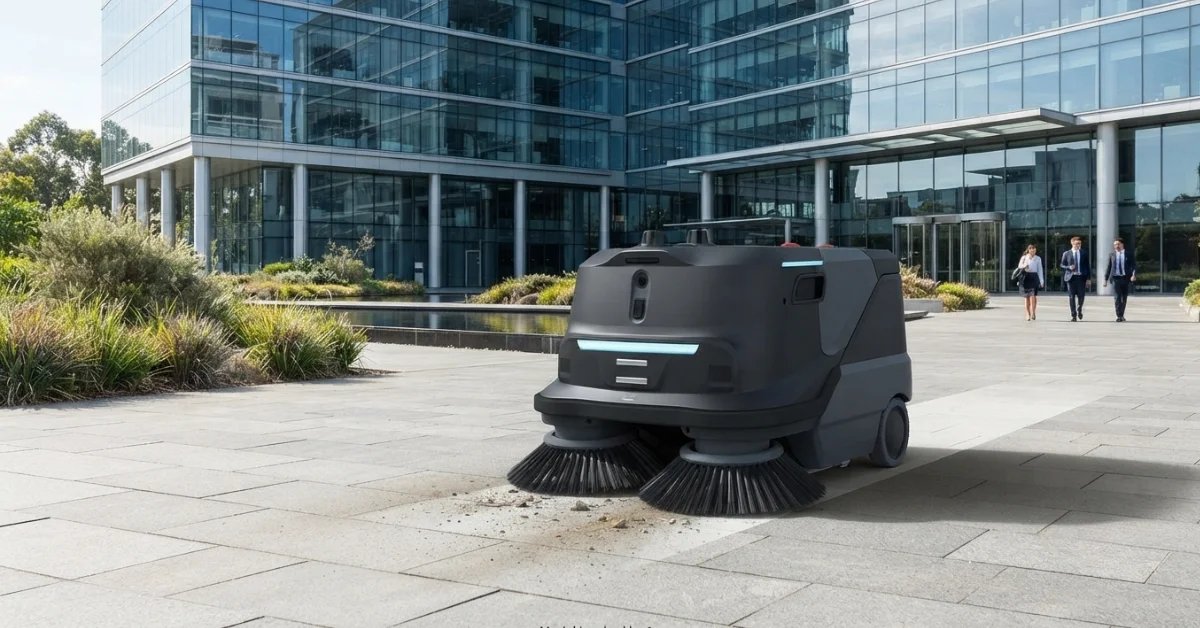
Redefining the parameters of industrial hygiene, outdoor cleaning robots for commercial properties have transitioned from experimental prototypes to essential operational assets. These autonomous mobile platforms are engineered specifically for the rigorous demands of exterior environments, performing high-precision sweeping, scrubbing, and disinfection across diverse surfaces. Unlike traditional human-operated machinery, these systems utilize advanced intelligence to operate without direct supervision, offering a level of reliability that manual crews simply cannot replicate in large-scale settings. Tracing the trajectory of this technology reveals a clear shift from basic automation to sophisticated service robotics capable of managing complex logistics. Understanding The Evolution of Outdoor Sanitation provides a baseline for how these industrial machines have inherited and expanded upon early automated principles to secure the perimeters of modern infrastructure.
Manual labor is increasingly unsustainable for high-frequency cleaning in massive national precincts. The sheer scale of modern retail hubs, industrial parks, and transport terminals requires a frequency of maintenance that exceeds human physical limits and budgetary constraints. These sectors lead the adoption of robotic solutions because they manage the highest traffic volumes and face the most stringent hygiene requirements. Relying on manual sweeping for a fifty-acre industrial yard often results in inconsistent quality and missed cycles. Autonomous systems eliminate these variables, delivering a standardized output that protects the facility’s professional standing and operational flow.
Addressing the Global Labor Crisis in Facility Management
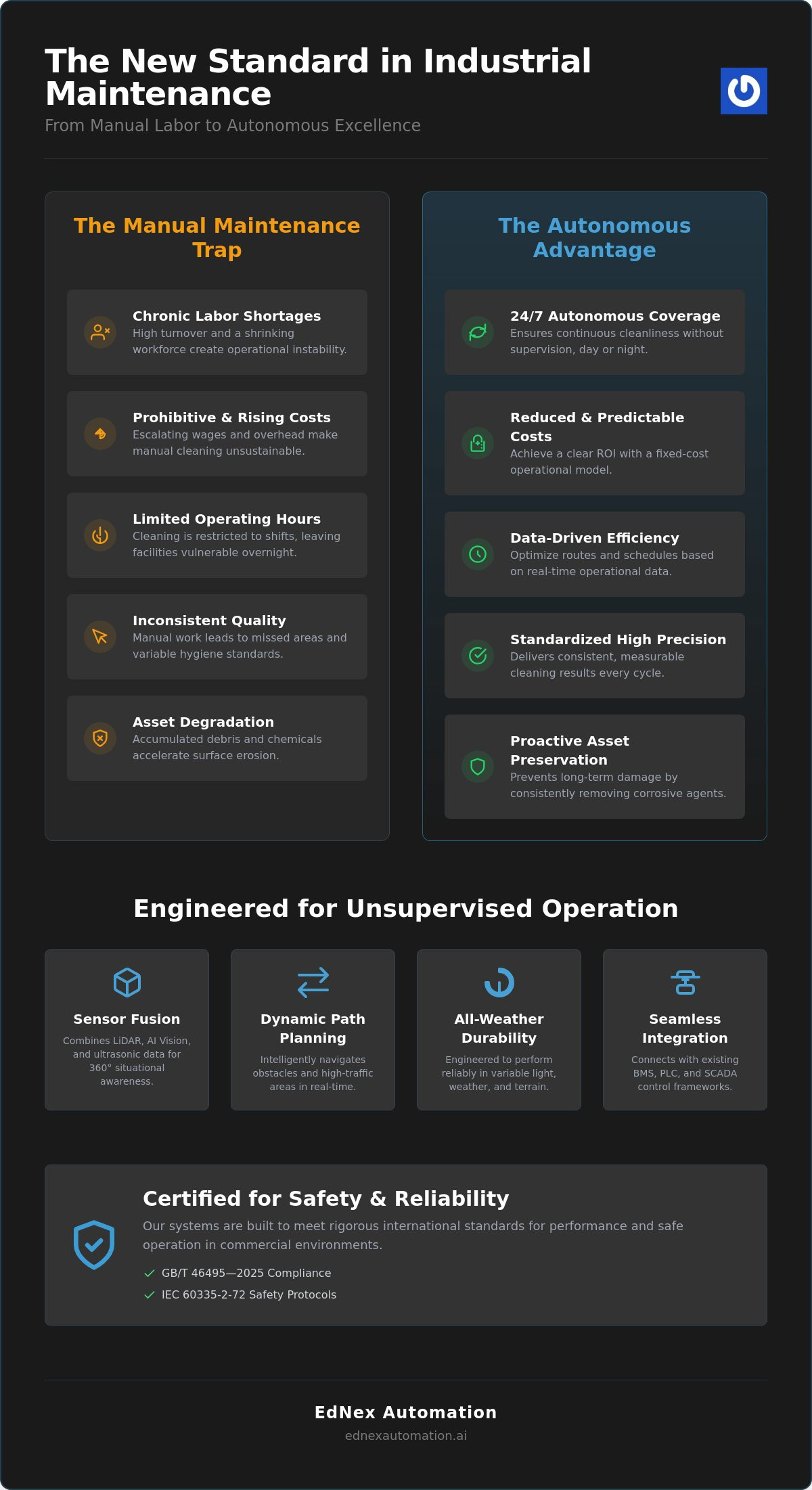
Rising labor costs and high turnover rates have created a persistent instability in the sanitation sector. Facility managers often struggle to maintain basic standards when faced with a shrinking workforce and escalating wage demands. Autonomous systems solve this by providing a predictable, fixed-cost solution for long-term operations. Instead of managing a revolving door of entry-level staff, organizations are transitioning their existing personnel into higher-value roles. Current employees don’t lose their relevance; they evolve into robotic fleet supervisors who oversee multiple units from a centralized control interface. This shift stabilizes the operational budget and improves job satisfaction by removing the physical burden of repetitive manual labor.
The Strategic Importance of Exterior Asset Maintenance
Consistent outdoor cleaning prevents the long-term degradation of pavements and industrial surfaces caused by accumulated debris and chemical runoff. When salt, oil, and grit are allowed to settle, they accelerate the erosion of expensive concrete and asphalt assets. High-quality exterior maintenance directly correlates with property value and tenant satisfaction, as the perimeter is the first point of contact for any visitor or stakeholder. Autonomous exterior sanitation represents a key pillar of modern property management, ensuring the long-term viability of physical assets through consistent, high-precision maintenance. By integrating these robots into a broader facility strategy, managers move from reactive cleaning to a proactive model of asset preservation.
The Engineering of Autonomy: How Outdoor Robots Navigate Complex Commercial Environments
Utilizing a sophisticated array of hardware and software, outdoor cleaning robots for commercial properties achieve operational precision through advanced sensor fusion. This technical framework combines LiDAR, ultrasonic sensors, and AI-powered vision to construct a comprehensive understanding of the surrounding environment in real-time. Unlike indoor units that operate in controlled conditions, outdoor systems must interpret variable light, shifting weather patterns, and irregular terrain. By integrating these diverse data streams, the robot maintains a high-fidelity situational awareness that ensures safety in high-traffic commercial zones. This level of autonomy allows the machine to function as a reliable agent within the facility’s broader maintenance ecosystem.
Sensor Fusion and LiDAR: The Eyes of the Robot
Harnessing the power of Light Detection and Ranging (LiDAR), these platforms generate high-definition 3D maps of parking lots and pedestrian walkways. This spatial intelligence facilitates Simultaneous Localization and Mapping (SLAM), enabling the unit to pinpoint its location within centimeters even when GPS signals are obstructed by large industrial structures. Recent research on public space cleaning robots emphasizes that redundant sensor systems are mandatory for achieving 100% safety in public-facing zones. By cross-referencing LiDAR depth data with AI vision, the system distinguishes between a static bollard and a moving pedestrian, adjusting its path dynamically to avoid collisions without interrupting the cleaning cycle. This predictive capability ensures that the robot doesn’t just react to obstacles but anticipates them to maintain a fluid operational flow.
Hardening for Harsh Climates: Heat and Dust Resistance
Operating in the specific climate of the UAE requires specialized engineering to protect sensitive electronics from extreme ambient temperatures and abrasive sand. Advanced thermal management systems utilize active cooling and specialized heat sinks to maintain internal integrity when external temperatures exceed 50 degrees Celsius. High-efficiency filtration and sealed chassis designs prevent fine particulate matter from infiltrating the motor housing or sensitive sensor arrays. In 2026, the industry standard for outdoor cleaning robots for commercial properties demands a minimum IP65 rating to ensure total protection against dust ingress and low-pressure water jets during routine maintenance. Organizations looking to deploy these systems should consult with a technical integration partner to ensure hardware specifications match the local environmental profile.
AI-driven obstacle detection represents the pinnacle of modern navigation logic. By utilizing deep learning models trained on thousands of outdoor scenarios, the robot identifies potential hazards long before they enter its immediate safety perimeter. This intelligence allows for fluid movement through busy transport terminals and retail hubs where the flow of people is constant and unpredictable. Dynamic path planning algorithms then calculate the most efficient route around these obstacles, ensuring the cleaning mission continues with zero downtime. This level of engineering transforms a simple utility machine into a sophisticated autonomous agent capable of protecting both the facility’s assets and its occupants.
Economic Impact: Evaluating ROI and Operational Efficiency
Transitioning from traditional manual cleaning contracts to autonomous systems requires a rigorous analysis of the Total Cost of Ownership (TCO). While manual labor involves escalating hourly wages and significant recruitment overhead, outdoor cleaning robots for commercial properties present a predictable capital or operational expenditure model. These systems eliminate the variability of human performance, delivering a consistent “Efficiency Dividend” through 24/7 operation. By removing human downtime and shift changes, facilities achieve a level of hygiene that was previously cost-prohibitive. Research on designing commercial cleaning robots indicates that translating specific user needs into precision-targeted algorithms significantly reduces the consumption of water and chemicals. This technical optimization ensures that resources are applied only where necessary, lowering environmental impact and recurring supply costs simultaneously.
Direct vs. Indirect Savings: A Financial Framework
Comparing hourly operational costs over a five-year horizon reveals that autonomous platforms often reach parity with manual labor within 12 to 18 months, depending on the scale of the facility. Beyond direct payroll, indirect savings emerge through reduced insurance premiums as the risk of workplace injuries in hazardous outdoor environments diminishes. High-level telemetry data from these units serves as a “Cleaning as Data” asset, providing facility managers with heat maps of debris accumulation to optimize overall maintenance schedules. This data-driven approach allows for predictive maintenance of the entire facility, identifying potential pavement degradation or drainage issues before they require expensive repairs.
Scaling Operations Without Increasing Headcount
Modern fleet management allows a single technician to oversee multiple units across geographically dispersed sites, effectively decoupling operational growth from labor availability. The deployment of autonomous mobile robots enables organizations to scale their logistics and sanitation capabilities simultaneously without a proportional increase in headcount. This structural efficiency is critical for maintaining competitiveness in a labor-constrained market. Before committing to a robotic investment, every CFO should review these specific financial metrics:
- Amortization Period: Calculate the point where capital expenditure offsets the projected escalation of manual contract rates.
- Resource Optimization: Measure the reduction in chemical and water utility expenditures achieved through precision application.
- Asset Preservation: Estimate the extension of pavement and surface life cycles through consistent, high-frequency maintenance.
- Risk Mitigation: Quantify the projected savings on liability and workers’ compensation insurance by removing humans from high-traffic outdoor zones.
Integrating outdoor cleaning robots for commercial properties into a broader facility strategy transforms sanitation from a reactive cost center into a proactive asset management tool. By leveraging autonomous technology, organizations don’t just clean their environments; they optimize their entire operational footprint for long-term business viability.
Strategic Implementation: Integrating Robotics into Commercial Facility Management
Executing a successful deployment of outdoor cleaning robots for commercial properties requires a methodical transition from legacy manual processes to a fully integrated autonomous ecosystem. This transformation begins with a comprehensive site audit, identifying critical environmental variables such as slope gradients, drainage patterns, and cellular signal strength for telemetry. Establishing these baseline parameters ensures that the robotic units operate within their optimal performance envelope, preventing technical friction during the initial rollout. Beyond the hardware, the strategic value of these systems lies in their ability to communicate with existing Building Management Systems (BMS), allowing facility managers to synchronize cleaning cycles with other automated building functions.
The Role of Industrial Control Systems (PLC/SCADA)
Achieving centralized control over a robotic fleet necessitates the expertise of PLC and SCADA integration services to bridge the gap between autonomous mobile units and the facility’s core infrastructure. SCADA systems provide a “single pane of glass” view, aggregating performance data and health status from every cleaning robot in the field. By automating charging and water-refilling cycles through PLC-controlled docking stations, organizations eliminate the need for manual intervention, ensuring the fleet remains mission-ready 24/7. This level of connectivity also demands rigorous data security protocols, utilizing industrial network standards to protect the integrity of the facility’s internal communications.
Operational Workflow: From Deployment to Optimization
Structuring a high-efficiency workflow involves defining precise “No-Go” zones and scheduling cleaning windows that avoid peak pedestrian footfall or high-traffic delivery hours. Utilizing cloud-based reporting, facility managers can verify cleaning compliance and hygiene standards through automated logs that serve as an official record of maintenance activity. This transparency is vital for meeting regional industrial standards and maintaining high-prestige commercial environments. Successful implementation hinges on selecting an integration partner capable of aligning global technological breakthroughs with specific regional requirements. To begin your facility’s digital transformation, you should consult with an automation specialist who can design a bespoke roadmap for your infrastructure.
Adopting a “Human-in-the-Loop” model ensures that staff roles evolve from manual labor to high-level supervision. Training existing personnel to manage robotic fleets transforms them into technical operators who can interpret data insights and perform basic field maintenance. This evolution doesn’t just improve operational efficiency; it future-proofs the workforce by aligning their skills with the demands of Industry 4.0. By positioning outdoor cleaning robots for commercial properties as collaborative tools rather than simple replacements, organizations foster a culture of innovation that drives long-term business viability.
To complement these operational advancements, service-oriented enterprises looking to amplify their market reach can discover Tools N Tactics | Local SEO & Digital Marketing Solutions to implement a comprehensive growth engine.
Future-Proofing Your Assets with EdNex Automation
Harnessing the transformative potential of Industry 4.0 requires more than the acquisition of hardware; it demands a partner capable of architecting a comprehensive technological roadmap. EdNex Automation operates as a high-level technical consultant, bridging the gap between global robotic breakthroughs and the specific industrial requirements of the UAE market. By positioning outdoor cleaning robots for commercial properties as a centralized pillar of facility management, we ensure that your assets remain competitive in an increasingly automated economy. Our approach moves beyond simple equipment distribution, focusing instead on the bespoke integration of autonomous systems that drive measurable operational improvement.
Consultant-Led Automation: The EdNex Advantage
Distinguishing ourselves from traditional vendors, EdNex Automation functions as a Strategic Enterprise Guide for organizations navigating large-scale transformation. Leveraging the specialized expertise of a division founded in 2018, we provide the intellectual framework and technical support necessary for successful robotic deployment across national commercial and industrial sectors. This comprehensive service model includes everything from initial feasibility studies to complex PLC and SCADA integration. Our national support network ensures that your robotic fleet maintains peak performance, protecting your investment against the technical friction that often plagues poorly integrated systems. We don’t just sell tools; we deliver the systematic organization required to bring order, safety, and efficiency to complex environments.
Building the Intelligent Facility of Tomorrow
Constructing a future-proof environment involves creating a synergy between diverse autonomous platforms within a single, intelligent ecosystem. In this visionary framework, autonomous cleaning robots operate alongside automated storage and retrieval systems and surveillance robots to create a unified, self-maintaining infrastructure. This interconnected web of intelligence allows for a level of efficiency and security that manual processes cannot match. By integrating these systems, property managers gain deep data insights that inform long-term maintenance strategies and maximize asset longevity. We invite commercial property leaders to collaborate with our engineering teams to design bespoke automation roadmaps that align with their specific geographic and economic objectives. Modernizing your facility infrastructure is a necessary evolution to ensure the continued viability and prestige of your organization in 2026 and beyond.
Advancing Toward the Autonomous Industrial Perimeter
Transitioning from manual sanitation to high-precision autonomous systems is no longer a speculative future; it’s a current operational necessity for maintaining asset value. By deploying outdoor cleaning robots for commercial properties, organizations address chronic labor shortages while securing consistent, 24/7 hygiene standards across large-scale precincts. We’ve explored how the integration of these platforms into PLC and SCADA frameworks provides a single pane of glass for facility management, transforming cleaning data into actionable maintenance insights. As a visionary leader in national robotic deployment, EdNex Automation offers the intellectual framework and technical expertise needed to bridge the gap between global innovation and regional industrial needs. Our specialized division provides comprehensive support, ensuring that every robotic asset is seamlessly integrated into your broader Industry 4.0 ecosystem. To secure your organization’s long-term business viability, you must move beyond equipment acquisition toward a strategy of controlled, deliberate innovation. Consult with EdNex Automation to design your autonomous facility roadmap and leverage our status as an official integrator of advanced Industry 4.0 systems. We look forward to engineering your path to industrial excellence.
Frequently Asked Questions
How do outdoor cleaning robots handle uneven surfaces and curbs in commercial properties?
Outdoor cleaning robots for commercial properties utilize high-torque motors and advanced suspension systems to navigate gradients and surface irregularities effectively. Utilizing 3D LiDAR and ultrasonic sensors, these units identify curbs and steep inclines in real-time, adjusting their path to prevent mechanical stress or instability. This spatial intelligence ensures consistent coverage across industrial yards and parking facilities without requiring manual intervention to overcome physical obstacles.
Can autonomous cleaning robots operate in extreme heat and dusty conditions?
Engineered for harsh climates, these autonomous platforms feature IP65+ ingress protection ratings to prevent fine dust and sand from infiltrating sensitive electronics. Active thermal management systems utilize specialized heat sinks and cooling fans to maintain internal integrity even during extreme UAE summer temperatures. These hardening measures ensure operational reliability in environments that would typically cause standard machinery to suffer from thermal degradation or mechanical failure.
What is the typical ROI period for an outdoor cleaning robot in a large commercial facility?
Most large-scale facilities achieve a full return on investment within 12 to 18 months through the substantial reduction of manual janitorial labor costs. By eliminating shift turnover downtime and optimizing chemical and water usage, organizations capture an efficiency dividend that offsets the initial capital expenditure. This financial framework allows CFOs to treat robotic deployment as a long-term asset preservation strategy rather than a recurring operational cost.
Do outdoor cleaning robots require a constant internet connection to navigate?
Constant connectivity isn’t required for primary navigation because the robots utilize local SLAM (Simultaneous Localization and Mapping) processing to interpret their immediate environment. They rely on internal high-definition maps and real-time sensor data to execute their cleaning cycles autonomously. However, a periodic network connection is necessary for cloud-based reporting, software updates, and remote telemetry monitoring via centralized management systems.
How do these robots ensure the safety of pedestrians and vehicles in public spaces?
Safety is maintained through a multi-layered sensor fusion approach that combines LiDAR, 3D cameras, and ultrasonic sensors to detect moving obstacles. AI-driven vision algorithms differentiate between static infrastructure and dynamic entities like pedestrians or vehicles, allowing the robot to halt or reroute instantly. These systems comply with international safety standards to ensure zero-risk operation in high-traffic public commercial zones.
Is it possible to integrate cleaning robots with my existing SCADA or Building Management System?
Integration with existing SCADA or Building Management Systems (BMS) is a core capability of advanced outdoor cleaning robots for commercial properties. Utilizing standard industrial protocols, these units communicate performance metrics and battery status to a centralized dashboard for holistic facility oversight. This connectivity allows for the synchronization of cleaning cycles with other automated building functions, creating a truly intelligent and responsive infrastructure.
What kind of maintenance do autonomous outdoor sweepers require on a daily basis?
Daily maintenance is streamlined to ensure maximum uptime, typically requiring less than fifteen minutes of human intervention per unit. Operators must empty debris hoppers, refill water tanks, and perform a quick visual inspection of the brushes and sensor windows. These simple preventative steps protect the unit’s longevity and ensure the high-definition mapping systems remain clear for precise navigation during the next cycle.
How many hours can a commercial cleaning robot operate on a single charge?
Commercial cleaning robots typically provide four to eight hours of continuous operation on a single charge, depending on the intensity of the scrubbing or sweeping task. Utilizing automated docking stations, these units return to charge independently when battery levels reach a predefined threshold. This self-sustaining cycle ensures the facility receives consistent coverage without requiring staff to monitor power levels or manage charging cables manually.