Will your 2026 automation strategy deliver a definitive competitive edge, or will it succumb to the structural complexities that stall many ambitious transformations? While the global ASRS market is projected to reach 10.13 billion USD, the path to achieving a 90% reduction in space utilization is often obstructed by high upfront capital expenditure and the fear of catastrophic system downtime. We recognize that the challenges of implementing ASRS extend far beyond simple hardware acquisition; they require a sophisticated synchronization of PLC and SCADA integration with your existing WMS and ERP infrastructure to prevent operational paralysis.
Leveraging our expertise in Industry 4.0 digital transformation, this guide provides the authoritative roadmap you need to mitigate risk and ensure seamless continuity. You’ll learn to calculate a realistic return on investment while aligning your workforce with advanced autonomous systems. By identifying critical technical hurdles early, you can transform these complex industrial obstacles into a streamlined, high-ROI reality that secures your organization’s long-term business viability. This strategic analysis ensures your transition to automation is both deliberate and highly profitable.
Key Takeaways
- Identify the primary structural and organizational bottlenecks that lead to project misalignment to ensure your automation strategy remains grounded in operational reality.
- Master the technical challenges of implementing ASRS by synchronizing robotic controllers with central logic systems and your existing ERP frameworks.
- Shift from a basic cost-per-unit mindset to a sophisticated Total Cost of Ownership model that accounts for long-term operational efficiency and risk mitigation.
- Implement modular design principles to ensure your automated storage systems remain flexible enough to handle seasonal surges without becoming an operational bottleneck.
- Leverage full-service integration for PLC and SCADA to bridge the gap between global technological breakthroughs and your specific regional infrastructure needs.
The Strategic Landscape of ASRS Implementation Challenges
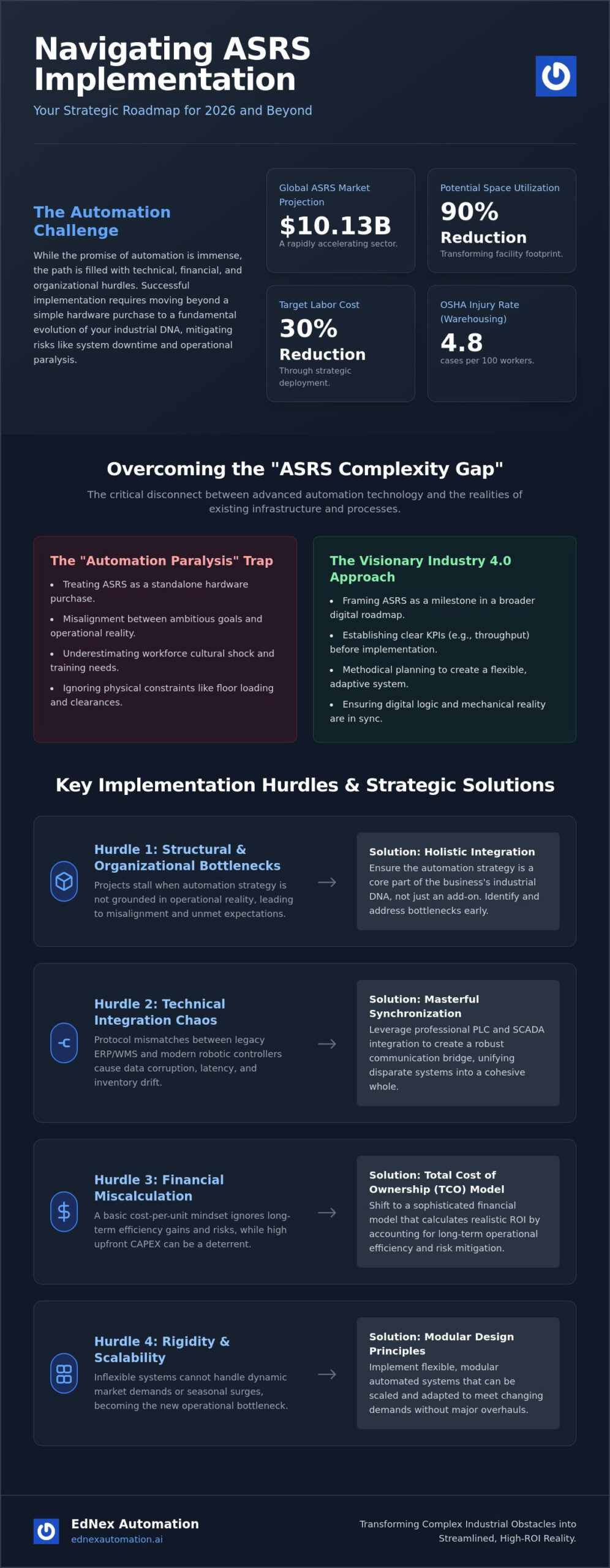
The global ASRS market is rapidly accelerating toward a 10.13 billion USD valuation, yet many organizations find that the transition from manual workflows to autonomous retrieval is fraught with structural friction. The challenges of implementing ASRS are rarely confined to a single department; instead, they represent a convergence of technical, financial, and organizational bottlenecks. Projects frequently stall when leadership treats automation as a standalone hardware purchase rather than a fundamental evolution of their industrial DNA. This misalignment between ambitious expectations and the gritty reality of warehouse operations often results in “automation paralysis,” where the new system fails to deliver its promised 90% reduction in space utilization because the underlying processes weren’t optimized for high-velocity robotics.
Moving from traditional manual picking to automated retrieval systems often triggers a profound cultural shock within the workforce. Operators who previously relied on physical intuition must now master complex digital interfaces and oversee sophisticated machinery. If this transition isn’t managed through a systematic intellectual framework, the resulting “Complexity Gap” can lead to significant downtime. Industrial leaders must recognize that successful deployment requires more than just installing cranes; it demands a total recalibration of how material flows through the facility. With OSHA reporting injury rates in the warehousing sector at 4.8 cases per 100 workers, the stakes for getting this transition right extend beyond mere efficiency to include critical safety and compliance mandates.
Understanding the ASRS Complexity Gap
Integrating physical robotics with digital control layers creates a unique set of technical hurdles. While modern software platforms like WAMAS or Fabrico offer unprecedented optimization, hardware limitations often throttle these digital gains. Hidden variables, such as existing floor loading capacities and precise vertical clearances, can derail a project during the installation phase. If the facility’s physical infrastructure cannot support the high-density load of an optimized ASRS, the software’s intelligence becomes secondary to structural constraints. Identifying these protocol mismatches early is essential to preventing the “bottleneck effect” that occurs when digital logic outpaces mechanical reality.
Why Implementation Demands a Visionary Approach
Adopting a forward-thinking perspective allows organizations to move beyond simple storage toward intelligent material handling. A visionary approach frames the challenges of implementing ASRS as milestones within a broader Industry 4.0 roadmap. By establishing clear KPIs—such as specific throughput targets and 30% labor cost reduction goals—before the first component is delivered, businesses ensure their investment remains strategically aligned. This methodical planning prevents the “Rigidity Trap,” creating a bespoke integration that remains flexible enough to adapt to 2026’s volatile market demands while securing long-term business viability.
Navigating Technical Integration and Control Architecture
Achieving seamless synchronization between high-velocity retrieval hardware and legacy software infrastructure represents one of the most formidable technical challenges of implementing ASRS. Many industrial facilities continue to operate on monolithic ERP and WMS platforms that lack the native API agility required for real-time robotic coordination. When these legacy systems attempt to communicate with modern robotic controllers, protocol mismatches often lead to latency issues or data corruption. Establishing a robust communication bridge is essential to maintaining inventory accuracy and preventing the operational drift that occurs when physical stock movements aren’t mirrored in the digital ledger in real time.
Utilizing professional PLC and SCADA integration services provides the necessary middleware to translate complex machine languages into high-level business intelligence. These services ensure that every crane movement, sensor trigger, and pallet transfer is logged and validated against central logic, creating a unified operational environment. Without this layer of sophisticated control, the system remains a collection of isolated machines rather than a cohesive, intelligent organism. Transitioning to this level of automation requires a methodical approach to data architecture that prioritizes long-term scalability over quick, patchwork fixes.
Bridging the Gap Between IT and OT
Standardizing communication protocols like OPC UA and MQTT has become the baseline for industrial reliability in 2026. Managing the resulting data deluge requires a high-performance SCADA system that can filter raw sensor feedback into actionable insights while mitigating the risk of information overload. This architectural layer also serves as the primary defense against cybersecurity threats, ensuring that networked automated storage remains resilient against unauthorized access. If you’re looking to fortify your digital infrastructure, consulting with an expert in industrial control systems can help bridge these complex technological gaps.
Hardware Interoperability Challenges
Interoperability in robotic storage is the capacity for heterogeneous hardware components to exchange data and execute synchronized tasks within a unified control environment without manual intervention. Integrating robotic cranes with existing conveyor belts and AMR fleets requires precise mechanical and electronic alignment to avoid throughput bottlenecks. Organizations often face a strategic choice between custom racking, which maximizes storage density, and standardized palletizing, which ensures broader compatibility across different automation fleets. Balancing these hardware requirements is critical to avoiding the ‘Rigidity Trap’ and ensuring the system can evolve alongside future technological breakthroughs.
Managing Capital Expenditure and Workforce Transition
Directing substantial capital toward automation requires a rigorous analysis of Total Cost of Ownership (TCO) that extends far beyond the initial procurement invoice. While the primary challenges of implementing ASRS often center on technical integration, the financial burden of site preparation, specialized training, and recurring software licensing can create significant “ROI anxiety” for stakeholders. Mitigating this risk requires a phased investment strategy that manages cash flow while demonstrating incremental value across the organization. By utilizing ASRS for manufacturing, industrial leaders can justify multi-departmental budgets by highlighting improvements in both production line feeding and finished goods storage. Most businesses see a return on investment within three to five years, but achieving this timeline requires precise financial planning and a clear understanding of 2026’s economic environment.
Securing a high-ROI industrial transformation necessitates a shift from viewing labor as a variable cost to viewing the workforce as a strategic asset in an automated environment. Overcoming internal resistance is rarely about the technology itself; it’s about addressing the fear of displacement through transparent change management and clear career pathways. When employees understand how automation removes the physical strain of manual picking, they’re more likely to embrace their new roles as system supervisors. This transition is critical for maintaining operational continuity during the deployment phase, ensuring that human expertise remains synchronized with robotic precision.
The Financial Reality of ASRS Investment
Identifying hidden costs early in the planning phase is essential for maintaining budget integrity. Site preparation often involves significant structural modifications, such as floor leveling to meet high-tolerance robotic requirements or upgrading electrical infrastructure to support 24/7 crane operations. In July 2026, interest rates for SBA 504 loans, which are frequently used for major equipment purchases, remain between 6.17% and 6.20%. These competitive rates provide a strategic window for organizations to finance modular systems that can scale alongside revenue growth. A structured, phased approach allows you to:
- Allocate capital to the highest-impact zones first.
- Validate performance metrics before full-scale rollout.
- Distribute the cost of software licensing over several fiscal periods.
Upskilling for the Era of Autonomy
Transitioning manual pickers into system operators and monitors is not merely a training exercise; it’s a fundamental recalibration of the organizational culture. Utilizing intuitive Human-Machine Interfaces (HMI) can significantly reduce training time, allowing staff to focus on high-level system oversight rather than repetitive physical tasks. This proactive approach to upskilling builds a culture of safety around high-speed automated machinery, directly addressing the safety concerns highlighted by OSHA’s 2026 enforcement standards. With willful violation penalties now reaching $165,514, investing in a highly trained workforce is both a moral imperative and a critical risk-mitigation strategy for any modern facility.
Addressing Flexibility and Scalability in Dynamic Markets
The ‘Rigidity Trap’ represents a critical failure point where an automated system, once designed for high efficiency, becomes an operational bottleneck during unexpected seasonal surges. Avoiding this requires a move away from monolithic, fixed-aisle architectures toward modular frameworks that prioritize agility. One of the primary challenges of implementing ASRS in 2026 is ensuring the system can adapt to shifting SKU profiles and evolving packaging dimensions without requiring a total infrastructure overhaul. By prioritizing modularity during the initial design phase, organizations can maintain a delicate balance between maximum storage density and the high-velocity throughput required for modern e-commerce fulfillment.
Designing for future-proof scalability involves anticipating the lifecycle of your product range and the potential for rapid market pivots. Systems that lack the ability to reconfigure their internal logic or physical layout often become obsolete within three to five years, negating the long-term ROI promised at the outset. A visionary strategy focuses on ‘elastic’ automation, where the infrastructure can expand or contract in response to real-time data, ensuring that the warehouse remains a competitive advantage rather than a sunk cost. This methodical approach to design prevents the obsolescence that often plagues less sophisticated automation attempts.
Designing a Modular ASRS Framework
Implementing shuttle-based systems rather than traditional fixed-aisle cranes provides the mechanical flexibility necessary to scale throughput independently of storage capacity. Software-defined logic allows for the rapid reconfiguration of picking sequences and slotting strategies, enabling the system to evolve without physical hardware modifications. Integrating autonomous mobile robots further enhances this flexibility by providing intelligent ‘last-meter’ delivery between the ASRS and dispatch zones. This decentralized approach ensures that your automation investment remains a dynamic asset rather than a static liability.
Scaling Operations Nationally
Standardizing ASRS design across multiple facility locations enables regional operators to maintain consistent performance metrics while simplifying maintenance and spare parts inventory. Managing these systems requires a sophisticated choice between centralized control architectures for global visibility and decentralized logic for localized resilience. To expand a modular ASRS rack, engineers typically secure additional upright frames to the existing structure, install synchronized horizontal rail extensions, and then update the control software to recognize the new storage coordinates. If you’re ready to build a scalable foundation for your logistics network, consult with EdNex Automation’s technical specialists today to explore bespoke integration solutions.
Partnering for Excellence: The EdNex Approach to ASRS
EdNex Automation positions itself not merely as an equipment vendor, but as a high-level technical partner capable of navigating the multifaceted challenges of implementing ASRS. Bridging the gap between visionary global technology and the specific logistical requirements of the UAE, we provide the intellectual framework necessary for a successful industrial transformation. Our status as a specialized division of the established EdNex group allows us to offer a unique blend of international innovation and deep regional expertise. By acting as a systematic organizer, we ensure that your transition to automation is controlled, deliberate, and aligned with your long-term business viability.
Choosing a full-service integrator is essential for harmonizing the various layers of an automated facility. Without a cohesive strategy for PLC and SCADA integration, even the most advanced retrieval hardware remains an isolated asset. We provide end-to-end expertise that synchronizes robotic movements with central business logic, ensuring that your data remains accurate and your throughput remains high. This comprehensive approach mitigates the risk of system fragmentation, allowing your organization to remain competitive in a rapidly evolving industrial landscape.
Comprehensive Integration Services
Employing a methodical approach to site assessment, our engineering teams evaluate every physical and digital constraint before the design phase begins. We prioritize seamless communication across all robotic platforms, ensuring that your ASRS, AMRs, and conveyor systems operate as a single, intelligent organism. This rigorous planning phase identifies potential bottlenecks early, allowing us to implement bespoke solutions that address floor loading, vertical clearance, and software protocol mismatches simultaneously. Leveraging our national coverage across the UAE, we provide the localized support necessary to maintain peak operational efficiency throughout the system’s lifecycle.
The Future of Your Facility
Transitioning from reactive storage to proactive logistics requires a fundamental shift in how material flows through your environment. Integrating collaborative robots UAE allows your facility to complement ASRS throughput with human-centric precision, creating a hybrid workforce that excels in high-complexity tasks. This synergy between autonomous retrieval and cobot-assisted picking ensures that your warehouse remains agile enough to handle the SKU diversity of 2026 and beyond. By establishing this advanced infrastructure today, you position your facility as a definitive leader in the region’s digital transformation. If you are ready to secure a high-ROI future, partner with EdNex Automation for your ASRS implementation and redefine the limits of your industrial potential.
Securing Industrial Resilience through Intelligent Automation
Navigating the transition to high-density autonomous storage requires a meticulous synchronization of physical infrastructure and digital control logic. By addressing the technical challenges of implementing ASRS through robust PLC and SCADA architecture, organizations can transform their warehouse from a static cost center into a dynamic engine of efficiency. This evolution demands a visionary approach that prioritizes modular scalability and workforce empowerment to ensure long-term operational viability in 2026’s competitive landscape. Implementing these systems is no longer an optional upgrade; it’s a fundamental necessity for organizations aiming to lead the UAE’s industrial transformation.
Securing this transformation necessitates a partnership with experts who understand the intersection of global innovation and regional industrial needs. As a specialized Industrial Automation Division of the EdNex group, we provide the intellectual framework and national UAE technical support required to mitigate risk and maximize ROI. Our expert PLC and SCADA integration specialists are ready to help you bridge the complexity gap and achieve a seamless deployment. Book an ASRS Feasibility Consultation with EdNex Automation to define your path toward a fully optimized, autonomous future. Your facility’s next phase of growth begins with a deliberate and data-driven strategy.
Frequently Asked Questions
What is the biggest technical challenge when implementing ASRS?
The most significant technical hurdle involves achieving seamless synchronization between physical robotic controllers and higher-level digital logic layers. Without sophisticated PLC and SCADA integration, data latency often causes physical bottlenecks that disrupt the flow of material. This misalignment results in inventory inaccuracies that undermine the entire automation strategy, making a robust communication bridge essential for operational success.
How long does a typical ASRS implementation take from design to go-live?
A typical ASRS deployment spans six to eighteen months, depending on the system’s scale and structural complexity. This timeline encompasses a rigorous site assessment, custom engineering, physical installation, and a comprehensive commissioning phase to validate performance. Planning for this duration allows organizations to manage the challenges of implementing ASRS without causing catastrophic disruptions to their current operational continuity.
Can ASRS be integrated with my existing manual warehouse management system?
Modern automated retrieval systems can be integrated with legacy or manual Warehouse Management Systems through sophisticated API layers and custom middleware. This connection allows the automated hardware to receive instructions from existing software while providing real-time feedback on stock movements. Transitioning to this hybrid model requires a methodical approach to data architecture to ensure both systems remain perfectly synchronized.
Is ASRS suitable for facilities with high SKU variability?
Automated systems are highly effective for facilities with high SKU variability when they utilize modular storage containers and flexible retrieval logic. Shuttle-based architectures allow for the handling of diverse dimensions and weights within a unified framework, ensuring maximum throughput for complex inventories. This adaptability is critical for organizations facing the dynamic market shifts and evolving packaging sizes expected in 2026.
What kind of maintenance is required for automated storage systems?
Automated storage systems require a shift from reactive to predictive maintenance strategies powered by real-time sensor feedback and SCADA monitoring. Regular inspections of mechanical rails, sensors, and electrical components are essential to prevent unscheduled downtime and ensure long-term reliability. Identifying potential wear through machine health data allows operators to perform targeted interventions before a minor component failure halts the entire system.
How do I calculate the ROI for an ASRS project in 2026?
Calculating a realistic ROI involves analyzing the Total Cost of Ownership against documented gains in labor efficiency and space utilization. Most industrial leaders achieve a return within three to five years by leveraging a 30% reduction in labor costs and a 90% improvement in storage density. Factoring in the mitigation of OSHA penalties and reduced product damage further clarifies the strategic financial benefits of the investment.
What are the safety requirements for operating ASRS alongside human workers?
Safety requirements for ASRS operations include the installation of physical barriers, light curtains, and emergency stop systems that comply with the latest 2026 OSHA enforcement standards. When operating in shared environments, the system must employ advanced sensor arrays to detect human proximity and prevent collisions in real time. Establishing a rigorous safety culture ensures that high-speed automation remains a secure and reliable asset for the entire workforce.