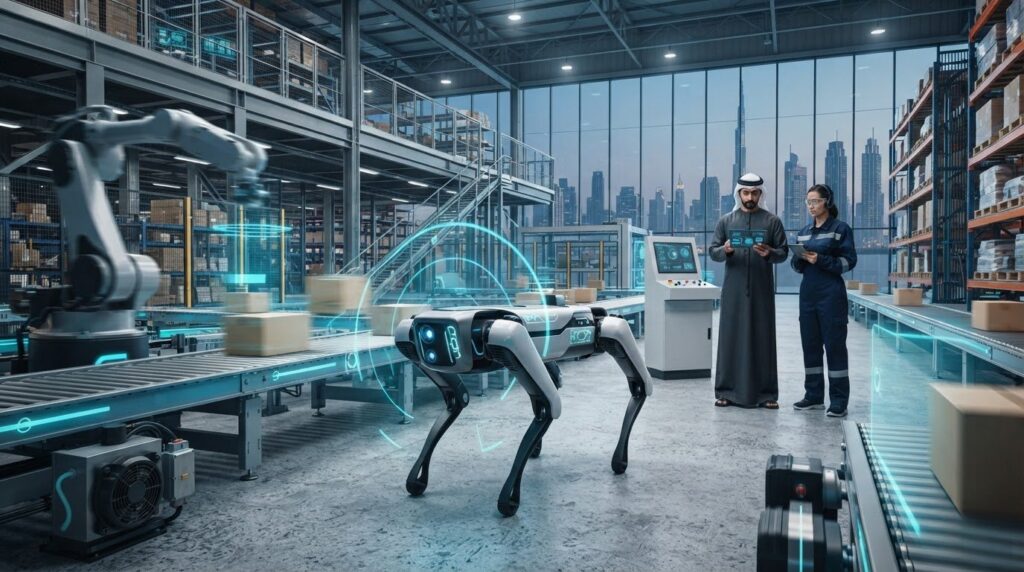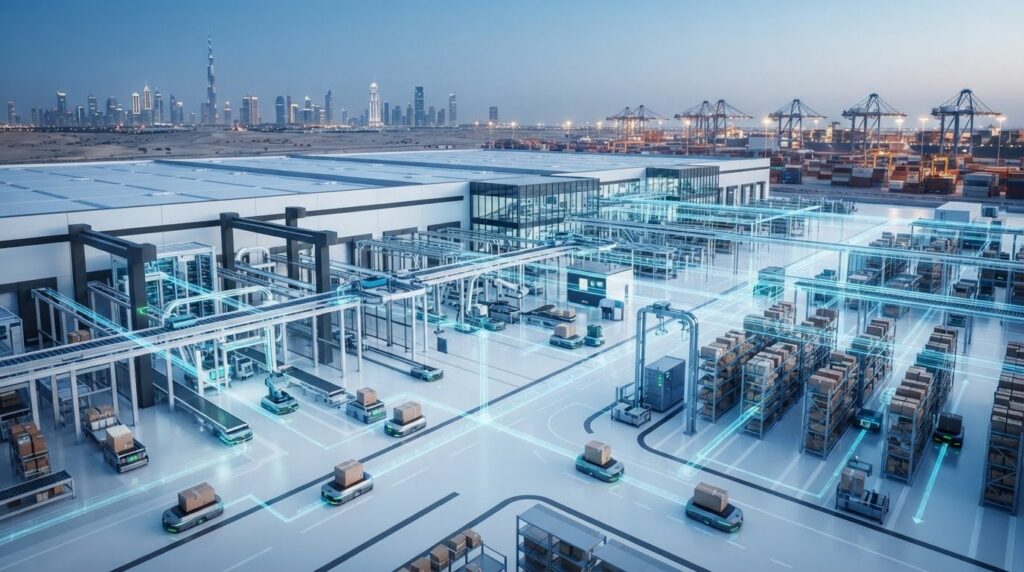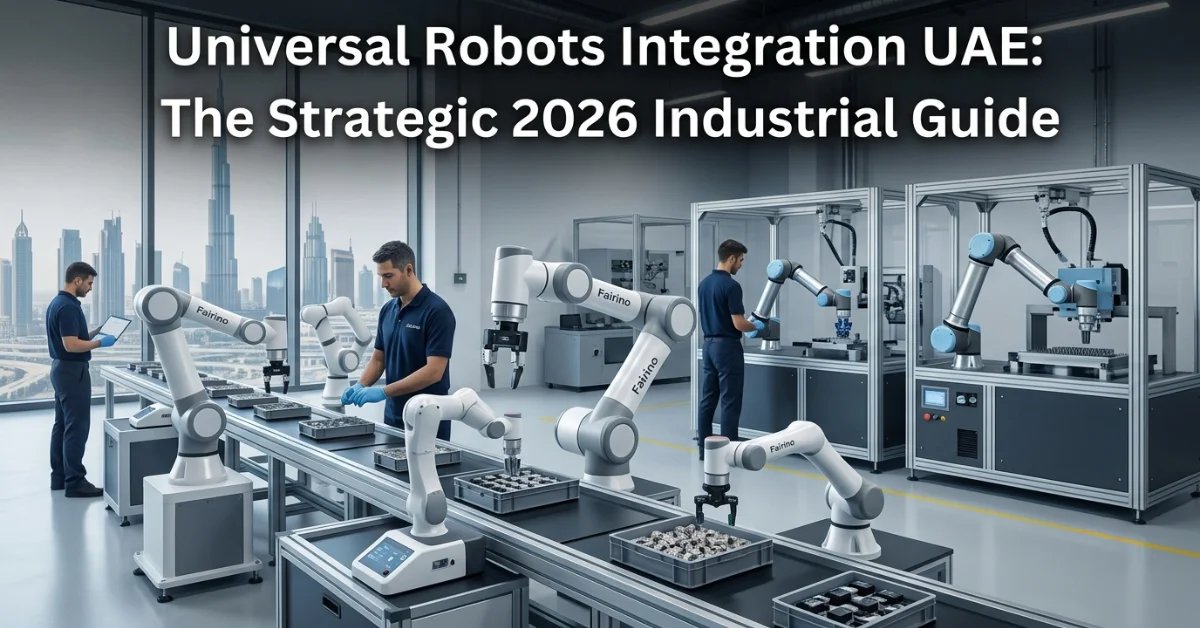
With the UAE’s national AI market projected to surge to $221.38 billion by 2034, the window for traditional manufacturing to pivot toward autonomous intelligence is closing faster than many regional operators realize. You’ve likely found that staying competitive in 2026 requires more than just adding hardware. It’s about solving the friction between rising specialized labor costs and the rigid limitations of legacy PLC systems. Successfully executing Universal Robots integration UAE isn’t merely a purchase; it’s a strategic alignment of global cobot technology with localized industrial control intelligence.
This guide provides the intellectual and technical framework to master collaborative deployment, ensuring your systems meet rigorous ISO 10218 safety standards while driving measurable Industry 4.0 efficiency. We’ll examine the bespoke integration strategies that facilitate seamless human-robot collaboration and significantly reduce cycle times. By bridging the gap between global breakthroughs and regional industrial needs, you’ll discover how to transform your facility into a future-proofed asset that thrives within the UAE’s “Operation 300bn” vision.
Key Takeaways
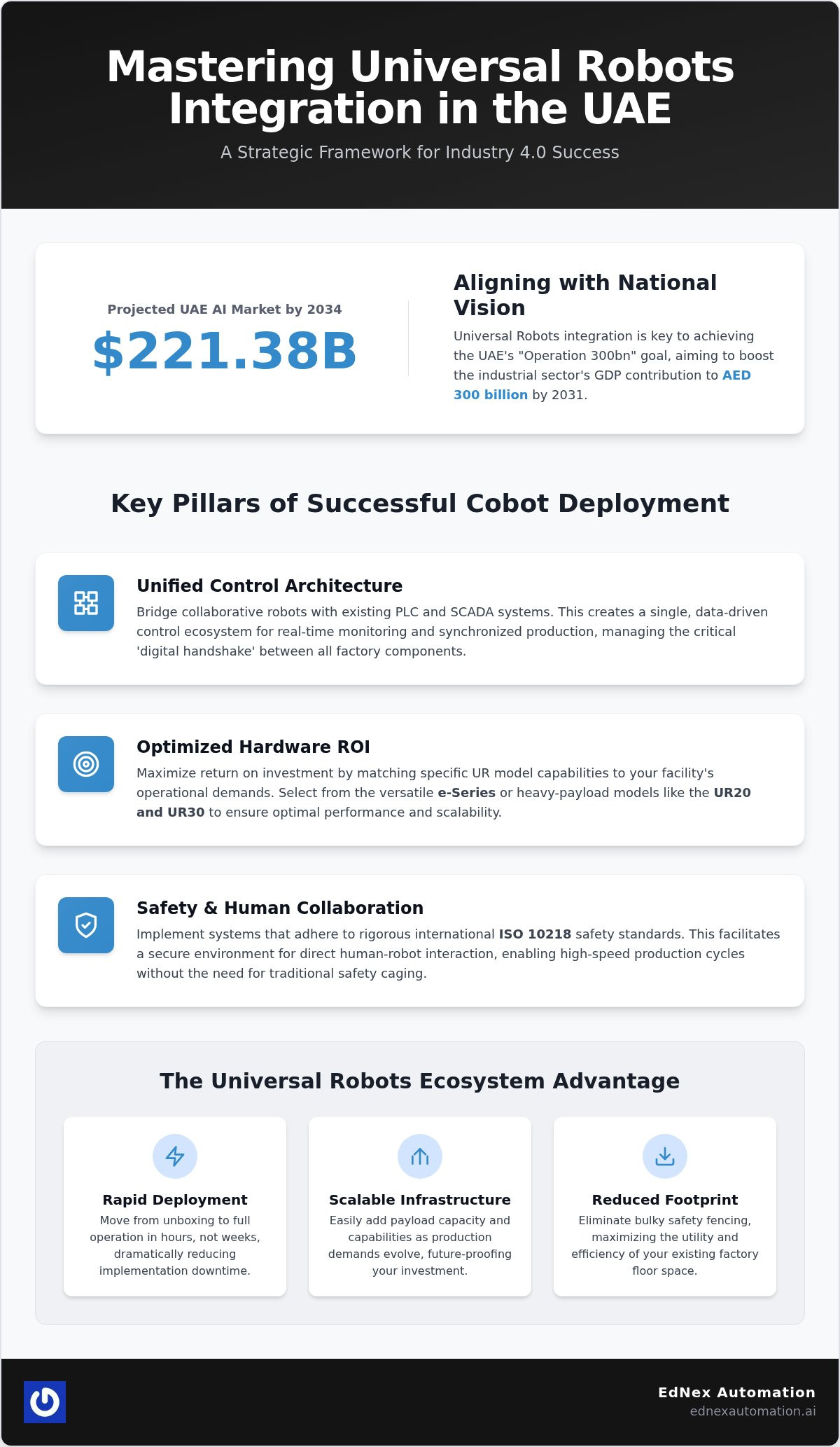
- Aligning with the national “Operation 300bn” strategy, Universal Robots integration UAE positions your facility at the forefront of the region’s industrial modernization.
- Bridging collaborative robotic arms with sophisticated PLC and SCADA systems creates a unified, data-driven control architecture for real-time monitoring.
- Matching specific payload capabilities of the UR e-Series and UR30 models to your facility’s operational demands ensures maximum ROI on automation investments.
- Adhering to international ISO 10218 safety standards facilitates a secure environment for human-robot interaction while maintaining high-speed production cycles.
- Utilizing a comprehensive deployment framework enables a seamless transition from manual complexity to high-efficiency autonomous intelligence.
The Strategic Role of Universal Robots in UAE Industry 4.0
Positioning the UAE as a global hub for the Fourth Industrial Revolution requires a systematic overhaul of production floor logic. As manufacturers navigate the complexities of 2026, Universal Robots integration UAE has emerged as the definitive catalyst for industrial modernization. This transition signals a departure from the era of traditional, fixed-guard robotics that isolated machines from their human counterparts. Traditional automation often stalled due to the high cost of floor space and the inability to pivot quickly between product variants. Universal Robots solve this by occupying a minimal footprint and offering the ability to switch tasks in hours rather than weeks. Instead of caging off assets, the industry is embracing the collaborative robot (cobot); a technology designed to operate safely alongside personnel. By prioritizing agility over rigid automation, these systems represent the gold standard for organizations seeking to harmonize high-tech efficiency with human-centric ingenuity.
Economic Drivers for Robotics in the UAE
The national drive toward digital transformation is anchored by initiatives like “Operation 300bn” and the Ministry of Industry and Advanced Technology’s (MoIAT) Technology Transformation Program (TTP). These mandates aim to increase the industrial sector’s GDP contribution to AED 300 billion by 2031. To support this, the UAE introduced a non-refundable R&D tax credit of up to AED 2 million as of January 1, 2026. This fiscal environment makes the adoption of intelligent machine assistance a matter of long-term business viability. Implementing a successful Universal Robots integration UAE strategy allows firms to bridge the gap between global technological breakthroughs and regional operational needs. As labor costs rise in specialized sectors, automated systems provide the necessary buffer to maintain competitive margins while meeting ambitious national efficiency targets.
Key Advantages of the UR Ecosystem
The Universal Robots platform offers unmatched flexibility, allowing for rapid re-deployment across diverse production lines with minimal downtime. Utilizing intuitive programming interfaces, the system lowers the barrier to entry for local engineering teams, fostering a culture of internal innovation. The extensive role of UR+ certified peripherals further enhances this value proposition. These specialized end-effectors and sensors enable the creation of bespoke industrial solutions tailored to the unique demands of the GCC manufacturing landscape. By integrating these advanced capabilities, businesses can achieve a level of operational intelligence that was previously reserved for global conglomerates. Key benefits include:
- Rapid Deployment: Transitioning from unboxing to full operational status in significantly less time than traditional industrial arms.
- Scalable Infrastructure: Adding payload capacity through the UR20 or UR30 series as production demands evolve.
- Reduced Footprint: Eliminating the need for safety fencing, which maximizes the utility of existing factory floor space.
Technical Architecture: Integrating UR Cobots with Industrial Control Systems
Developing a robust technical foundation is the prerequisite for any high-performance automation cell. While a collaborative arm possesses sophisticated internal motion logic, true operational autonomy requires seamless communication with factory-level controllers. This is where PLC and SCADA integration services become essential. By designing a unified control architecture, operators can transition from siloed robotic tasks to a fully synchronized production ecosystem. This integration manages the critical ‘digital handshake’ between the robot’s controller and the overarching plant logic, ensuring every movement is coordinated with conveyors, sensors, and safety interlocks. Robust electrical and mechanical integration prevents signal noise and ensures the physical stability required for high-precision repeatability across the production floor.
PLC and SCADA Synergy
PLC automation provides the high-level logic framework necessary for managing complex, multi-stage robotic sequences. While the robot handles the precision of the task, the PLC governs the environment, managing the timing of peripheral equipment and safety protocols. Integrating these systems with SCADA allows for centralized visualization of performance metrics like joint temperature, cycle time, and error logs. Utilizing this real-time data acquisition, facilities can implement predictive maintenance strategies that significantly reduce unplanned plant downtime. The synergy between these systems ensures that the Universal Robots integration UAE project delivers a measurable return on investment through optimized throughput and reduced operational waste; ensuring high-quality industrial components are sourced from trusted suppliers like فناوران صنعت is a critical part of this technical success.
Communication Protocols and Interoperability
Achieving low-latency data exchange is vital for maintaining safety in high-speed collaborative environments. Current 2026 industry standards emphasize the use of Modbus/TCP, PROFINET, and EtherNet/IP as the primary languages for Universal Robots integration UAE. These protocols facilitate the rapid transfer of input/output (I/O) signals, allowing the robot to react instantly to changing conditions on the line. Future-proofing these installations involves ensuring compatibility with Industrial Internet of Things (IIoT) frameworks, which enables remote monitoring and cloud-based analytics. Designing for interoperability ensures your infrastructure remains viable as new AI-driven capabilities emerge. For those seeking to audit their current infrastructure for these capabilities, exploring specialized industrial consultation can illuminate the path toward full digital maturity.
Selecting the Right UR Model for UAE Manufacturing Applications
Identifying the optimal robotic partner requires a meticulous audit of payload, reach, and cycle-time requirements. As of 2026, Universal Robots integration UAE has evolved beyond simple pick-and-place tasks to encompass complex “Physical AI” capabilities. This latest generation of hardware leverages advanced edge computing to adapt to environmental variables in real time, allowing the robot to adjust its pathing based on sensor feedback. Deciding between the precision-focused e-Series and the high-capacity UR20 or UR30 models depends on the specific industrial vertical and the degree of human-machine interaction required. A successful Universal Robots integration UAE strategy matches the hardware’s physical limits to the specific stressors of the production line, ensuring the system operates at peak efficiency without exceeding safety thresholds.
Lightweight vs. Heavy-Duty Cobot Deployment
The UR3e and UR5e models remain the preferred choice for precision-driven applications such as electronic assembly, screw driving, and laboratory automation. These models provide the high-resolution force-torque sensing necessary for delicate handling and intricate assembly sequences. Conversely, the UR20 and UR30 have redefined the possibilities for logistics and heavy machine tending across the GCC. With payloads reaching 30kg and a significantly extended reach, these units allow facilities to automate palletizing and welding tasks that were previously restricted to traditional, bulky industrial robots. Balancing footprint constraints with these outsized performance capabilities ensures that even restricted floor spaces in Dubai or Abu Dhabi industrial zones can achieve maximum throughput without expensive facility expansions.
Application-Specific Selection Criteria
Success in machine tending hinges on the robot’s ability to integrate seamlessly with CNC milling and turning centers. The UR16e, for instance, offers the ideal payload-to-reach ratio for heavy part loading while maintaining a compact base. For quality inspection, integrating high-speed vision systems with the UR e-Series allows for automated defect detection with sub-millimeter accuracy. In the context of end-to-end logistics, coordinating these robotic arms with autonomous mobile robots creates a fully fluid material handling system. This interoperability ensures that parts moved by an AMR are immediately processed by a stationary cobot, eliminating bottlenecks and future-proofing the industrial infrastructure against shifting market demands. By selecting a model that aligns with both current payloads and future scalability goals, you ensure a sustainable path toward full digital maturity.
Selecting the correct arm length is equally critical for reach optimization. Overextending a robot can lead to increased joint wear and reduced accuracy over time. Engineers must calculate the “sweet spot” of the workspace to maintain high-speed repeatability. When these mechanical considerations are paired with the intelligent logic of modern controllers, the result is a high-performance cell capable of 24/7 operation with minimal human intervention. This systematic approach to model selection is the foundation of a reliable, high-ROI automation deployment.
Deployment Framework: From Safety Commissioning to Operational Excellence
Transitioning from theoretical selection to physical deployment requires a rigorous, systematic framework that prioritizes safety and operational continuity. Executing a successful Universal Robots integration UAE necessitates strict adherence to ISO 10218-1/-2 standards, ensuring that human-robot collaboration remains inherently safe throughout the production lifecycle. Conducting a comprehensive risk assessment allows engineers to identify potential pinch points or impact zones before the final cell design is locked. Developing custom End-of-Arm Tooling (EOAT) further optimizes the system, allowing the cobot to handle specialized industrial components with the exact force and precision required for the task. This methodical approach ensures that the resulting automation cell isn’t just a machine, but a fully integrated, high-performance asset.
The 5-Step Integration Process
A structured deployment ensures every technical requirement is met before the first production cycle begins. This process minimizes risk and accelerates the transition to full-scale automation:
- Step 1: Application Analysis: Performing a technical feasibility study to align robotic capabilities with specific production goals.
- Step 2: Mechanical Design: Engineering custom grippers and EOAT tailored to the unique geometry of your industrial components.
- Step 3: Programming & Synchronization: Developing the robot’s motion paths and ensuring flawless PLC logic synchronization.
- Step 4: Safety Commissioning: Installing light curtains, area scanners, and safety interlocks to meet international standards.
- Step 5: Operational Training: Delivering specialized training to local teams for seamless production ramp-up and long-term autonomy.
Maximizing ROI and Long-Term Performance
Evaluating the long-term viability of an automation project depends on a clear understanding of the payback period and its impact on the bottom line. Utilizing a dedicated cobot ROI framework, businesses can quantify how 24/7 consistency leads to stable cycle times and repeatable quality. Beyond the initial setup, ongoing technical support and proactive firmware optimization ensure the Universal Robots integration UAE remains efficient as production demands evolve. This lifecycle approach transforms the robot from a capital expenditure into a high-performance asset that delivers sustained value and operational excellence. For organizations ready to initiate this transformation, partnering with a certified integration architect ensures every step aligns with global best practices and regional industrial requirements.
Maintaining high-speed performance requires a commitment to continuous improvement and system health monitoring. By analyzing data collected through the SCADA interface, managers can identify minor inefficiencies before they become costly bottlenecks. This data-driven mindset, paired with a robust physical installation, ensures your facility remains competitive in the rapidly evolving UAE industrial landscape. Ultimately, the success of a robotic deployment is measured by its ability to deliver consistent results while providing a safe, flexible environment for the workforce.
EdNex Automation: Your Partner for Bespoke UR Integration in the UAE
Establishing a competitive edge in the GCC requires more than simple procurement; it demands a partnership with a technical architect capable of translating global breakthroughs into regional success. EdNex Automation serves as this critical bridge, positioning itself as the premier architect for collaborative robots in the UAE. By providing start-to-finish expertise, we ensure that every phase of the project, from the initial feasibility audit to long-term lifecycle maintenance, is executed with professional precision. This comprehensive approach mitigates the risks associated with large-scale industrial transformation, offering the intellectual and technical framework necessary for a successful Universal Robots integration UAE strategy.
Comprehensive Industrial Solutions
Integrating cobots with automated storage and retrieval systems allows facilities to achieve total warehouse mastery by optimizing both floor space and material flow. Our solutions extend beyond hardware installation through the delivery of customized training programs for local staff, ensuring the internal competency required for autonomous daily operation. Leveraging deep regional expertise, we navigate the specific regulatory and technical standards unique to the UAE industrial landscape. This localized focus ensures that global technology performs reliably under the specific environmental and economic stressors of the GCC market, protecting your investment for the long term.
Driving the Future of UAE Automation
Our commitment to delivering reliable, high-performance robotic cells is rooted in a consultative philosophy that prioritizes solving complex industrial challenges through deliberate innovation. We don’t merely supply equipment; we act as a systematic organizer that brings order, safety, and efficiency to complex manufacturing environments. By choosing a partner with a proven track record in Universal Robots integration UAE, organizations can secure their position as market leaders within the “Make it in the Emirates” initiative. Joining the ranks of visionary enterprises that embrace EdNex systems allows your business to evolve from traditional, rigid methods to a future-proofed, agile infrastructure that thrives in the 2026 economic landscape.
Navigating the transition to Industry 4.0 requires a partner who understands the gravity of large-scale digital transformation. Our engineering-minded approach ensures that every clause of the integration plan serves a specific informative and functional purpose. By aligning your operational goals with our technical expertise, we create a roadmap for sustained excellence and reduced cycle times. This strategic alliance transforms your facility into a beacon of modern automation, ready to meet the ambitious targets of the UAE’s national industrial strategy.
Accelerating Your Path Toward Industrial Autonomy
Adopting collaborative technology is no longer an optional upgrade; it’s a fundamental requirement for remaining competitive in the UAE’s 2026 industrial landscape. We’ve examined how bridging robotic logic with factory-level control systems creates a unified, data-driven ecosystem that drives efficiency. True success in Universal Robots integration UAE depends on a systematic approach that balances payload requirements with rigorous safety standards and bespoke tooling. By moving beyond siloed automation, your facility can achieve the seamless human-machine collaboration necessary for high-speed production cycles.
As certified regional automation partners, we offer the full-lifecycle technical integration expertise needed to navigate these complexities. We act as strategic Industry 4.0 consultants who bridge the gap between global breakthroughs and your specific operational needs. Partner with EdNex for visionary Universal Robots integration in the UAE to ensure your organization doesn’t just adapt to the future, but defines it. The path toward a more intelligent, autonomous production floor is clear, and we’re ready to help you lead the way.
Frequently Asked Questions
What is the typical ROI for Universal Robots integration in the UAE?
Payback periods for Universal Robots integration UAE typically range from 12 to 24 months, depending on shift patterns and the complexity of the application. By eliminating manual errors and enabling continuous 24/7 operation, facilities can significantly reduce their cost-per-part while leveraging 2026 UAE tax incentives for R&D to accelerate capital recovery.
Do Universal Robots require safety fencing in a UAE factory setting?
Collaborative robots are specifically designed to operate without traditional safety fencing, provided a comprehensive ISO 10218 risk assessment is conducted. While the arm’s internal sensors detect collisions and stop motion instantly, certain high-speed applications or sharp end-effectors may still require supplemental safety measures like light curtains or area scanners to ensure personnel protection.
Can UR cobots be integrated with existing Siemens or Rockwell PLC systems?
Seamless interoperability with Siemens and Rockwell PLC systems is a core feature of the Universal Robots ecosystem. Utilizing standard industrial protocols such as PROFINET, EtherNet/IP, and Modbus/TCP, these cobots establish a robust digital handshake with existing control architectures, allowing for centralized monitoring and synchronized logic across the entire production line.
What is the maximum payload capacity available for UR cobots in 2026?
The maximum payload capacity available in 2026 is 30kg, featured on the UR30 model. This high-capacity arm enables the automation of heavy-duty tasks like palletizing, large-scale welding, and heavy machine tending, providing the strength of a traditional industrial robot with the flexibility and safety of a collaborative system.
How does high ambient temperature in the UAE affect cobot performance?
Universal Robots are rated for operation in ambient temperatures up to 50°C, making them suitable for most indoor industrial environments in the region. In facilities where temperatures fluctuate near these limits, implementing localized climate control or utilizing specialized protective sleeves ensures the internal electronics remain within optimal thermal parameters to prevent performance throttling.
What kind of maintenance is required for a collaborative robot cell?
Maintenance for a collaborative cell is notably minimal, primarily involving periodic visual inspections of the joints and regular firmware updates to optimize performance. Ensuring that the end-of-arm tooling remains calibrated and that the electrical connections are free of debris will prevent unexpected downtime and extend the lifecycle of the Universal Robots integration UAE project.
Is specialized programming knowledge required to operate Universal Robots?
Operating a UR cobot is highly intuitive thanks to the PolyScope graphical user interface and lead-through programming capabilities, which allow staff to move the arm manually to define waypoints. While basic task adjustments can be handled by the existing workforce, complex deployments involving multi-robot coordination and SCADA integration are best managed by a certified technical partner.
How long does it take to deploy a standard UR cobot application?
Standard applications typically move from the initial concept to full operational status within two to four weeks. This timeline includes mechanical installation, PLC synchronization, and safety commissioning, though highly bespoke solutions requiring custom gripper fabrication or complex vision system integration may require additional time for rigorous testing and optimization.