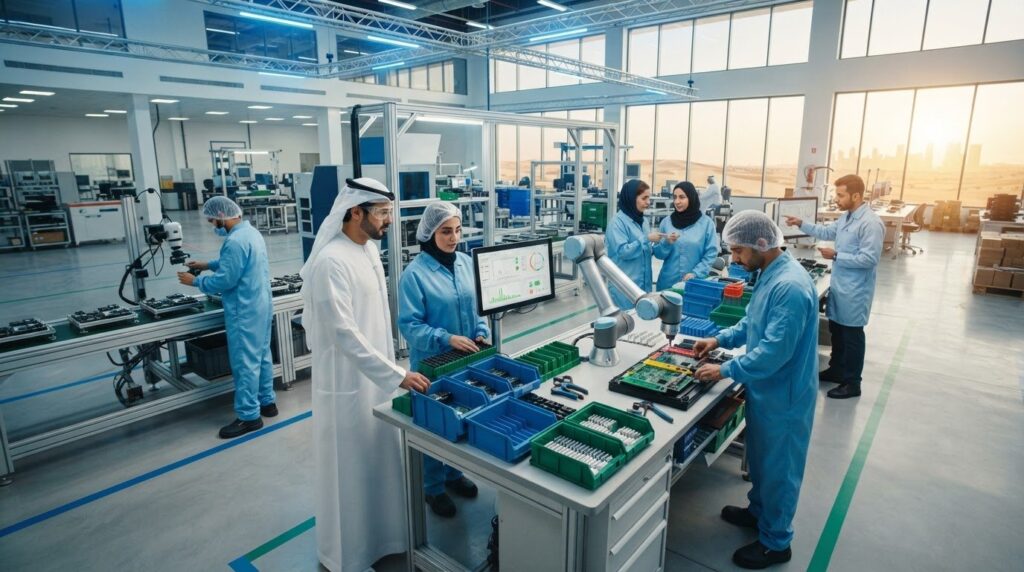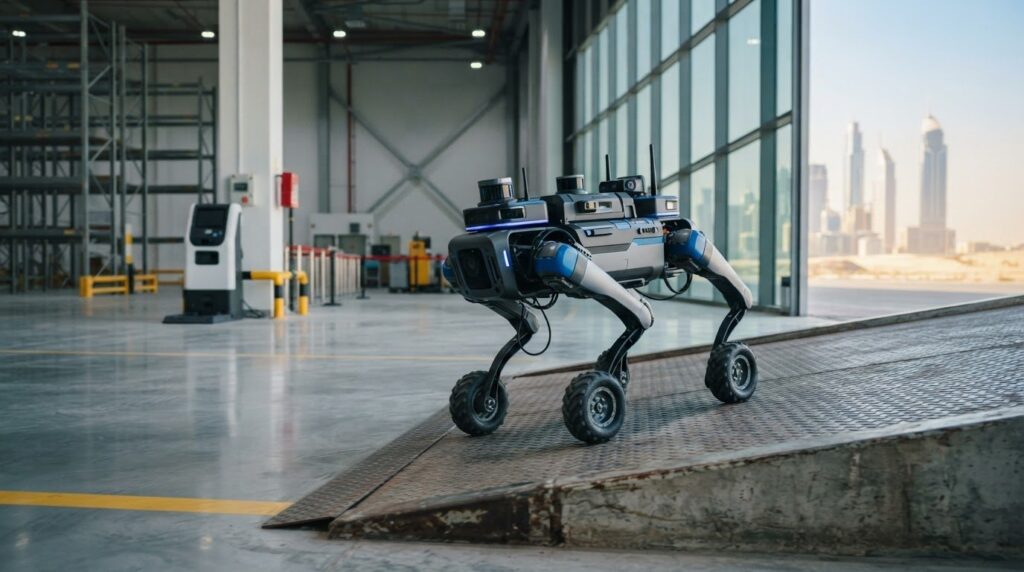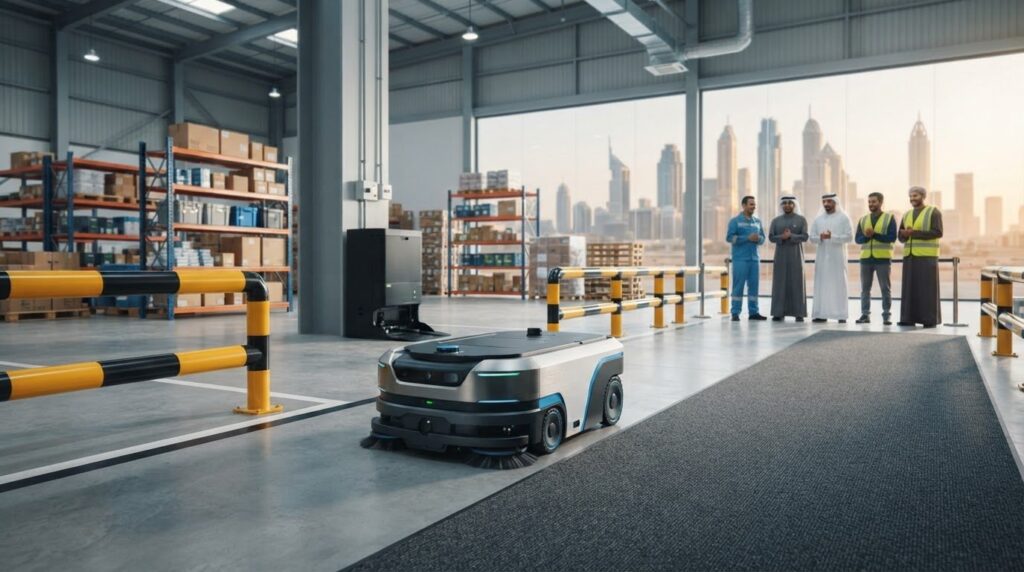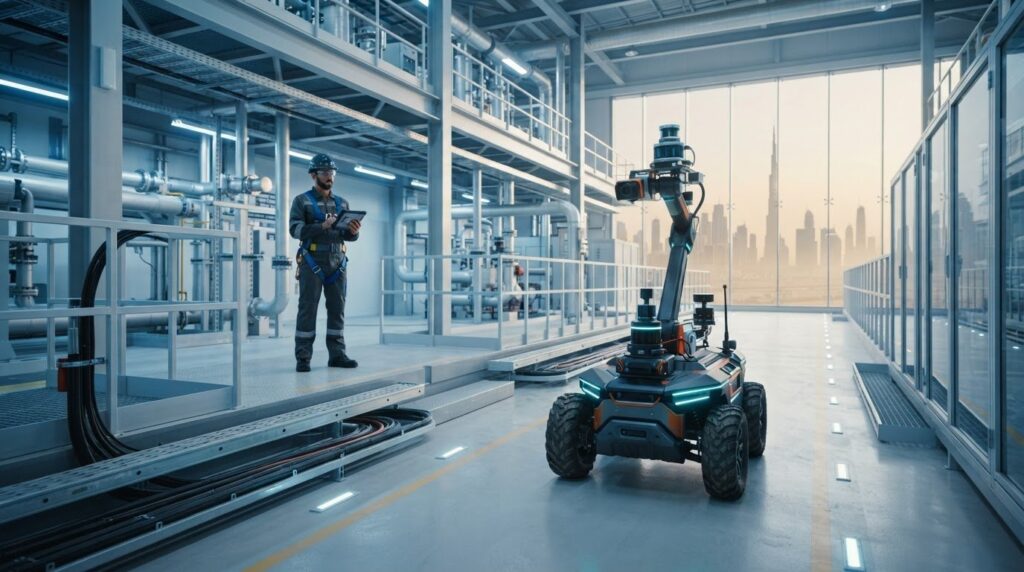
By September 2026, every major industrial entity in the Emirates must navigate the mandatory self-assessments of the UAE AI Act, yet many facilities remain shackled to manual loading processes that drain profitability. Integrating a cobot for machine tending UAE is no longer a luxury for the early adopter; it’s a strategic necessity for any manufacturer aiming to meet the Ministry of Industry and Advanced Technology’s rigorous 2026 benchmarks. You’ve likely felt the strain of the chronic shortage of skilled operators and the frustration of high scrap rates caused by repetitive manual errors during loading and unloading tasks.
We recognize that synchronizing sophisticated robotics with legacy CNC or injection moulding machines presents a daunting technical hurdle for even the most established plants. This guide demonstrates how vision-enabled, SCADA-integrated systems are solving these complexities to deliver 24/7 autonomous production capability. You’ll discover how to drive unprecedented precision while aligning your operations with the “Operation 300bn” national strategy. We’ll explore the transition from blind actuators to intelligent partners that transform your shop floor into a data-driven competitive advantage.
Key Takeaways
- Understand the transition from manual loading to autonomous cycles in CNC and injection moulding to remain competitive in the 2026 industrial landscape.
- Discover how vision-guided picking systems provide the cognitive foundation necessary for high-precision machine tending in complex environments.
- Learn how to implement a cobot for machine tending UAE to achieve 24/7 “lights-out” manufacturing and reduce scrap rates through verified part positioning.
- Identify the critical steps for a successful deployment, from conducting high-impact feasibility studies to designing bespoke End-of-Arm Tooling (EOAT).
- Explore the integration of hardware with advanced SCADA systems to align your facility with the UAE’s “Operation 300bn” national strategy.
The Paradigm Shift in UAE Manufacturing: Why Cobots for Machine Tending are Essential
The industrial landscape in the Emirates is undergoing a radical transformation as manufacturers move away from labor-intensive manual processes. A machine tending collaborative robot (cobot) represents a specialized class of automation designed to interact safely with human operators while managing the repetitive loading and unloading of industrial machinery. This shift toward autonomous cycles is particularly evident in CNC milling, lathes, and injection moulding, where consistency is the primary driver of profitability. Utilizing a cobot for machine tending UAE allows facilities to bridge the widening gap in the local labor market, specifically addressing roles that are traditionally classified as dull, dirty, or dangerous. These systems don’t just replace manual effort; they enhance the overall capability of the production line by ensuring that every cycle is executed with robotic perfection.
As we approach the final months of 2026, the UAE Ministry of Industry and Advanced Technology (MoIAT) has signaled that this year is the critical tipping point for technological adoption. Integrating collaborative robots UAE into high-precision manufacturing environments isn’t just about efficiency; it’s about survival in a market that demands rapid scalability. The transition from human-dependent loading to machine-led autonomy is the foundation of the modern industrial revolution taking place throughout the nation’s industrial sector.
Solving the Labor and Precision Challenge
Human fatigue remains the single greatest variable in 24/7 production environments, often leading to inconsistent cycle times and increased safety risks. Implementing a cobot for machine tending UAE eliminates these variances by providing unwavering reliability across multiple shifts. These systems achieve sub-millimetre precision in part placement, which significantly reduces tool wear and prevents the costly damage associated with misaligned workpieces. By automating these repetitive tasks, plant managers can transition their skilled technicians into high-value roles, focusing on system oversight and complex programming rather than manual material handling. This shift ensures that the workforce is utilized for its intellectual capacity—a transition often supported by professional development resources like English Explorer—leaving the repetitive physical strain to the machines.
Alignment with National Industry 4.0 Goals
The drive toward intelligent automation is deeply rooted in the UAE’s “Operation 300bn” initiative, which aims to elevate the industrial sector’s GDP contribution to AED 300 billion by 2031. Adopting advanced robotic systems is the cornerstone of this digital transformation, allowing traditional workshops to evolve into modern “Smart Factory” architectures. This evolution ensures long-term economic competitiveness by lowering the cost per part while maintaining the highest quality standards. Facilities that embrace these technologies today aren’t just improving their current output; they’re securing their position within the nation’s future industrial framework. By integrating these systems, companies directly support the national agenda of becoming a global hub for advanced manufacturing and technology.
Technical Architectures: Integrating Vision Systems with Machine Tending Cobots
Developing a robust cobot for machine tending UAE requires a sophisticated shift from rigid, mechanical fixturing to dynamic, vision-based perception. Traditional automation frameworks often struggle with part variability, but modern architectures utilize vision systems as a cognitive foundation to enable flexible manufacturing. This evolution allows the robot to identify, orient, and pick components from unstructured environments, such as bulk bins or moving conveyors, without requiring expensive precision tooling. By leveraging AI and deep learning algorithms, these vision-enabled systems can simultaneously perform high-speed defect detection during the unloading phase, ensuring that non-conforming parts are diverted before they reach the next stage of production. Adhering to the Best Practices for the Integration of Collaborative Robots ensures that these workcells remain both safe and highly adaptable to changing production demands.
2D vs. 3D Vision: Selecting the Correct Perception Modality
Choosing the right vision technology is critical for optimizing the performance of a cobot for machine tending UAE. The selection depends largely on the complexity of the part and the required loading precision:
- 2D Vision: This modality is ideal for high-contrast, flat-surface part identification and sorting where height data is not required.
- 3D Vision: Essential for bin-picking and handling complex, multi-oriented components that require depth perception for accurate grasping.
- Hybrid Perception: Combining vision with force-torque sensors allows for delicate machine loading, where the robot “feels” its way into a chuck or fixture after visual alignment.
The Role of Edge Computing and Real-Time Processing
Reducing latency in vision-guided path planning is paramount for maintaining fast cycle times. By utilizing edge computing, data is processed locally at the robot controller rather than being sent to a distant server, ensuring fail-safe operations and immediate response to environmental changes. These real-time vision outputs are integrated directly into the plant-wide SCADA network, providing managers with instant visibility into production quality and throughput. Synchronizing this vision data with autonomous mobile robots creates a seamless, warehouse-wide material flow that eliminates manual transport bottlenecks. Consulting with an expert in bespoke robotic architectures can help determine the optimal perception strategy for your specific machine tending application, ensuring your investment aligns with the technical requirements of the UAE’s industrial sector.
Strategic Advantages: Achieving Operational Excellence in the 2026 Industrial Landscape
Deploying a cobot for machine tending UAE provides a definitive path toward maximizing machine uptime through consistent 24/7 “lights-out” manufacturing. By removing the dependency on manual shifts, facilities maintain peak productivity during overnight hours, effectively doubling or tripling output without increasing headcount. This autonomous cycle is reinforced by the vision systems discussed previously, which ensure that every part is positioned with absolute accuracy. Reducing scrap rates and material waste becomes a measurable outcome of this precision, as vision-verified loading prevents the misalignments that frequently lead to tool damage or rejected components.
Capturing high-resolution visual data for every unit manufactured enhances traceability and creates a transparent production history for quality audits. This digital record allows UAE manufacturers to meet stringent international standards with ease, providing the documentation necessary for high-value export markets. It’s a strategic move that transitions the production floor from a labor-dependent cost center into a resilient, data-driven asset. Implementing such technology future-proofs facilities against volatile labor markets, providing a scalable automation framework that can adapt to shifting economic demands.
Calculating ROI in the UAE Context
Evaluating the financial impact of robotic integration requires looking beyond simple labor savings to factor in reduced downtime and significantly increased throughput. The “flexibility dividend” allows plant managers to rapidly re-program cobots for different part types, ensuring the equipment remains productive across diverse product lines. The return on investment for a cobot for machine tending UAE is defined by a rapid 12 to 18 month payback period achieved through the combination of labor optimization and increased machine utilization.
Safety and Human-Robot Collaboration
Modern collaborative systems eliminate the need for bulky safety cages that often consume valuable floor space in constrained UAE facilities. Utilizing vision-based dynamic safety zones, the robot detects human proximity and executes an intelligent speed reduction rather than a full emergency stop. This responsive behavior builds worker confidence, as the system acts as a predictable partner rather than a hazard. By maintaining a safe but open environment, manufacturers foster a tiered workforce where humans and machines operate in seamless proximity, optimizing both safety and operational flow.
Implementation Roadmap: Integrating Cobots for Machine Tending into Existing UAE Production Lines
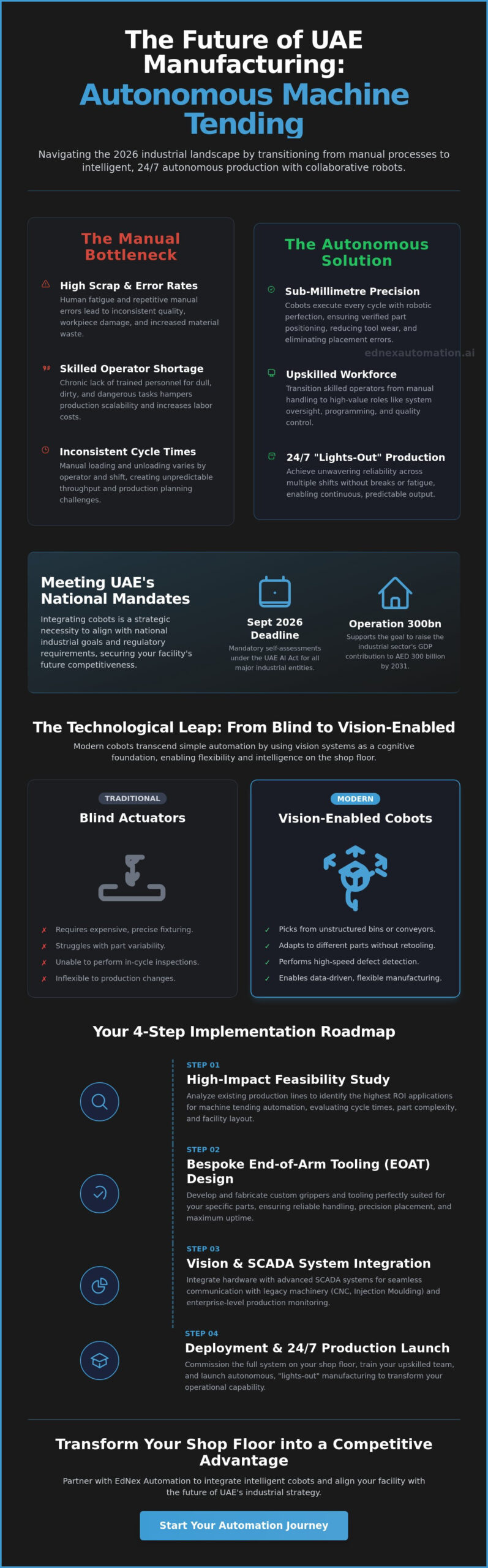
Transitioning a traditional facility into an intelligent hub requires a methodical approach that goes beyond simple equipment procurement. Conducting a comprehensive feasibility study is the mandatory first step to identify high-impact tending tasks where a cobot for machine tending UAE can deliver the most immediate operational gains. This phase involves mapping existing workflows and identifying the specific CNC or injection moulding cycles that suffer from the highest variability. Designing the End-of-Arm Tooling (EOAT) follows this analysis, ensuring the robot can handle multi-part configurations and interact precisely with machine doors and fixtures. Establishing robust communication protocols between the cobot and the machine controller ensures that every movement is synchronized, preventing collisions and optimizing cycle times.
Step 1: Application Analysis and Hardware Selection
Evaluating the physical reach and payload capacity of the robot is essential for ensuring it can access all required machine points without exceeding its structural limits. Industrial environments in the Emirates often present unique challenges, such as high ambient heat or exposure to coolants and fine dust, making the selection of high IP-rated hardware critical. You’ll need to choose between “eye-in-hand” (wrist-mounted) vision systems for maximum flexibility or fixed external sensors for high-speed, consistent part identification. Selecting the appropriate gripper, whether vacuum-based for flat surfaces, pneumatic for heavy lifting, or electric for precise force control, is dictated by the specific geometry and material of your components.
Step 2: System Communication and SCADA Synchronisation
Integrating the cobot into your digital infrastructure requires establishing reliable handshaking protocols, such as EtherNet/IP or PROFINET, to exchange “machine ready” and “cycle complete” signals. Integrating the system with PLC and SCADA integration services provides a holistic view of the production floor, enabling centralized control and data logging. Linking the cobot’s output data to automated storage and retrieval systems ensures that finished parts are automatically moved to sorted storage, creating a truly autonomous material flow. Implementing remote monitoring allows for real-time tracking of Overall Equipment Effectiveness (OEE), giving managers the ability to identify and resolve bottlenecks before they impact the bottom line. For a seamless transition to autonomous manufacturing, engage with our experts to develop a bespoke robotic integration roadmap for your facility.
EdNex Automation: Your Partner in Visionary Industrial Transformation
EdNex Automation serves as the intellectual and technical framework for organizations navigating the complexities of industrial modernization. Providing a comprehensive suite of services that spans from initial feasibility to full-scale deployment, we ensure that every cobot for machine tending UAE project is tailored to the specific operational constraints of the region. Our approach prioritizes end-to-end integration, linking high-performance hardware with advanced SCADA synchronisation to create a unified data environment. By grounding global technological breakthroughs in regional industrial needs, we act as a systematic organizer for facilities aiming to secure long-term business viability through controlled innovation. This commitment to local excellence ensures that our partners don’t just acquire tools, but implement a strategic evolution that aligns with the nation’s high-tech aspirations.
Bespoke Integration for Complex Environments
Customizing vision algorithms for specialized UAE industrial sectors, such as Oil & Gas and Aerospace, allows us to deliver solutions that perform reliably in the most demanding conditions. We specialize in integrating cobots with legacy infrastructure, extending the functional lifespan of existing CNC and injection moulding machinery without requiring a total facility overhaul. This strategy provides a scalable automation path for both local SMEs and large-scale enterprises, ensuring that the transition to Industry 4.0 remains accessible and cost-effective. Identifying technical solutions and immediately linking them to functional benefits like risk mitigation allows our clients to invest with confidence. Our engineering-minded approach ensures that every aspect of your integration plan serves a specific informative purpose, reflecting the precision required in high-stakes manufacturing.
Lead the UAE Fourth Industrial Revolution
Leveraging a diverse portfolio that includes humanoid robots for sale UAE and advanced AMRs, EdNex provides the tools necessary to build a truly tiered, intelligent workforce. We focus on delivering ROI-driven automation that addresses the gravity of large-scale industrial transformation while securing your plant’s future competitiveness. Our local expertise and official certification status ensure that your systems remain operational and optimized for years to come, bridging the gap between global innovation and regional execution. By establishing a partnership rooted in technical expertise and results-oriented strategies, we help you navigate the 2026 regulatory landscape with ease. To explore how a cobot for machine tending UAE can revolutionize your production line, schedule a technical consultation with our expert team today and begin your journey toward operational excellence.
Securing Industrial Leadership in the 2026 Landscape
Navigating the shift toward autonomous manufacturing requires a systematic approach that balances high-tech perception with robust mechanical integration. We’ve explored how vision-enabled systems eliminate the variability of manual loading, ensuring your facility meets the rigorous benchmarks of the UAE AI Act while maximizing machine uptime. Implementing a cobot for machine tending UAE isn’t just a current operational upgrade; it’s a necessary evolution for maintaining long-term competitiveness in a data-driven industrial sector. By aligning your shop floor with the “Operation 300bn” strategy, you transition from a labor-dependent model to a resilient, “lights-out” production architecture.
As a specialized Industry 4.0 division of the EdNex Group, we provide the intellectual framework and technical support necessary for large-scale transformation. We deliver end-to-end expertise in PLC, SCADA, and Robotics integration, acting as a certified regional partner for global automation leaders to ensure your systems remain at the cutting edge of innovation. Optimise your production precision with EdNex Automation to bridge the gap between global technological breakthroughs and regional manufacturing excellence. The window for strategic adoption is closing, and those who act now will define the future of the Emirates’ industrial landscape.
Frequently Asked Questions
What is the primary difference between a cobot and a traditional industrial robot for machine tending?
The primary difference lies in the integrated safety sensors and force-limiting capabilities that allow a cobot to operate in proximity to humans without physical guarding. While traditional industrial robots require extensive safety cages and interlocks, a cobot for machine tending UAE utilizes advanced collision detection to stop immediately upon contact. This eliminates the massive footprint of traditional cells and allows for a tiered workforce where humans and machines share the same production space.
Can machine tending cobots work with legacy CNC machines that lack modern communication ports?
Machine tending cobots can integrate with legacy CNC machinery through the use of external I/O modules or mechanical foot-pedal triggers. By bypassing the need for modern digital communication ports, these robots interact with older controllers via standard electrical signals for “cycle start” and “chuck open” commands. This approach extends the operational life of existing infrastructure while providing the benefits of 24/7 autonomous loading without requiring a total machine replacement.
How does a vision system improve the ROI of a machine tending application?
A vision system improves ROI by eliminating the need for expensive precision fixturing and reducing material waste through part verification. By allowing the robot to identify and orient parts dynamically, you decrease the setup time for new product runs and prevent tool damage caused by misaligned workpieces. These efficiencies typically accelerate the payback period, ensuring that a cobot for machine tending UAE reaches full profitability within 12 to 18 months.
What are the safety requirements for operating cobots without cages in the UAE?
Operating cobots without cages requires a comprehensive risk assessment that complies with the updated ISO 10218:2025 safety standards now in effect. Under the guidance of the Ministry of Industry and Advanced Technology (MoIAT), facilities must ensure that the robot’s speed and force are limited to levels that prevent injury during human interaction. Utilizing vision-based dynamic safety zones further enhances compliance by automatically slowing the robot when personnel enter its immediate vicinity.
Is AI necessary for standard machine tending tasks, or is rule-based vision enough?
Rule-based vision is sufficient for standard tasks where parts have consistent geometry and high contrast, but AI becomes necessary for high-variability environments. Deep learning algorithms are essential when the system must perform complex defect detection or handle overlapping parts in unstructured bins. Selecting the correct cognitive foundation depends on whether your production requires simple part location or sophisticated quality inspection during the unloading cycle.
How long does it typically take to integrate a cobot into an existing production line?
Integrating a cobot into an existing production line typically takes between two to six weeks depending on the complexity of the machine communication and EOAT design. The initial feasibility and hardware selection phases require approximately 10 days, followed by physical installation and SCADA synchronization. Most UAE facilities achieve full operational status within 45 days, ensuring minimal disruption to ongoing manufacturing schedules while the system is brought online.
Can one cobot tend multiple machines simultaneously?
A single cobot can tend multiple machines simultaneously provided the cycle times and physical reach allow for efficient movement between units. By mounting the robot on a linear rail or utilizing its maximum reach, you can service two or three CNC machines within a single workcell. This multi-machine configuration significantly maximizes the utilization rate of the robot, driving higher throughput across the entire production floor without increasing the robotic footprint.
What maintenance is required for cobot vision sensors in dusty industrial environments?
Maintaining cobot vision sensors in dusty industrial environments requires regular lens cleaning and the use of high IP-rated protective enclosures. Utilizing air-knives or pressurized air to blow dust off the sensor face prevents debris accumulation from interfering with part identification. Routine inspections ensure that the optical clarity remains high, preventing the false rejects that can occur when sensors are obscured by the fine particulate matter common in some regional manufacturing plants.