With the UAE AI Act now in full effect, organizations that fail to complete their mandatory automation self-assessments by September 2026 risk falling behind a rapidly accelerating industrial standard. Implementing high-performance robotic pick and place systems UAE manufacturers and logistics providers now deploy is no longer merely a matter of speed; it’s a strategic necessity for any enterprise aiming to contribute to the nation’s AED 300 billion industrial GDP goal. You’re likely aware that manual sorting and rigid packaging lines create unsustainable bottlenecks that drain your operational budget and hinder scalability.
This strategic guide demonstrates how advanced robotic integration transforms these technical hurdles into high-precision throughput, ensuring your new assets communicate flawlessly with legacy PLC and SCADA frameworks. By aligning global technological breakthroughs with regional industrial needs, we provide the intellectual framework required to achieve seamless warehouse management integration. We’ll examine the specific robotic architectures that drive long-term ROI through reduced downtime, providing a clear roadmap for your organization’s transition into a fully realized Industry 4.0 ecosystem.
Key Takeaways
- Identify the strategic advantages of implementing robotic pick and place systems UAE to achieve the precision and speed required by modern Industry 4.0 standards.
- Analyze the distinct mechanical capabilities of Delta, SCARA, and 6-axis articulated robots to match the specific payload and cycle-time demands of your facility.
- Learn how intelligent vision systems and advanced end-of-arm tooling (EOAT) provide the adaptability needed to handle complex product geometries with surgical accuracy.
- Understand the critical importance of integrating robotic hardware with PLC, SCADA, and ASRS frameworks for a unified, data-driven industrial ecosystem.
- Discover how a comprehensive, start-to-finish integration approach ensures long-term ROI by mitigating downtime and facilitating seamless scalability in the UAE market.
The Strategic Role of Robotic Pick and Place Systems in the UAE
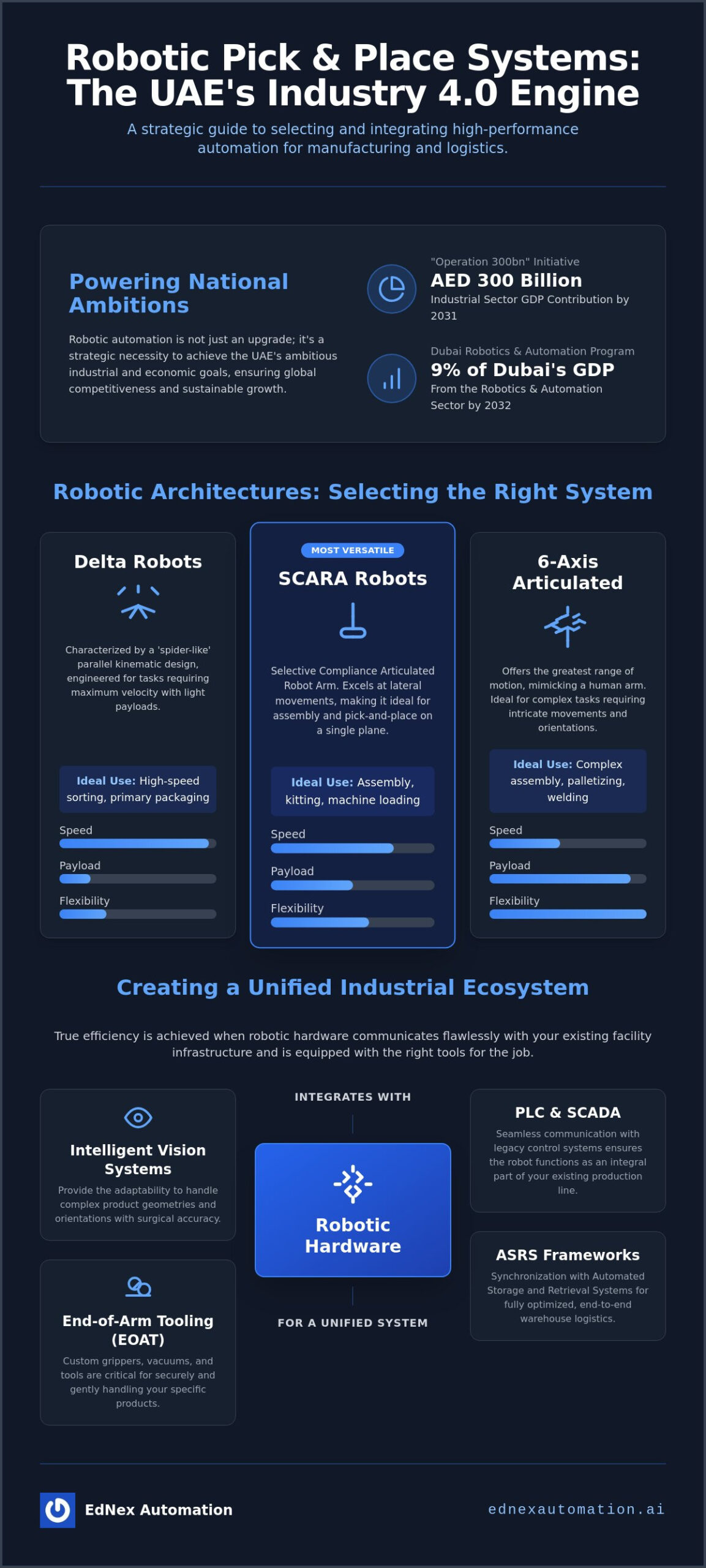
Positioning the UAE as a global hub for smart manufacturing requires a fundamental departure from legacy manual processes. Integrating robotic pick and place systems UAE manufacturers can utilize ensures that high-speed production lines operate with surgical precision, effectively eliminating the human error inherent in repetitive tasks. Leveraging foundational robotics technology, these advanced systems utilize sophisticated kinematics to transfer objects between locations with repeatable accuracy. This transition toward autonomous operations isn’t merely an upgrade; it’s a strategic realignment with the nation’s “Operation 300bn” initiative, which seeks to expand the industrial sector’s contribution to the national GDP to AED 300 billion by 2031.
Adopting these high-speed solutions allows facilities to achieve 24/7 operational continuity without the performance degradation associated with manual labor. By maintaining a zero-error rate during high-velocity sorting and packaging, enterprises protect their brand integrity while significantly reducing waste. These systems act as the mechanical backbone of a modern facility, providing the throughput necessary to meet the demands of a rapidly growing regional market.
Driving UAE Industry 4.0 Objectives
Aligning industrial output with national digital transformation goals, robotic automation facilitates the emergence of “dark factories” where production continues autonomously under minimal supervision. This shift supports economic diversification by reducing reliance on low-skilled labor and fostering a high-tech ecosystem driven by intelligent machinery. By implementing these sophisticated architectures, UAE-based manufacturers enhance their global competitiveness, ensuring they can match the production efficiency of any international counterpart. This evolution is critical as the Dubai Robotics and Automation Program aims to increase the sector’s contribution to Dubai’s GDP to 9% by 2032.
Key Applications Across National Sectors
Deploying specialized robotic arms across diverse industries addresses unique operational challenges with bespoke efficiency. In the food and beverage sector, high-speed Delta robots execute rapid sorting and primary packaging of perishable goods, ensuring hygiene and consistency. The electronics and pharmaceutical industries utilize 6-axis articulated robots for precision assembly where tolerances are measured in microns. Within large-scale distribution centers, these systems synchronize with Automated Storage and Retrieval Systems (ASRS) to optimize end-of-line palletizing and logistics. This synergy creates a fluid supply chain capable of handling the massive volumes processed through the UAE’s strategic trade hubs.
Robotic Architectures: Selecting the Right System for Your Facility
Selecting the optimal mechanical architecture is the most critical decision in designing effective robotic pick and place systems UAE industries require for sustained growth. Engineers must evaluate the inherent trade-offs between velocity, range of motion, and load capacity to ensure the system meets specific cycle-time targets. Footprint optimization is equally vital; a robot that occupies excessive floor space without a proportional increase in throughput can diminish the overall efficiency of a production cell. It’s not just about the hardware; it’s about how that hardware fits into the physical constraints of your existing line.
Determining the correct payload capacity involves more than just weighing the product. It’s essential to account for the mass of the End-of-Arm Tooling (EOAT) and the dynamic forces generated during high-acceleration movements. Matching these technical specifications to your facility’s unique workflow requires a deep understanding of robotic kinematics. For organizations looking to modernize their infrastructure, exploring bespoke automation solutions ensures that every component is selected for maximum industrial synergy and long-term reliability.
Delta Robots for Ultra-High-Speed Operations
The Delta robot, often characterized by its ‘spider’ design, is engineered for ultra-high-speed operations where payload weights remain relatively low. A Delta robot’s parallel kinematic structure keeps heavy motors at the base, allowing for ultra-low inertia and extreme acceleration during high-cycle pick and place tasks. These systems are the gold standard for the UAE’s fast-moving consumer goods (FMCG) and pharmaceutical sectors, where they handle thousands of units per hour with relentless consistency. Their overhead mounting configuration saves valuable floor space, making them ideal for dense packaging lines where every square meter is a premium asset.
SCARA and Articulated Robots for Versatility
SCARA (Selective Compliance Assembly Robot Arm) systems offer a rigid vertical axis, making them the preferred choice for high-speed insertion and vertical assembly tasks. They provide an excellent cost-to-performance ratio for applications that don’t require a full 3D range of motion but demand high repeatability. Conversely, 6-axis articulated arms offer maximum flexibility, enabling complex, multi-angle placement tasks that mimic human arm movement. While they might have slightly longer cycle times than Delta robots, their ability to reach into tight spaces and manipulate objects from various orientations is unmatched. Choosing between these architectures depends on whether your specific process prioritizes linear speed or spatial versatility.
End-of-Arm Tooling (EOAT) and Intelligent Vision Systems
Realizing the full potential of robotic pick and place systems UAE requires looking beyond the mechanical arm to the critical interface between the machine and the product. End-of-Arm Tooling (EOAT) functions as the specialized “hand” of the system, and its design dictates the success or failure of the entire automation project. While the robotic arm provides the reach and speed, the EOAT provides the dexterity needed to manipulate diverse materials without causing structural damage. Selecting the wrong gripper often leads to dropped parts or surface marring, which directly impacts your facility’s yield and overall equipment effectiveness (OEE).
Advanced integration projects now frequently utilize a combination of vacuum and mechanical grippers to handle fluctuating product lines. Vacuum solutions excel at lifting flat, non-porous surfaces like glass or corrugated cardboard, while mechanical grippers provide the rigid security required for heavy or irregularly shaped industrial components. By incorporating intelligent sensors into the EOAT, these systems monitor grip force in real time, ensuring that even the most delicate pharmaceutical vials or electronic components are handled with consistent, calibrated pressure.
Customizing Gripper Technology
Deploying soft robotics and adaptive grippers allows manufacturers to automate the handling of delicate or highly irregular items that were previously restricted to manual labor. These flexible interfaces conform to the shape of the object, providing a secure hold without the need for high-pressure clamping. For heavy industrial applications involving metallic parts, magnetic or pneumatic solutions offer the robust force required for high-velocity transfers. Implementing precision force control within these tools significantly reduces product damage, protecting your bottom line and ensuring that every item leaving the line meets rigorous quality standards.
The Power of Machine Vision and AI
Integrating 2D and 3D machine vision transforms a standard pick and place unit into an autonomous observer capable of navigating unstructured environments. 2D vision systems facilitate rapid identification based on contrast and color, making them ideal for high-speed sorting on flat conveyors. However, 3D vision systems utilize point-cloud data to calculate precise X, Y, and Z spatial coordinates, allowing the robot to navigate complex picking environments with millimeter accuracy. This “see and react” capability is essential for random bin picking, where products arrive in tangled or overlapping configurations.
AI-driven vision systems further enhance this autonomy by learning to identify varying product shapes and orientations under shifting lighting conditions. Beyond simple location tracking, these systems perform real-time quality control by identifying surface defects or missing components during the pick and place cycle. This dual-purpose functionality ensures that only perfect products move forward in the production chain, reinforcing your facility’s reputation for technical excellence and reliability.
Industrial Synergy: Integrating Robotics with PLC, SCADA, and ASRS
Achieving peak operational efficiency requires the total synchronization of individual robotic cells with factory-wide intelligence. While the mechanical speed of robotic pick and place systems UAE facilities deploy is impressive, their true value is unlocked only when they communicate seamlessly with the broader control layer. This industrial synergy ensures that every movement is coordinated with upstream production and downstream logistics, preventing the accumulation of inventory buffers that stagnate cash flow. By harvesting real-time telemetry from robotic controllers, engineers can drive predictive maintenance schedules and optimize Overall Equipment Effectiveness (OEE) through data-backed insights.
Utilizing specialized PLC and SCADA integration services provides the necessary intellectual framework to monitor robotic health and performance. These systems act as the nervous system of the factory, translating raw sensor data into actionable visualizations that allow operators to preempt mechanical failures before they result in costly downtime. To explore how your facility can achieve this level of technical cohesion, consult with our automation integration experts today.
Centralized Control and Visualization
Deploying SCADA dashboards across UAE industrial sites enables management to visualize robotic throughput and cycle times from a single, centralized location. PLC programming serves as the foundational logic that ensures synchronized movement between high-speed conveyors and robotic arms, eliminating the risk of collisions or timing misalignments. By adopting secure industrial communication protocols, such as OPC UA or MQTT, manufacturers establish a resilient network that protects sensitive operational data while facilitating high-speed information exchange across the automated environment.
The Robotics and ASRS Connection
Integrating robotic pick and place units with automated storage and retrieval systems (ASRS) creates a frictionless interface between production lines and storage bins. This connection is vital for high-volume fulfillment centers where robots serve as the primary induction and retrieval mechanism, drastically reducing the need for human intervention in hazardous or repetitive environments. Optimizing warehouse density through these high-speed robotic interfaces allows enterprises to maximize their existing footprint, ensuring that every cubic meter of storage is utilized with maximum efficiency.
Future-Proofing Your Operations with EdNex Automation
EdNex Automation acts as a strategic bridge, connecting global technological breakthroughs with the specific economic requirements of the Emirates. Delivering the sophisticated robotic pick and place systems UAE organizations need for long-term viability, we provide the intellectual framework necessary for large-scale industrial transformation. Our start-to-finish expertise ensures that your investment is protected from the initial feasibility study through to commissioning and ongoing technical maintenance. Partnering with a visionary consultant rather than a simple equipment vendor allows you to navigate the complexities of Industry 4.0 with a methodical and reliable approach. This systematic organization of technology brings order and efficiency to the most complex manufacturing environments.
Establishing a resilient automation strategy requires more than just high-speed hardware; it demands a partner who understands the gravity of regional industrial shifts. We align our integration services with national objectives, ensuring your facility is prepared for the mandatory self-assessments required by the UAE AI Act. By positioning your enterprise at the cutting edge of innovation, we help you mitigate the risks of technical obsolescence while maximizing the return on your automation investments.
Comprehensive Automation Consulting
Leveraging our status as a specialized division of the EdNex group, we provide bespoke integration of collaborative robots alongside high-speed industrial arms. Our engineering teams conduct rigorous assessments to ensure that every robotic cell meets official international certifications and local safety standards. We emphasize workforce empowerment, offering tailored training programs that transform your local staff into skilled operators capable of managing advanced robotic telemetry. By fostering this internal expertise, your organization ensures that its automation assets continue to deliver peak performance throughout their entire lifecycle. This commitment to long-term business viability frames our services as a necessary evolution for any enterprise wishing to remain competitive in a data-driven market.
Next-Gen Solutions: Humanoids and AMRs
Expanding your automation horizon requires moving beyond fixed robotic cells into the realm of total mobility and human-centric interaction. Integrating autonomous mobile robots (AMRs) with your pick and place units creates an elastic logistics chain that adapts to real-time warehouse demands without manual repositioning. Looking toward the next decade of industrial growth, the deployment of a humanoid service robot offers unparalleled potential for complex tasks in unstructured environments where traditional machinery faces limitations. These next-generation assets provide the flexibility required to handle diverse product portfolios while maintaining the speed of a fully automated line. Contact EdNex Automation to begin your journey toward a fully autonomous facility and secure your competitive standing in the future economy.
Mastering the Future of Industrial Autonomy
Aligning your facility with the UAE’s ambitious industrial roadmap requires more than the mere acquisition of hardware; it demands a comprehensive integration strategy that synthesizes mechanical precision with factory-wide intelligence. We’ve explored how selecting the appropriate robotic architecture and advanced End-of-Arm Tooling (EOAT) determines the surgical accuracy of your production lines. Achieving a seamless connection between robotic cells and centralized PLC/SCADA frameworks is essential for harvesting the telemetry needed to drive predictive maintenance and operational efficiency. Implementing high-performance robotic pick and place systems UAE manufacturers rely on today ensures that your organization remains competitive in an increasingly autonomous global market.
As a specialized division of the EdNex group, we offer the technical expertise required to bridge the gap between global innovation and regional industrial needs. Our team provides start-to-finish support, from initial feasibility studies to the deployment of complex Industry 4.0 solutions. Partner with EdNex Automation for your industrial transformation to secure the intellectual framework necessary for sustainable growth. Embracing these advanced systems today positions your enterprise as a leader in the nation’s high-tech evolution, paving the way for a future of unprecedented productivity and precision.
Frequently Asked Questions
What is the typical ROI for a robotic pick and place system in the UAE?
Return on investment typically manifests within 12 to 24 months, though this timeline varies based on your specific operational throughput and current labor expenditures. By eliminating human error and enabling 24/7 production cycles, these systems significantly reduce the cost per unit. Long-term profitability is further enhanced through minimized waste and lower insurance premiums associated with repetitive strain injuries. Investing in automation ensures your facility remains competitive as regional labor regulations and economic standards continue to evolve.
Can pick and place robots be integrated with my existing manual conveyor lines?
Seamless integration with legacy manual conveyor lines is entirely achievable through bespoke PLC and SCADA programming. Specialized sensors and encoders are installed to synchronize the robot’s cycle time with the conveyor’s speed, ensuring precise picking without requiring the line to stop. This modular approach allows you to modernize specific sections of your facility without a total infrastructure overhaul. It’s a highly efficient strategy for transitioning toward a fully autonomous Industry 4.0 ecosystem over time.
What is the difference between a Delta robot and a SCARA robot for packaging?
Delta robots utilize a parallel kinematic structure designed for ultra-high-speed, low-payload tasks, making them the gold standard for rapid primary packaging. SCARA robots feature a rigid vertical axis that provides superior performance for heavy-duty vertical assembly and kitting where precision is paramount. While Delta robots are typically ceiling-mounted to save valuable floor space, SCARA units offer a compact footprint for pedestal or tabletop installations. Choosing the right architecture depends on your specific cycle-time and payload requirements.
How do vision systems improve the accuracy of robotic picking?
Vision systems improve accuracy by providing the robot with real-time spatial awareness and the capability to identify objects in unstructured environments. By utilizing 2D or 3D point-cloud data, robotic pick and place systems UAE facilities deploy can calculate precise coordinates for overlapping or randomly oriented items. This technology eliminates the need for expensive mechanical fixtures and allows the system to adapt to varying product shapes or shifting lighting conditions with millimeter-level repeatability and precision.
What maintenance is required for high-speed robotic arms in industrial settings?
High-speed robotic arms require routine lubrication of joints, gear inspections, and periodic software calibrations to maintain peak performance. Implementing a predictive maintenance strategy using SCADA telemetry allows you to identify wear in motors or belts before a mechanical failure occurs. This proactive approach minimizes unscheduled downtime and extends the operational lifespan of your high-tech assets. Regular inspection of End-of-Arm Tooling is also critical to ensure consistent grip force and protect product integrity during high-velocity transfers.
Do I need specialized staff to program and operate these robotic systems?
Modern robotic interfaces are designed for intuitive operation, allowing your existing workforce to manage daily tasks with minimal technical background. However, high-level PLC programming and complex system reconfigurations require specialized training or the support of an expert integration partner. We provide comprehensive training and support services to empower your local team, ensuring they possess the intellectual framework needed to supervise advanced autonomous environments. This approach successfully bridges the gap between manual labor and high-level technical management.
Are collaborative robots (cobots) suitable for high-speed pick and place tasks?
Collaborative robots excel in environments where flexibility and human-robot interaction are prioritized over raw mechanical velocity. While they don’t match the extreme cycle times of dedicated Delta or SCARA systems, they offer rapid deployment and don’t require expensive safety fencing for most applications. Cobots are ideal for low-to-medium volume pick and place tasks where the production layout frequently changes. For ultra-high-speed requirements, traditional industrial robots remain the preferred solution for maximizing total facility throughput.
How does EdNex Automation support businesses with robotic integration in the UAE?
EdNex Automation provides start-to-finish expertise by acting as a strategic consultant for your entire industrial transformation. We conduct rigorous feasibility studies, design bespoke robotic architectures, and execute seamless PLC and SCADA integration across your entire facility. Our status as a specialized division of the EdNex group ensures we deliver global technological breakthroughs tailored to the UAE’s unique economic landscape. We provide the reliable technical partnership necessary to achieve long-term ROI through controlled and deliberate innovation.