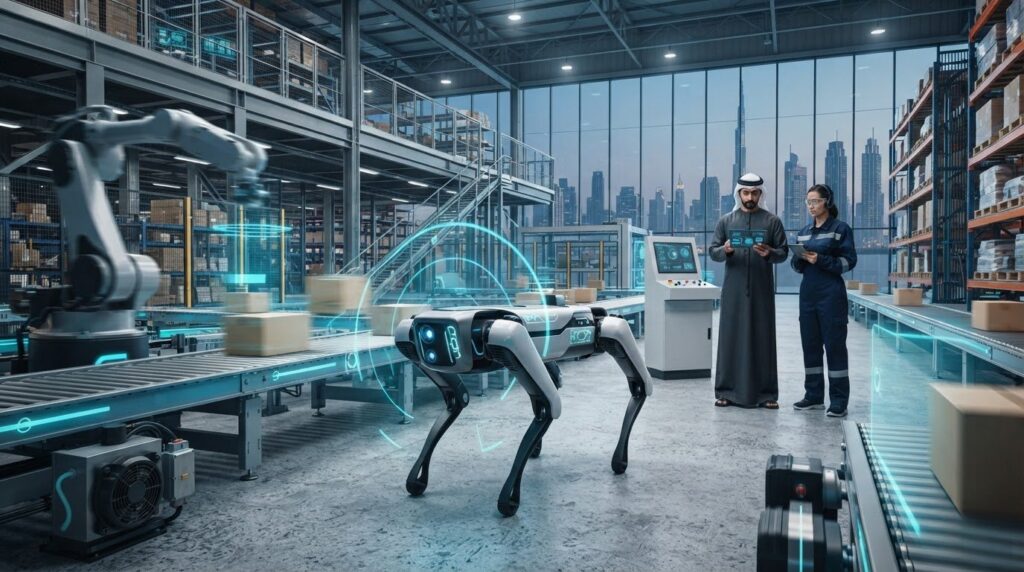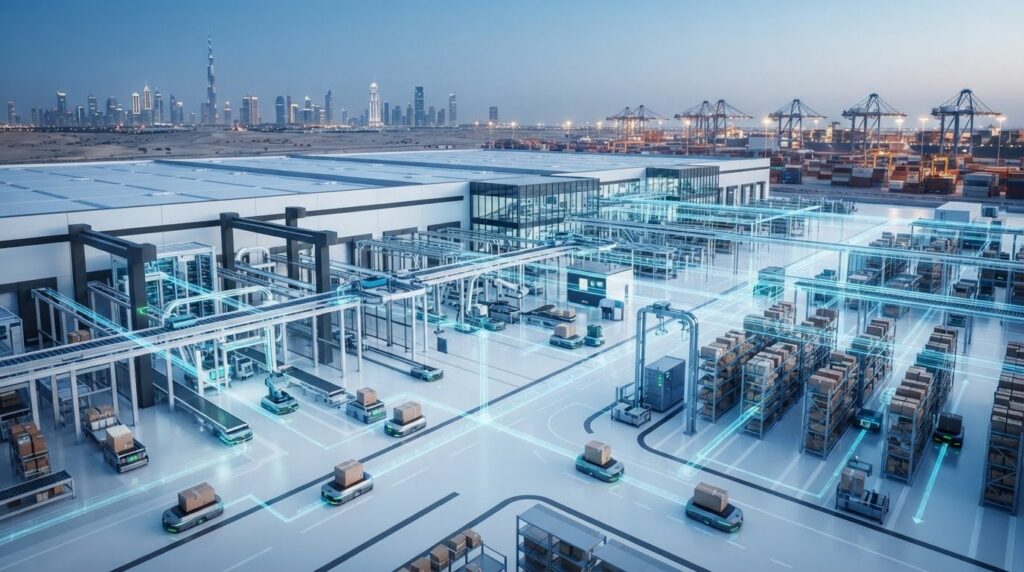
By 2026, the UAE digital transformation market has ascended to a value of USD 1.82 billion, signaling a definitive shift toward an industrial landscape where physical AI and autonomous systems define market leadership. Executing a successful digital transformation in manufacturing UAE requires more than just capital investment; it necessitates a systematic orchestration of robotics and intelligent control infrastructure. You likely recognize that the friction between legacy hardware and modern IT protocols often creates operational bottlenecks, while the scarcity of specialized technical talent complicates the transition to Industry 4.0.
This article provides a comprehensive strategic roadmap to overcome these hurdles, positioning your facility to eliminate operational downtime and achieve full compliance with the Ministry of Industry and Advanced Technology’s TTP standards. We’ll explore the sophisticated integration of Collaborative Robots and Automated Storage and Retrieval Systems, demonstrating how to bridge the gap between shop floor execution and enterprise-level intelligence. By leveraging the latest 2026 R&D tax incentives and EDB financing, your organization can transform complex OT-IT convergence into a streamlined, competitive advantage.
Key Takeaways
- Understand how “Operation 300bn” and MoIAT mandates provide the regulatory framework for industrial growth through 2026.
- Discover how integrating Collaborative Robots (Cobots) and Autonomous Mobile Robots (AMRs) creates a resilient, high-output production environment.
- Master the mechanics of digital transformation in manufacturing UAE by bridging the gap between shop floor hardware and enterprise software via PLC and SCADA systems.
- Learn to calculate the true ROI of robotic systems while utilizing 2026 tax incentives to offset initial capital expenditure.
- Identify the critical steps for achieving TTP compliance through bespoke, start-to-finish infrastructure modernization.
The National Mandate: UAE’s Industrial Strategy 2026
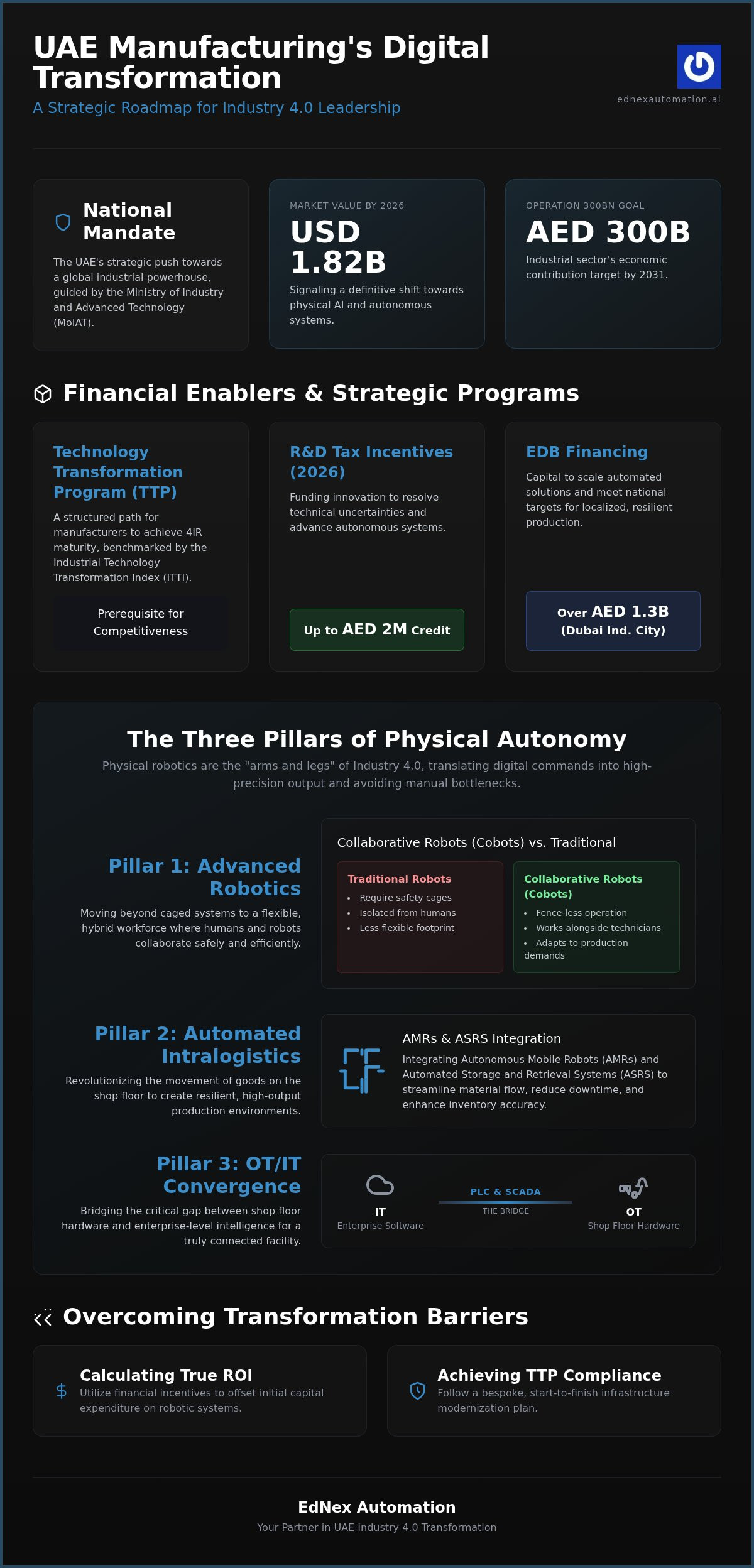
Positioning the UAE as a global industrial powerhouse, the Ministry of Industry and Advanced Technology (MoIAT) has established a rigorous framework for 2026 that demands a departure from traditional manual workflows. The digital transformation in manufacturing UAE serves as the primary vehicle for Operation 300bn, aiming to increase the industrial sector’s economic contribution to AED 300 billion by 2031. By leveraging the Technology Transformation Program (TTP), manufacturers can now access a structured path toward 4IR maturity, utilizing the Industrial Technology Transformation Index (ITTI) to benchmark their progress against global leaders. This national mandate creates a high-stakes environment where autonomy is no longer a luxury but a prerequisite for regional competitiveness.
Key National Programs Driving Automation
The UAE’s Fourth Industrial Revolution Strategy provides a workable blueprint for integrating physical AI into the manufacturing core. Central to this is the TTP, which incentivizes the adoption of advanced robotics through targeted financial enablers. For instance, the new R&D Tax Incentive Program, effective for tax periods starting January 1, 2026, offers a non-refundable credit of up to AED 2 million for manufacturers resolving specific technical uncertainties. These programs don’t just suggest innovation; they actively fund the transition toward “Future Industries” where autonomous systems handle the heavy lifting of production, ensuring that the UAE remains at the cutting edge of global industrial standards.
The Strategic Importance of ‘Make it in the Emirates’
Participating in the “Make it in the Emirates” campaign requires a commitment to localized, high-precision production that can compete on a global scale. By implementing Digital manufacturing frameworks, local factories can reduce their reliance on volatile global logistics and consolidate their supply chains within the UAE’s borders. This localization is supported by digitized inspection systems that ensure every component meets international quality standards without manual intervention.
Automated production lines allow for a level of consistency that manual labor simply can’t replicate, securing the UAE’s status as a reliable hub for sophisticated industrial exports. Using EDB financing, which surpassed AED 1.3 billion for companies in Dubai Industrial City by May 2026, manufacturers can scale these automated solutions to meet national targets while ensuring operational resilience. This shift toward localized, automated production isn’t just about efficiency; it’s a strategic move to build a sovereign industrial infrastructure that’s immune to global disruptions.
The Three Pillars of Physical Autonomy in Manufacturing
Leading with a physical-first perspective, forward-thinking manufacturers are discovering that data analytics alone cannot drive productivity without the mechanical execution of advanced robotics. While software provides the necessary intelligence, physical robotics represent the “arms and legs” of Industry 4.0, translating digital commands into high-precision output. In the context of digital transformation in manufacturing UAE, this physical layer is the critical differentiator between a theoretical model and a high-throughput facility. Organizations that fail to modernize their hardware alongside their software often find themselves with “intelligent” systems that remain bottlenecked by manual, low-speed production lines.
Collaborative vs. Traditional Industrial Robotics
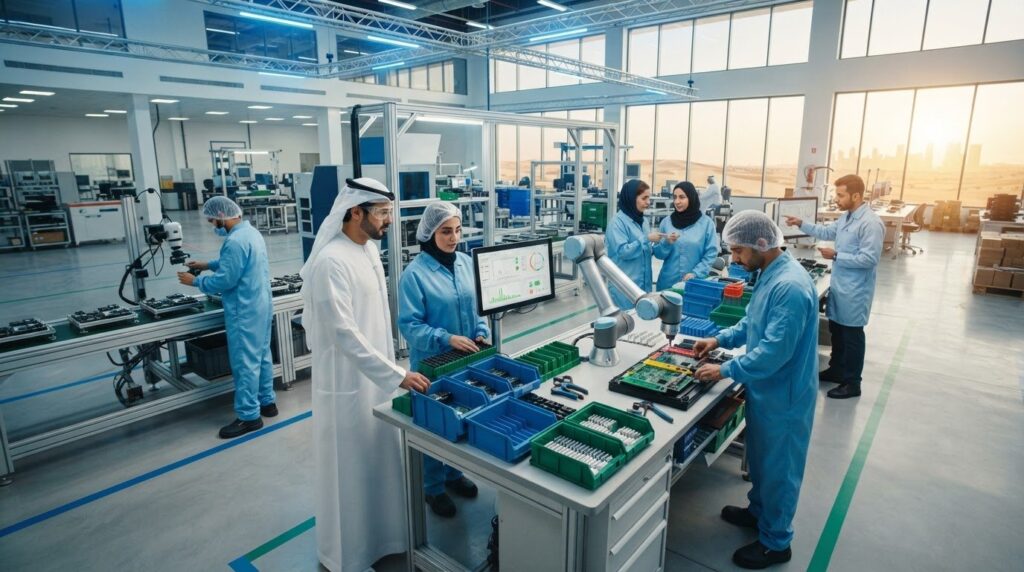
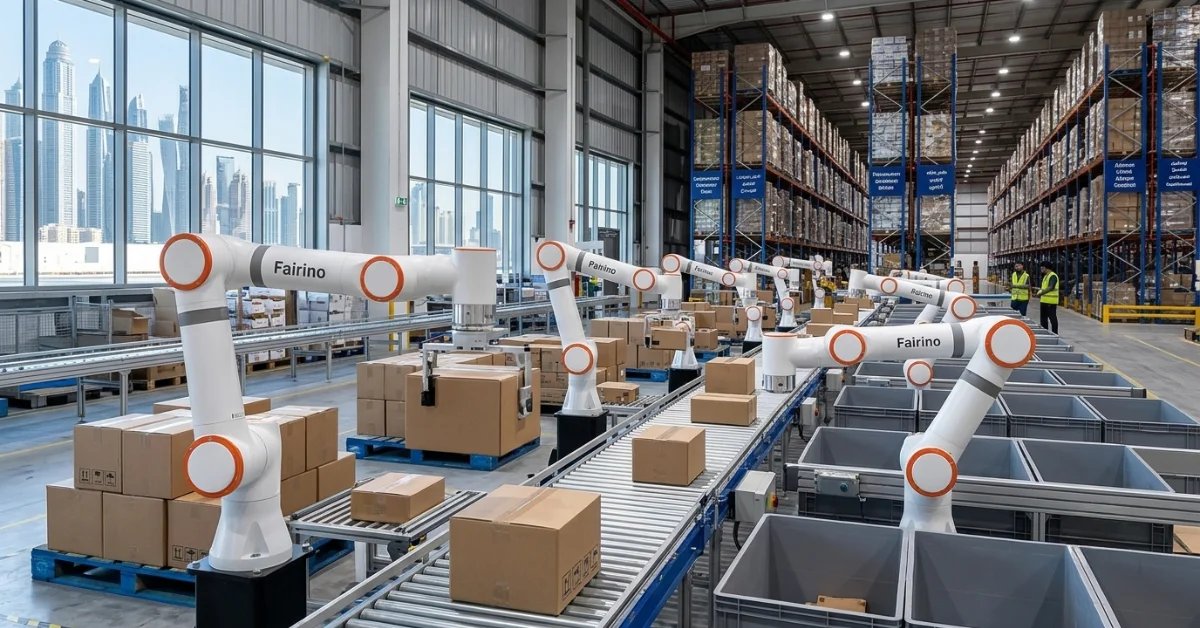
Moving beyond the restrictive safety cages of the past, modern factories are increasingly adopting Collaborative Robots (Cobots) to facilitate a hybrid workforce. Utilizing sophisticated proximity sensors and force-torque feedback, these systems enable fence-less operation, allowing robots to work in immediate proximity to human technicians without risk of injury. This synergy is particularly effective in high-mix, low-volume production environments where human problem-solving is paired with robotic consistency for tasks like palletizing, precision assembly, and machine tending. By removing the physical barriers of traditional automation, plants can achieve a more flexible footprint that adapts to shifting production demands in real-time.
Intralogistics: AMRs and ASRS Integration
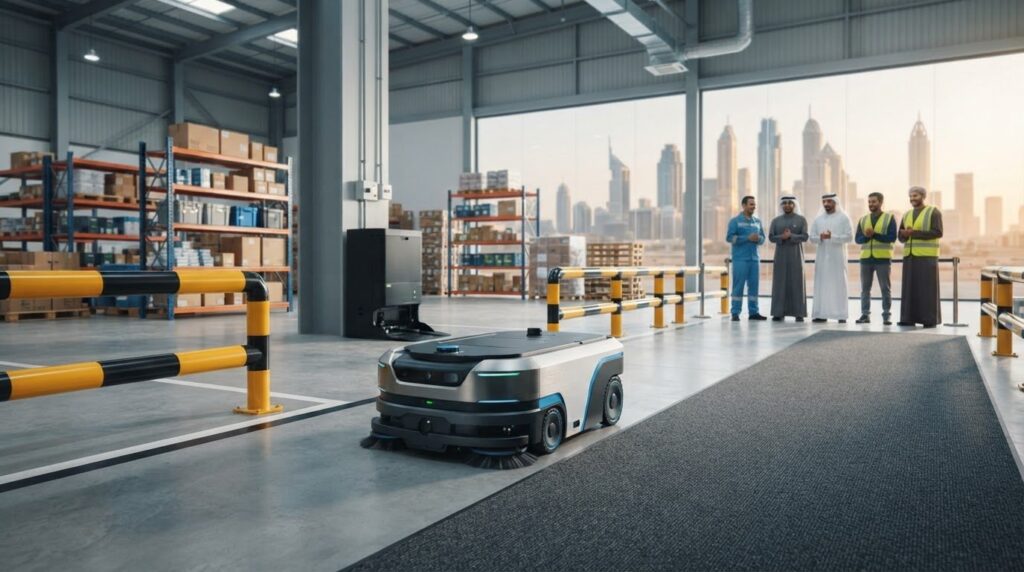
Revolutionizing the movement of goods on the shop floor, the integration of autonomous mobile robots (AMRs) has rendered rigid conveyor systems obsolete. These intelligent units navigate complex environments without the need for magnetic strips or fixed tracks, providing a dynamic logistics framework that supports a reconfigurable factory layout. When these mobile units are paired with automated storage and retrieval systems (ASRS), the result is a vertically optimized warehouse that maximizes every square meter of industrial real-time.
Synchronizing directly with enterprise software, ASRS provides absolute inventory visibility and eliminates the human error associated with manual picking. This level of precision is essential for maintaining the high-speed supply chains required by the UAE’s 2026 industrial mandates. Implementing these bespoke robotics solutions ensures that your internal logistics are as intelligent and responsive as your top-level management systems, creating a seamless flow from raw material intake to final dispatch.
OT-IT Convergence: The Infrastructure of Intelligence
Establishing a robust digital architecture requires more than just deploying hardware; it demands the seamless synchronization of Operational Technology (OT) and Information Technology (IT). Implementing a comprehensive digital transformation in manufacturing UAE relies on the ability to extract actionable intelligence from the shop floor and transmit it securely to enterprise management levels. While the robotics discussed previously provide the physical output, Programmable Logic Controllers (PLCs) and Supervisory Control and Data Acquisition (SCADA) systems act as the central nervous system, orchestrating every movement with microsecond precision. Without this convergence, a factory remains a collection of isolated machines rather than a unified, intelligent organism.
Strategic PLC and SCADA Integration
Modernizing legacy control systems is a critical step for ensuring 2026 compatibility across multi-vendor robotic fleets. Utilizing specialized PLC and SCADA integration services allows manufacturers to create a unified control architecture that mitigates the risk of vendor lock-in. This integration facilitates the deployment of edge computing, where data is processed locally at the machine level to enable real-time adjustments. Processing data at the edge reduces latency and ensures that critical safety protocols aren’t dependent on cloud connectivity. By bridging the gap between raw sensor data and high-level ERP software, plants can achieve a level of operational transparency that was previously impossible, directly reducing plant downtime and optimizing energy consumption.
Industrial Cybersecurity in a Connected Plant
Connecting a factory to the broader enterprise network introduces significant security considerations that must be addressed at the architectural level. Securing SCADA networks against emerging 2026 cyber threats requires a multi-layered approach that balances accessibility with absolute protection. While some legacy operations still rely on air-gapped systems, the demands of modern Industry 4.0 often necessitate secure remote access for predictive maintenance and global monitoring.
Adhering to UAE national cybersecurity standards for the industrial sector ensures that your infrastructure remains resilient against sophisticated attacks. Implementing these standards involves several key protocols:
- Network Segmentation: Isolating critical control traffic from standard corporate data to prevent lateral threat movement.
- Encrypted Data Transmission: Protecting data integrity from the sensor level to the cloud.
- Multi-Factor Authentication: Restricting access to sensitive PLC configurations and SCADA interfaces.
Maintaining data integrity through these secure channels ensures that management decisions are based on absolute reality, providing the intellectual framework necessary for long-term business viability. It’s a necessary evolution for any organization wishing to remain competitive in the UAE’s increasingly sophisticated industrial economy.
Overcoming Transformation Barriers: ROI and Implementation
Addressing the perceived barrier of high initial capital expenditure is the first step toward a successful digital transformation in manufacturing UAE. While the upfront costs of advanced robotics and autonomous systems are substantial, viewing these investments through a lens of long-term business viability reveals a compelling return on investment (ROI). Many manufacturers struggle with the complexity of calculating value beyond simple labor displacement, often overlooking the significant gains in quality consistency, waste reduction, and energy efficiency. By adopting a phased implementation strategy, organizations can secure high-impact “low-hanging fruit” automation—such as end-of-line palletizing or automated inspection—to generate immediate operational savings that fund subsequent stages of modernization.
Financial Modeling for Industrial Automation
Utilizing sophisticated financial modeling allows stakeholders to evaluate the Total Cost of Ownership (TCO) for AMRs and Cobots over a standard five-year cycle. This analysis must account for the UAE’s 2026 fiscal environment, specifically leveraging the R&D Tax Incentive Program which provides a non-refundable tax credit of up to AED 2 million for eligible technological advancements. Additionally, the Emirates Development Bank’s mandate to deploy AED 30 billion in financing offers flexible repayment options that mitigate the impact of initial CAPEX. Factoring in these government enablers alongside a 27.2% projected CAGR in AI and analytics adoption ensures that the financial roadmap aligns with the reality of the 2026 industrial market.
Strategic Workforce Evolution
Transitioning from manual labor to a high-tech operating model requires a systematic approach to upskilling the local workforce. As the UAE moves toward its target of 10% Emiratization in the private sector by the end of 2026, the demand for robotics technicians and systems integrators has reached a critical peak. This evolution involves more than just training; it requires a cultural shift where human operators work in tandem with intelligent systems.
Deploying humanoid robots for hazardous or highly repetitive service tasks allows your human talent to focus on complex problem-solving and process optimization. This strategic reallocation of labor not only improves safety but also creates a culture of innovation that attracts top-tier technical talent. To ensure your facility remains scalable and avoids the pitfalls of technical debt, it’s essential to partner with a provider who offers modular, vendor-neutral solutions. If you’re ready to define your facility’s future, consult with our automation specialists to design a bespoke implementation roadmap tailored to your specific production goals.
EdNex Automation: Your Partner in UAE Industry 4.0
Delivering a successful digital transformation in manufacturing UAE requires more than just the procurement of advanced hardware; it demands a partner capable of orchestrating the entire technological lifecycle. EdNex Automation operates as a specialized division of the EdNex group, specifically engineered to address the unique industrial requirements of the Middle East. By maintaining strategic alliances with global technology leaders and securing official certifications, we provide a marker of legitimacy that ensures your infrastructure meets international benchmarks. Our role is that of a systematic organizer, bringing order and safety to complex environments through the deliberate integration of autonomous systems and intelligent control layers.
Why EdNex is the Strategic Choice
Choosing EdNex provides the intellectual framework necessary for high-level implementation rather than just a collection of tools. We specialize in the bespoke integration of PLC and SCADA systems with a comprehensive portfolio of ASRS and AMRs, ensuring that every component of your facility communicates within a unified architecture. This approach minimizes plant downtime and maximizes throughput, directly supporting the UAE’s national mandate for industrial scaling.
Our commitment to technological future-proofing means your systems are designed for long-term business viability. We don’t just solve today’s bottlenecks; we build the foundation for tomorrow’s innovations. By acting as a bridge between global technological breakthroughs and regional needs, we ensure that your investment in automation remains competitive as physical AI and agentic models continue to evolve through 2026 and beyond.
Executing Your Transformation Roadmap
Executing a transformation roadmap begins with a rigorous technical audit to identify existing legacy limitations and high-impact opportunities for automation. From this foundation, we manage the full-scale deployment of robotic systems, ensuring seamless synchronization with your current enterprise software. Our start-to-finish expertise covers several critical phases:
- System Architecture Design: Creating a modular, scalable blueprint that aligns with TTP standards.
- Hardware Integration: Deploying Cobots, AMRs, and ASRS tailored to your specific shop floor requirements.
- Control System Optimization: Implementing PLC and SCADA layers that provide real-time visibility and control.
- Ongoing Lifecycle Support: Providing maintenance and data-driven optimization to ensure peak performance.
Our national-scale support ensures that manufacturing and logistics sectors across the UAE have access to the technical talent required to maintain sophisticated automated environments. This comprehensive approach eliminates the friction of multi-vendor management and ensures that your digital evolution is both steady and results-oriented. Consult with EdNex Automation to begin your transformation and secure your organization’s position at the forefront of the UAE’s industrial evolution.
Securing Your Industrial Future in the UAE
Achieving a competitive edge in the 2026 industrial landscape requires a deliberate shift from manual processes to a unified, autonomous framework. By aligning your operations with the UAE’s “Operation 300bn” and the Technology Transformation Program, you don’t just achieve regulatory compliance; you unlock a new tier of operational excellence. Executing a successful digital transformation in manufacturing UAE involves the seamless orchestration of physical robotics with advanced control infrastructure, ensuring that your facility remains resilient against global supply chain volatility.
As the strategic bridge between global innovation and regional requirements, EdNex Automation provides the intellectual and technical framework necessary for this transition. Utilizing our advanced PLC/SCADA integration and expertise in AMRs and ASRS, we help you mitigate technical debt while maximizing your return on investment. We’re a dedicated partner for UAE national industrial goals, offering the start-to-finish expertise required to bring order and efficiency to complex environments. The future of production belongs to those who view automation as a necessary evolution for long-term business viability.
Drive your facility’s evolution with EdNex Automation’s Industry 4.0 solutions and lead the next era of regional industrial progress.
Industrial Automation: Frequently Asked Questions
What are the primary goals of the UAE’s Technology Transformation Program (TTP) for manufacturers?
The TTP aims to accelerate the adoption of advanced technologies to increase industrial productivity and position the UAE as a global leader in the Fourth Industrial Revolution. It utilizes the Industrial Technology Transformation Index (ITTI) to measure digital maturity while providing specialized centers to build the technical capacity of local manufacturers. These initiatives are designed to increase the industrial sector’s contribution to the national GDP to AED 300 billion by 2031.
How does PLC and SCADA integration facilitate digital transformation in the UAE?
These systems act as the central nervous system of a facility, translating raw machine data into actionable enterprise intelligence. By unifying multi-vendor robotic fleets into a single control architecture, they enable real-time monitoring and predictive maintenance. This level of synchronization is foundational for any digital transformation in manufacturing UAE, ensuring that shop floor execution remains perfectly aligned with top-level strategic objectives.
What is the typical ROI period for Autonomous Mobile Robots (AMRs) in a UAE warehouse?
While specific timelines depend on the scale of operation, many industrial leaders target a return on investment within 18 to 36 months. This period is often accelerated by the elimination of fixed infrastructure costs and the significant reduction in human error during intralogistics. Utilizing the 2026 R&D tax incentives and flexible EDB financing can further shorten the payback cycle for these autonomous systems.
Can collaborative robots (cobots) be integrated with existing legacy manufacturing equipment?
Modern cobots are engineered with modular interfaces that allow for seamless integration with legacy machinery that lacks native digital capabilities. Utilizing advanced PLC layers, these robots can communicate with older systems to automate specific tasks like machine tending or assembly. This phased approach allows you to modernize your production line without the immediate capital requirement of a total facility overhaul.
How do Automated Storage and Retrieval Systems (ASRS) improve factory efficiency?
ASRS optimizes vertical storage space and eliminates the operational bottlenecks associated with manual picking and put-away processes. By automating the movement of raw materials and finished goods, these systems reduce the physical footprint of the warehouse while increasing throughput speed. They provide absolute inventory accuracy, which is essential for maintaining the high-velocity supply chains required by modern industrial mandates.
What cybersecurity measures are essential for digitized manufacturing plants in the UAE?
Essential measures include network segmentation, multi-factor authentication, and the implementation of encrypted communication protocols from the sensor level to the cloud. Adhering to the UAE’s national cybersecurity standards protects SCADA networks from sophisticated 2026 threats that target industrial infrastructure. Securing data integrity ensures that your digital transformation in manufacturing UAE remains resilient against both external attacks and internal system vulnerabilities.
Are there government incentives for adopting Industry 4.0 technologies in the UAE?
Yes, the UAE provides several financial enablers, including the R&D Tax Incentive Program which offers up to AED 2 million in non-refundable tax credits for technological advancements. Manufacturers can also access low-interest financing through the Emirates Development Bank, which has a mandate to deploy AED 30 billion by 2026. Customs duty exemptions on imported industrial machinery and raw materials further reduce the initial capital burden for automation projects.
How does EdNex Automation support the ‘Make it in the Emirates’ initiative?
EdNex acts as a local integration partner that bridges global technological breakthroughs with regional industrial needs to build sovereign production capabilities. By providing start-to-finish expertise in robotics and control systems, we help local factories meet the high-precision standards required for international export. Our focus on localized, automated production reduces reliance on global logistics and ensures the long-term business viability of the UAE’s industrial sector.