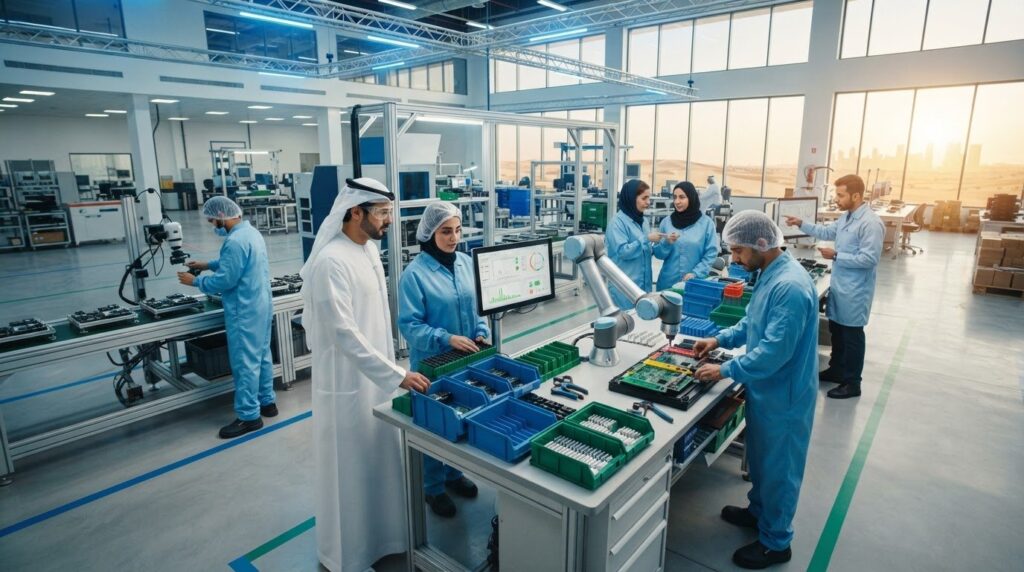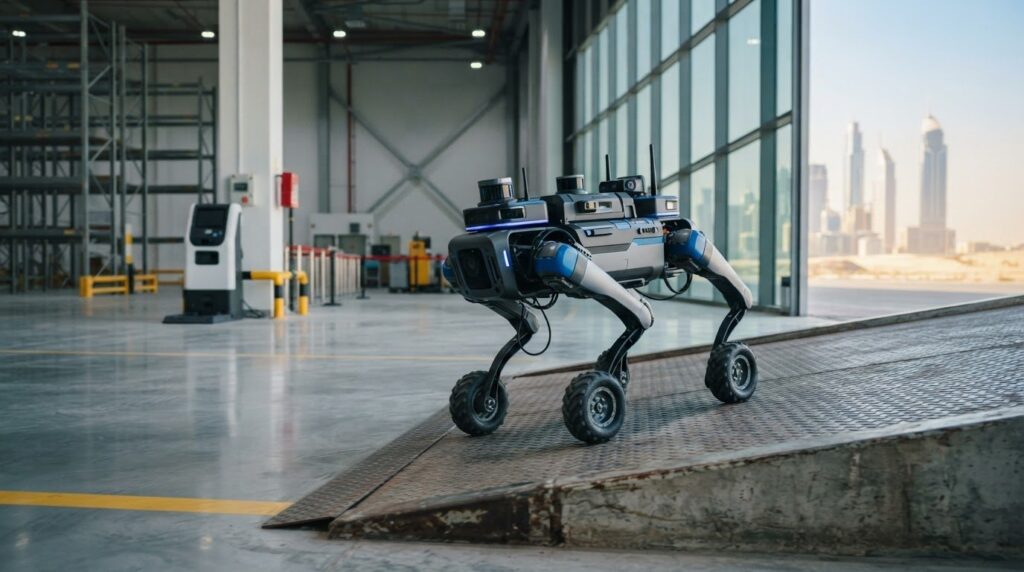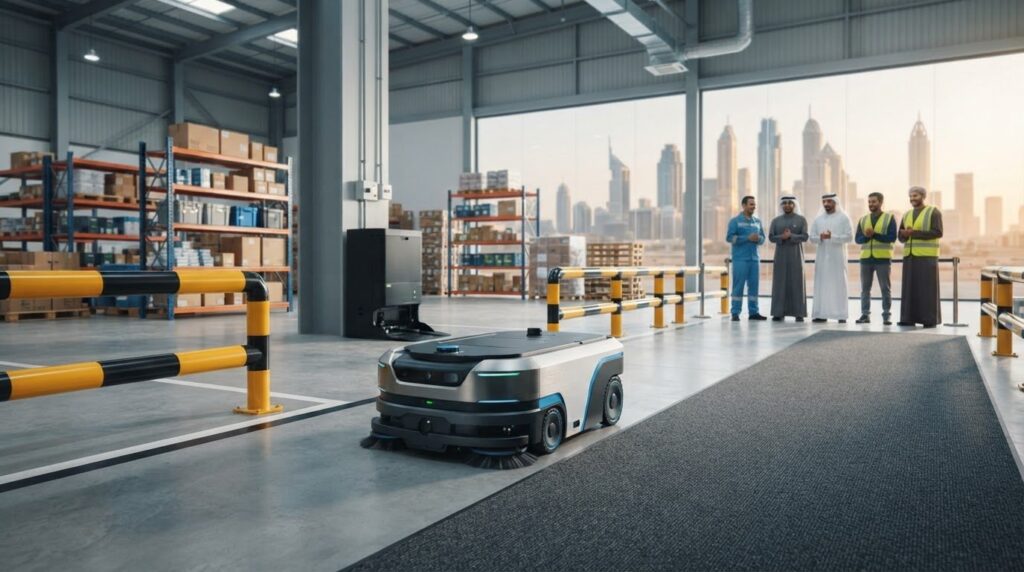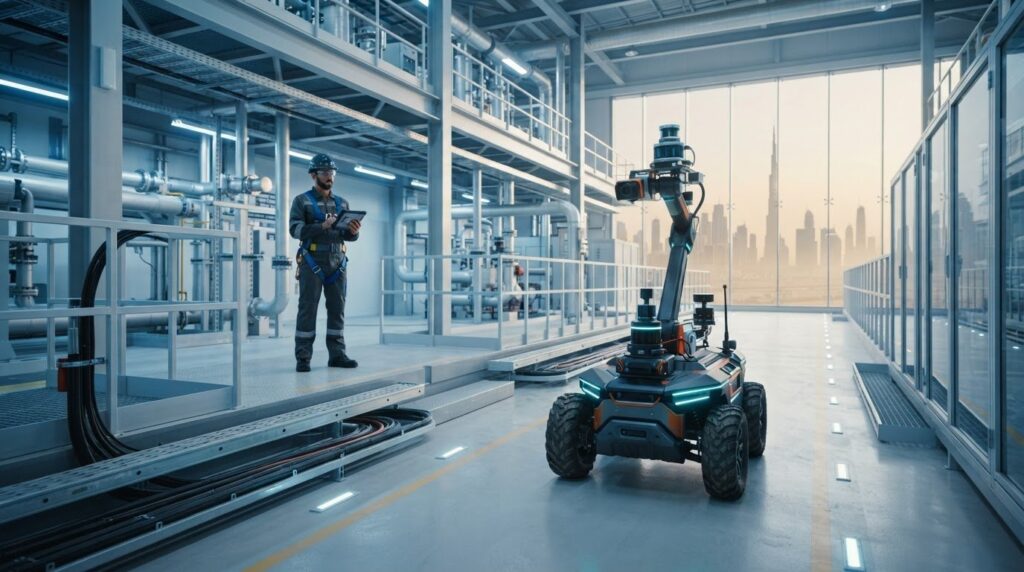
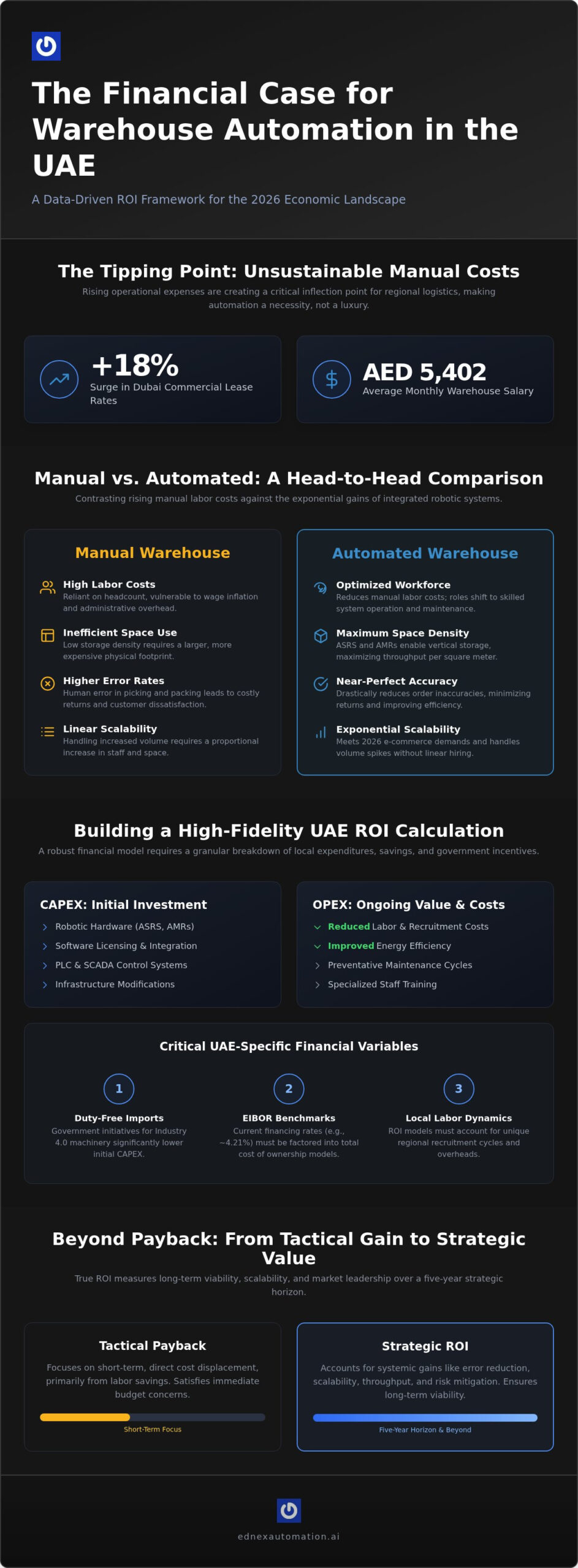
With Dubai commercial lease rates surging by up to 18% and local warehouse salaries reaching an average of AED 5,402 per month, the financial pressure on regional logistics has reached a critical inflection point. You likely recognize that manual operations are becoming unsustainable, yet justifying a multi-million dirham investment in robotics requires more than just a vision of the future. It demands a rigorous, data-driven defense of every capital expenditure against the backdrop of the UAE’s unique economic landscape.
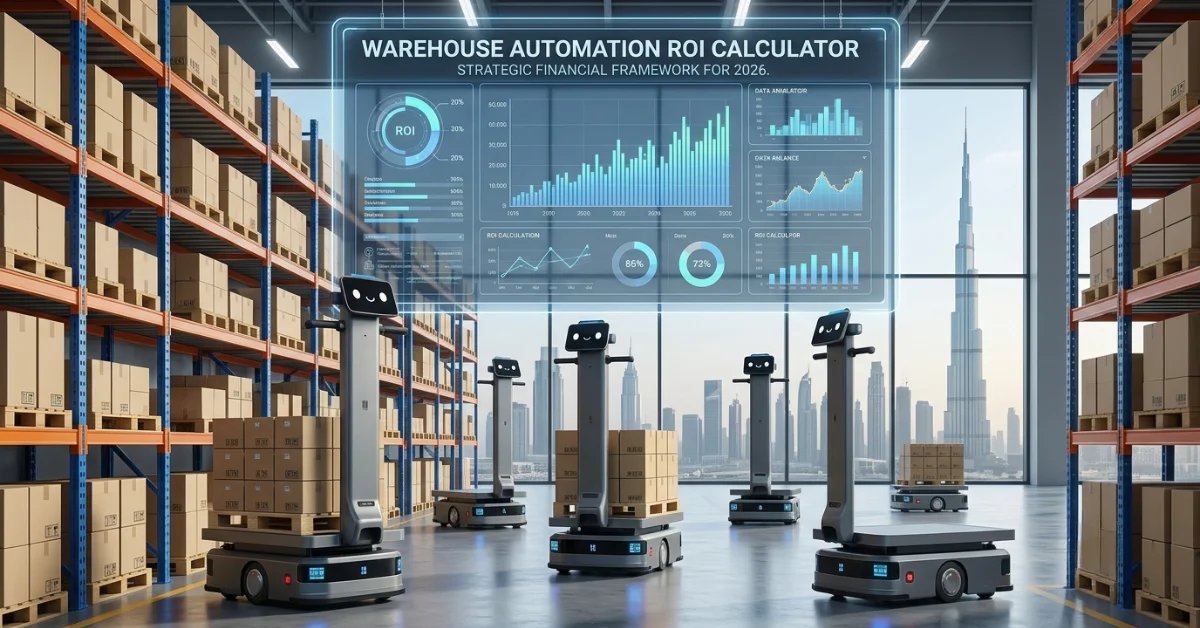
This article provides a comprehensive warehouse automation ROI calculator UAE framework designed to help you master the financial metrics necessary for board-level approval. By integrating specific 2026 variables like duty-free imports for Industry 4.0 machinery and current EIBOR benchmarks, we’ll transform vague operational goals into a precise roadmap for phased automation. You’ll gain the intellectual tools to quantify everything from energy efficiency gains to the risk mitigation provided by Autonomous Mobile Robots and ASRS systems. We’ll begin with a deep dive into total cost of ownership before establishing a clear path toward a definitive payback period within a five-year strategic horizon.
Key Takeaways
- Analyze the UAE’s strategic evolution into a global logistics hub and how this transition necessitates a shift toward high-tech, capital-intensive operational models.
- Identify critical CAPEX and OPEX variables, including duty-free machinery imports and regional energy tariffs, to build a robust financial justification for automation.
- Contrast the rising costs of manual labor against the exponential efficiency gains offered by integrated systems like ASRS and Autonomous Mobile Robots.
- Utilize a specialized warehouse automation ROI calculator UAE framework to accurately project payback periods and total cost of ownership over a five-year horizon.
- Discover how bespoke PLC and SCADA integration ensures that robotic hardware and control architectures work in harmony to maximize measurable industrial value.
Navigating the Financial Landscape of Warehouse Automation in the UAE
Defining Return on Investment (ROI) for advanced industrial systems requires a shift from simple cost-saving metrics to a comprehensive valuation of systemic efficiency gains against total capital deployment. Within the Emirates, this calculation isn’t a theoretical exercise but a survival requirement as the nation accelerates its transition into a pre-eminent global logistics hub. Traditional, manual-heavy operations are encountering a ceiling of diminishing returns. Rising industrial costs and an 18% increase in commercial lease rates within key hubs like Business Bay create an environment where physical footprint must be maximized through vertical density and high-speed throughput.
Establishing a robust understanding logistics automation is essential before deploying a warehouse automation ROI calculator UAE framework. We distinguish between Tactical Payback, which focuses on immediate labor displacement, and Strategic ROI, which accounts for long-term scalability, error reduction, and the ability to handle the 2026 e-commerce volume projections without linear increases in headcount. While tactical metrics satisfy short-term budgets, strategic frameworks ensure that your infrastructure remains viable as the regional market evolves.
The Economic Drivers of Automation in 2026
The UAE industrial sector is undergoing a fundamental restructuring. Recent government initiatives have introduced duty-free status for Industry 4.0 machinery and robotics, effectively lowering the entry barrier for advanced systems like ASRS and Autonomous Mobile Robots (AMRs). As e-commerce continues its rapid expansion, the demand for warehouse density has spiked. Relying on manual picking in a high-density environment leads to safety risks and operational bottlenecks that human labor simply can’t solve. National industrial strategies now prioritize high-tech infrastructure, making capital equipment incentives a primary driver for those seeking to modernize their supply chain.
Why Standard Calculators Fail Regional Enterprises
Most generic ROI tools utilize labor cost baselines from Europe or North America, which don’t reflect the UAE’s specific economic variables. While the average warehouse worker salary in Dubai has reached approximately AED 5,402 per month, the total cost of employment includes unique administrative overhead and recruitment cycles that western models ignore. Additionally, regional enterprises must account for local technical support availability and the current 1-year EIBOR rate of 4.212770% when financing large-scale deployments. The UAE Automation Gap is the discrepancy between potential and realized efficiency that occurs when firms apply foreign financial models to local industrial realities.
Essential Metrics for a Comprehensive ROI Calculator
Constructing a high-fidelity warehouse automation ROI calculator UAE necessitates a granular breakdown of both tangible and intangible assets. While many regional enterprises focus exclusively on the procurement of robotic units, the true capital expenditure (CAPEX) must encompass the entire ecosystem of hardware, software licensing, and critical infrastructure modifications. Recognizing that physical machinery is only as effective as the logic driving it, savvy operators prioritize PLC and SCADA integration services as a foundational investment. These systems serve as the intellectual core of the facility, enabling the real-time data acquisition and synchronized control necessary to thrive in the booming market for warehouse automation.
Operational expenditure (OPEX) variables require similar precision, particularly regarding energy consumption trajectories and the specialized training required for local staff. Calculating the total cost of ownership involves projecting the preventative maintenance cycles essential for high-uptime environments. By quantifying throughput improvements, such as a targeted increase in picks per hour and a reduction in order inaccuracy, you can transform abstract efficiency goals into a defensible financial report. Establishing this data-driven baseline is the first step toward securing board approval for your technical roadmap.
Hard Costs: Beyond the Robotic Hardware
Deploying automated storage and retrieval systems involves significant site preparation that standard calculators often overlook. Floor leveling to meet the strict tolerances of high-reach cranes and the installation of specialized safety fencing represent substantial upfront costs. Commissioning and system testing phases also carry a financial weight that must be accounted for to avoid mid-project budget overruns. These stages ensure that the transition from manual to autonomous operation doesn’t disrupt existing supply chain commitments.
Soft Benefits: Quantifying Quality and Safety
Assigning a financial value to “soft” benefits is critical for a holistic ROI perspective. Reducing workplace accidents through the deployment of autonomous mobile robots directly lowers insurance premiums and associated legal liabilities. Beyond safety, the elimination of picking errors significantly reduces the cost of returned shipments and the administrative overhead of customer service. Operating a state-of-the-art facility also enhances brand value, positioning your organization as a modern leader capable of meeting the rigorous delivery standards of the 2026 industrial landscape.
Comparative Analysis: Manual Operations vs. Integrated Robotic Systems
Achieving financial clarity requires a direct comparison between the linear scaling of human labor and the exponential efficiency of autonomous systems. Traditional manual operations scale costs in direct proportion to volume; every increase in throughput necessitates a corresponding increase in headcount. Integrating a warehouse automation ROI calculator UAE into your feasibility study reveals that manual operations carry a volatility risk often ignored in standard accounting. While human labor remains a variable cost, robotics represent a fixed capital investment that delivers higher value as order volumes intensify. This shift from variable to fixed cost structures provides a level of budgetary predictability that manual-heavy facilities can’t match.
Hidden costs within the UAE labor market often skew traditional financial models. Beyond the base salary of AED 5,402 for Dubai-based warehouse operatives, enterprises must account for significant administrative overhead. This includes visa processing, mandatory health insurance, and recruitment cycles that can disrupt operations during peak seasons. Automated systems don’t require these recurring administrative outlays. By deploying autonomous mobile robots, facilities can operate 24/7 without the exponential increase in multi-shift labor costs or the overtime premiums required to meet 2026 delivery standards.
Labor Dynamics and the Automation Pivot
Long-term labor availability presents a growing operational risk for regional logistics firms. Automation doesn’t just replace labor; it allows for the strategic upskilling of your existing workforce into higher-value technical roles. Transitioning staff from manual picking to system oversight roles improves retention and reduces the constant churn of entry-level employees. Robotic OPEX remains remarkably stable over time, protecting your margins from the fluctuating labor market rates and the inflationary pressures seen in the wider economy. This stability is a cornerstone of any reliable industrial transformation strategy.
Space Optimization and Real Estate ROI
Rising real estate costs in Dubai, with lease rates increasing by up to 18% year-on-year in prime hubs like Business Bay, demand a rethink of warehouse layouts. Vertical space utilization through ASRS technology allows you to maximize your existing footprint rather than investing in costly physical expansions. Traditional forklift aisles require significant floor space that AMRs simply don’t need. High-density storage directly offsets rising industrial land costs by packing more inventory into every square foot of your facility. This optimization ensures that your real estate ROI remains positive even as market prices continue their upward trajectory.
A 5-Step Framework for Projecting Long-Term Automation Value
Transitioning from theory to implementation requires a structured financial model that accounts for the UAE’s specific industrial variables. A successful warehouse automation ROI calculator UAE approach begins with an exhaustive audit of your current state, establishing a baseline of manual throughput and total operational spend. This includes not just the direct wages discussed earlier but the administrative friction inherent in manual workflows. Once this baseline is fixed, you must define the automation scope, choosing between full-scale ASRS for vertical density or modular AMR deployments for horizontal flexibility. Calculating the Total Cost of Ownership (TCO) over a 60-month horizon allows you to view the investment as a strategic asset rather than a sunk cost.
Step 1-3: Data Collection and TCO Modeling
Extracting granular data from your existing Warehouse Management Systems (WMS) and ERP platforms is vital for ensuring the integrity of your financial projections. You’ll need to amortize initial hardware costs over the expected lifecycle of the robots while factoring in the nuanced costs of collaborative robots UAE for hybrid workflows where human-machine interaction remains necessary. This modeling phase must include the current 4.212770% EIBOR rate to reflect the true cost of capital for financed deployments. By meticulously mapping these variables, you create a defensible report that stands up to the scrutiny of any corporate board.
Step 4-5: Scenario Planning and Risk Mitigation
Projecting growth scenarios is where the strategic value of automation becomes undeniable. You should model your ROI against 10%, 20%, and 50% increases in order volume to demonstrate how the system absorbs growth without the linear cost spikes associated with manual labor. Perform a sensitivity analysis to test the resilience of your ROI against potential changes in energy prices or maintenance schedules. Identifying the “Break-Even Point” is critical; this is the moment where cumulative operational savings equal the initial capital outlay. Don’t ignore the risk of inaction, as the cost of falling behind automated competitors in the 2026 market often exceeds the price of the technology itself. For those ready to begin this transition, developing a bespoke automation roadmap ensures your facility is engineered for long-term viability.
Executing Your Automation Strategy with EdNex Automation
Transitioning from a theoretical warehouse automation ROI calculator UAE model to a functional, high-uptime facility requires more than just procurement. It demands an alliance with a technical partner who provides the intellectual framework necessary to synchronize complex robotics with existing industrial workflows. EdNex Automation acts as this systematic organizer, bridging the gap between global technological breakthroughs and the specific economic needs of the Emirates. By ensuring that bespoke PLC and SCADA integration architectures are established from the outset, we guarantee that your hardware investment translates into measurable, long-term financial performance. Our focus remains on creating a unified ecosystem where every robotic unit contributes to a centralized data stream for real-time optimization.
Reliability in the 2026 industrial sector is built on the foundation of local technical support and official certification status. We understand that large-scale industrial transformation is a high-stakes endeavor, which is why our approach emphasizes risk mitigation through controlled and deliberate innovation. Partnering with a regional expert ensures that your facility maintains global standing while benefiting from a team that understands the gravity of local energy tariffs and labor trajectories. This localized expertise prevents the integration gaps that often occur when utilizing generic, non-regional technical frameworks.
Start-to-Finish Expertise in the UAE
Our methodology encompasses a rigorous start-to-finish process, beginning with an initial site audit and concluding with the final deployment of intelligent control systems. Utilizing introductory diagnostic phases, we identify the specific bottlenecks where automation will deliver the highest yield. Beyond traditional AMRs and ASRS, we integrate specialized solutions such as humanoid robots for sale UAE to support intricate service and inspection roles within the modern industrial environment. This comprehensive approach ensures that hardware and control systems work in absolute harmony, delivering the autonomy and intelligence required for 24/7 operations.
Securing Future Competitiveness
Adopting advanced automation is a necessary evolution for any organization wishing to remain competitive as the UAE cements its status as a global logistics powerhouse. We bring order and safety to complex environments through controlled innovation that protects your margins from the rising operational costs discussed throughout this framework. The transformative power of these systems lies in their ability to provide total autonomy at scale, allowing your business to absorb market volatility without sacrificing throughput. By aligning your strategic vision with our technical expertise, you secure a future-proof facility ready to lead the regional logistics sector for years to come.
Stakeholders ready to move beyond generic projections are invited to join us for a professional consultation. We provide a tailored ROI assessment that aligns our high-tech solutions with your specific financial objectives, ensuring your transition to Industry 4.0 is both profitable and seamless.
Mastering the Industrial Evolution of the Emirates
Achieving a definitive competitive advantage in the 2026 logistics sector requires a transition from reactive spending to proactive, strategic investment. Utilizing a rigorous warehouse automation ROI calculator UAE framework allows you to move beyond simple labor displacement, focusing instead on vertical density and systemic intelligence to offset rising commercial lease rates. This methodical approach ensures that your infrastructure remains a core pillar of long-term profitability within a rapidly maturing market.
EdNex Automation provides the full-service industrial control and robotics integration required to transform these complex calculations into a high-performance reality. By maintaining official certifications and global technology alliances, we ensure your facility aligns perfectly with the UAE National Industrial Development strategy. It’s time to replace uncertainty with engineering-minded precision and visionary leadership. Take the first step toward securing your facility’s future and Request a Professional ROI Assessment from EdNex Automation. Your organization’s path to sustainable industrial excellence begins with data-driven clarity.
Frequently Asked Questions
What is the typical payback period for warehouse automation in the UAE?
Typical payback periods for large-scale warehouse automation in the UAE range between three and five years. This timeline is heavily influenced by the 2026 duty-free status of Industry 4.0 machinery and the rising cost of manual labor in Dubai. Utilizing a precise warehouse automation ROI calculator UAE framework helps enterprises identify the exact inflection point where cumulative operational savings exceed the initial capital expenditure.
How do I account for integration costs in my ROI calculation?
Accounting for integration costs requires a granular audit of software licensing, site preparation, and control architecture synchronization. Enterprise leaders must view PLC and SCADA integration not as an auxiliary expense but as a core investment that ensures hardware and software work in harmony. Neglecting these middleware costs often leads to budget overruns that delay the realization of projected financial returns.
Can I calculate ROI for a phased automation rollout?
Calculating ROI for a phased automation rollout is entirely possible and often recommended for risk mitigation. By deploying modular systems like Autonomous Mobile Robots (AMRs) in specific zones, businesses can achieve immediate efficiency gains while reinvesting those savings into subsequent phases. This iterative approach allows for a more manageable capital outlay and provides real-world data to refine future financial projections.
What are the most significant hidden costs in warehouse robotics?
Significant hidden costs in warehouse robotics often include specialized technical training, preventative maintenance cycles, and necessary infrastructure modifications like precision floor leveling. Regional enterprises must also account for the administrative overhead of managing a more technical workforce. Identifying these variables early prevents the erosion of margins and ensures that the total cost of ownership remains within the established strategic framework.
How does energy consumption impact the ROI of ASRS systems in the UAE?
Energy consumption impacts ASRS ROI by balancing the power requirements of high-speed cranes against the massive savings in climate control and land usage. Vertical storage allows for a smaller physical footprint, which significantly reduces the energy required for air conditioning in the UAE’s harsh climate; read more about how smart thermostat integration can further lower these cooling costs. Modern systems also utilize regenerative braking to feed power back into the grid, further optimizing the operational cost profile of the facility.
Is it possible to achieve a positive ROI with collaborative robots in smaller warehouses?
Achieving a positive ROI with collaborative robots in smaller warehouses is highly feasible due to their lower entry costs and extreme operational flexibility. Cobots allow smaller firms to automate repetitive tasks without the massive infrastructure overhaul required for full-scale ASRS. This creates a bridge to modernization, enabling smaller players to remain competitive as the regional logistics landscape shifts toward high-tech, automated models.
How do I quantify the value of increased order accuracy?
Quantifying the value of increased order accuracy involves calculating the total cost of returned shipments, re-picking labor, and associated administrative friction. Beyond these direct costs, enterprises must factor in the brand value of reliability and customer retention. Automated systems virtually eliminate human error, providing a level of precision that directly protects the bottom line and enhances long-term market positioning.
What role does PLC and SCADA integration play in long-term financial returns?
PLC and SCADA integration plays a critical role in long-term financial returns by providing the data visibility necessary for continuous process optimization. These systems act as the central nervous system of the warehouse, ensuring that disparate robotic units operate as a synchronized whole. High-level integration prevents technical obsolescence and allows for the seamless addition of new technologies as the business scales, protecting the initial investment for years to come.