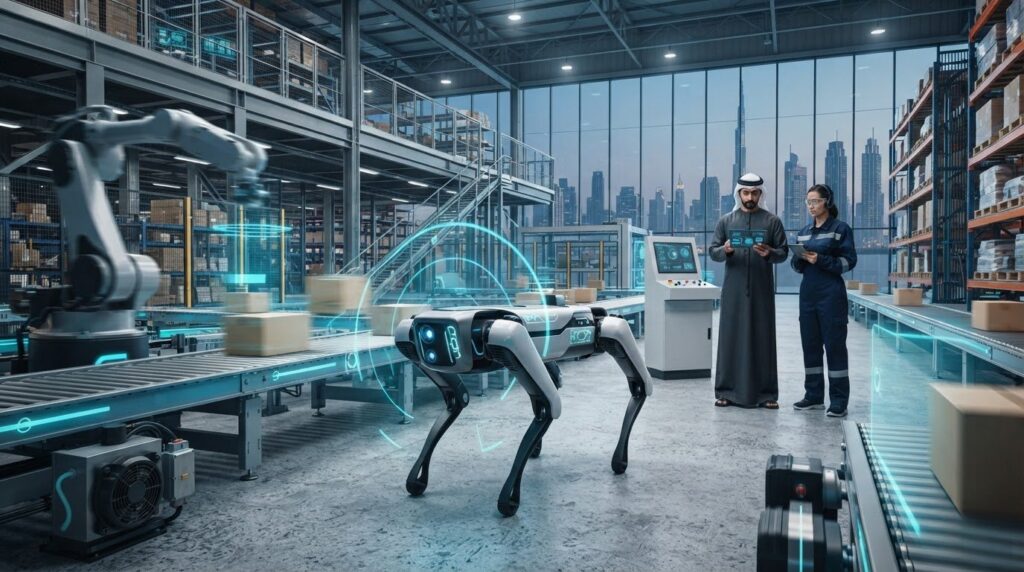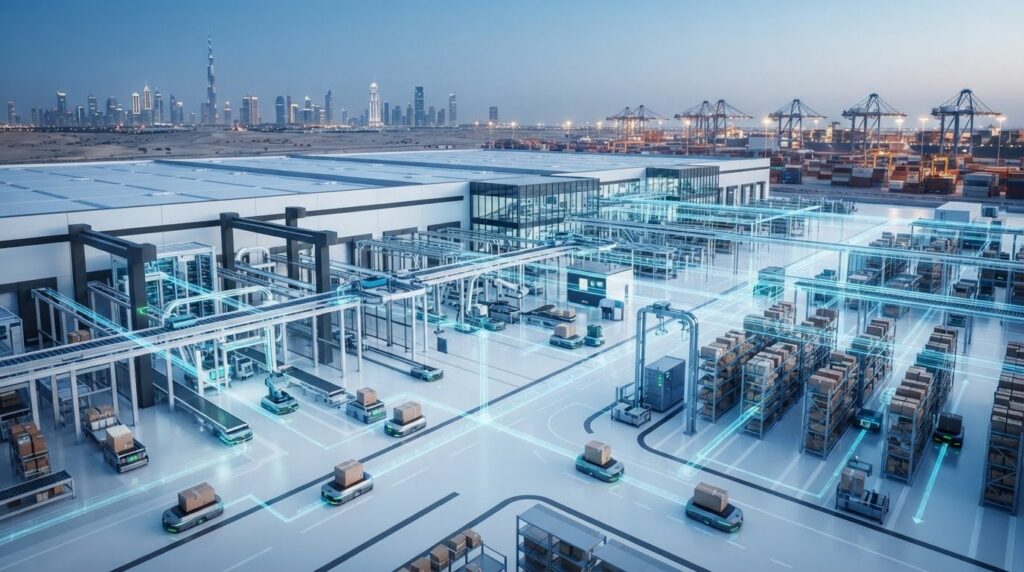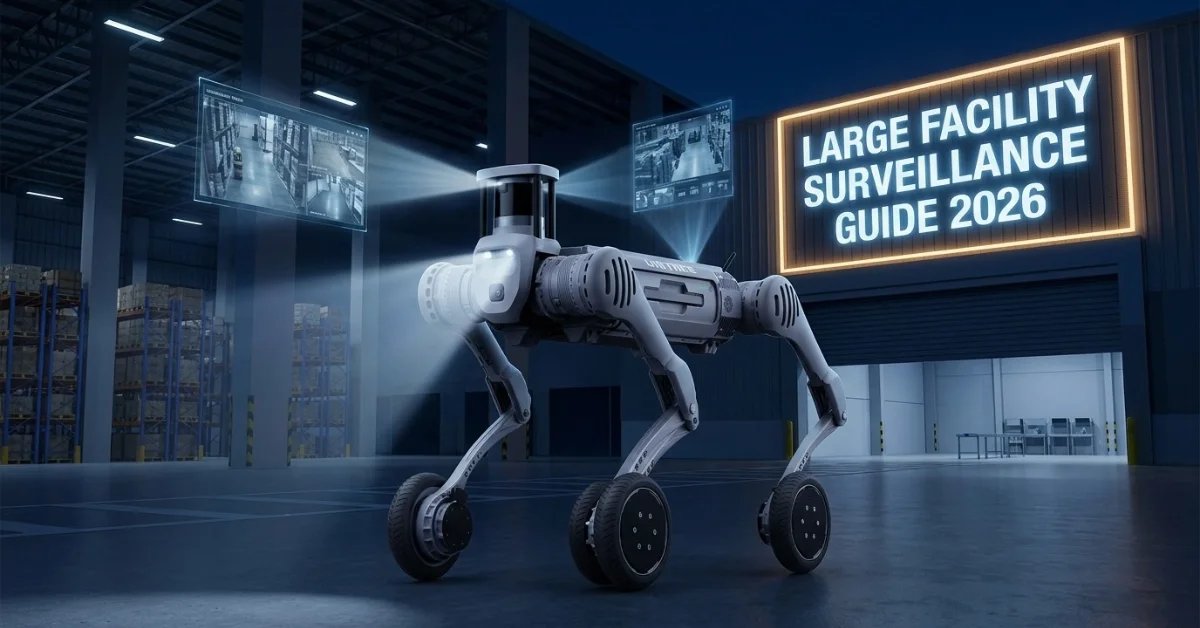
Treating an autonomous patrol unit as a standalone replacement for human guards fundamentally misjudges modern industrial defense. Deploying surveillance robots for large facilities delivers measurable operational resilience only when these mobile platforms operate as dynamic, continuous sensory extensions of your core infrastructure. Securing vast perimeters with static optical sensors inevitably generates stubborn visual blind spots, while relying strictly on manual physical patrols introduces persistent operational friction through acute guard fatigue, turnover, and harsh weather exposure.
Operating across disconnected security platforms often leaves facility leaders wrestling with delayed incident verification and erratic false alarms. In this 2026 guide, you’ll discover how autonomous surveillance robots eliminate industrial blind spots, withstand severe environmental conditions, and integrate directly into enterprise security architectures to optimize personnel costs. We examine the technical configurations, multi-sensor fusion capabilities, and control system workflows necessary to maintain verified, 24/7 site-wide visibility.
Key Takeaways
- Deploying surveillance robots for large facilities transforms static perimeter defense into an active, continuous sensory sweep across expansive industrial perimeters.
- Layered sensor fusion synthesizes thermal imaging, optical cameras, and acoustic sensors to verify genuine security threats instantly while suppressing costly false alarms.
- Combining autonomous mobile platforms with existing fixed cameras eliminates persistent blind spots without the high capital expenditure of civil trenching and extra cable infrastructure.
- Reliable mission execution depends on bridging fleet telemetry directly into enterprise SCADA, PLC, and video management systems over ruggedized communications networks.
- Long-term operational viability requires turnkey engineering and integration expertise rather than simple off-the-shelf robotics hardware procurement.
What Are Autonomous Surveillance Robots for Large Facilities?
Engineering modern industrial defense requires treating surveillance robots for large facilities not as roving gadgets, but as intelligent mobile sensor nodes executing synchronized security protocols. Sprawling logistics yards, petro-chemical complexes, and manufacturing hubs encompass dynamic environments where physical assets move constantly. Fixed infrastructure struggles to maintain uninterrupted line of sight across these shifting terrains. Grounded in the foundational architectures that define what are autonomous robots, these unmanned ground units patrol predefined routes, interpret physical surroundings in real time, and dynamically adjust their telemetry to investigate anomalies. By positioning edge-compute robotics directly onto the plant floor and perimeter grounds, industrial operators turn physical security into a fully integrated layer of Industry 4.0 automation.
Limitations of Static Surveillance and Manual Guarding
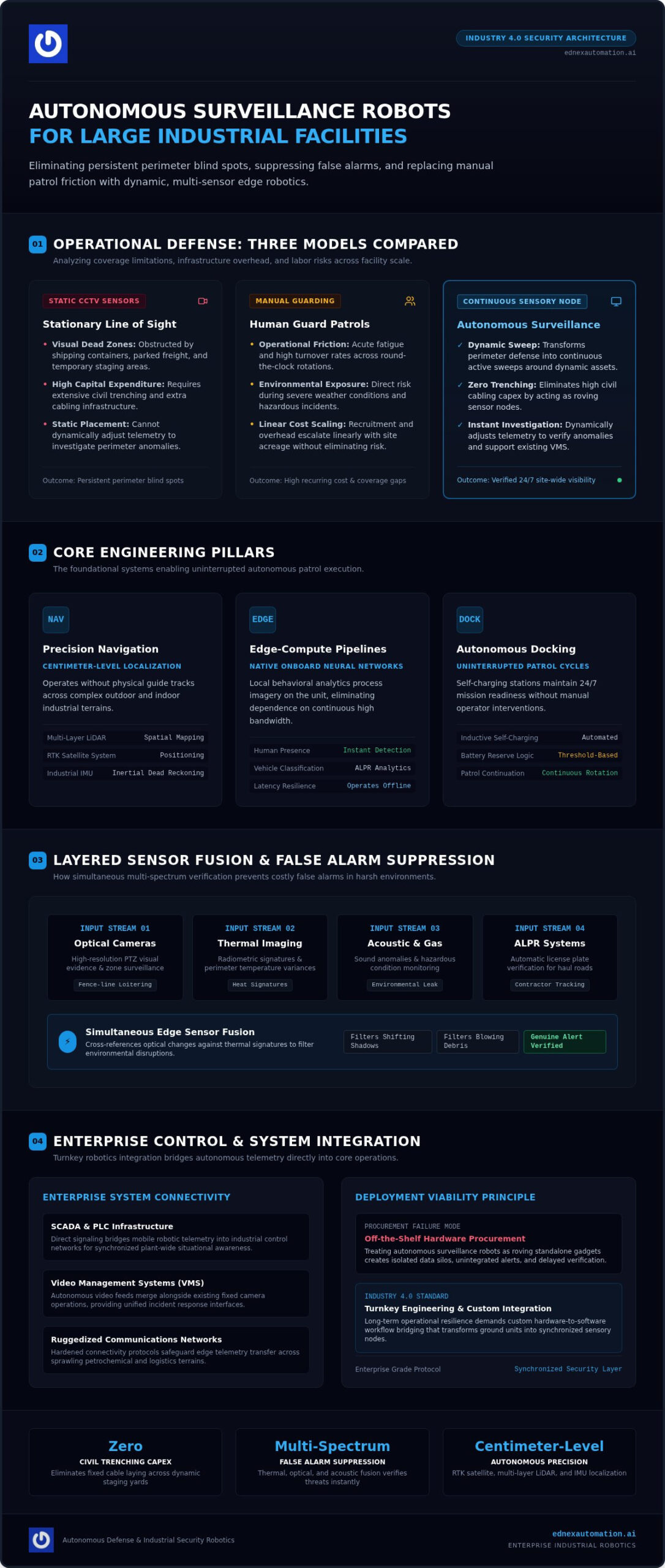
Relying solely on fixed-mount closed-circuit television (CCTV) cameras leaves dangerous visual dead zones across expansive industrial properties. Stacks of shipping containers, parked freight fleets, and temporary staging areas routinely obstruct stationary lenses, giving intruders unmonitored avenues of approach. At the same time, maintaining round-the-clock physical foot patrols exposes human guards to acute fatigue, severe weather hazards, and elevated turnover rates. The compounding operational overhead of recruiting, training, and retaining manual guarding teams escalates linearly with site acreage, driving up security budgets without eliminating operational risk.
Core Technological Pillars of Modern Security Robots
Deploying autonomous surveillance robots for large facilities bridges the gap between static sensors and mobile verification through several foundational engineering systems:
- Precision Navigation Architectures: Utilizing multi-layer LiDAR, real-time kinematic (RTK) satellite positioning, and industrial inertial measurement units (IMUs), mobile platforms maintain centimeter-level spatial localization across outdoor perimeters and indoor pathways without physical tracking guides.
- Edge-Compute Vision Pipelines: Running native neural networks on onboard processors allows the unit to detect human presence, classify unauthorized vehicles, and identify thermal variations locally, triggering instant alerts even during network latency drops.
- Autonomous Inductive Docking: Operating through automated self-charging stations, security robots execute continuous mission schedules, self-docking when battery reserves hit critical thresholds to maintain uninterrupted patrol cycles.
Multi-Sensor Payloads and AI Anomaly Detection in Large Facilities
Modern surveillance robots for large facilities rely on integrated sensor fusion rather than simple video streaming to safeguard expansive industrial operations. Processing optical, radiometric, and acoustic inputs simultaneously on edge processors enables these units to detect operational threats without swamping local network bandwidth. By cross-referencing visual changes against thermal signatures, multi-spectrum systems filter out ambient false alarms triggered by shifting shadows, adverse weather, or blowing debris. As detailed in industry analyses on automating security with robots, this layered sensory architecture converts unstructured field observations into verified, real-time security events.
Thermal Imaging and Optical Computer Vision
Equipped with dual-spectrum pan-tilt-zoom (PTZ) camera systems, autonomous patrol units capture high-resolution visual evidence alongside radiometric data. Embedded neural networks continuously execute behavioral analytics, instantly flagging unauthorized fence-line loitering, human presence in restricted zones, and perimeter fence breaches. These visual feeds correlate with automatic license plate recognition (ALPR), ensuring that only scheduled logistics carriers and authorized contractor vehicles access internal haul roads.
Environmental and Hazardous Condition Monitoring
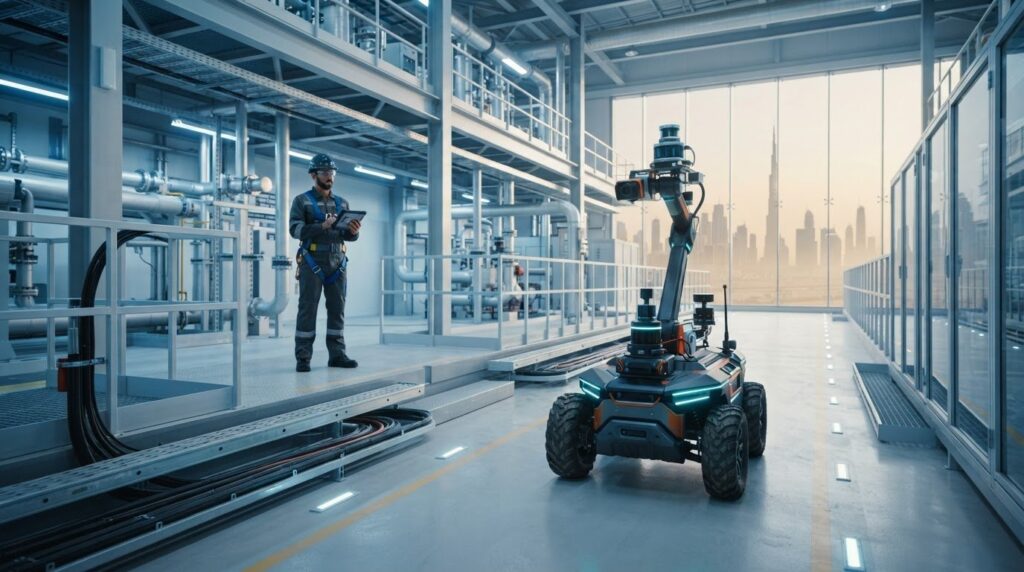
Securing petro-chemical and heavy manufacturing sites requires environmental situational awareness that exceeds conventional physical guarding. Security robotics platforms house integrated gas monitors and volatile organic compound (VOC) sniffers to detect invisible fugitive emissions before they ignite. Acoustic arrays and thermal imagers pinpoint overheated transformer bushings or failing conveyor bearings early, coordinating with specialized inspection robots to resolve mechanical and safety issues across processing lines.
Autonomous Path Planning and Obstacle Avoidance
Operating reliably within sprawling facilities demands dynamic spatial intelligence across diverse operations. Surveillance robots leverage Simultaneous Localization and Mapping (SLAM) routines to maintain absolute positioning, smoothly transitioning between wide outdoor staging areas and GPS-denied indoor spaces like high-bay racking terminals. When unexpected obstructions emerge, such as temporary staging pallets, active mobile machinery, or personnel, the robot calculates real-time bypass trajectories, maintaining uninterrupted route velocity without compromising safety margins.
Surveillance Robots vs. Fixed Security Infrastructure
Viewing mobile robotics as an outright replacement for stationary cameras misinterprets enterprise defense architecture. Effective industrial security relies on defense-in-depth principles where fixed sensors and mobile units reinforce one another. Fixed surveillance offers uninterrupted focal points at critical gates, whereas surveillance robots for large facilities supply dynamic, ground-level adaptability across multi-hectare perimeters. Rather than competing, these systems collaborate: static line-crossing tripwires trigger mobile units to intercept, investigate, and visually confirm breaches before security teams escalate emergency protocols.
Coverage Dynamics and Blind-Spot Elimination
Stationary cameras operate with unyielding geometric constraints. Intruders can map their fixed fields of view, exploiting structural occlusions to evade detection. Autonomous mobile units dismantle these vulnerabilities by running randomized patrol intervals that make perimeter sweeps fundamentally unpredictable. If a vibration sensor on an exterior fence line activates, the robotic platform reroutes autonomously to provide immediate optical and thermal eyes on target, capturing decisive evidence while keeping human personnel out of direct harm.
Lifecycle Economics: Mobile Automation vs. Manned Scaling
Expanding fixed camera coverage across expansive properties demands substantial capital expenditure. Operators must fund extensive ground trenching, run hundreds of meters of fiber-optic cabling, and install concrete pole foundations across unpaved terrain. Deploying surveillance robots for large facilities bypasses these heavy civil engineering costs entirely:
- Civil Infrastructure Avoidance: Mobile units utilize existing roadways and perimeter paths, eliminating the need to tear up asphalt or trench remote boundary lines.
- Labor Budget Stabilization: Routine perimeter patrols shift to autonomous systems, enabling organizations to curb spiraling overtime and contracted guarding expenses.
- Centralized Verification: Operators in central monitoring hubs oversee complete fleets, verifying field incidents through autonomous dispatch without adding headcount.
Environmental Hardening for Harsh Operating Conditions
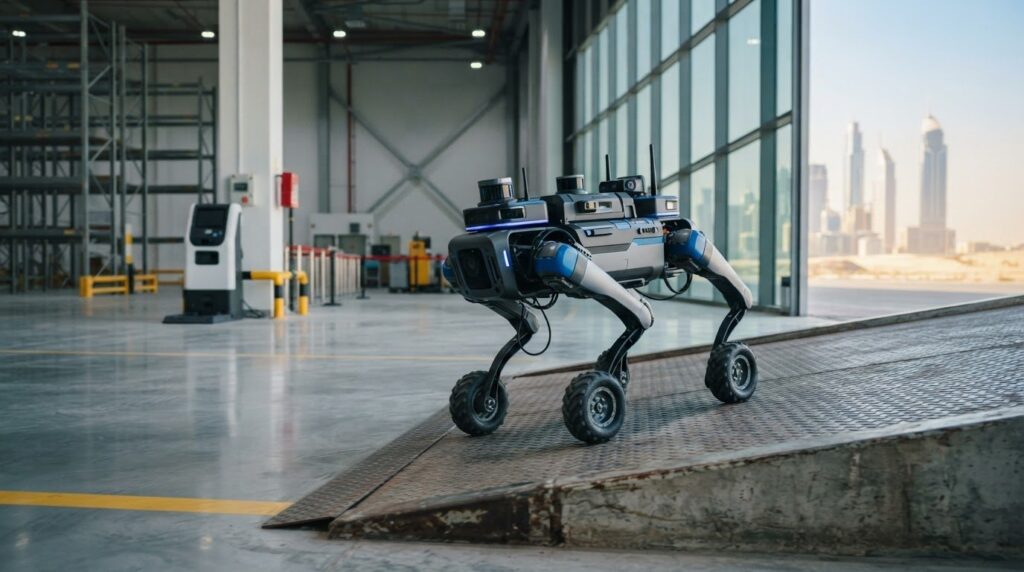
Operating industrial assets in punishing environments requires mechanical engineering that withstands severe physical stress. Consumer-grade security hardware quickly fails when exposed to abrasive sand, torrential downpours, or extreme ambient temperatures. Enterprise surveillance platforms integrate IP65 or higher ingress-rated enclosures that prevent airborne particulate penetration. Specialized thermal management systems, combining passive heat sinks with sealed fluid loops, maintain edge computing reliability in scorching desert heat. Heavy-duty independent suspensions and high-torque wheel hubs let these units navigate loose gravel berms, washouts, and unpaved perimeter access lanes effortlessly.
How to Integrate Surveillance Robots into Enterprise Security Systems
Commissioning surveillance robots for large facilities demands a methodical engineering workflow rather than a plug-and-play approach. Integrating mobile autonomous units into high-consequence environments succeeds when technical teams follow five structured phases:
- Phase 1 (Topography and Risk Mapping): Survey site grade variations, network dead spots, and high-risk boundary perimeters to establish precise geofenced operating corridors.
- Phase 2 (Communications Architecture): Deploy ruggedized field access points or private cellular arrays to secure low-latency data transmission across internal yards.
- Phase 3 (VMS Protocol Interfacing): Configure real-time optical and thermal video streams into the primary security operations center using standard ONVIF profiles.
- Phase 4 (Industrial Control Layer Bridging): Connect autonomous robotics logic directly to facility supervisory control networks to trigger automated physical interlocks.
- Phase 5 (Docking and Mission Validation): Install weatherproof charging terminals and run stress tests on multi-unit patrol schedules under real operational constraints.
Network Infrastructure and Low-Latency Data Streaming
Transmitting continuous high-definition video, thermal telemetry, and positional updates across sprawling complexes requires robust communications infrastructure. Private 5G networks and industrial wireless mesh topologies ensure rapid packet delivery without contending with public network bandwidth. To defend against cyber-physical intrusions, all wireless transmissions require WPA3-Enterprise encryption, certificate-based hardware authentication, and segregated VLAN architectures. When units traverse temporary blind zones between bulk metal storage bins, edge buffering systems store critical sensory evidence locally, automatically offloading backlogged files once the signal restores.
Telemetry Bridging with VMS and SCADA Platforms
Treating mobile units as siloed platforms cripples incident response times. Video streams and pan-tilt controls interface cleanly with enterprise platforms like Milestone or Genetec, allowing security operators to manage static and mobile visual feeds side by side. Establishing direct links via PLC and SCADA integration services enables field alarms, such as an unauthorized perimeter gate breach, to instantly trigger plant horns, illuminate boundary floodlights, and lock down automated access gates. On internal logistics floors, perimeter telemetry coordinates seamlessly alongside internal material movement driven by autonomous mobile robots to prevent routing conflicts.
Autonomous Docking and Mission Fleet Management
Maintaining persistent site defense requires intelligent fleet orchestration. Position charging bays strategically near high-risk nodes to reduce non-patrol transit times. Fleet software schedules overlapping patrol cycles, deploying a fully charged unit to take over a sector before an active robot departs for its inductive charging pad. To secure long-term hardware reliability across severe industrial environments, partner with EdNex Automation for turnkey system integration to manage your complete lifecycle deployment.
Selecting the Right Surveillance Robotics Partner
Procuring surveillance robots for large facilities represents an enterprise engineering commitment rather than an off-the-shelf equipment purchase. Catalog brokers and third-party vendors often sell mobile units as isolated gadgets, leaving facility operators with unsupported APIs, uncalibrated sensors, and fragmented software stacks. Successfully deploying autonomous robotic patrols requires an automation partner that understands industrial control architecture, physical plant dynamics, and lifecycle system maintenance. By working with seasoned engineering integrators, industrial enterprises ensure mobile robotic fleets collaborate smoothly alongside existing access systems, plant automation, and centralized security teams.
Key Evaluation Criteria for Industrial Automation Providers
Selecting an integration partner requires evaluating capabilities that extend beyond standard hardware distribution. Industrial facilities should screen prospective automation partners using several core criteria:
- Multi-Disciplinary Engineering Expertise: Look for documented engineering mastery spanning mechanical integration, wireless network topologies, and industrial automation protocols.
- Industrial Deployment History: Verify that the provider has demonstrable experience commissioning autonomous mobile platforms across mission-critical, high-consequence environments.
- Nationwide Lifecycle Support: Ensure your partner guarantees prompt on-site engineering assistance, domestic inventories of mission-critical spare parts, and enforceable service-level agreements (SLAs).
Future-Proofing Facilities with Scalable Autonomous Systems
Adopting mobile physical security lays the operational foundation for facility-wide digital transformation. Unifying perimeter surveillance feeds with inventory data from automated storage and retrieval systems establishes complete physical traceability across indoor logistics and outdoor yards. As autonomous technology expands toward agile humanoid robots capable of tackling dexterous maintenance and facility tasks, forward-thinking organizations need modular system architectures that scale effortlessly. Engineering this level of unified autonomy requires deep domain integration. Connect with our engineering specialists at EdNex Automation to design a resilient physical security roadmap tailored to your facility.
Transform Industrial Facility Defense with Integrated Autonomous Robotics
Deploying surveillance robots for large facilities transforms physical security from a reactive burden into an active, verified operational asset. By combining multi-spectral sensor fusion with dynamic ground mobility, these autonomous systems dismantle hazardous perimeter blind spots, slash false alarms, and insulate manual guarding teams from extreme environmental fatigue. Real operational resilience doesn’t come from isolated hardware. It happens when mobile robotic platforms link directly into your plant SCADA networks, PLC interlocks, and central video consoles.
Scaling this level of protection requires an engineering partner with proven industrial automation expertise and comprehensive national lifecycle maintenance capabilities. EdNex Automation delivers turnkey deployments that bridge robotics, supervisory control, and ongoing field maintenance across demanding industrial environments. Schedule an enterprise facility security assessment with EdNex Automation to modernize your perimeter defense and secure your operational future.
Frequently Asked Questions
How do autonomous surveillance robots navigate large industrial facilities without GPS?
Surveillance robots navigate GPS-denied industrial spaces using Simultaneous Localization and Mapping (SLAM) powered by multi-layer LiDAR, visual odometry, and wheel encoders. These systems construct and continuously update a high-definition 3D geometric point cloud of the facility. Onboard inertial measurement units track orientation and acceleration, ensuring centimeter-accurate positioning even inside dense metal structures, high-bay racking corridors, and covered loading bays where satellite signals can’t penetrate.
Can surveillance robots operate reliably in extreme ambient heat and sandstorms?
Yes, purpose-built industrial units operate reliably in severe climates by utilizing IP65 or higher ingress-rated enclosures and specialized thermal management systems. Sealed chassis prevent abrasive dust, moisture, and fine airborne sand from penetrating sensitive drive motors and onboard electronics. Advanced liquid cooling loops and heat pipe assemblies actively dissipate internal thermal buildup, allowing edge processors and optical sensors to execute continuous missions during sustained high-temperature operations.
How do mobile security robots integrate with existing CCTV and VMS networks?
Mobile platforms integrate directly with enterprise video management software using standard open protocols like ONVIF Profile S and Profile G. Security operations centers ingest robotic optical and radiometric video feeds alongside static camera channels on their primary monitor walls. Beyond basic video feeds, API bridges transmit telemetry data, coordinate automated dispatch alarms, and let human dispatchers seize manual pan-tilt-zoom control or two-way audio channels when verifying critical perimeter threats.
What safety mechanisms prevent surveillance robots from colliding with workers or machinery?
Autonomous security units prevent collisions through layered active safety systems, combining safety-rated LiDAR, ultrasonic depth sensors, and computer vision. If a worker, forklift, or unexpected obstacle enters the robot’s dynamic safety envelope, the onboard controller slows transit velocity or executes a full stop immediately. When navigating dynamic logistics zones, the platform’s path-planning algorithm calculates real-time evasive bypass routes to avoid disrupting active personnel and material handling machinery.
How long do robotic security patrols run before needing to recharge?
Typical industrial patrol units operate continuously for 4 to 8 hours on a single charge, depending on payload power draw and terrain resistance. Deploying surveillance robots for large facilities achieves uninterrupted 24/7 security cycles through autonomous self-charging docks. Fleet management software monitors real-time battery status, automatically dispatching a replacement robot to patrol designated sectors while depleted units dock for high-speed top-offs, eliminating coverage gaps across shifting security rotations.
Can surveillance robots detect industrial hazards like gas leaks or electrical fires?
Yes, enterprise surveillance units detect environmental hazards by carrying specialized auxiliary sensor arrays alongside optical cameras. Integrated thermal imagers spot dangerous heat buildup in transformer bushings, mechanical bearings, and high-voltage switchgear long before smoke emerges. Onboard sniffing sensors analyze volatile organic compounds and combustible gases, instantly transmitting telemetry alerts through industrial control platforms to halt machinery or initiate emergency ventilation protocols.
What is the primary operational advantage of security robots over fixed cameras?
The primary operational advantage is dynamic ground mobility, which systematically dismantles the predictable visual blind spots created by stationary camera installations. While fixed cameras leave dead angles around shifting cargo piles and perimeter fences, surveillance robots for large facilities dynamically investigate tripwire alerts and change patrol paths at random intervals. This unpredictable presence deters perimeter intrusions, provides immediate multi-spectral verification, and reduces the substantial labor overhead associated with traditional manned guarding patrols.