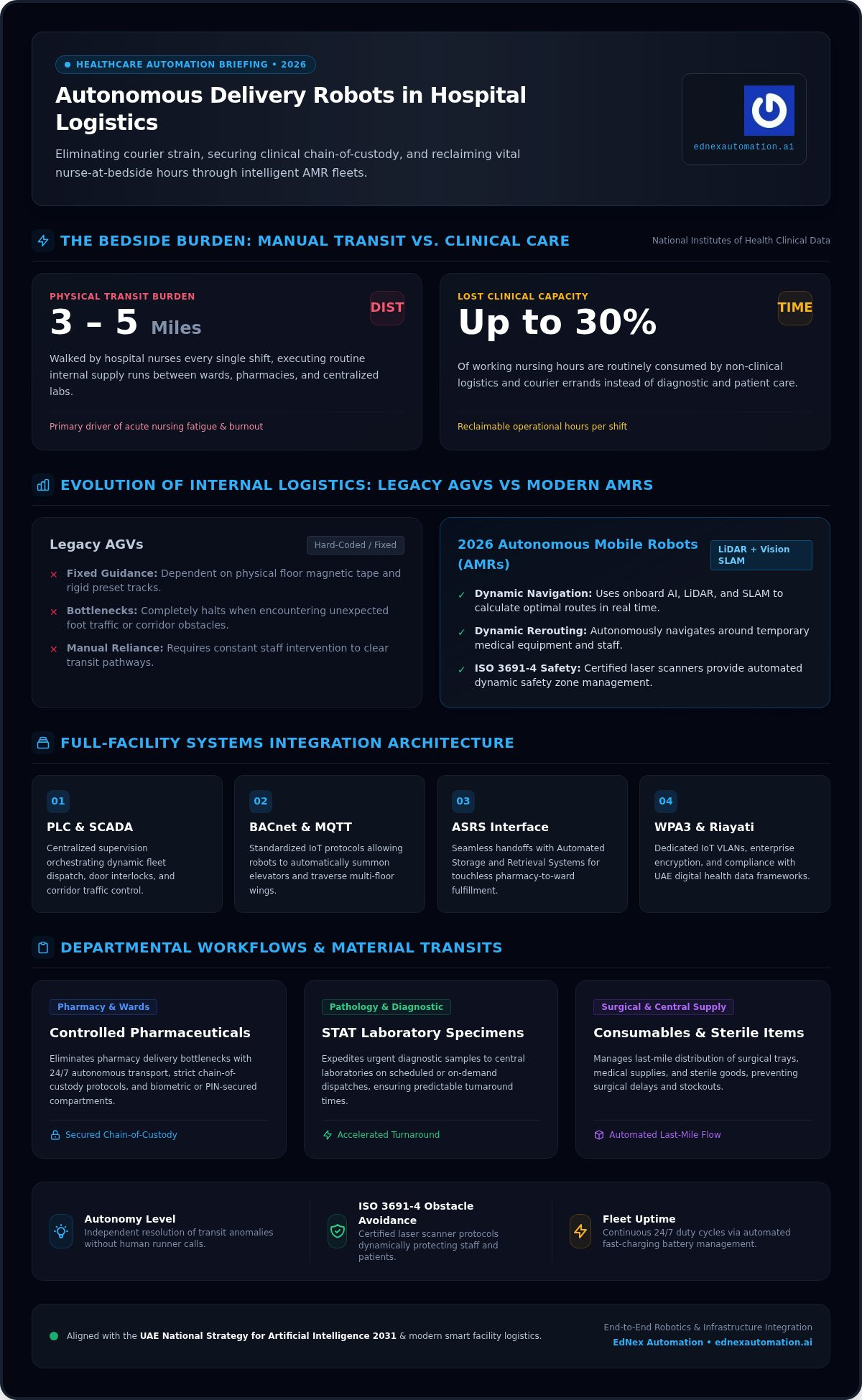
According to clinical studies indexed by the National Institutes of Health, hospital nurses walk between three and five miles every shift, routinely losing up to 30 percent of their working hours to internal courier tasks. You already know the compounding strain this friction creates: acute nursing burnout, mounting labor costs, and persistent bottlenecks in routine pharmacy-to-ward distribution. In 2026, deploying autonomous delivery robots for hospitals is no longer a speculative novelty; it’s a foundational operational strategy designed to reclaim valuable nursing hours.
Discover how autonomous mobile robots are transforming clinical workflows, mitigating severe staffing shortages, and modernizing healthcare logistics across the UAE. This strategic guide details how modern fleets deliver around-the-clock autonomous transport for medications and laboratory specimens, eliminate non-clinical transit burdens, and interface seamlessly with automated storage and retrieval systems (ASRS) and multi-floor elevators through robust PLC and SCADA integration.
Key Takeaways
- Explore how autonomous delivery robots for hospitals directly alleviate severe clinical staffing shortages by reallocating non-clinical logistics away from bedside teams.
- Understand the vital role of PLC and SCADA integration architectures alongside automated storage and retrieval systems (ASRS) in executing autonomous, multi-floor transport.
- Examine department-specific workflows for securing controlled pharmaceuticals, expediting STAT laboratory specimens, and safeguarding strict chain-of-custody protocols.
- Master total cost of ownership models and the critical “Nurse-at-Bedside” return-on-investment metrics that justify clinical automation projects in 2026.
- Discover how comprehensive, start-to-finish system integration bridges advanced global robotics with modern smart facility requirements across the UAE.
The Evolution of Healthcare Logistics: Addressing the Labor Shortage with AMRs
Healthcare facilities face structural workforce constraints that manual workflows can no longer sustain. Clinical talent remains in short supply across global institutions, compounding operational strain and escalating operational costs. Historically, hospital operations relied on human porters or floor nurses to run physical supplies across expansive medical complexes. Transitioning from manual runners to autonomous clinical support systems eliminates these operational bottlenecks, ensuring mission-critical supplies move without diverting skilled staff from diagnostic and therapeutic duties.
Operating within the ambitious framework of the UAE National Strategy for Artificial Intelligence 2031, healthcare operators across the Emirates are deploying intelligent automation to protect institutional capacity. Adopting autonomous delivery robots for hospitals allows organizations to align with national digital health frameworks, ensuring internal logistics match the precision of modern electronic medical records. Far from removing the human element from healthcare, deliberate automation protects it. Relieving staff from non-clinical transport tasks preserves cognitive bandwidth, minimizes physical fatigue, and redirects institutional resources directly back to patient care.
Defining Autonomy in the Modern Hospital
Hospital AMRs are intelligent agents capable of navigating dynamic, populated clinical environments without fixed tracks or physical guidance markers. Unlike legacy Automated Guided Vehicles (AGVs) that depend on floor magnetic tape and rigid, hard-coded pathways, modern 2026-era units utilize advanced LiDAR, vision-based Simultaneous Localization and Mapping (SLAM), and onboard artificial intelligence to calculate optimal routes in real time. When corridors encounter unexpected foot traffic or temporary medical equipment, modern units dynamically reroute without halting operations.
Evaluating an operational fleet requires tracking rigorous engineering metrics:
- Autonomy Level: The system’s capacity to resolve transit anomalies independently without human intervention.
- Obstacle Avoidance: Conformance to safety standards like ISO 3691-4, employing certified safety laser scanners for dynamic zone management.
- Fleet Uptime: Maintaining continuous duty cycles through automated fast-charging protocols that optimize battery life.
The Human-Centric Benefit of Robotics
Deploying autonomous delivery robots for hospitals addresses the core drivers of clinician fatigue. By automating the last-mile distribution of surgical consumables, laboratory supplies, and sterile items, robotic units recover substantial clinical hours previously lost to transit errands. Concurrently, scheduled robotic dispatches eliminate manual transit delays, establishing dependable turnaround times for patient medications.
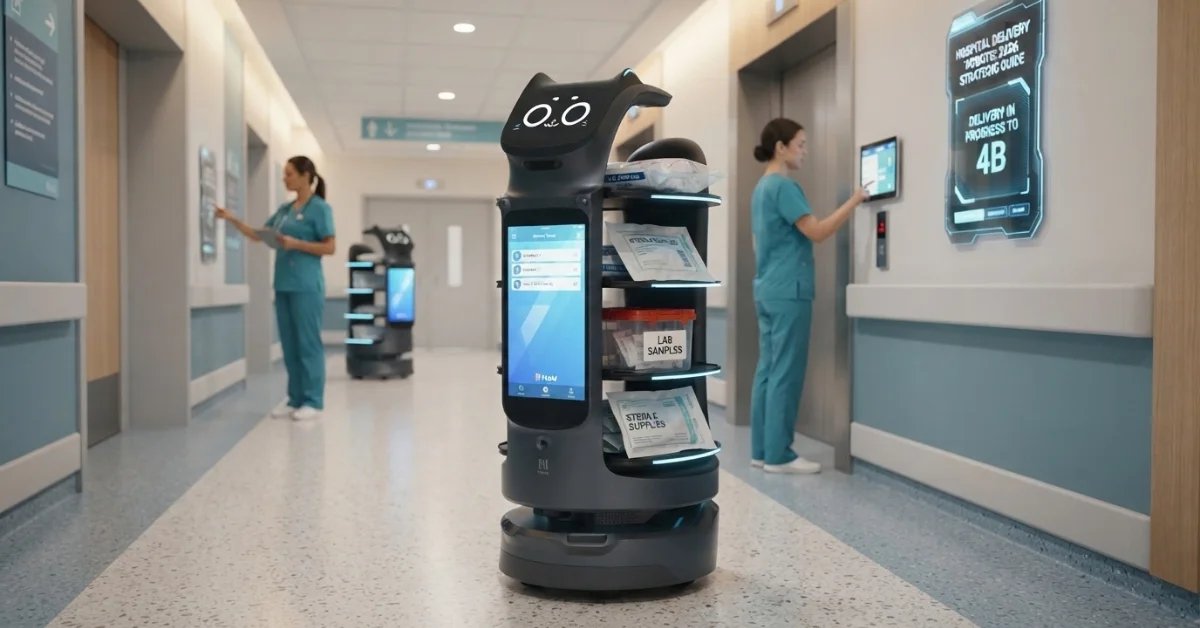
Staff integration thrives when robotics feature thoughtful physical and interface designs. Introducing machines with approachable, humanoid-influenced visual cues fosters natural workplace integration. Healthcare teams quickly view these mobile units as supportive, reliable colleagues rather than complex mechanical intrusions.
Technical Architecture: Integrating Robots into Hospital Infrastructure
Treating autonomous delivery robots for hospitals as standalone appliances creates logistical silos. Successful adoption requires full-scale systems engineering where mobile platforms communicate directly with the facility envelope. Modern deployments integrate with vertical transport through standardized IoT protocols like BACnet and MQTT, enabling AMRs to summon elevators, clear automatic doors, and traverse multi-story wings without human intervention. Concurrently, operational networks secure fleet telemetry via dedicated IoT VLANs and WPA3-Enterprise encryption, aligning hardware with national UAE digital health frameworks such as Riayati to ensure sensitive transit data remains strictly protected.
The Role of PLC and SCADA in Robotics
Reliable multi-robot management depends on proven industrial automation frameworks. Enterprise PLC and SCADA integration services unify dynamic fleet dispatching with building management systems, orchestrating corridor traffic and managing doorway interlocks. Centralized SCADA supervisors oversee dynamic opportunity charging, balance fleet utilization, and monitor mechanical health in real time. Redundant control logic ensures that if an operational node fails, fail-safe architectures immediately transition units into safe, deterministic states, satisfying rigorous ISO 3691-4 personnel safety mandates.
Hardware Synergy: AMRs and ASRS
Clinical supply chains achieve peak velocity when mobile units interface directly with centralized inventory machinery. Coupling autonomous delivery robots for hospitals with Automated Storage and Retrieval Systems (ASRS) transforms central inpatient pharmacies into closed-loop fulfillment hubs. When a physician submits an order through the electronic medical record, the ASRS automatically retrieves the dosage, transfers it into a biometrically sealed AMR bay, and dispatches the unit directly to the nursing station.
- Automated Handoff: Mechanical transfer mechanisms eliminate human handling errors between high-density stock racks and transport bays.
- Chain-of-Custody Tracking: Real-time software tracking monitors payload temperature, access timestamps, and recipient credentials.
- Dynamic Replenishment: Inventory levels reconcile instantly across the hospital information system as items leave the dispensing hub.
Healthcare facilities aiming to build resilient clinical supply networks can consult with EdNex Automation engineering specialists to architect unified hardware and software ecosystems tailored to regional clinical standards.
Strategic Use Cases: Enhancing Efficiency Across Clinical Departments
Autonomous mobile robotics unlock operational value across every layer of hospital administration. Grand View Research reports that hospitals account for 71.7% of the global healthcare mobile robotics end-use market, with material transport and logistics comprising the single largest application segment at 35.7%. Deploying autonomous delivery robots for hospitals eliminates the traditional reliance on batch delivery schedules, replacing sluggish manual transport with a responsive, continuous logistics loop. Heavy material haulers effortlessly manage bulk linen and biohazard removal, while precision couriers streamline delicate clinical tasks.
Specialized units also streamline patient-facing operations. Automated food delivery systems transport thermal dietary trays directly to patient floors, preserving precise nutritional temperatures. Similarly, targeted outpatient “meds-to-beds” programs deliver discharge medications directly to bedside tables, expediting discharge protocols while reinforcing patient compliance before departure. In specialized settings such as geriatric and memory care wards, pairing quiet delivery automation with thoughtful interior design helps maintain patient calm and orientation; for facility planners seeking guidance on creating supportive spaces, visit Find Memory Care.
Medication and Pharmacy Automation
Securing pharmaceutical distribution requires absolute accountability. Modern delivery robots feature motorized, locked compartments accessible only via two-factor authentication, such as an RFID staff badge scan or biometric verification. Implementing these smart controls prevents diversion and establishes a definitive digital audit trail for scheduled narcotics and high-value oncology therapies.
Transitioning from intermittent manual rounds to continuous delivery balances pharmacy workloads throughout the entire day. By integrating with unit-dose packaging machinery, robotic couriers transport verified medications directly to ward dispensing stations, dramatically reducing the dispensing and delivery errors caused by urgent, interrupted transit runs.
Laboratory and Specimen Transport
Diagnostic precision depends entirely on the physical stability of clinical specimens. Advanced autonomous mobile robots incorporate active suspension systems and vibration-dampening cargo bays to shield whole blood samples, biopsy vials, and spinal fluids from mechanical shock. This smooth motion preserves sample integrity, preventing hemolysis and eliminating costly re-draws for fragile, critically ill patients.
Clinical complexes achieve optimal logistics efficiency by establishing a hybrid model combining pneumatic tubes with mobile robots:
- Urgent Micro-Payloads: Pneumatic systems handle emergency single-vial STAT runs between critical care departments and the core lab.
- High-Volume and Fragile Specimens: Autonomous delivery robots for hospitals transport large collection batches, pathology tissue containers, and delicate lab plates that exceed pneumatic size or shock limits.
- Continuous Turnaround: On-demand robotic runs maintain an unbroken flow of diagnostic material, preventing evening intake bottlenecks in central accessioning.
Evaluating ROI: The Business Case for Hospital Automation
Calculating the true financial return of mobile automation demands evaluating total cost of ownership (TCO) across multi-year asset lifecycles. Beyond the initial capital acquisition, comprehensive financial modeling accounts for ongoing industrial maintenance, software upgrades, network infrastructure, and fleet integration. Leading healthcare executives avoid treating autonomous delivery robots for hospitals as simple headcount replacements. Instead, the modern business case centers on workforce capacity expansion, measuring return on investment through the strategic “Nurse-at-Bedside” metric.
Operating across three continuous daily shifts requires substantial human resourcing, driving up recruitment, onboarding, and overtime expenses. In contrast, an autonomous fleet operates continuously across a 24-hour cycle, pausing only for autonomous opportunity charging during low-demand intervals. Stabilizing routine supply movements with robotics insulates hospitals from turnover spikes, preserving institutional knowledge while cutting the severe recurring costs of agency nursing and emergency staffing.
Direct vs. Indirect Cost Savings
Direct financial savings materialize quickly by reducing reliance on internal human courier networks and external expedited delivery services. The 2026 ROI benchmark for hospital robotics investments is typically achieved within an 18-to-24-month operational window. Concurrently, indirect financial gains surface through faster turnaround times for discharge medications and laboratory results, accelerating patient room turnover and unlocking higher clinical throughput without expanding physical facility boundaries. Similarly, complementing automated logistics with flexible point-of-care technology can optimize diagnostic turnaround; clinical teams modernizing their bedside workflows can check out Dextro Imaging Solutions for portable imaging workstations and diagnostic displays.
Successful hospital automation initiatives leverage phased, modular deployments that protect capital reserves while systematically compounding operational value:
- Phase 1: High-Value Medication Distribution: Automate time-sensitive pharmacy runs to secure controlled substances and eliminate ward-level delivery delays.
- Phase 2: Heavy Material Logistics: Deploy autonomous tugs to haul bulk linens, dietary supplies, and hazardous bio-waste along dedicated basement and service corridors.
- Phase 3: Front-of-House Clinical Synergy: Integrate sophisticated humanoid robots to manage patient guidance, intake registration, and outpatient coordination in public hospital concourses.
Sustaining this fleet evolution across multi-facility networks relies on cloud-based fleet management suites that monitor component wear and dispatch dynamic routing updates centrally. Hospital administrators evaluating long-term autonomous delivery robots for hospitals can consult with EdNex Automation to calculate a tailored institutional ROI model that aligns with national healthcare benchmarks.
EdNex Automation: Architecting the Future of UAE Healthcare
Pioneering the next era of clinical logistics, EdNex Automation delivers end-to-end robotic integration that elevates healthcare institutions beyond legacy operational constraints. Transforming hospital workflows doesn’t mean simply procuring off-the-shelf machinery; it demands bespoke engineering tailored to intricate architectural footprints and stringent clinical workflows. Operating at the forefront of the UAE’s Industry 4.0 evolution, EdNex aligns enterprise automation directly with national digital transformation directives. By designing and orchestrating high-performance autonomous delivery robots for hospitals, EdNex bridges world-class technological breakthroughs with the unique requirements of modern medical infrastructure.
Why UAE Hospitals Choose EdNex
Healthcare operators partner with EdNex to secure comprehensive, start-to-finish expertise that encompasses system design, mechanical commissioning, and lifecycle SCADA maintenance. Through official alliances with global robotics leaders, EdNex provides verified, cutting-edge hardware backed by deep local engineering authority. Deployments adhere strictly to international safety benchmarks such as ANSI/RIA R15.08 and ISO 3691-4, alongside national UAE health guidelines, guaranteeing that autonomous platforms integrate safely into shared clinical corridors without disrupting sensitive patient environments.
Commencing Your Automation Journey
Transitioning to an automated internal logistics ecosystem begins with a thorough facility audit. EdNex specialists conduct rigorous on-site evaluations to map logistical friction points, quantify internal transport volumes, and determine optimal fleet sizing. Following this initial analysis, our multidisciplinary engineering teams execute turnkey implementations:
- Infrastructure Readiness: Coordinating network architecture, automated door triggers, and elevator interfaces for seamless transit.
- Fleet Deployment: Commissioning autonomous delivery robots for hospitals with customized multi-tier cargo shells and biometric authentication.
- Operational Enablement: Delivering structured staff training programs to guarantee frictionless cross-departmental adoption.
Modernizing your facility’s internal supply chain establishes durable operational efficiency for decades to come. Contact our automation specialists today to schedule an exhaustive facility assessment and architect an autonomous logistics framework tailored to your clinical enterprise.
Accelerating the Autonomous Era in Healthcare Logistics
Modern clinical logistics don’t have to remain constrained by manual transit tasks. Integrating autonomous delivery robots for hospitals directly relieves frontline staff from repetitive distribution duties, returning vital clinical hours back to patient bedsides. By anchoring mobile fleets within specialized PLC and SCADA integration frameworks, healthcare facilities transform disparate wings and multi-story corridors into unified, responsive supply networks that operate continuously without disruption.
Achieving this level of operational resilience demands a technical partner capable of delivering comprehensive, start-to-finish execution. As a visionary Industry 4.0 leader, EdNex Automation bridges advanced robotic breakthroughs with dedicated UAE national service and technical support to future-proof medical institutions. Partner with EdNex Automation to modernize your healthcare facility logistics and lead the regional transition toward intelligent, highly connected clinical care.
Frequently Asked Questions
How do autonomous delivery robots navigate crowded hospital hallways safely?
Autonomous delivery robots navigate crowded corridors using multi-layered sensor arrays, including 3D LiDAR, optical depth cameras, and ultrasonic proximity detectors. Operating under ISO 3691-4 safety protocols, these systems dynamically map temporary obstructions, gurneys, and walking pedestrians in real time. Rather than stopping abruptly, an AMR recalculates a smooth bypass trajectory or politely yields clearance, ensuring zero physical contact while maintaining uninterrupted clinical delivery schedules.
Can AMRs be integrated with our existing hospital elevators and automatic doors?
Yes, modern AMRs interface with existing elevator banks and automatic doors through standardized IoT relays and industrial protocols like BACnet and MQTT. Dedicated PLC controllers communicate wirelessly with elevator supervisory systems to call cars, select destination floors, and hold doors open. Automatic swing or sliding doors clear automatically as the robot approaches, allowing the fleet to transition across separate wards and vertical towers without mechanical retrofits.
What is the typical battery life and charging time for a hospital delivery robot in 2026?
In 2026, healthcare-grade AMRs typically offer 10 to 14 hours of continuous operational runtime on high-density lithium-iron-phosphate power cells. Fast-charging docking stations replenish batteries from 20 percent to 80 percent within 30 to 45 minutes. Fleet algorithms schedule autonomous opportunity charging during low-activity windows between delivery dispatches, ensuring reliable availability across day and night shifts without requiring manual battery swaps.
How do robots handle the delivery of sensitive or controlled medications?
Sensitive pharmaceuticals travel in motorized, tamper-evident cargo compartments that remain locked throughout transit. Access requires two-factor authentication at the drop-off point, requiring authorized clinical staff to scan an RFID badge or enter a secure PIN. Every transit event, door opening, and recipient ID is logged with precise timestamps, establishing a tamper-proof digital chain of custody that satisfies stringent clinical compliance guidelines.
What level of training is required for hospital staff to interact with AMRs?
Clinical and pharmacy staff require minimal operational onboarding, typically mastering daily interactions within a single 30-minute training session. Intuitive touchscreen interfaces mirror common smartphone apps, allowing users to select destinations, verify authentication, and dispatch payloads with a few taps. Comprehensive engineering training is reserved exclusively for facilities management teams, who learn centralized SCADA monitoring, routine sensor cleaning, and basic fleet health management protocols.
Can autonomous robots integrate with our current Hospital Information System (HIS)?
Yes, autonomous delivery robots for hospitals connect natively with Hospital Information Systems (HIS) and Electronic Health Records (EHR) through secure REST APIs and HL7/FHIR messaging standards. When a clinician prescribes urgent medication or requests a lab draw, the order triggers an automated task in the fleet dispatch engine. System integration ensures real-time location tracking and instant delivery confirmation right within the patient’s digital chart.
What happens if a robot encounters an emergency situation or a patient fall in the corridor?
If an AMR encounters an unexpected emergency, such as a patient fall or Code Blue team, onboard safety laser scanners bring the unit to an immediate, controlled stop. Certified safety algorithms dynamically classify the obstruction and attempt to reroute through adjacent corridors. If all paths are blocked, the robot pulls closely against the corridor wall, sounds a discreet audio status chime, and alerts the central supervisory console.
How does the ROI of a delivery robot compare to traditional manual labor in the UAE?
Autonomous delivery robots for hospitals deliver measurable financial advantages over manual courier models by operating continuously across multiple operational shifts without recurring overtime, benefits, or turnover recruitment costs. While human porters remain subject to logistical fatigue and staffing shortages, an integrated robotic fleet stabilizes facility logistics under a predictable operational expenditure model. UAE medical institutions typically achieve operational payback within 18 to 24 months through reclaimed nursing hours and accelerated bed turnover.