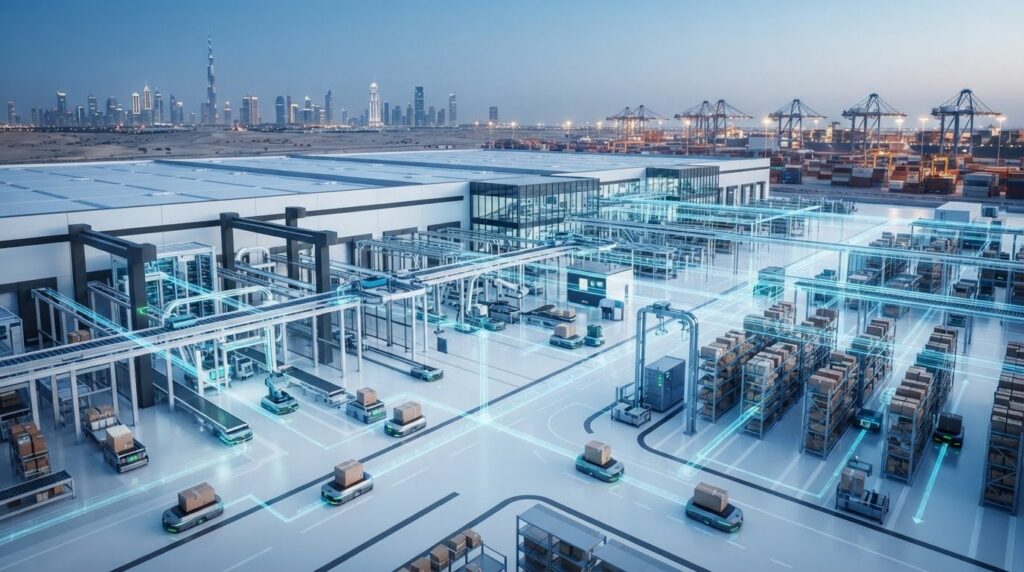
With the UAE industrial sector contributing $54 billion to the national GDP and the Ministry of Industry and Advanced Technology launching the AED 1 billion National Industrial Resilience Fund in May 2026, the mandate for digital transformation is now a strategic priority. You likely recognize that manual labor shortages and inefficient warehouse utilization are no longer just operational hurdles; they’re barriers to remaining competitive under the mandatory National In-Country Value framework. Building a resilient facility requires more than just adding hardware. It demands a sophisticated ecosystem where autonomous systems and legacy controls are unified through bespoke integration.
Adopting comprehensive smart factory solutions UAE allows your organization to bridge the gap between global technological breakthroughs and regional industrial needs. By reading this guide, you’ll discover how to integrate collaborative robots, Automated Storage and Retrieval Systems (ASRS), and PLC systems to build a future-ready, autonomous manufacturing environment. We’ll explore the technical framework necessary to achieve full visibility through SCADA integration, ensuring your transition to Industry 5.0 is both systematic and highly profitable.
Key Takeaways
- Define the transition from traditional automation to self-optimizing Industry 4.0 ecosystems to maintain regional competitiveness.
- Explore the role of collaborative robots and smart factory solutions UAE in mitigating labor shortages and increasing production throughput.
- Centralize operational visibility by integrating PLC and SCADA systems to ensure real-time data acquisition and reduced downtime.
- Revolutionize internal logistics and storage density using Autonomous Mobile Robots (AMRs) and Automated Storage and Retrieval Systems (ASRS).
- Follow a structured strategic roadmap to audit facilities and design bespoke automation plans tailored to specific manufacturing needs.
What is a Smart Factory in the 2026 UAE Industrial Landscape?
Defining the modern industrial facility requires looking beyond simple mechanization toward a fully integrated, cyber-physical ecosystem. A smart factory is a highly digitized environment where autonomous robotics and real-time data streams converge to create a self-optimizing production cycle. While traditional automation relied on static, pre-programmed sequences, the transition to Industry 4.0 introduces systems that perceive, analyze, and react to operational variables. Implementing smart factory solutions UAE allows manufacturers to replace rigid legacy processes with flexible architectures capable of predictive maintenance and autonomous decision-making. To understand the foundational shift toward these intelligent systems, one must examine the broader evolution of What is a Smart Factory? and its role in global industrial resilience.
Physical autonomy serves as the primary mechanism for reducing human error and operational risk. By removing operators from hazardous environments and repetitive tasks, companies can secure higher safety standards while maintaining continuous production cycles. It isn’t just about speed; it’s about the precision and consistency that only a connected, intelligent infrastructure can provide. This transformation ensures that every component of the production line communicates seamlessly, eliminating the data silos that traditionally hindered growth.
The Core Components of Industrial Autonomy
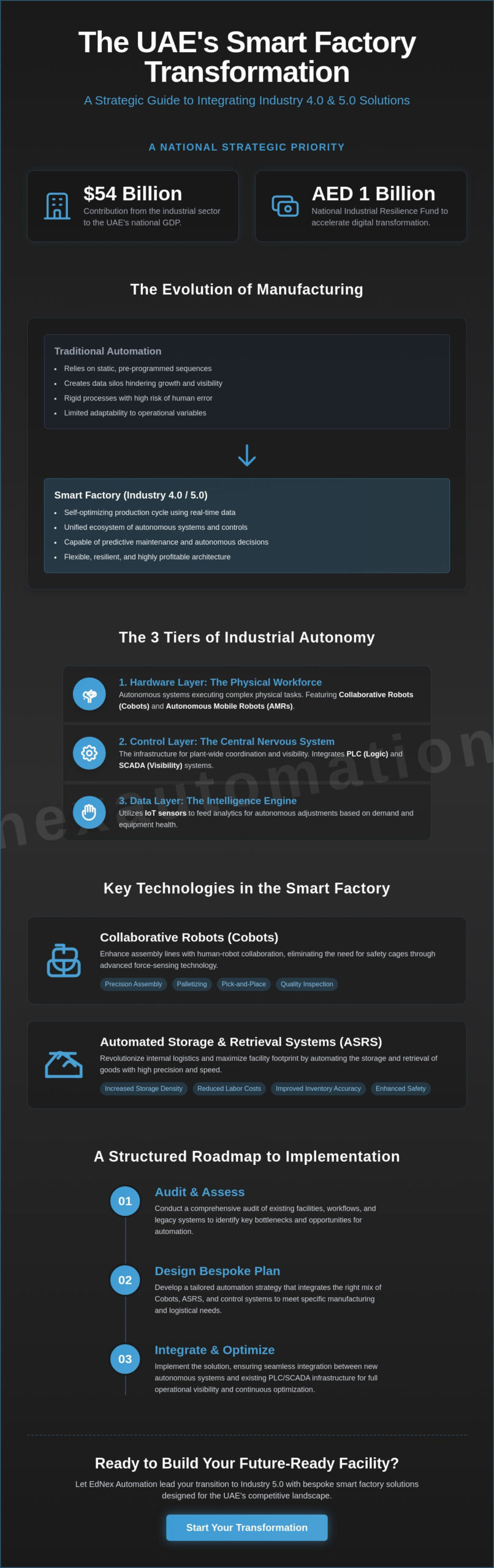
Establishing true autonomy necessitates a three-tiered approach to factory architecture. At the hardware level, Autonomous Mobile Robots (AMRs) and Collaborative Robots (Cobots) execute complex material handling and assembly tasks with minimal oversight. Supporting this physical layer is the control infrastructure, where PLC and SCADA integration provides the fundamental logic and centralized visibility required for plant-wide coordination. Finally, a robust data layer utilizes IoT sensors to feed real-time analytics into the system. This allows the facility to adjust its output based on real-time demand or equipment health, ensuring the hardware remains productive and optimized.
Why the UAE is Leading the Smart Factory Transition
Strategic government mandates, such as the “Operation 300bn” strategy and the AED 1 billion National Industrial Resilience Fund announced in May 2026, have accelerated the adoption of advanced robotics across the Emirates. The Ministry of Industry and Advanced Technology (MoIAT) further supported this transition by launching the ITTI Use Case Guide 2.0, providing a clear roadmap for smart factory solutions UAE integration. These initiatives allow local manufacturers to scale production without the proportional increase in labor costs typically associated with expansion. Beyond economic growth, precision automation supports national sustainability goals by drastically reducing energy waste and material scrap through optimized resource management, leveraging specialized Industrial automation and energy optimisation solutions.
Autonomous Robotics: The Workforce of the Smart Factory
Transitioning from abstract digitalization to physical implementation requires a workforce capable of 24/7 precision. In the context of smart factory solutions UAE, this workforce is increasingly composed of autonomous systems that eliminate the variability of manual labor. This evolution aligns with the UAE’s leadership in Industry 4.0, where the focus has shifted from simple automation to intelligent, reactive machines. These systems provide the intellectual and physical framework necessary to maintain production continuity in a competitive global market.
Collaborative Robots (Cobots) for Precision Assembly
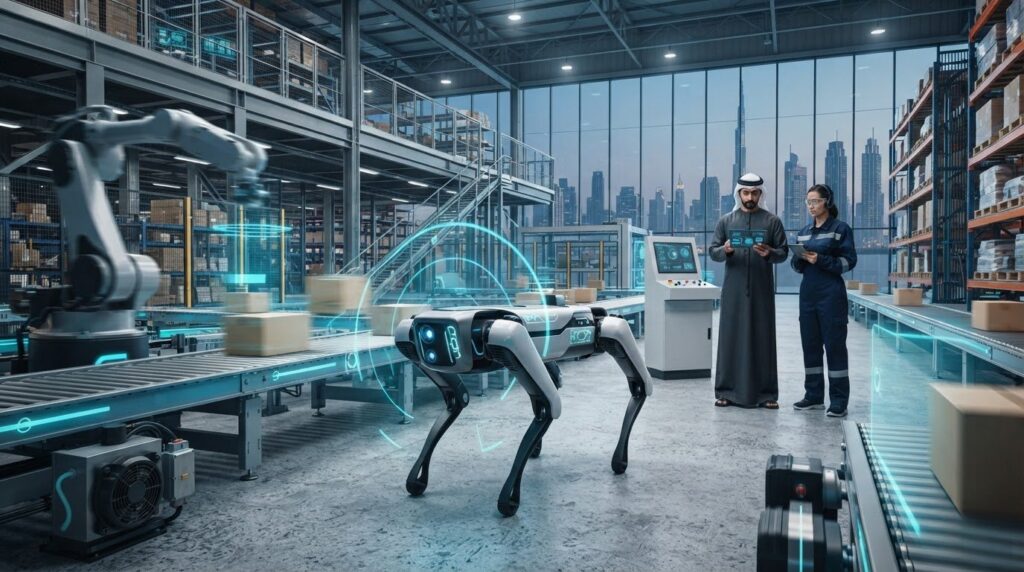
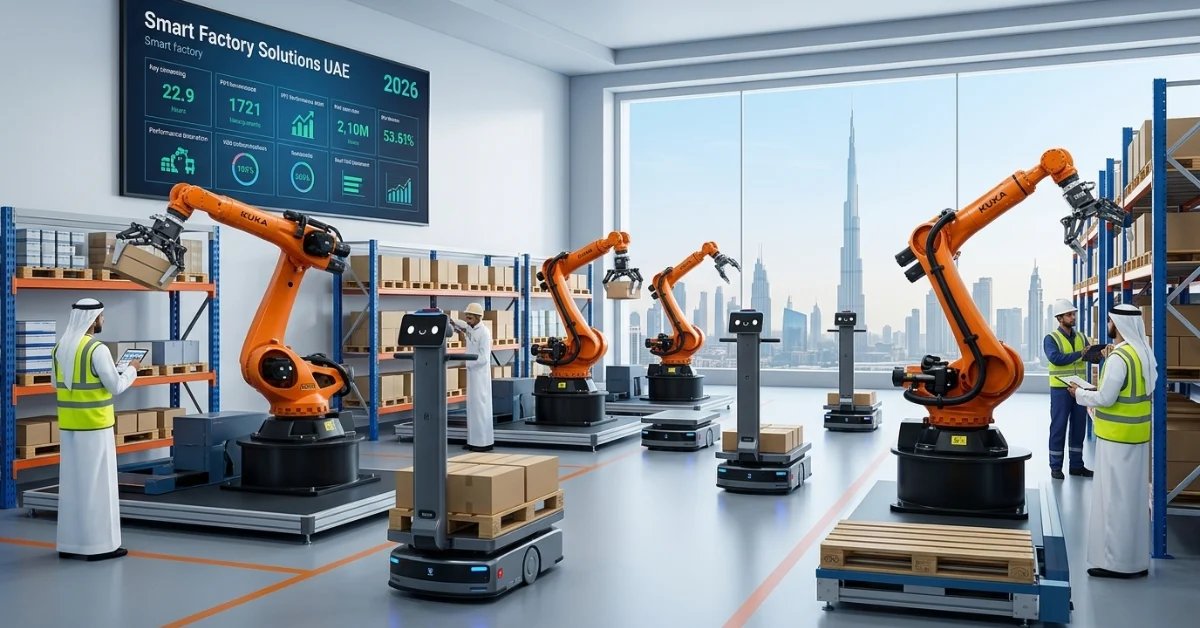
Advanced safety protocols now enable seamless human-robot proximity without the need for traditional safety cages. Utilizing high-resolution force-sensing technology, collaborative robots UAE assist in palletizing, pick-and-place operations, and rigorous quality inspection. These systems don’t just replace tasks; they enhance assembly line precision by handling repetitive, high-accuracy requirements that often lead to human fatigue. By integrating cobots, manufacturers achieve a hybrid environment where human intuition and robotic consistency coexist to drive higher throughput.
AMRs and the Transformation of Internal Logistics
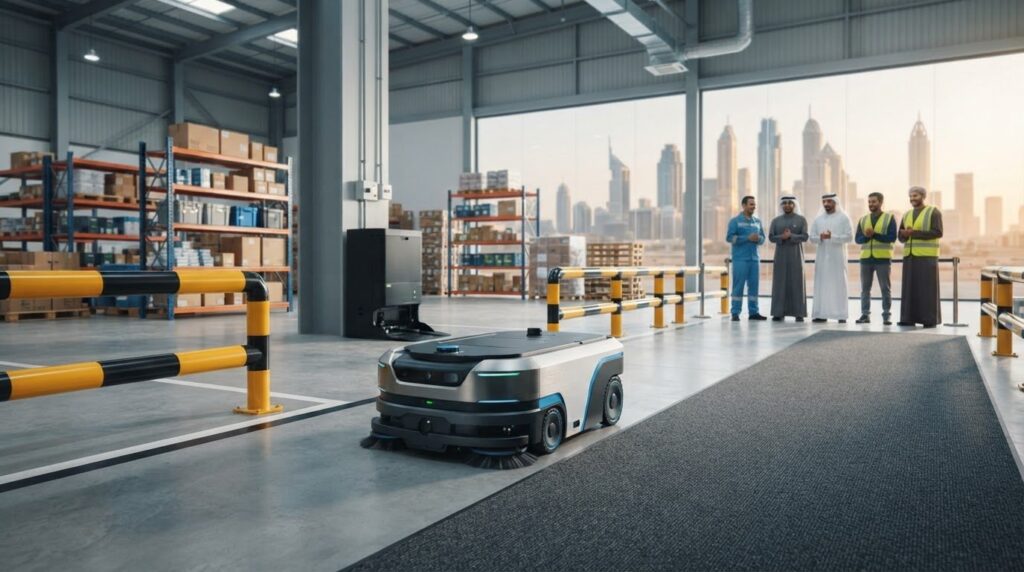
Internal logistics have undergone a radical transformation through the deployment of autonomous mobile robots. Unlike legacy AGVs that rely on fixed magnetic tracks, modern AMRs utilize LIDAR and SLAM navigation to move dynamically through complex environments. Linking these robots with centralized fleet management software allows for the immediate scaling of material handling. This ensures that raw materials and finished goods flow through the plant floor without bottlenecking, directly addressing the pain of inefficient warehouse space utilization.
Advanced Service and Humanoid Robotics
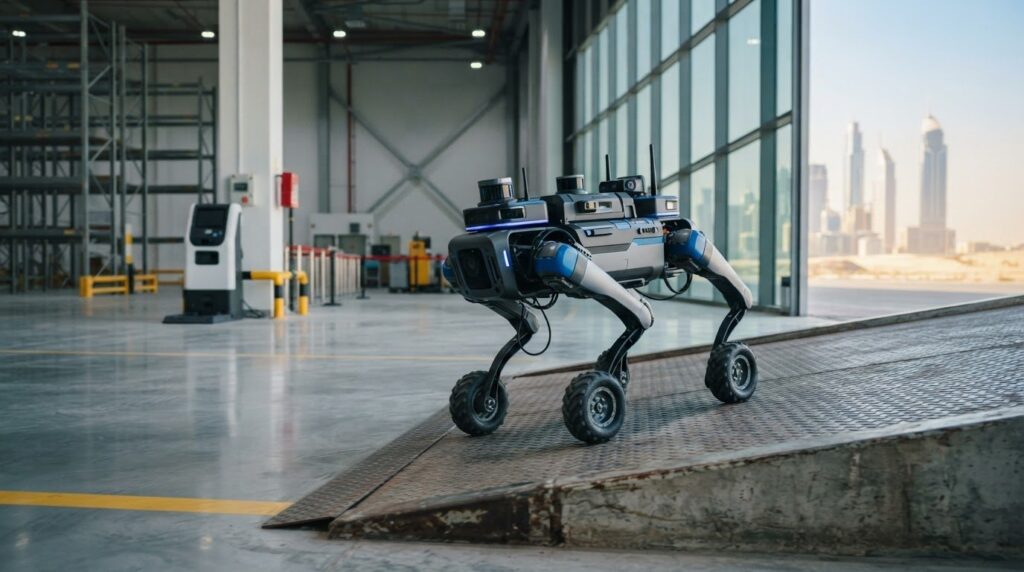
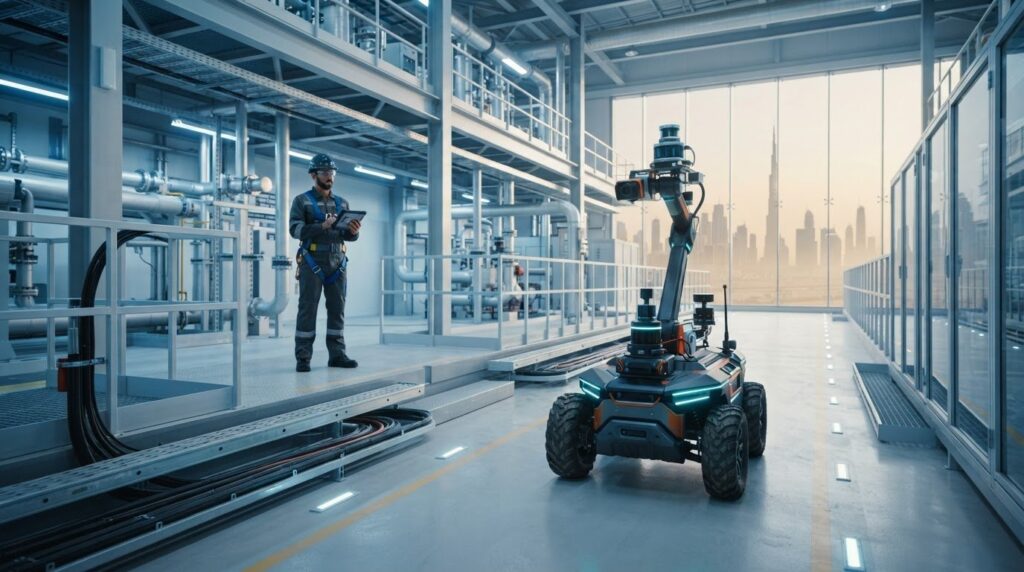
Moving beyond initial hype, humanoid and service robots provide functional utility in facility management and complex inspection roles. For organizations assessing the humanoid robots for sale UAE market, these machines offer a versatile platform for tasks requiring human-like dexterity or presence. Specialized units, including outdoor cleaning robots and surveillance robots, extend this autonomy to the facility perimeter. Deploying these smart factory solutions UAE creates a comprehensive security and maintenance layer that functions independently of human scheduling, effectively mitigating operational risks in high-risk industrial environments.
Identifying the right hardware mix is essential for long-term viability and ROI. You can consult with the technical partners at EdNex Automation to determine which robotic configurations best suit your specific facility layout and production goals.
Industrial Control Systems: Integrating PLC, SCADA, and ASRS
Unifying disparate hardware into a cohesive operational unit requires more than just physical connectivity; it demands a sophisticated control architecture that serves as both the brain and the central nervous system of the facility. While the autonomous robotics discussed previously provide the physical mobility, industrial control systems provide the logic and oversight necessary to transform individual machines into a synchronized ecosystem. Implementing smart factory solutions UAE involves a deep integration of legacy hardware with modern digital interfaces, ensuring that every sensor and actuator contributes to a unified data stream. This structural alignment is essential for achieving the high-level autonomy required by the 2026 industrial standards set by the Ministry of Industry and Advanced Technology.
Bridging the gap between legacy control systems and modern robotic fleets remains a primary hurdle for many regional manufacturers. Achieving interoperability requires a bespoke integration approach where Programmable Logic Controllers (PLCs) are configured to communicate across multiple protocols. This allows for a seamless exchange of data between older production lines and new autonomous systems, effectively mitigating the risk of operational silos. By establishing a robust control layer, organizations can ensure that their hardware investments remain viable and scalable as technology continues to evolve.
Strategic PLC and SCADA Integration
Acting as the primary logic centers, PLCs govern the micro-interactions of machinery while SCADA systems provide the macro-level visibility necessary for plant-wide optimization. Utilizing PLC and SCADA integration services allows facility managers to achieve real-time monitoring and rapid anomaly detection across complex production lines. This centralized visibility enables predictive maintenance strategies, where the SCADA interface generates alerts based on sensor data before a component failure occurs. Minimizing downtime through these proactive interventions directly improves production throughput and ensures a reliable return on automation investment.
Optimising Warehouse Density with ASRS
Maximizing vertical density within UAE industrial zones often hinges on the deployment of automated storage and retrieval systems (ASRS). Whether utilizing unit-load, mini-load, or high-speed shuttle systems, ASRS technology eliminates the inefficiencies of manual picking and traditional forklift operations. Integrating these systems with a Warehouse Management System (WMS) provides total inventory control and near-perfect accuracy. This level of precision is a core component of smart factory solutions UAE, allowing companies to optimize their existing footprint and reduce the reliance on manual material handling in high-density storage environments.
Establishing this integrated framework provides the intellectual foundation for a truly autonomous facility. To explore how these control systems can be tailored to your specific infrastructure, contact the engineering experts at EdNex Automation for a comprehensive system audit.
Implementing Smart Factory Solutions: A Strategic Roadmap
Successful industrial transformation isn’t an overnight acquisition; it’s a methodical re-engineering of the manufacturing environment. Transitioning to smart factory solutions UAE requires a top-down approach that aligns physical hardware with the intellectual framework of the organization. This systematic evolution ensures that every robotic unit and control interface contributes to a measurable increase in production throughput. To achieve long-term business viability, manufacturers must follow a structured implementation sequence that prioritizes integration over isolated automation.
- Phase 1: Facility Audit. Conduct a comprehensive assessment to identify automation bottlenecks, specifically targeting areas with high manual labor reliance or inefficient space utilization.
- Phase 2: Bespoke Integration Planning. Design a technical blueprint that bridges the gap between existing legacy hardware and modern robotic systems, ensuring protocol compatibility across all layers.
- Phase 3: Hardware Deployment. Commission the physical infrastructure, including AMRs for logistics, Cobots for assembly, and ASRS for high-density storage.
- Phase 4: Software Unification. Establish the critical link between PLC/SCADA systems and robotic fleet management software to create a centralized data stream.
- Phase 5: Optimization and Training. Implement continuous system monitoring and staff training programs to refine the human-machine collaboration and maximize operational efficiency.
Assessing ROI in Industrial Automation
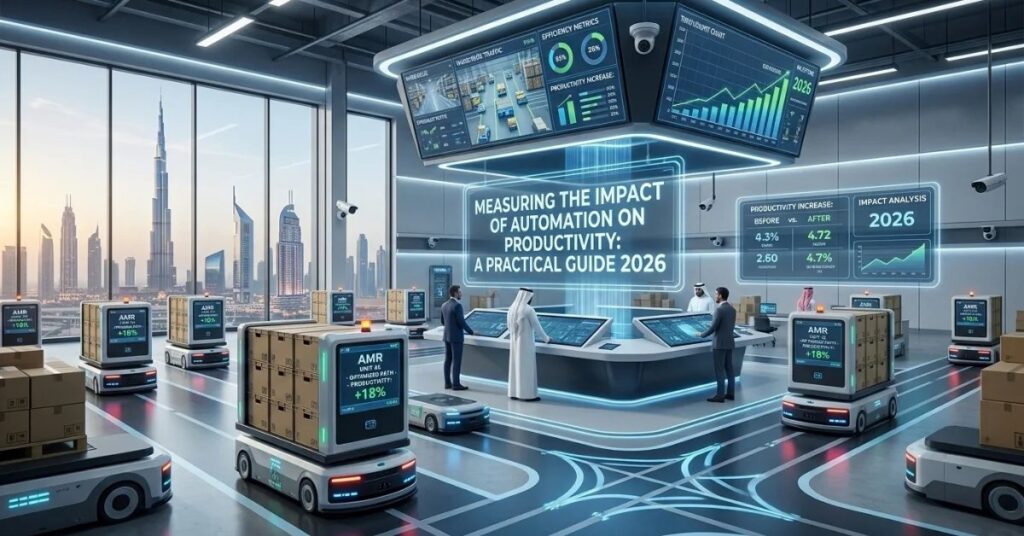
Calculating the return on investment for smart factory solutions UAE involves measuring both direct and indirect value gains. Reducing material waste through robotic precision and lowering labor costs in logistics provide immediate financial relief. However, the most significant impact often comes from reduced operational downtime. By 2026, adopting Industry 4.0 has become a necessity for organizations wishing to remain competitive under the UAE’s mandatory National In-Country Value framework. Scaling production without a proportional increase in overhead ensures that the facility remains resilient against global supply chain fluctuations.
Overcoming Integration Challenges
Interoperability remains a primary challenge when connecting equipment from different manufacturers. Addressing protocol compatibility early in the design phase prevents the creation of data silos that hinder real-time decision-making. Furthermore, ensuring cybersecurity for connected industrial control networks is paramount, especially given the UAE’s stringent data protection regulations. Choosing a national partner with UAE-wide support capabilities is essential for maintaining system uptime. A local partner provides the intellectual framework and technical response times necessary to sustain complex, autonomous environments without the risks associated with overseas support delays.
Establishing a clear implementation strategy is the first step toward securing your facility’s future. You can initiate your transformation by scheduling a facility audit with EdNex Automation to identify the most impactful automation opportunities for your specific operation.
EdNex Automation: Leading UAE’s Industrial Transformation
Positioning itself as an ambitious industry pioneer, EdNex Automation provides the intellectual and technical framework necessary for large-scale industrial transformation across the Emirates. By bridging the gap between global technological breakthroughs and specific regional needs, the organization acts as a systematic organizer for facilities seeking long-term business viability. Implementing smart factory solutions UAE requires a partner that understands the gravity of Industry 4.0 mandates while delivering the precise hardware needed for daily operations. From high-precision collaborative robots to centralized control systems, EdNex offers a comprehensive portfolio designed to bring order, safety, and efficiency to the most complex industrial environments.
Trusting an industry leader with official certification status ensures that your automation journey is grounded in technical excellence and reliable engineering. EdNex doesn’t merely provide tools; it delivers a full-service partnership that includes strategic consultation, hardware deployment, and ongoing national support. This end-to-end approach allows manufacturers to transition toward autonomy with confidence, knowing their systems are backed by regional expertise and a commitment to the UAE’s economic growth targets for 2026. Whether your facility requires humanoid robots for complex interactions or robust ASRS for high-density storage, our team provides the bespoke integration required for a future-ready operation.
Bespoke Solutions for Every Industrial Sector
Developing tailored robotic ecosystems is essential for meeting the unique demands of sectors such as Oil & Gas, logistics, and large-scale manufacturing. EdNex provides specialized hardware configurations, including inspection and surveillance robots, to secure high-risk environments and perimeter zones. For commercial and industrial facilities, the integration of autonomous cleaning robots ensures that hygiene standards are maintained through consistent, machine-driven schedules. These smart factory solutions UAE are designed to scale alongside your business, providing the flexibility needed to adapt to changing market requirements without sacrificing production quality or operational safety.
National Reach and Technical Reliability
Ensuring consistent performance requires a partner with UAE-wide support capabilities and a deep understanding of local regulatory frameworks. EdNex Automation maintains a steady commitment to regional industrial resilience, providing technical reliability that overseas vendors cannot match. By aligning with the National Strategy for Industry and Advanced Technology, the brand helps local organizations emerge stronger through controlled and deliberate innovation. This geographic focus ensures that your facility receives the intellectual and technical support necessary to maintain 24/7 uptime. To begin your facility’s digital transformation and secure your place in the future of UAE manufacturing, contact our specialists today for a professional consultation.
Securing Industrial Resilience Through Intelligent Automation
Securing industrial resilience in 2026 requires more than just capital investment; it demands a systematic shift toward cyber-physical integration. We’ve explored how the synergy between autonomous robotics and centralized control systems forms the backbone of modern production. By following a structured roadmap, manufacturers can transition from legacy silos to self-optimizing environments that mitigate labor shortages and maximize vertical density. Implementing smart factory solutions UAE ensures your facility remains compliant with national value frameworks while scaling output with precision.
EdNex Automation provides the intellectual framework and technical reliability needed to navigate this transition. With a specialized Industry 4.0 division and certified PLC and SCADA integrators, our team delivers start-to-finish expertise backed by national UAE-wide technical support. You don’t have to navigate these complex technological shifts alone. Partner with EdNex Automation for your Industrial Transformation and secure your organization’s long-term viability in the digital age. The future of autonomous manufacturing is here, and it’s time to build a more resilient industrial legacy.
Frequently Asked Questions
What are the primary benefits of smart factory solutions in the UAE?
Primary benefits include increased production throughput and a significant reduction in reliance on manual labor. Implementing smart factory solutions UAE allows manufacturers to optimize storage density and achieve full visibility through unified data layers. These systems facilitate the transition to Industry 5.0 by fostering seamless human-machine collaboration while ensuring compliance with national industrial resilience standards.
How do Autonomous Mobile Robots (AMRs) differ from traditional AGVs?
AMRs utilize LIDAR and SLAM navigation to move dynamically through complex environments without the need for fixed magnetic tracks or wires. This differs from legacy AGVs which are restricted to pre-defined, rigid paths. AMRs offer greater flexibility in rapidly changing warehouse layouts, allowing for the immediate scaling of internal logistics operations without expensive infrastructure modifications.
Can modern robotics be integrated with my existing legacy PLC systems?
Yes, modern robotics can be integrated with legacy PLC systems through bespoke integration plans designed by certified engineering partners. Utilizing specialized communication protocols enables older machinery to interact with new robotic fleets and sensors. This approach effectively eliminates data silos and ensures that existing infrastructure remains a viable part of a connected, autonomous ecosystem.
What is the typical ROI timeline for an ASRS implementation?
The ROI timeline for ASRS implementation depends on facility throughput and the specific reduction in material waste and labor costs achieved. Manufacturers typically see gains in storage density and inventory accuracy immediately following the commissioning phase. These systems maximize vertical space utilization, which is a critical factor for long-term business viability in high-density industrial zones.
Are humanoid robots ready for functional use in UAE factories in 2026?
Humanoid robots have reached a stage of functional utility for specific enterprise applications in 2026. Beyond initial hype, these machines are utilized for tasks requiring human-like dexterity or complex interactions in commercial environments. They serve as a sophisticated component of smart factory solutions UAE, providing a versatile platform for diverse industrial and facility management roles.
How does SCADA integration improve factory safety and monitoring?
SCADA integration centralizes visibility across the plant floor, allowing for real-time monitoring of all connected machinery and autonomous units. This system improves safety by providing immediate anomaly detection and predictive maintenance alerts before a component failure occurs. Having a single source of truth for operational data reduces risk and ensures high-level oversight of complex, autonomous processes.
What role do cleaning robots play in a smart factory environment?
Cleaning robots provide consistent, machine-driven hygiene automation that functions independently of human scheduling or labor availability. In a smart factory, these units ensure that production areas and commercial facilities remain compliant with strict health and safety standards. They mitigate operational risks by handling maintenance tasks in hazardous or high-traffic zones without disrupting the primary production flow.
Does EdNex Automation provide national support for robotic maintenance?
EdNex Automation provides comprehensive, national UAE-wide technical support for all robotic maintenance and system optimizations. This partnership includes consultation, deployment, and ongoing technical assistance to ensure 24/7 uptime for your facility. Having a local partner with regional expertise ensures that your autonomous infrastructure remains optimized and resilient against global supply chain fluctuations.